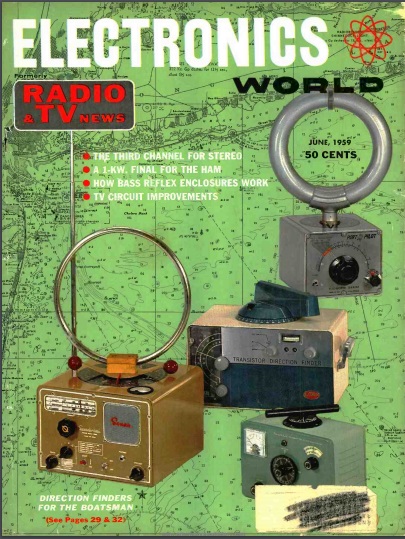
 Sixty years ago this month, the June 1959 issue of Electronics World carried a good basic introduction to marine direction finding (DF). The cover image shows a number of commercially made DF units, and the article explains how they work.
While the technology looks archaic, it actually still works quite well, and will continue to do so as long as there are AM radio stations on the air. While commercial direction finders are no longer readily available, virtually any AM radio will work well, as long as the antenna is directional. And if the radio has an internal loop antenna, it will be directional. 

For example, the inexpensive portable shown at the right will perform very well. (It’s available at Amazon at this link, but any other inexpensive portable will work just as well.) You simply rotate the radio until the signal is the weakest. At that point, the internal antenna (usually in parallel with the top of the radio) is in a straight line with a station. You place a 
 ruler on the map over that station’s location, and draw a line in that direction. You repeat the process with a second station, and where the lines meet is your location. You’ll need to orient the map, so if you don’t know what way is North, it’s a good idea to have an inexpensive compass. And you don’t really need a ruler. You place the map on a table oriented with the Earth–the top of the map facing North–and then use the top of the radio as your ruler.
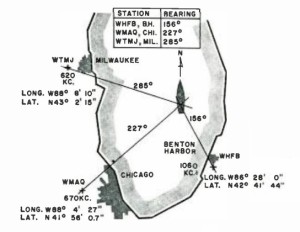
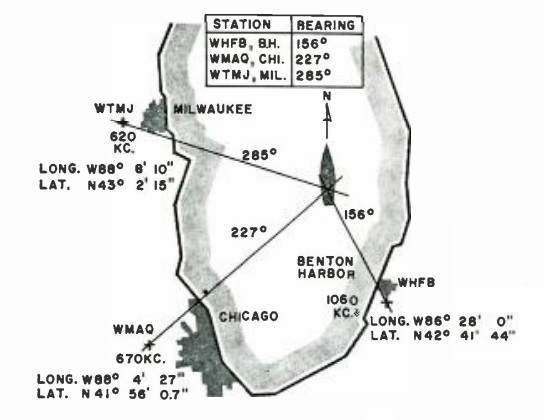
This method is surprisingly accurate. It’s very easy to find your location within a mile, and with some practice, you’ll be able to narrow it down even more. It’s not quite as accurate as GPS, but if GPS ever becomes unavailable for any reason, this is an excellent backup method. The example shown at the left is typical. By knowing the exact location of radio stations in Chicago, Milwaukee, and Benton Harbor, MI, the boat can find its location within a few hundred yards.
Radio station locations are shown on maritime and aeronautical charts. You can also find the exact locations of AM radio stations from the FCC database.

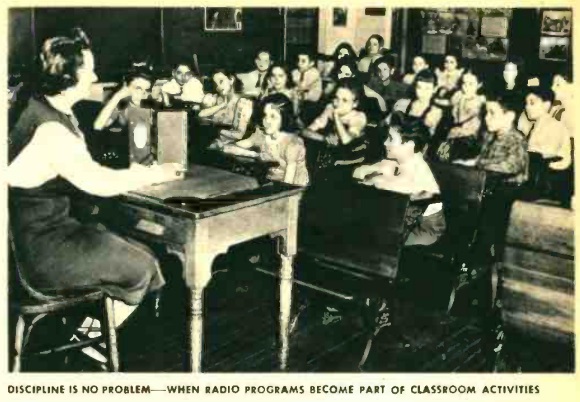
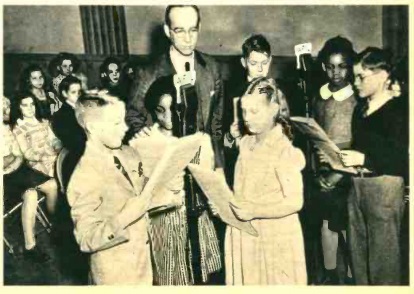 Seventy-five years ago, the over 170,000 students in the Philadelphia schools were getting a good dose of the fourth “R.” In addition to reading, ‘riting, and ‘rithmatic, the schools were taking full advantage of Radio. Thanks to the community spirit of the city’s commercial radio stations, regular lessons were scheduled. For example, for the elementary grades, WFIL carried “Studio Schoolhouse,” an educational program three days a week. The Monday program allowed the students, left, to participate in dramatized scripts about how they could help the war effort.