Category Archives: Radio history

1959 Two Transistor Portable

1959MayPM1Sixty years ago this month, the May 1959 issue of Popular Mechanics showed how to put together this two transistor receiver. While within the capabilities of the beginner, the set was a good performer. According to the article, the set was capable of pulling in stations 10-15 miles away with only the built-in antenna.

The RF amplification was handled by a 2N168A transistor. It operated as a regenerative amplifier, with a 1N66 diode serving as detector. The audio was then fed back to the same transistor, which was “reflexed” to serve as the first AF stage. A 2N170 transistor served as a second stage of audio amplification to drive the high-impedance earphone. The set was powered by four penlite cells wired in series.

1959MayPM2


Electronics Quiz from 1959

1959MayPEquizSixty years ago this month, the May 1959 issue of Popular Electronics contained these electronic brain teasers. We’re confident that most of our readers can figure them out, but just in case, we’ll show the answers tomorrow.

If you need a larger version, from most browsers, click twice on the image above.


1969 Two Tube Superhet/Regen

1969MayEE1Fifty years ago this month, the May-June 1969 issue of Elementary Electronics showed how to put together this two-tube receiver. The set covered 1.7-30 MHz with plug-in coils. And despite having only two tubes, it had excellent performance thanks to its design, which combined a superheterodyne and regenerative receiver.

The set used two dual tubes. A 6CQ8 served as mixer and IF amplifier, with a 12AT7 serving as regenerative detector and audio amplifier. The power supply consisted of transformer and solid-state diode.

1969MayEEschematic


1934 Two Tube Regenerative Shortwave Receiver

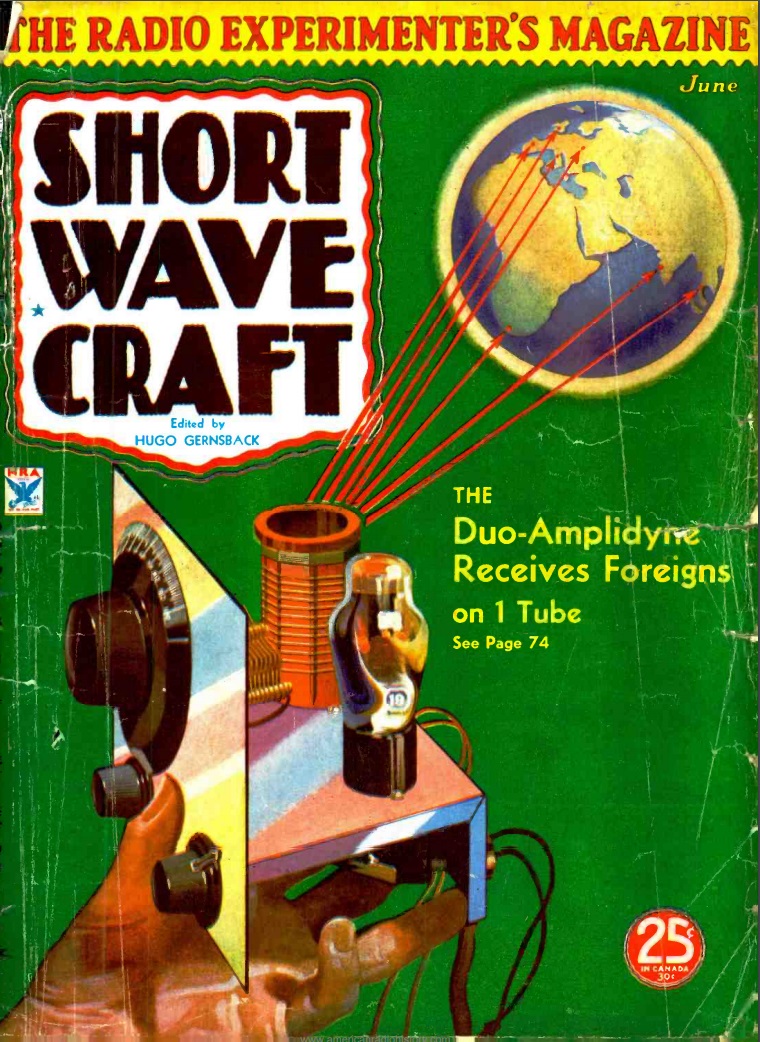
1934MaySWcraft

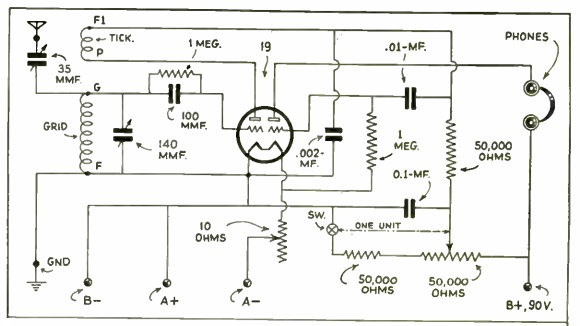
This handsome little two-tube shortwave receiver is described in the May 1934 issue of Short Wave Craft magazine. The circuit was designed by the National Radio Distributing Co., which presumably had all of the parts for sale, and used two type 30 tubes. A 45-volt B battery was sufficient for normal reception, but to pull in the weak signals, it was recommended to use 90 volts for the amplifier stage. In addition to the tuning dial, two other controls were visible on the front panel. One was a variable capacitor for adjusting regeneration, and the other was a rheostat for setting the filament voltage.

A well-insulated antenna of 45-100 feet was recommended.

1934MaySWcraftSchematic


Eico 720 Transmitter, 1959

1959MayEISixty years ago this month, the May 1959 issue of Electronics Illustrated carried a review for the then-new Eico 720 transmitter.

The reviewer noted that the kit could be assembled in a week of evenings, and was within the capabilities of the beginning kit builder. The set had a maximum input power of 90 watts, but the plate current meter had a red line indicating the 75 watt limit for novices, the kit’s primary market. The review noted that the transmitter ran cool, despite its compact size. The output filtering was especially lauded, as the transmitter was well protected against television interference.

The kit sold for $79.95, with the wired version selling for $119.95. The review concluded by declaring the 720 a Good Buy for either the novice or the veteran ham.

For a look at a remarkably well preserved specimen, see this link.


Dr. W. Eberle Thompson: Abolitionist, Underground Railroad Conductor, Doctor, Radio Fan

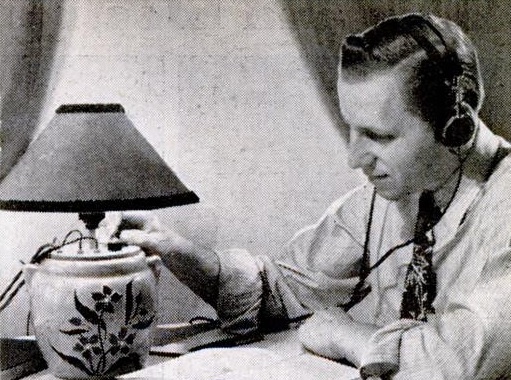
1939MayRuralRadioShown here is Dr. William Eberle Thompson of Bethel, Ohio. The 104-year-old doctor is wearing headphones and listening to WLW radio. The photo was taken on the occasion of an interview by Ed Mason, WLW Farm Events Announcer, who wrote about the interview in the May 1939 issue of Rural Radio magazine. Mason noted that he “interviews some mighty interesting and important people. But never have I talked to anyone who could match this country doctor who voted twice for Lincoln.”

While the magazine article is lacking in details, the centenarian doctor is almost certainly the same person described in the book The Underground Railroad: An Encyclopedia of People, Places, and Operations. In addition to merely voting for Lincoln, Dr. Thompson played a much greater role in ending slavery. “In his youth, the family’s two-story brick residence at 133 South Main Street was a safehouse. In adulthood, his home and office at 213 East Plane Street received refugees.” The Rural Radio article mentions that Dr. Thompson’s “hands and eyes, now weary from service to his neighbors, had brought him fame as a crack shot with his old muzzle-loading rifle.” The old muzzle loader had been put to good use, since “to secure slaves in flight from posses, Thompson shot their bloodhounds.”

According to this site, Dr. Thompson became an active member of the Bethel Underground Railroad network as a teen. He guided fugitives from Bethel to the Elklick area near Williamsburg. He practiced medicine in the community for eight decades and was active in village government and social affairs.

The headphones in the photo were a gift, as explained in the magazine article:

Long after the switch had been turned which took us off the air, we talked. I learned that he liked to listen to the radio, and especially news broadcasts, but his hearing had failed and he had not used his radio for several years.

When Phil Underwood, WLW engineer, heard this, he opened that magic box that a radio engineer always carries. He brought out headphones, special amplifiers, wires and switches. When we left, Dr. Thompson was sitting by his radio hearing distinctly for the first time in years hearing news by the magic of radio.

The Rural Radio article refers to the doctor as  “C.  Eberle Thompson.”  This is almost certainly an error, since it’s unlikely that there was another centenarian doctor in the same small town.    Dr. Thompson died in 1940, a few months shy of his 105th birthday.  He continued to practice medicine until about a month before his death.


American Television Turns 80

1939AprRadioRetailingAmerican television didn’t really get off the ground until after the war, but by 1939, there were a handful of stations, mostly in New York City, using standards compatible with postwar standards. For example, we’ve previously written about W2XBS, which later became WNBT, and is currently WNBC, which came on the air 80 years ago today, April 30, 1939. That station has been in continuous operation, meaning that modern television in the U.S. is 80 years old. The receivers numbered in the hundreds, and the majority of them were in public places such as taverns. The April 1939 issue of Radio Retailing shows the offerings available from a number of different manufacturers.

The viewer shown here is enjoying a program on her set manufactured by the American Television Corporation.


1944 Portable Phono

1944AprPMPhonoSeventy five years ago this month, the April 1944 issue of Popular Mechanics showed how to make this portable phonograph, to easily bring recorded music to a friend’s house.  Since the friend presumably already owned a radio, then it was a simple matter of plugging this set into the phono input of the friend’s radio.

And if there was no phono input, then you would screw in two 60 watt light bulbs (which served as the dropping resistor for the filaments) which would bring to life the two-tube oscillator contained in the phono.  The music would be heard near the top of the radio dial.

1944AprPMPhonoSchematic


1934 One Tube Regen

1934AprSWcraft2The plans for this handsome one-tube shortwave receiver appeared 85 years ago this month in the April 1934 issue of Short Wave Craft.  The set employed a single type 30 tube as its regenerative detector. The magazine recommended putting together one of these simple sets for those just becoming acquainted with the short waves, in order to acquaint themselves thoroughly with the operating and handling of a shortwave set.  Plug-in coils would allow tuning 16-200 meters.

An antenna of 30-100 feet was said to be adequate, in conjunction with a good ground. But the magazine advised keeping the antenna as high as possible.

1934AprSWcraft3