Category Archives: Phonograph History

WW2 Music at Work

1945AugRadioServiceDealerThis image could be mistaken for the studio of a small radio station, but it’s actual the public address console of a wartime industrial plant. Specifically, it’s the console of the RCA Plant Broadcasting System. It appeared in the August 1945 issue of Radio Service Dealer, as part of an article penned by the manager of RCA’s Music Library Service. The article is one of a series giving dealers ideas on how to promote the P-A business, and focused on providing music in the industrial environment.

Plant managers learned that by piping in the right mix of music, they would increase productivity and worker morale. Such sound systems were suitable for industrial plants, as well as office areas devoted to stenographic and clerical work. Business offices such as banks and insurance companies could play music both for workers and customers. And in hospitals, hotels, and stores, music could be piped in over sound systems.

RCA had the musical programming down to a science, and had packages of records available for sale to companies. Musical selections were broken down into four categories.

First of all, there was music for the opening period. These songs would play as workers arrived, and would continue for about fifteen minutes after starting time. These were invariably marches or patriotic tunes, such as “Stars and Stripes Forever,” or the “Washington Post March.” Other possibilities would be upbeat or fast tempo dance selections such as “Pennsylvania Polka.”

About an hour and a half after starting time, and again about an hour and a half before lunch, songs from the “Fatigue” playlist would be played. More songs from this list would be played similar times in the afternoon. Many of these were waltzes, and also popular hits, Latin and Hawaiian tunes, or old time favorites. Some songs on this list included “Green Eyes,” “Star Dust,” and “Begin the Beguine.”

The magazine stressed that the playlists had to be fine tuned to the audience. For example, it noted one small plant where about 75% of the workers were girls between 18 and 23. The music picked for that audience simply wouldn’t work at a plant where most workers were over 35.

RCA’s library also included some records for special occasions, such as Christmas songs and more patriotic tunes.
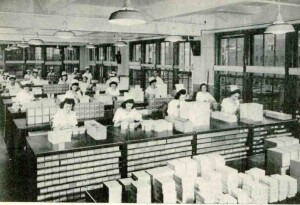
Workers at Davis & Geck, Inc., Brooklyn, N.Y., pack surgical sutures with the help of music piped in from wall-mounted RCA speakers.

Workers at Davis & Geck, Inc., Brooklyn, N.Y., pack surgical sutures with the help of music piped in from wall-mounted RCA speakers.

One office employed 600 girls doing monotonous filing duties. Normally, at about 3:00, fatigue would set in, but the author observed those 600 girls instead singing along softly with a popular recording. The office manager was initially skeptical, but experience showed that the vocals did not impede efficiency.

A plant with many Polish or Slavic workers would get more polkas and folk dances. One plant in Trenton employed mostly Italians, and that plant had almost every record Caruso ever made.

Toward this end, one service featured by RCA was a survey that could be given to workers and analyzed at headquarters in Camden, N.J. to come up with a custom record library from the RCA catalog. “The psychological effect of having the personnel feel that the music is theirs, played for them, gives them a personal interest in the project which is otherwise unattainable.” The overall effect was greater efficiency, less absenteeism, and better output.

On the other side of the Atlantic, Britain was also seeing to it that war workers had music. The BBC program Music While You Work was programmed following similar principles. One interesting rule for the BBC program was the banning of the song “Deep in the Heart of Texas,” due to the potential danger of workers taking their hands off their work to perform the hand claps in the chorus.


1920 Magnavox Telemegafone

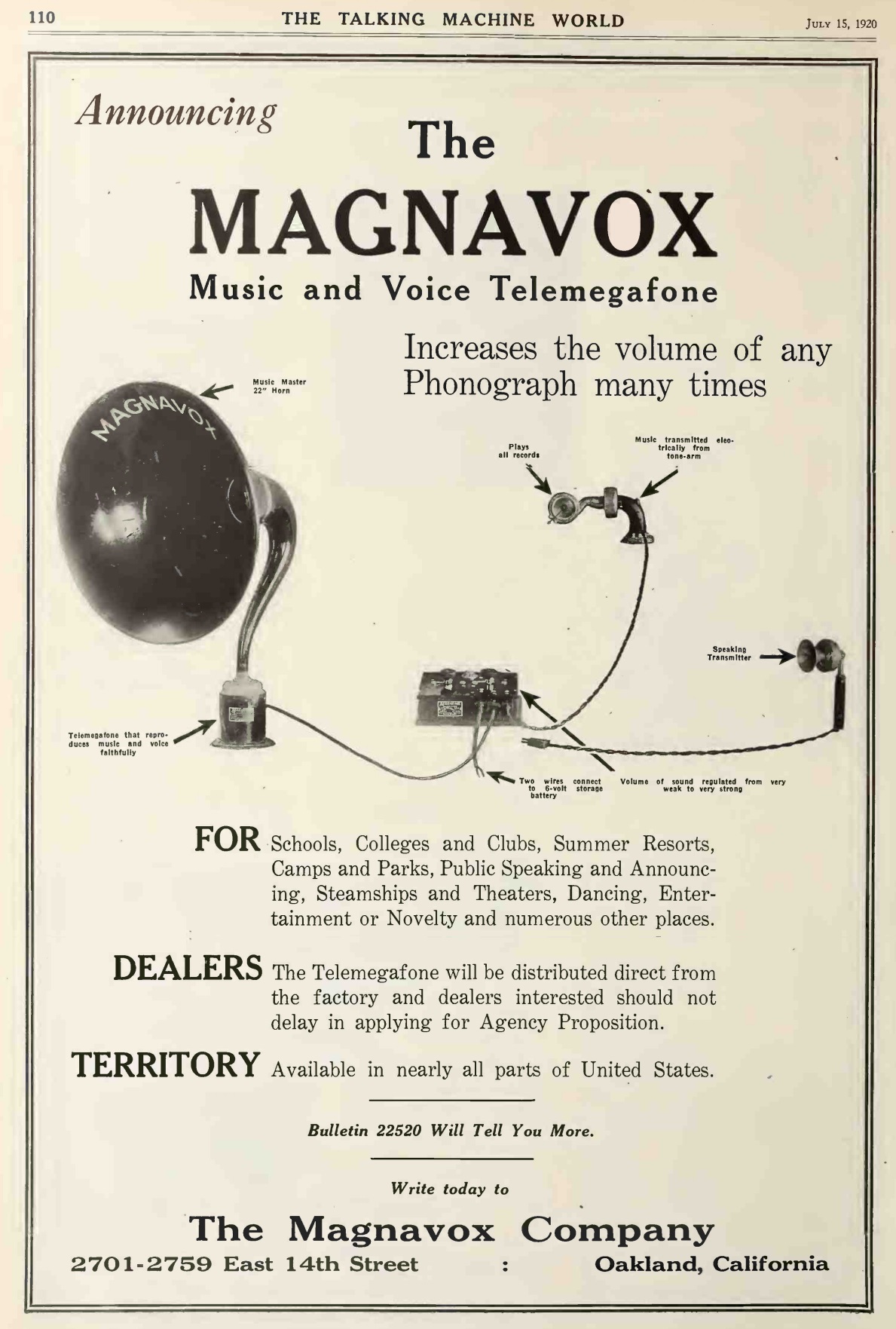
1920JulTalkingMachineWorld1These days, we tend to take for granted the availability of amplified sound systems. If you’re going to make a speech before a large auditorium, the first matter of business is to turn on the sound system and locate the microphone.

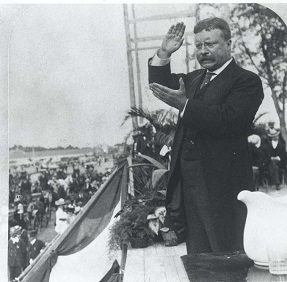
BigStickSpeechBut there was a time, not so long ago, that electronic sound amplification didn’t exist. A hundred years ago, if you were going to be a preacher, a politician, or some other kind of public speaker, then you had to learn how to project your voice. If the people in the back row couldn’t make out your voice, then they weren’t going to hear the Gospel, they weren’t going to vote for you, or they weren’t even going to hear what you had to say.  When Theodore Roosevelt gave his “big stick” speech in 1901 at the Minnesota State Fair, hundreds of people heard him because he used a big voice to deliver it.

It was only in the 20th century that public speaking came to be associated with electronic amplification.  As we’ve previously reported, for example, Notre Dame cathedral was first wired for sound in 1925.  And when the Iowa legislature was getting a sound system in 1939, it was probably about the same time as other legislative chambers.

One of the first examples of an electrical sound system comes from Talking Machine World a century ago this month.  This particular system wouldn’t have been of much use to preachers or politicians trying to be heard in a large auditorium, but it’s an early example of what would be perfected within a few years.  The Magnavox Telemegafone system shown here could be used with a phonograph, or with what we would today call a microphone, although that term hadn’t been coined.

I describe this as an “electrical” system rather than “electronic,” because there doesn’t appear to be any electronic amplification.  The microphone is probably a carbon mike, and the phonograph transducer probably is as well.  They drive the speaker directly.  The speaker does not have a permanent magnet.  Instead, it has a field coil powered by a 6 volt battery.

One of the described purposes is as a “novelty,” and a speaker who could project his voice well would probably be better off not bothering.  But within just a few years, the idea of electronic sound would become popular, and the profession of “sound man” would be born.  And a century later, we would take for granted that to speak before a large audience, we need to find the microphone and turn on the P.A.


1920 Stewart Portable Phonograph

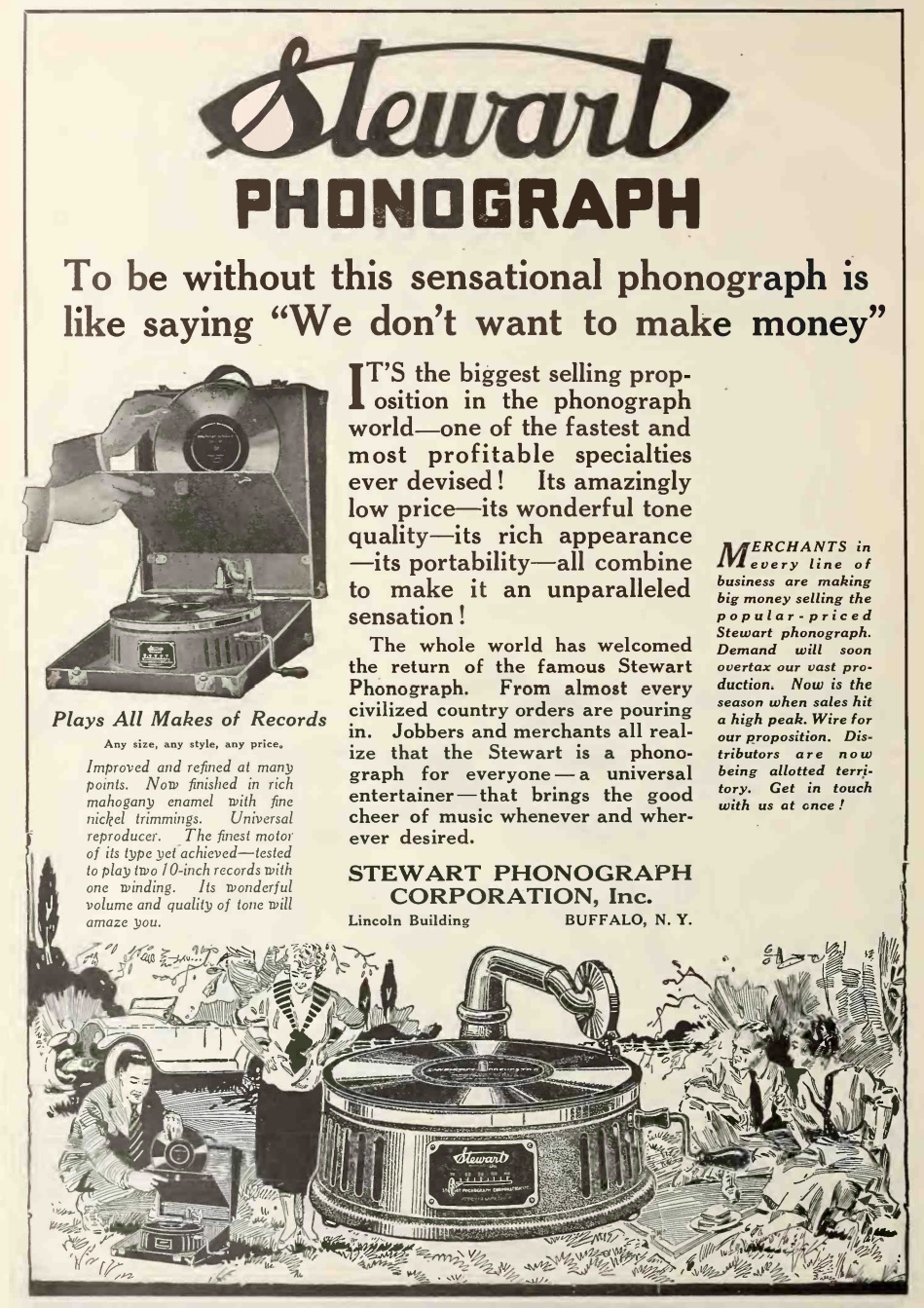
1920JulTalkingMachineWorldWe previously featured a 1917 ad for this Steward portable phonograph. The set had gone to war, as that ad pointed out that thousands were on their way to the boys in the Army and Navy. Peace now prevailed, and this ad shows the phonograph being used by picnickers.

The 1917 ad gave a Chicago address. By 1920, the phonographs were being made in Canada, and this 1920 ad gives the company’s address as the Lincoln Building, Buffalo, New York, presumably a more convenient location to import from Canada.

According to this ad directed to retailers, not carrying this phonograph was the equivalent of a dealer saying they didn’t want to make money.

The ad appeared a hundred years ago this month in the July 1920 issue of Talking Machine World.


Vera Lynn, 1917-2020

We are sad to report that Vera Lynn has died at the age of 103.  She was known in Britain as the “Forces’ Sweetheart” for her songs that helped raise morale during World War 2.  Her most famous recording was “We’ll Meet Again,” which was recently echoed by Queen Elizabeth II in her address to her subjects about the coronavirus.


Camping With the Phonograph: 1920

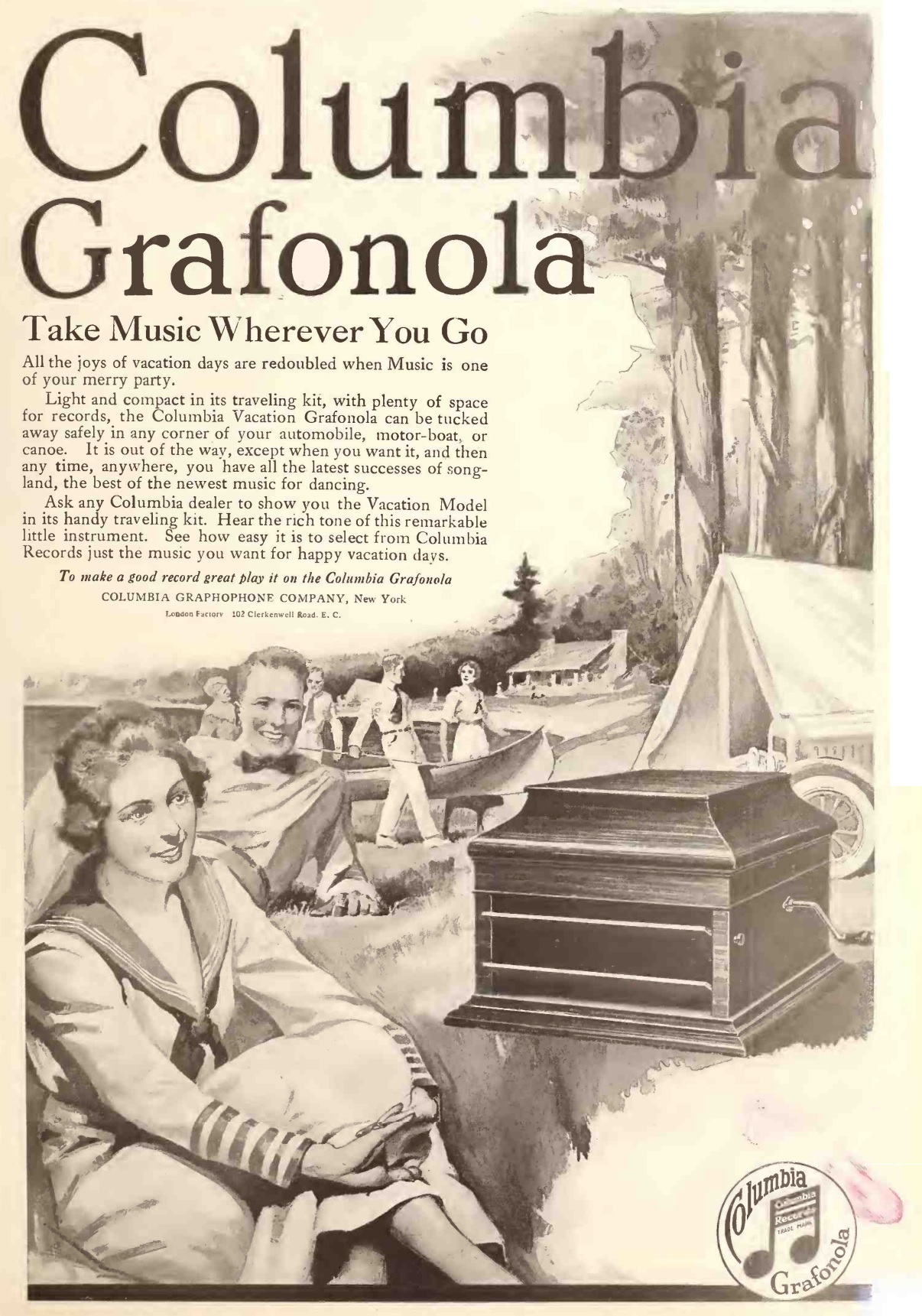
1920JuneTalkingMachineWorldA hundred years ago this month, the June 1920 issue of Talking Machine World carried this ad for the Columbia Grafonola phonograph, and reminded readers that the joys of vacation are redoubled when music is brought along.

The compact instrument in its traveling kit could be tucked away safely in any corner of an automobile, motor boat, or even canoe. It stayed out of the way until needed for the latest music for dancing.


1940 Portable Hand-Crank Radio-Phono

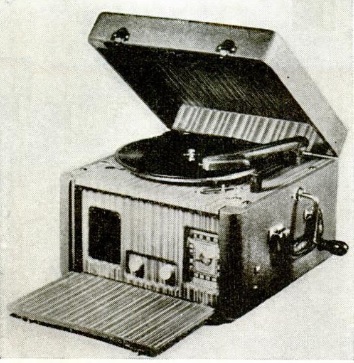
1940MayPMxFrom 80 years ago, here’s another example of a hand-crank phonograph, but with electrical rather than mechanical sound reproduction. The set in question is a portable radio-phonograph combination.

The radio was a four-tube superhet, powered by batteries. It made perfect sense to use the hand-crank motor, since the motor would unnecessarily run down the batteries.

The set, which appears to be from General Electric, was shown in the May 1940 issue of Popular Mechanics.


Father Bernard R. Hubbard, The Glacier Priest.

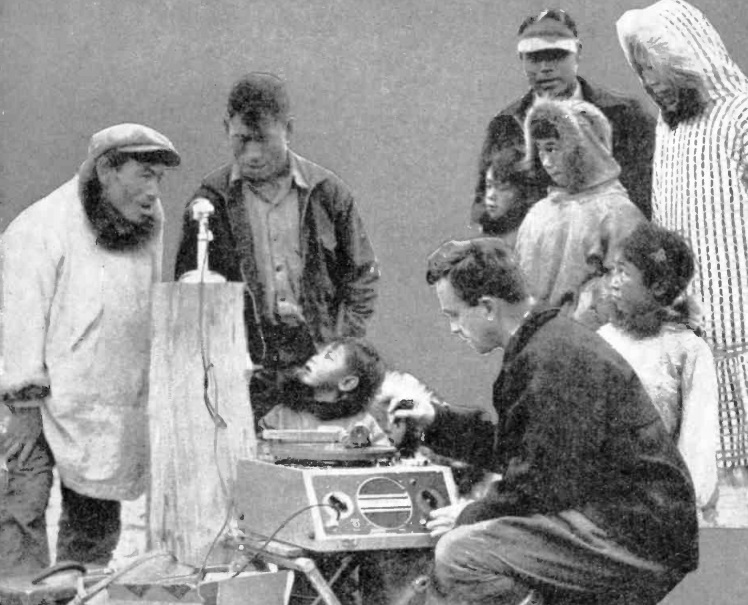
1940AprNRNShown here operating an RCA recorder is Father Bernard R. Hubbard, “the Glacier Priest.” Hubbard was an American Jesuit Priest, ordained in Austria in 1923. Upon his return to America, he was a college lecturer in German, geology, and theology. He found, however, that his heart wasn’t completely in academia. He therefore undertook regular expeditions to Alaska to study geology and volcanology. By the late 1930s however, his interests turned to anthropology, and he began to study the culture and language of native Alaskans.

He was a compelling lecturer, and at one point was the world’s highest paid member of the lecture circuit, earning up to $2000 per talk. He donated the money to Jesuit missions in Alaska.

He’s shown here on the cover of National Radio News, April-May 1940, recording chants by these native Alaskans.


From The People Who Brought You the Flame Thrower…

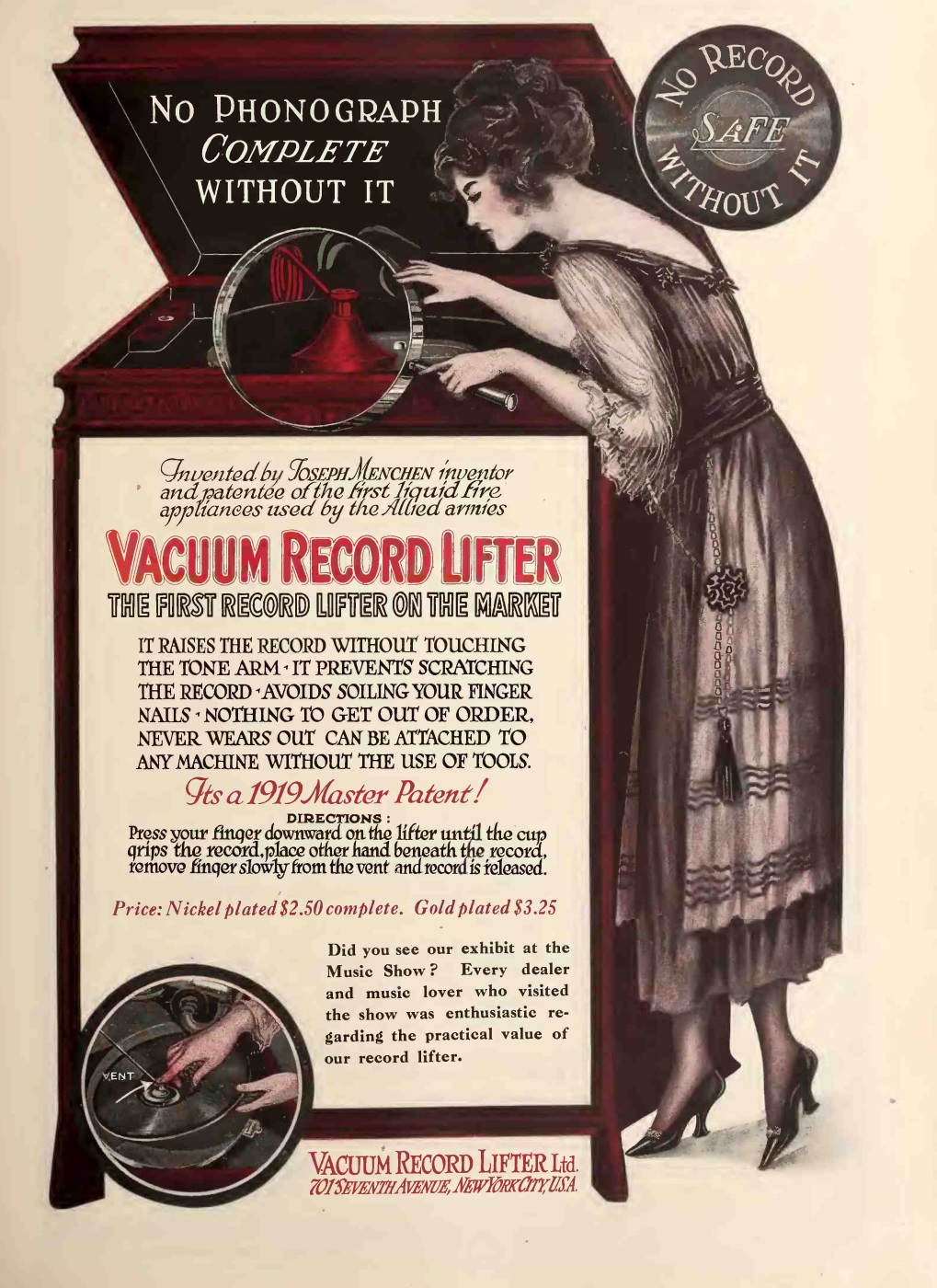
1920FebTalkMachWorldThis young woman, even if she weren’t armed with a giant magnifying glass, could easily change records without soiling her finger nails, thanks to the Vacuum Record Lifter, from Vacuum Record Lifter Ltd., 701 Seventh Avenue, New York.

The device appears to be a suction cup which is placed on the record. It had a vent hole at the top, which was covered by one finger. When the record is safely lifted, the vent can be opened, and the record falls gently into the other hand.

The device was invented by Joseph Menchen, whom the article calls the inventor of “the first liquid fire appliances used by the Allied armies.” Sure enough, Wikipedia lists Menchen as the inventor of a flame thrower, as well as “self-made businessman, film producer, screenwriter, and literary agent.”

The ad appeared a hundred years ago this month in the February 1920 issue of Talking Machine World.


Arvin Model 302 Radio-Phono

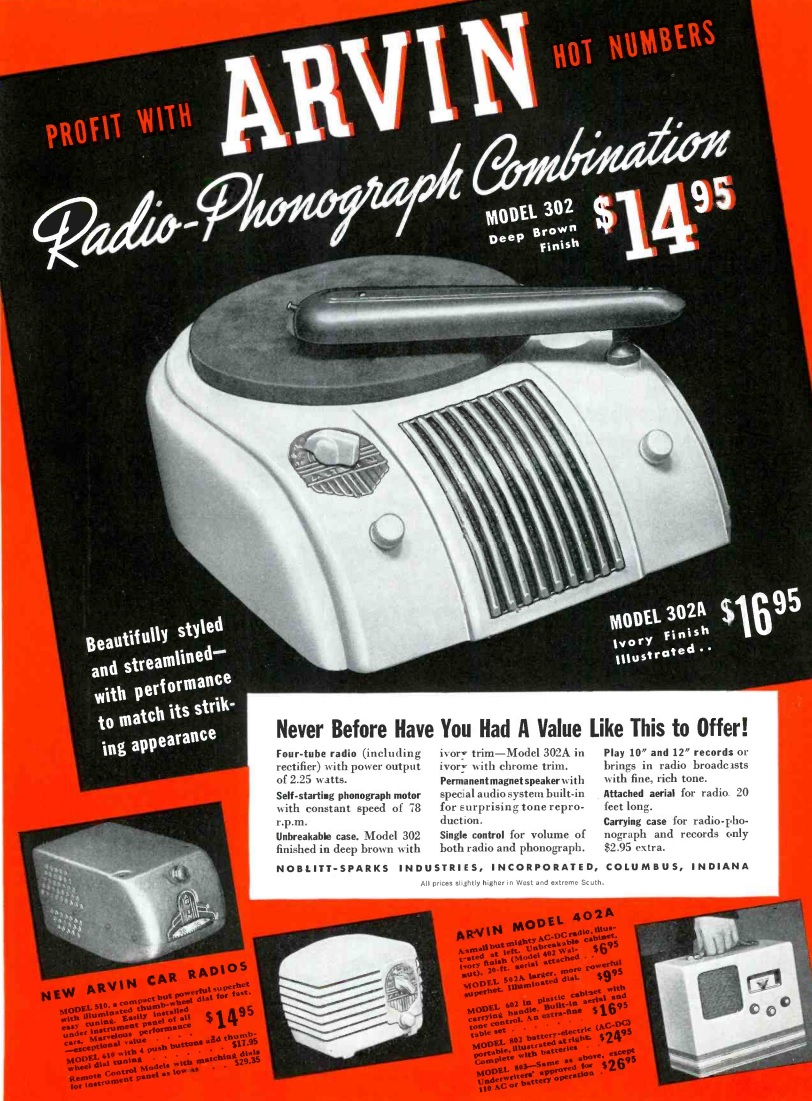
1940JanRadioRetailingIf you needed an inexpensive radio-phonograph 80 years ago, then the Arvin model 302 (brown with ivory trim) or 302A (ivory with chrome trim) was just the thing.  The four-tube (12SK7, 12SQ7, 50L6GT, and 35Z5GT) superhet would pull in the local stations, and the would also play either 10″ or 12″ records.

For full portability, a carrying case was available for only $2.95 extra.

The ad, which also shows a car radio, table radio, and portable, appeared in the January 1940 issue of Radio Retailing.


Freddy Fender Museum, San Benito, TX

20191227_142105

We recently had the opportunity to visit the Freddy Fender Museum in San Benito, Texas. We are shown above in front of Freddy’s motorcycle and one of the suits in which he performed.  The museum is part of the Museums of San Benito, along with the San Benito History Museum and the Texas Conjunto Music Hall of Fame and Museum.

We were shown around by a friendly volunteer, and the visit was well worth the small detour we took to get there.  Unfortunately, the exact future of the museum is in question, and it might not be there when you read this.  On the very day we visited in December 2019, some of the Freddy Fender exhibits were being removed.  The museum will be moving to a new location, but the exact new location is not known at this time.  Some of the exhibits were apparently on their way back to Freddy’s widow in Corpus Christi.  The volunteer seemed optimistic, however, that the museum would continue in either San Benito or Corpus Christi.  But the exact future location has not been determined.  Before making a special trip, I would contact the museum to check on the status.  The museum is currently open Thursday, Friday, and Saturday.

Fortunately, some of the exhibits remained, and are shown here.  Notably, Freddy’s two gold records are still on display, for Before the Next Teardrop Falls, and Wasted Days and Wasted Nights:

FreddyFenderGoldRecords

WastedDaysGoldRecord   TeardropGoldRecord

FreddyFenderZenithChairFreddyFenderZenithChair2Of particular interest to our readers is this chair, marked “Zenith Arm Chair Radio,” in which Freddy Fender probably sat.  I’ve heard of Zenith chairside radios, but this is the first I ever heard of an actual Zenith chair.  The tag on the exhibit indicated that the chair was from “the 1970s”.  Perhaps it was in use then, but my guess would be closer to the 1930s or 1940s.  The tag indicated that the chair was last used at the Rio Grande Music Company recording studio, 1165 Sam Houston, San Benito, TX.

The museum also contained another room displaying some of the equipment from the studio, shown below:

FreddyFenderRecordingStudio1

FreddyFenderRecordingStudio2


The “Rek-Kut” record cutting machine is shown below.  You can click on the images for a larger version:

RekKut1

RekKut2RekKut3RekKut4

There were also two Ampex recorders, one identified as a Model 354:

Ampex1Ampex2Ampex3

As mentioned above, there were two other museums in the same building, and this radio was part of the display in the general history museum:

FreddyFenderRadio

I couldn’t make out any brand name, but it appears to be from the late 1930s or 1940s, and covers the broadcast band and 5.8-15 MHz shortwave.

Finally, this shell casing was in the museum.  It was from a captured German gun from World War 1, and was engraved with the names of the American soldiers against whom it was directed.  The engraved text was very hard to read, and I unfortunately didn’t have time to try to transcribe much of it.  It would be a great service if some reader in the area could take the time to transcribe the text and post it online somewhere.  I’m sure that the relatives of the soldiers listed would be very appreciative.

Shell1Shell2Shell3