Category Archives: Phonograph History

Phonographs in Cicero, IL, Schools, 1921

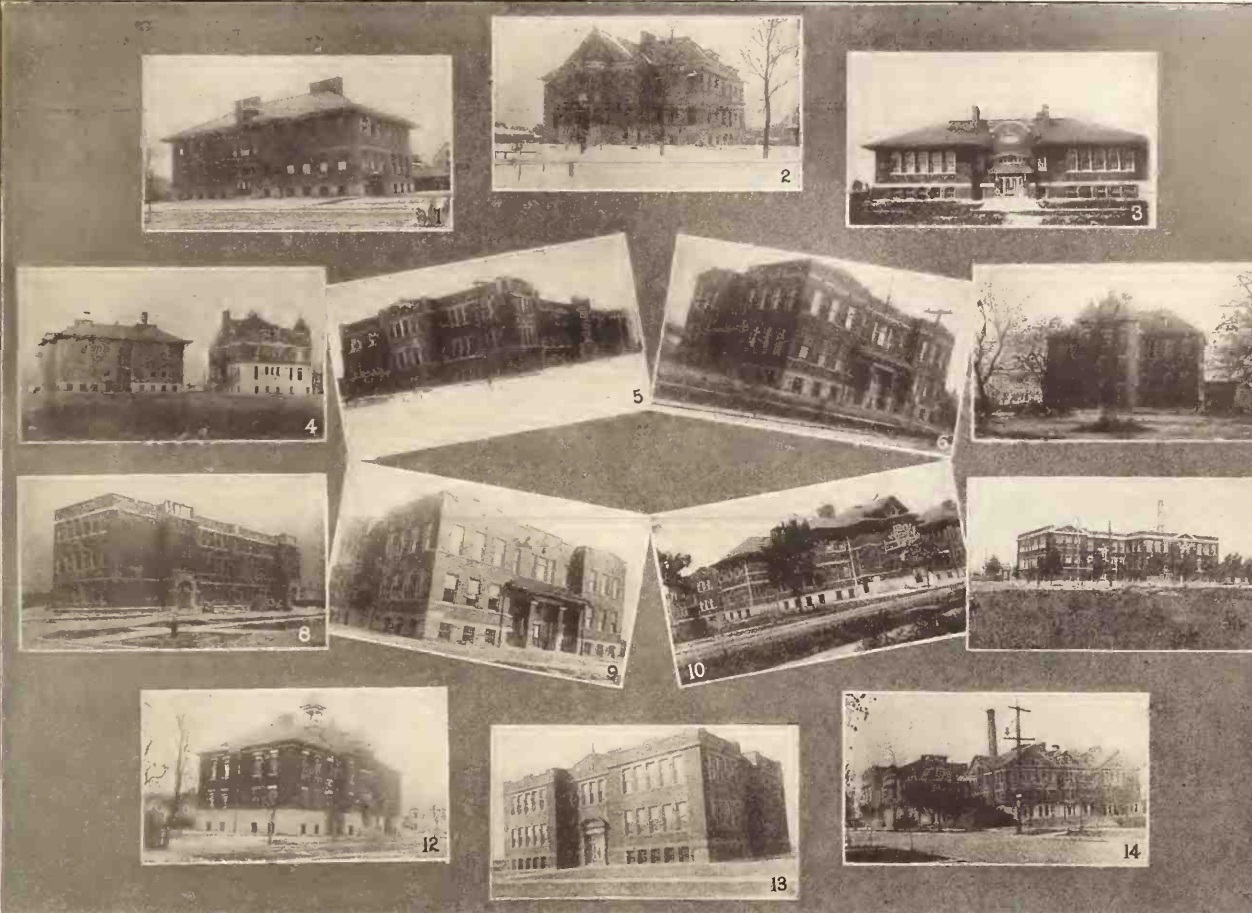
1921JanTalkMachWorldShown here, in the January 1921 issue of Talking Machine World, are fourteen schools in Cicero, Illinois. While the magazine wasn’t clear which was which, they are: Woodbine, Morton Park, Drexel, Goodwin Clyde, Cicero, SherlockMcKinley, Woodrow Wilson, Roosevelt, John Paul Jones, Burnham, Hawthorne, Columbus, and J.H. Sterling Morton High School.

What the schools had in common was an appreciation of music, recorded music to be specific. They had all recently purchased Columbia Grafanola phonographs to bring the 7000 scholars of Cicero the message of music.

The School Board was unfortunately not in a position to provide the needed funds, so the students took matters into their own hands to collect old newspapers, and use the proceeds from the sale to purchase the instruments.

The magazine suggested that other schools looking to increase the music appreciation of the students might consider cake and candy sales, or suppers and fairs. The magazine believed that when more schools started doing so, school boards would soon wake up to their obligation to provide all schools with this equipment.


1961 Philips Norelco “Auto Mignon” Record Player

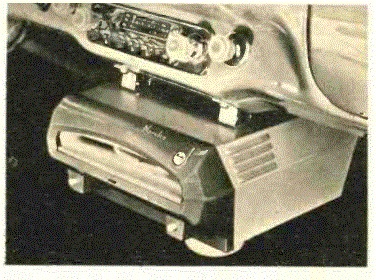
1961JanEISixty years ago this month, the January 1961 issue of Electronics Illustrated showed this automotive record player, the Norelco “Auto Mignon” (sold in Europe under the Philips name).

The set played 45 RPM records, which were loaded from the front with a “trap door,” not unlike how CD’s are loaded into most car players. The set played through the car radio, and ran off either 6 or12 volts. It retailed for $57.50

You can see a well preserved specimen of the model in this video:


1970 Dancing Light Display

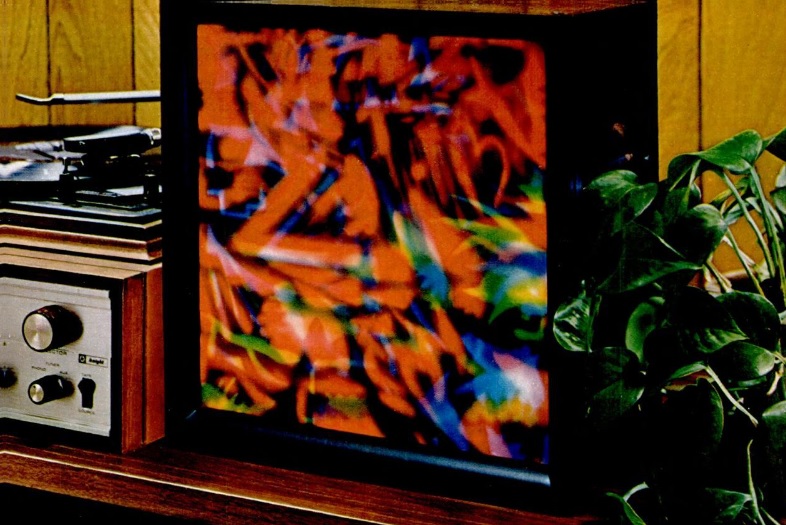
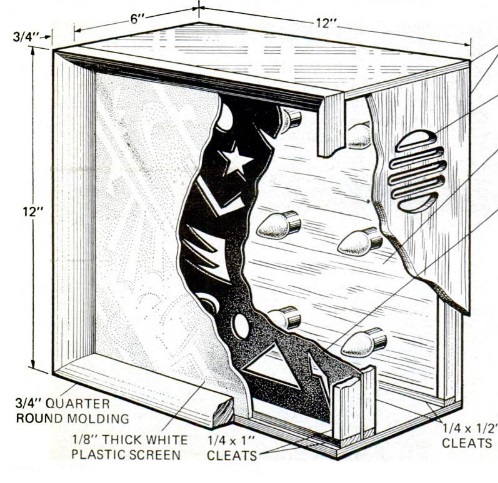
1970DecPMFifty years ago, the December 1970 issue of Popular Mechanics showed how to make this “dancing light display”. The idea was quite simple, and employed no electronics. It simply used a string of Christmas tree lights made up of flasher bulbs mounted on the rear. These were projected through a cardboard with cutouts of various geometric shapes, only a sheet of plastic on the front. Optionally, a speaker could be mounted inside the cabinet.

Even though the changing of the lights was random, according to the article, when music was playing, it would give the illusion of being in time with the music.

1970DecPM2


Sears Silvertone Model 5731 Radio-Phono-Recorder (1940)

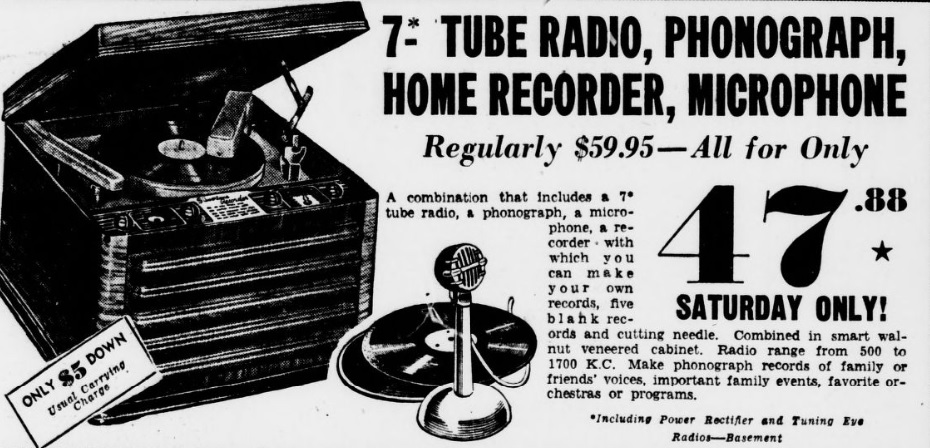
1940Dec27WashEveStarEIghty years ago today, the December 27, 1940, issue of the Washington Evening Star carried this Sears-Roebuck ad for a radio-phonograph-recorder.  The set came complete with microphone and five blank discs for $47.88.

It appears to be the Sears Silvertone model  5731.  You can view some photos at this link.


Selling Recorders in 1940

1940DecRadioRetailing3Shown here transporting a set are Cleveland radio dealer Louis Schwab and Rev. W.P. Schmidt of the Parma Evangelical Lutheran Church, 2625 Oak Park Ave., in suburban Cleveland. The photo is from an article in the December 1940 issue of Radio Retailing, which details Schwab’s success with selling recording phonographs. The article noted that less than 5% of the phonographs sold included recording, but with salesmanship of the type employed by Schwab, this number could be increased. The magazine noted that once the set was sold, sales of blank records were almost sure to follow. One family with musically inclined offspring bought two packages of records a week. And another customer did “recording parties,” at which he would go through at least three dozen disks.

The sale depicted in the photograph resulted from the fact that the church organist was going to have a baby. Rather than pay a substitute during her maternity leave, the church sprang for the radio-recorder shown here. The organist pre-recorded the hymns to be played during her absence, and the machine took over the musician’s duties. The set was used at other church gatherings to listen to broadcasts and recorded music.

The church shown here appears to be the predecessor of Parma Lutheran Church, which is now located about a mile away from its 1940 location.


1950 Hi-Fi Demonstration Console

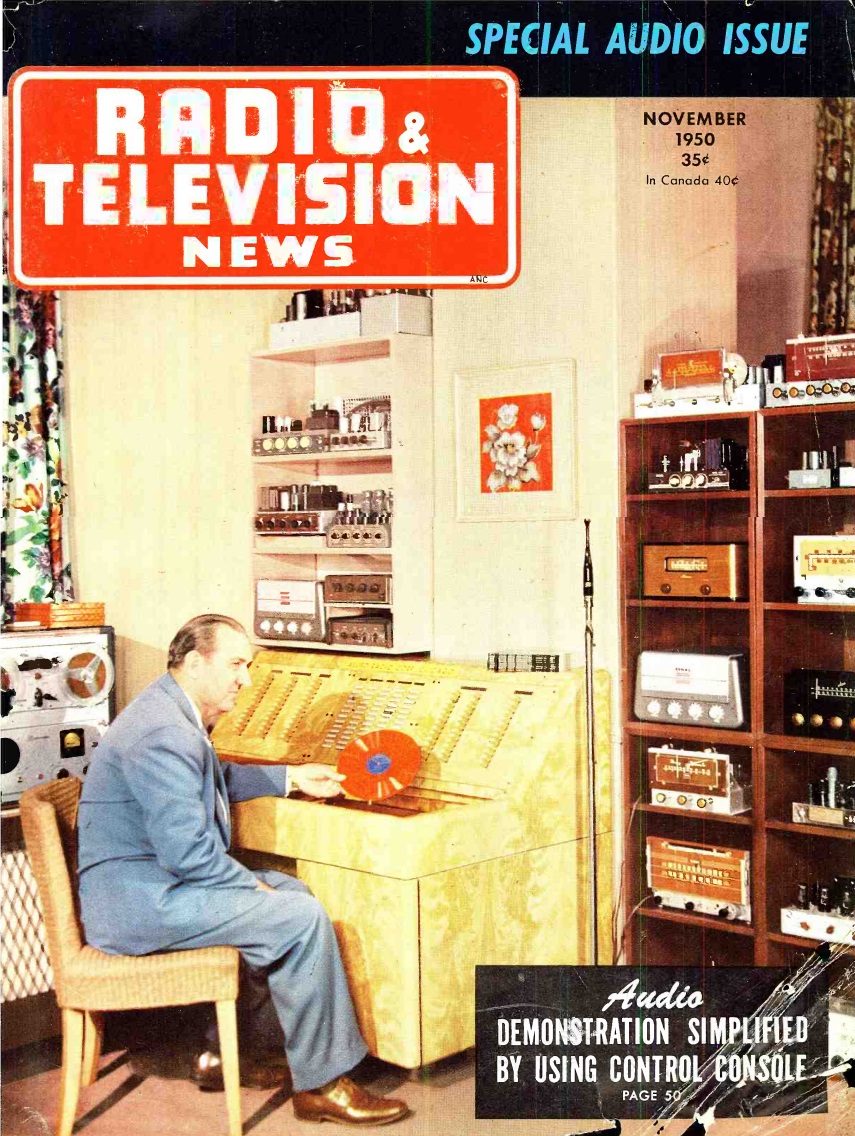
1950NovRadioNewsEighty years ago, this intriguing room could be found at Allied Radio in Chicago. Here, the Hi-Fi enthusiast interested in the very best equipment could be given a demonstration showing exactly how different pieces of equipment would sound together. Around the room were various tuners, amplifiers, preamplifiers, cartridges, tape machines, and other devices. From the console, different elements could be switched into and out of the circuit, and the discerning listener would be able to pick out exactly the right combination that met their needs.

The photo appeared on the cover of Radio & Television News, November 1950, which also included an article going into the room’s technical details.


Start Your Own Recording Business, 1950

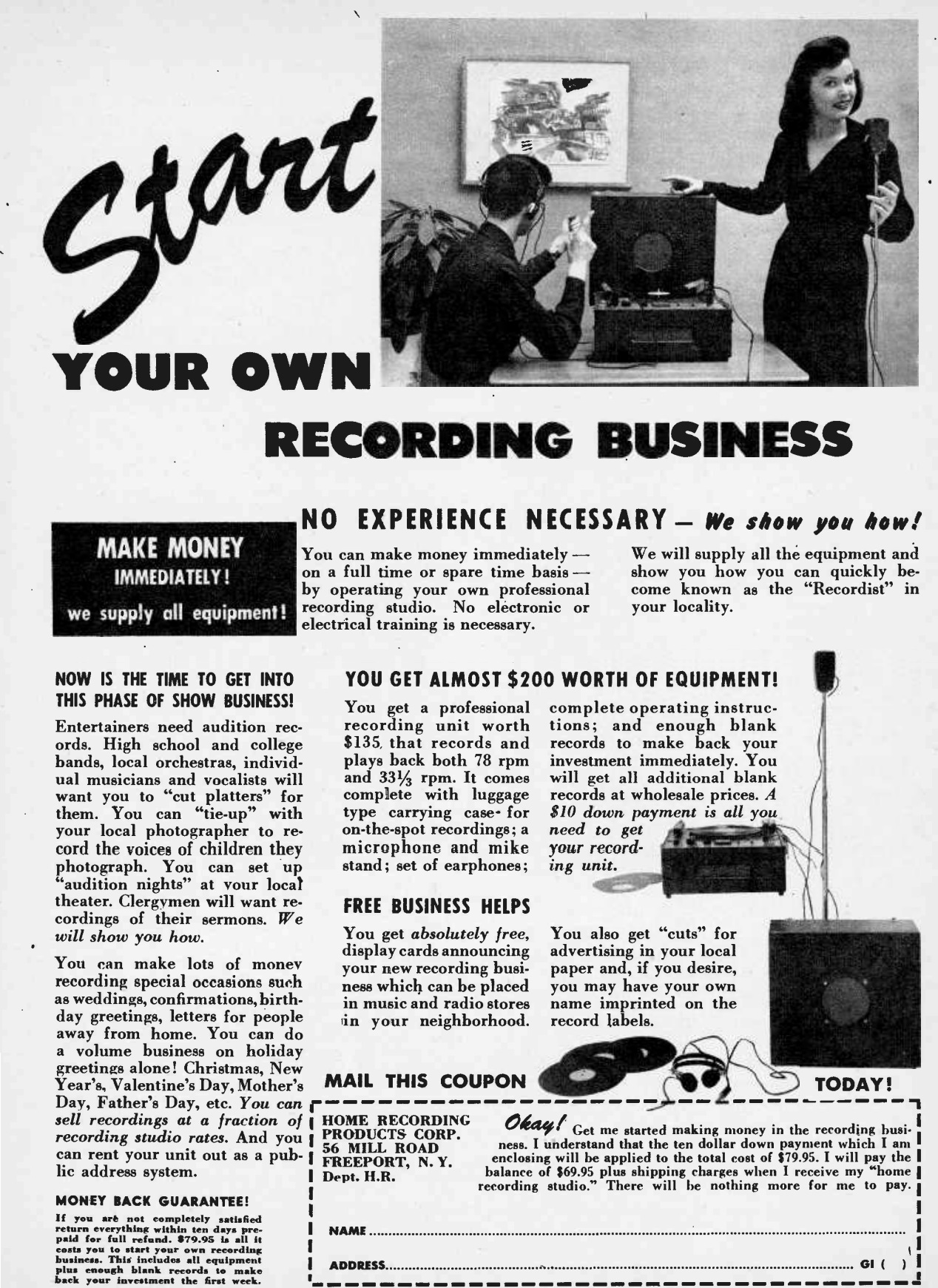
1950OctRadioBestSeventy years ago, if you wanted to get into show biz, or at least a small niche thereof, you couldn’t go wrong by starting your own recording business, as shown in this ad for the Home Recording Products Corp., 56 Mill Road, Freeport, NY, in the October 1950 issue of Radio Best magazine.

The possibilities seemed unlimited, and the investment was only $79.95–$10 down, with the balance plus shipping C.O.D.

You would get a professional recording unit (worth $135) capable of cutting both 78 and 33 RPM records, along with carrying case, microphone, mike stand, headphones, and complete instructions. It even came with enough blank records to get back your investment immediately, and additional blanks were available wholesale. With low overhead, you could make recordings for a tiny fraction of the cost of a recording studio.

The possibilities were unlimited. You could connect with a local photographer and make recordings of the children being photographed. Local musicians would want you to cut demo records for them. School bands would want records, and there was potential for a huge volume of business on holidays, as families sent records to loved ones. Even local clergymen would want their sermons recorded.

You would get display cards to put up at local stores to advertise, and you would get sample ads to run in your local newspaper. You could even rent out the unit for use as a public address system.


1945 FM Phono Oscillator

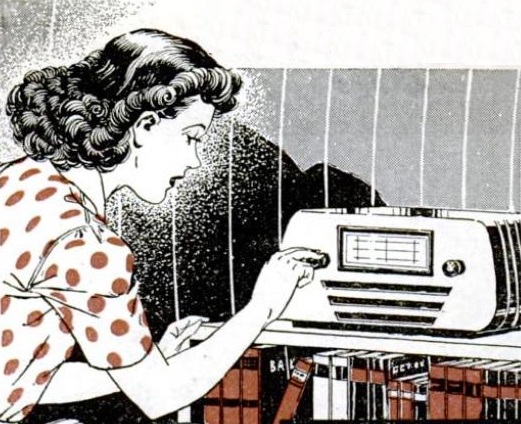
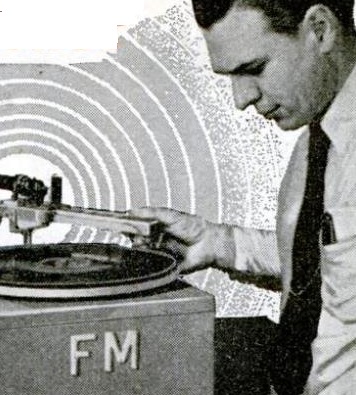
1945AugPM21945AugPM3The woman shown above, in the August 1945 issue of Popular Mechanics, appears to be tuning in a program on her broadcast radio. But looks are deceiving, and the set actually tunes the prewar FM band, which covered 42-49 MHz.  And she’s not listening to a radio station.  Instead, she’s listening to a record being played by the gentleman at left, who is a few feet away.

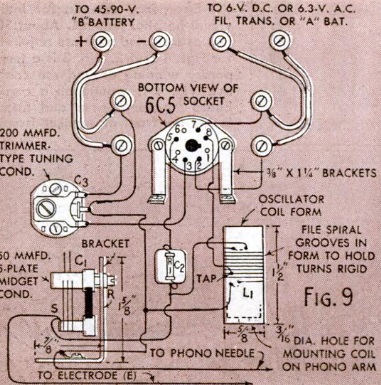
Phono oscillators which played records over a standard AM broadcast radio were fairly common, but this one played the records over an FM radio. According to the article, no claim was made that the simple circuit would give absolutely perfect reproduction, but results from the Popular Mechanics laboratory were satisfactory. The set was more a challenge to the experimenter to open up the new field of FM radio.

The whole circuit was remarkably compact, and consisted of a 6C5 triode tube along with a few other components. Even with wartime parts shortages, most of the parts could probably be scrounged up fairly easily. The whole circuit mounted right on the tone arm, which was constructed of hardwood.

1945AugPM4


Portrola Portable Phonograph, 1920

1920AugTalkingMachineWorldOne hundred years ago, these two were tasked with bringing along the recorded music to their respective outdoor gatherings. The gentleman simply grabbed the phonograph from the parlour, along was as many records as he thought he could carry. As you can see, the results were anything but sastifactory.

The woman, however, was much more savvy, and brought along her Portrola Portable Phonograph. She undoubtedly used it at home, but it was also perfect for outings, particularly since the carrying case had a convenient compartment for holding the records. The instrument had a list price of $35 with a single spring motor or $45 for the double spring model.

The ad appeared a hundred years ago this month in the August 1920 issue of Talking Machine World.


WW2 Music at Work

1945AugRadioServiceDealerThis image could be mistaken for the studio of a small radio station, but it’s actual the public address console of a wartime industrial plant. Specifically, it’s the console of the RCA Plant Broadcasting System. It appeared in the August 1945 issue of Radio Service Dealer, as part of an article penned by the manager of RCA’s Music Library Service. The article is one of a series giving dealers ideas on how to promote the P-A business, and focused on providing music in the industrial environment.

Plant managers learned that by piping in the right mix of music, they would increase productivity and worker morale. Such sound systems were suitable for industrial plants, as well as office areas devoted to stenographic and clerical work. Business offices such as banks and insurance companies could play music both for workers and customers. And in hospitals, hotels, and stores, music could be piped in over sound systems.

RCA had the musical programming down to a science, and had packages of records available for sale to companies. Musical selections were broken down into four categories.

First of all, there was music for the opening period. These songs would play as workers arrived, and would continue for about fifteen minutes after starting time. These were invariably marches or patriotic tunes, such as “Stars and Stripes Forever,” or the “Washington Post March.” Other possibilities would be upbeat or fast tempo dance selections such as “Pennsylvania Polka.”

About an hour and a half after starting time, and again about an hour and a half before lunch, songs from the “Fatigue” playlist would be played. More songs from this list would be played similar times in the afternoon. Many of these were waltzes, and also popular hits, Latin and Hawaiian tunes, or old time favorites. Some songs on this list included “Green Eyes,” “Star Dust,” and “Begin the Beguine.”

The magazine stressed that the playlists had to be fine tuned to the audience. For example, it noted one small plant where about 75% of the workers were girls between 18 and 23. The music picked for that audience simply wouldn’t work at a plant where most workers were over 35.

RCA’s library also included some records for special occasions, such as Christmas songs and more patriotic tunes.

Workers at Davis & Geck, Inc., Brooklyn, N.Y., pack surgical sutures with the help of music piped in from wall-mounted RCA speakers.

Workers at Davis & Geck, Inc., Brooklyn, N.Y., pack surgical sutures with the help of music piped in from wall-mounted RCA speakers.

One office employed 600 girls doing monotonous filing duties. Normally, at about 3:00, fatigue would set in, but the author observed those 600 girls instead singing along softly with a popular recording. The office manager was initially skeptical, but experience showed that the vocals did not impede efficiency.

A plant with many Polish or Slavic workers would get more polkas and folk dances. One plant in Trenton employed mostly Italians, and that plant had almost every record Caruso ever made.

Toward this end, one service featured by RCA was a survey that could be given to workers and analyzed at headquarters in Camden, N.J. to come up with a custom record library from the RCA catalog. “The psychological effect of having the personnel feel that the music is theirs, played for them, gives them a personal interest in the project which is otherwise unattainable.” The overall effect was greater efficiency, less absenteeism, and better output.

On the other side of the Atlantic, Britain was also seeing to it that war workers had music. The BBC program Music While You Work was programmed following similar principles. One interesting rule for the BBC program was the banning of the song “Deep in the Heart of Texas,” due to the potential danger of workers taking their hands off their work to perform the hand claps in the chorus.