Category Archives: Minnesota History

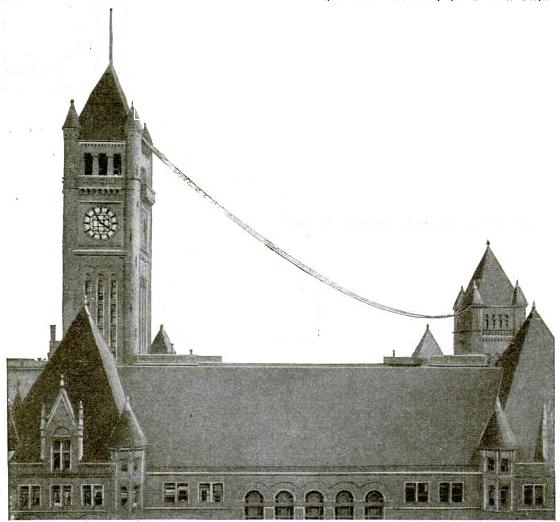
Minnesota Wireless Association in 1915

MNWirelessAssn1915

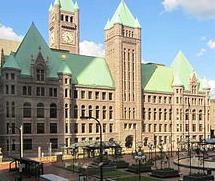
MplsCityHall

Minneapolis City Hall 2012 cropped” by Jason Riedy from East Point, GA, USA. Licensed under CC BY 2.0 via Wikimedia Commons.

The Minnesota Wireless Association (MWA), according to its QRZ.com listing, has been in existence since 1914, and that fact is borne out by the photograph above, which appeared a hundred years ago, in the March 1915 issue of Popular Mechanics.  The article describes the station installed in the Minneapolis City Hall, a structure which is still in existence and easily recognizable, as seen in the modern photo here.

The magazine reported that the station had just been installed by the Minnesota Wireless Association, and was “probably the largest private wireless station” at the time. It noted that the instruments in the station were “arranged with particular reference to experimental work, which will include tests and comparisons of new apparatus, studies of stray electrical disturbances, and the development of new apparatus.” The antenna consisted of eleven wires between the two towers, 400 feet above ground at the clock tower.

The article reported a receiving range of 4000 miles and a “sending range limited only by the power used.” The station had a license to operate on any wavelength and with any power, but the article noted that “every precaution will be taken not to interfere with other stations.” The station apparently used only radiotelegraph at the time, but the article noted that a wireless telephone set was under construction.

According to a 1914 Wireless Age account, the station’s best DX was Colon, Panama, as member Claud Sweeny had copied that signal.  The club also reported that the station had excellent reception of time signals, presumably from NAA in Arlington, Virginia, and it was likely that those signals would be utilized for controlling the city clock, “thus giving Minneapolis the first radio municipal time.”

The MWA currently holds the call sign W0AA, although I’m not sure when they received this call.  According to the Club’s QRZ.com listing, they’ve held it since 1967, in memory of one of its members, Art Andersen, who had held the call prior to his death.  However, W0AA is shown in the 1952 call book as belonging to the club, with Andersen listed as the trustee.  The 1938 call book shows W9AA as belonging to a ham in Chicago, so it appears that the club got the ‘AA call sometime between 1938 and 1952.

According to the September 1914 issue of Wireless Age, the station bore the call sign 9ZE.  That call is listed in the 1914 call book as being held by Philip E. Edelman, who is identified in the Wireless Age article as being the Association’s president.   The club is listed in the 1920 call book as holding the license for special land station 9ZT, with an address of 402 Courthouse Bldg.  In the 1926 call book, the licensee for that call sign is a familiar name in Amateur Radio history, D.C. Wallace, later W6AM.  A QST search for 9ZT reveals that the call was Wallace’s personal call sign until he moved to California in the 1920’s.  It’s unclear, therefore, whether MWA has continously held a license for the last hundred years.  But as the photo above proves, they have been a force in Amateur Radio for a century, as 9ZE, 9ZT, W0AA, and possibly other call signs.

Read More At Amazon

Don C. Wallace: W6AM, Amateur Radio’s Pioneer


Click Here For Today’s Ripley’s Believe It Or Not Cartoon


W9XJL: Duluth-Superior Shortwave Broadcast Station

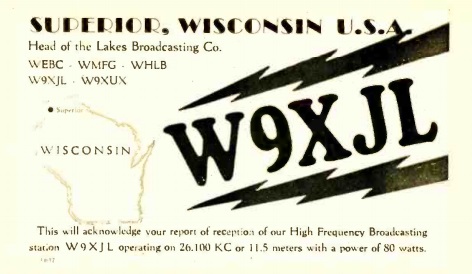
W9XJL QSL card,

W9XJL 1938 QSL card, All Wave Radio, Feb. 1938.  A color image of the card can be found at this link.,

You probably didn’t know that Superior, Wisconsin, was once the home of a shortwave broadcast station. Station W9XJL was an experimental station licensed to Head of Lakes Broadcasting Company.  It originally operated with 80 watts on 26.10 MHz, and later increased its power to 250 watts. The January 1940 issue of Radio & Television magazine carries the following report:

W9XJL, 26.10 mc, Superior, Wis., is now using a full 250 watts from 9 a.m. to 5 p.m. daily. Much can be said for the fine quality and consistency this station has shown in the last three years and for its excellent verification policy. Our observers in Massachusetts, Connecticut, New Jersey, Florida, Arizona, California and Washington all report an R9 signal whenever the band opens.

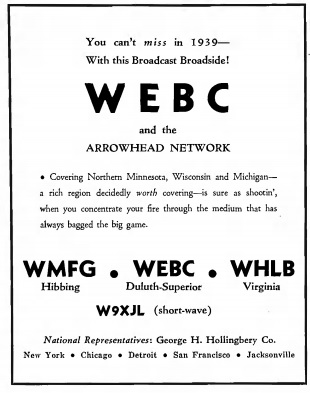
w9xjl

WEBC-W9XJL advertisement, 1939 Broadcasting Yearbook.

W9XJL  simulcasted  Duluth-Superior station WEBC on the Apex band, which existed from 1934 to 1940. The 11 meter band (25-27 MHz) was allocated internationally for broadcasting, but largely unused outside of the U.S. Apex stations. In Minnesota, both WCCO and WTCN had licenses to broadcast on the Apex band, as W9XHW and W9XTC respectively.  (A portion of the band, 25.6-26.1 MHz, is still allocated for international broadcasting, but rarely used.)  Some sources incorrectly describe W9XJL as an FM station, but it actually used amplitude modulation, although the Apex stations generally used a wider bandwidth than on the standard broadcast band, thus allowing for a more “high fidelity” audio signal.

W9XJL transmitted from 40th and Tower Avenue in Superior.  The program was generally the same as WEBC, with an announcer at the transmitter location breaking in to give the station identification.  One interesting use of the station was reported in 1937 as the relay of personal messages to and from persons wintering on Isle Royale. Station WSHC was licensed to Isle Royale.

W9XJL did receive reception reports from around the world.  As noted above, it had a good reputation for QSL’ing.

References


Click Here For Today’s Ripley’s Believe It Or Not Cartoon


Minneapolis School A-V Equipment of the 1960’s and 1970’s

SetchellCarlsonTV

If you went to school in Minneapolis in the 1970’s, I bet these pictures look vaguely familiar. This is a 1972 ad from Setchell-Carlson, then known as SC Electronics, Inc., a subsidiary of Audiotronics Corporation, with an address of 530 5th Avenue NW, New Brighton, MN. This ad appears in the March 1972 issue of Broadcast Engineering.

The Minneapolis Public Schools were equipped with what I believe was the model at the left.  I’m showing the one on the right to show the distinctive controls in the center, which are hidden behind the optional “tamper-proof control compartment door” of the black and white model on the left.  I don’t think that Minneapolis had the door, or else the doors were routinely left open.

At Waite Park Elementary School, I don’t believe that every classroom was equipped with a TV.  There were one or two of these that were wheeled in as needed.

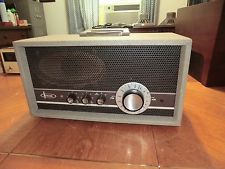
AV750Every room, as far as I can recall, was equipped with a radio, although it was rarely used.  The radio, shown here, was the Newcomb Model AV-750.  This was an 8-tube AM FM receiver, and was obviously built for severe service.   I’m sure I’m the only kid who noticed, but it had a connection on the back for an external AM antenna and ground.  I was always jealous of that radio, since I dreamed of all the exotic broadcast band stations it would pull in if connected to an external antenna.  There was also a connection on back for audio input, so it could be used as an audio amplifier.

I’m not positive, but I believe this Audiotronics phonograph was the standard issue model in the Minneapolis schools.  Again, I believe one was issued to each classroom, and they saw a bit more use than the radio.

The televisions were made not far from the school.  Setchell-Carlson made some consumer radios in the 1940’s, and TV‘s in the 1950’s and 1960’s.  They were never a big name nationally, although they did have a strong presence in their home state of Minnesota.  By the 1970’s, they had abandoned the consumer market, but they continued to make the institutional models shown above.

There’s a good history of the company in the October 2008 issue of Radio Age.

bc1206

Photo courtesy of Ian O’Toole, VK2ZIO, Kurrajong Radio Museum. Used by permission.

The company was founded in St. Paul in 1928 by Bart Setchell and Carl Donald Carlson as “Karadio Corporation.” As the name suggests, the company manufactured auto radios. Setchell claimed later to have been the “first” to use vibrators to power the car radio. The author of this article disputes that claim, but it is clear that Setchell-Carlson was one of the pioneers. In 1934, the company became Setchell Carlson, Inc., and made a few radios before the war. During World War II, the company was a defense contractor, and made products for the military, the most famous of which was the aviation receiver shown here. (For more information on this device, see my earlier post.)

In 1949, the company moved to New Brighton,

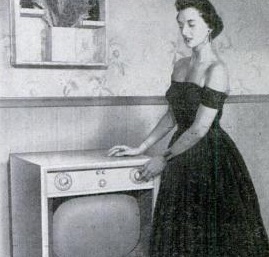
A Setchell Carlson TV from 1954, back when people apparently dressed up to watch TV. Popular Mechanics, Dec. 1954

A Setchell Carlson TV from 1954, back when people apparently dressed up to watch TV. Popular Mechanics, Dec. 1954

Minnesota, and went into the TV business, which lasted until the 1960’s. At its peak, the company employed about 500, and also had a plant in Arden Hills.  Setchell was later inducted into the Minnesota Broadcasting Hall of Fame.

One final note on the audio-visual equipment in use at my elementary school.  The Minnesota Historical Society has this photo  of the school’s public address system.  The photo is dated about 1955, but based upon the one or two times I saw it, this is the same console that was in use in the 1960’s and 1970’s when I was a student there.  Interestingly, the caption of this photo bills it as a “school broadcasting lab” and shows students at the mike.  I never recall the console being used by students, certainly not on a routine basis.

The couple of times I saw this, I was quite impressed.  It was in a separate room off the office, and in addition to the PA console, there was a radio receiver.  I remember one dial being for the standard AM band.  The other dial was calibrated in some numbers that did not look at all familiar to me.  In retrospect, it’s possible that they were FM channel numbers, which were used for a short time on some FM receivers.
Click Here For Today’s Ripley’s Believe It Or Not Cartoon


Mississippi River Open, December 1864

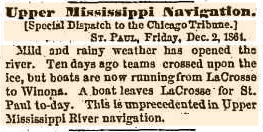
ChicagoTribune12031864A hundred fifty years ago today, December 2, 1864, the weather in Minnesota was warm and rainy.  And the Mississippi River was open to navigation, which was totally unprecedented this late in the season.  This dispatch from St. Paul was in the Chicago Tribune the next day.  It reported a boat leaving from LaCrosse, Wisconsin, to St. Paul.

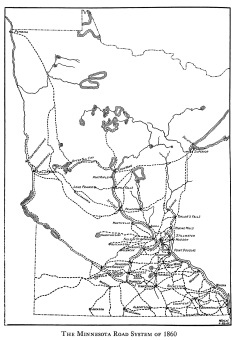
Minnesota's Road Network in 1860, Minnesota Historical Society.

Minnesota’s Road Network in 1860, Minnesota Historical Society.

There was no rail connection until 1867, when a line was built to Iowa and an all-rail route was available until Chicago.  A few rudimentary roads were in place, but the only means of economically transporting goods and passengers was by river.  So when a warm spell thawed the river in December, the pioneers were eager to take advantage of it.


References

Roads and the Settlement of Minnesota, Minnesota History, September 1940.


Red Owl Makes a Cameo Appearance, 1964


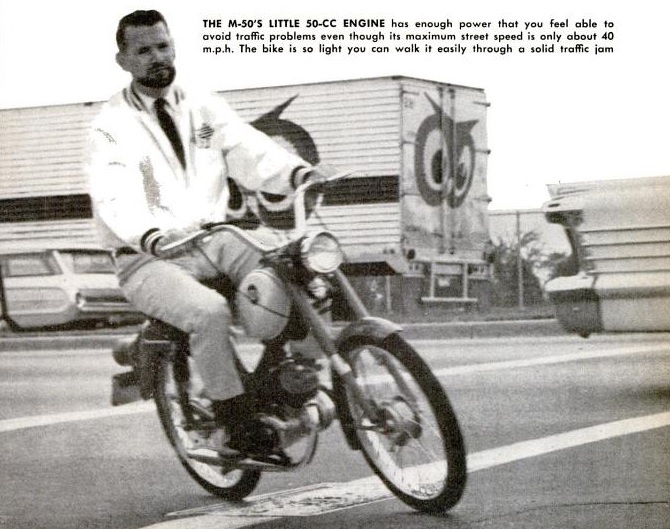
MotorcycleRedOwlThis review for a Harley-Davidson 50 cc motorcycle appeared fifty years ago, in the November, 1964, issue of Popular Mechanics. The photo shows how easily the little bike can weave in and out of congested traffic.

But what caught my eye was the Red Owl truck in the background.  In the 1960’s, Red Owl was one of the big grocery chains in the Twin Cities,  At its peak, it had 441 stores in Minnesota, Michigan, Wisconsin, Iowa, and the Dakotas. The name was acquired by Supervalu in the 1980’s and eventually phased out.  The name and familiar logo lives on, however, at at least one store in Green Bay, Wisconsin.


Click Here For Today’s Ripley’s Believe It Or Not Cartoon


1940 Armistice Day Blizzard

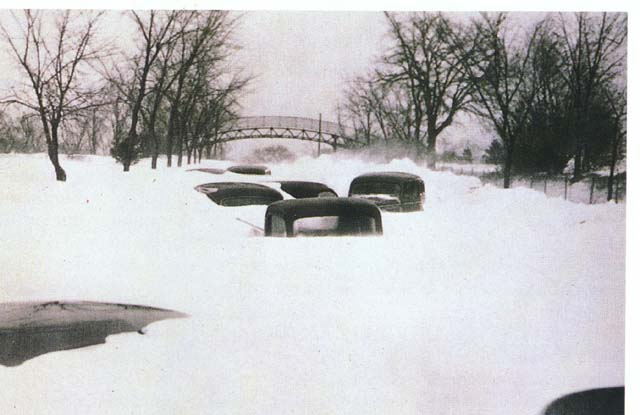
Armistice Day Blizzard, Excelsior Blvd., West of Minneapolis.  Minn. Historical Society photo, NOAA.

Armistice Day Blizzard, Excelsior Blvd., West of Minneapolis. Minn. Historical Society photo, NOAA.

For many, the eleventh day of November is remembered as Armistice Day or Veterans’ Day. In Minnesota and much of the Midwest, it’s also remembered as the date of the Armistice Day Blizzard of November 11-12, 1940.

The storm came up quickly and was responsible for 145 deaths, including 49 in Minnesota. About half of those 49 were duck hunters who froze to death, unable to escape the sudden storm.

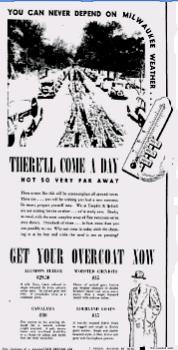
MilwAdThe severity of the storm was largely unpredicted. The newspaper forecast in the Milwaukee Sentinel was typical of that appearing in Midwestern papers. It called for “cloudy with occasional rain in south and rain or snow north; colder Monday (the 11th); Tuesday (the 12th) cloudy, possibly snow flurries and colder.” Ironically, that paper included the  advertisement shown here for overcoats, warning, “you can never depend on Milwaukee weather,” and “there’ll come a day, not so very far away, when scenes like this will be commonplace all around town.”

Those scenes came to the Midwest much faster than anyone expected.  Within hours, temperatures were dropping, massive amounts of snow fell, and winds caused peril to those on both land and water.

The storm disrupted communications through much of the region, as telephone and telegraph lines were taken down by the fierce winds.  As might be expected, Amateur Radio operators stepped in to fill the need, as reported in QST for January, 1941.  Hams provided communication to the railroads, the Red Cross, and especially for private citizens, since broadcast stations broadcast the telephone numbers of local hams who could relay messages to towns cut off by the storm.  Minneapolis Ham George H. King, W9OTE, reported that his phone rang constantly with requests from worried families, with his wife unable to prepare dinner because of the constant calls.

A couple of familiar names appear in the QST article.  The first was Stanley L. Burghardt, W9BJV, of Watertown, S.D., who contacted the families of dozens of Watertown residents who were stranded in Minneapolis.  Burghardt’s call later became W0IT, and is famous among Hams as the owner of Burghardt’s Amateur Center in Watertown.  Burghardt’s antenna collapsed in the blinding gale, forcing him to go outside to effect a repair that held until the storm ended.

Another familiar name in this story was that of Sherman Booen, then of Albert Lea, MN, W9HRT. He reported that most of the wire facilities in Albert Lea had been wiped out, and he reported that 75 meters was a beehive of activity. He reported that he went to bed, but at 10:30 PM, a railroad dispatcher in Albert Lea called him. The dispatcher had been unable to contact his chief in Minneapolis, and needed to get through for permission to start a snowplow north. Booen was able to get that message through in ten minutes. A total of 15 railroad messages were relayed by Booen.

The name Sherman Booen is familiar to many Minnesotans. After the war, his call sign became W0RHT, and he was a well-known Ham. He was also an aviator and broadcaster, and best known as the host for 28 years of “World of Aviation” on WCCO-TV in Minneapolis. He passed away in 2011 at the age of 97, having been licensed as a Ham since 1934.

Read More at Amazon


J. Frank Wheaton, Minnesota Republican Legislator

In many ways, the story of J. Frank Wheaton doesn’t fit in with a lot of people’s preconceptions of history. Therefore, he is simply ignored. Nobody has ever heard of J. Frank Wheaton. His story simply didn’t fit in with what people wanted to believe.

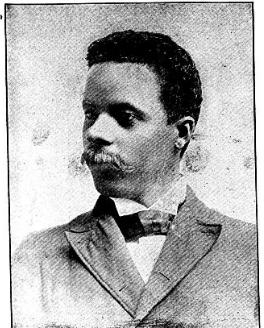
J. Frank Wheaton was the first African-American member of the Minnesota Legislature, and he was a Republican. He was elected to the House of Representatives in 1898 and served one term, after which he took a job out of state. He represented a district in southwest Minneapolis that was called “the most aristocratic portion of Minneapolis.” It included the Kenwood neighborhood of Minneapolis, and extended to modern day Eden Prairie and Excelsior. Of over 40,000 residents in the district, only about 100 were African-American.

In addition to being the first African-American to serve in the legislature, he was also the last until 1973, when Roy Pleasant of Minneapolis took office.

And Wheaton was by no means any kind of “token” Black. He was widely recognized as a brilliant attorney. He was the first African-American graduate of the University of Minnesota Law School in 1894, and was elected class orator. He worked in both state and city government in addition to his private practice.

Wheaton was also a Republican. Later in his life, after moving to New York, he became a Democrat. But in Minnesota, in addition to serving in the legislature as a Republican, he was twice elected to represent the state at the Republican National Convention.

He was featured in an article in the St. Paul Globe on February 12, 1899. Wheaton introduced into the legislature, and successfully saw passed, a measure to ban discrimination based upon race in public accommodations. The language of this 1899 statute is virtually identical to the language subsequently used in the federal Civil Rights Act of 1964. Once again, Wheaton’s story doesn’t fit in with the conventional narrative, which holds that Civil Rights flowed from federal action in the 1960’s. In truth, more than six decades earlier, Wheaton had seen this measure passed in the state legislature, with little notice taken of the common-sense provisions.

I find it appalling that nobody has ever heard of J. Frank Wheaton. He doesn’t fit the conventional narrative, so he is simply ignored.

References

J. Frank Wheaton at Minnesota Legislature

J. Frank Wheaton at Wikipedia

African American Registry

BlackPast.org


Downtown St. Paul, 1851

3rdRobert1851

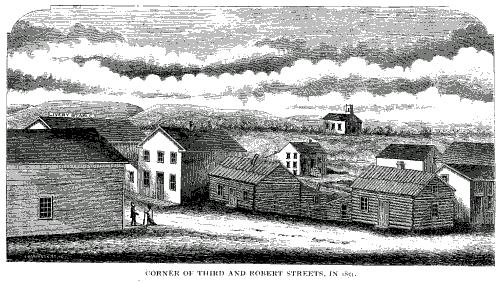
This view shows the corner of Third and Robert streets in downtown St. Paul, in 1851.  You can find the original at Google Books in A History of the City of St. Paul and the County of Ramsey, published by the Minnesota Historical Society in 1876.


Another Aeronautical/Radio Wedding

MNAeroWedding


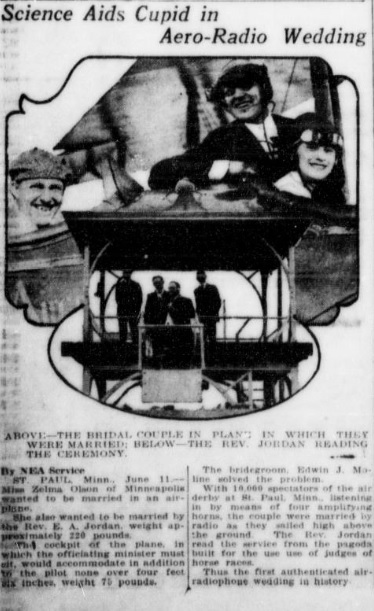
In an earlier post, I reported on the April 1922 wedding of Sarah Cockefair and Albert Schlafke, who were married in the skies above New York before thousands of radio witnesses.  Perhaps inspired by the New York couple, it seems that a Minnesota couple decided to tie the know in a similar fashion just a few months later.  This wedding took place in June, 1922, during an airshow at the Minnesota State Fairgrounds.  It is reported in the article shown above, a wire story appearing in various papers including the Albuquerque Evening Herald on July 2, 1922.

According to the article, Zelma Olson of Minneapolis desired to be married in an airplane, and desired that the ceremony be officiated by one Rev. E.A. Jordan, who weighed 220 pounds.  Unfortunately, the aircraft could accommodate only an additional 75 pounds.

It’s not until the third paragraph of the story that we learn that the groom was one Edwin Moline, who was presumably going to be present in the aircraft as well.  His weight is not stated.

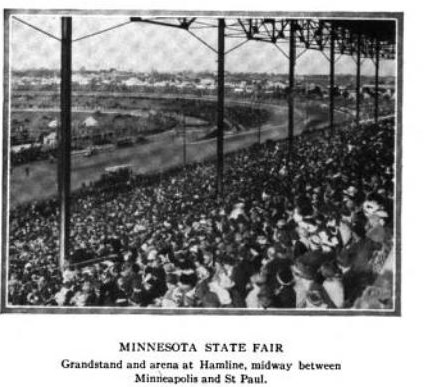
The site of the wedding, about five years earlier. (Photo from Google Books)

The site of the wedding, about five years earlier. (Photo from Google Books)

The problem was solved, at Moline’s suggestion, by placing a radiotelephone set in the plane (presumably one weighing less than 75 pounds), and having Rev. Jordan officiate by wireless.

This he did, and Rev. Jordan conducted the ceremony from a pagoda overlooking the State Fair Grandstand.

There doesn’t seem to be a great deal of historical record surrounding this novel ceremony.  I was able to find this post by one Jennifer Moline, presumably a relative of the 1922 newlyweds, indicating that the wedding actually took place on June 4, 1922, a fact not reported in the wire story.

Also, the original 1922 press photo is available for purchase on eBay, and a better copy of the photo can be found at that listing.  The back of the image notes that the photo originated from the St. Paul Daily News, and that the photographer was Earl L. Vogt.  There’s a date stamp on the back of June 8, 1922, which seems consistent with a wedding date of Sunday, June 4, 1922.

If anyone has any additional details about this wedding, I would enjoy hearing from you.