Category Archives: Emergency Preparedness

1963 Fallout Shelter Occupancy Experiment

falloutblastshelter

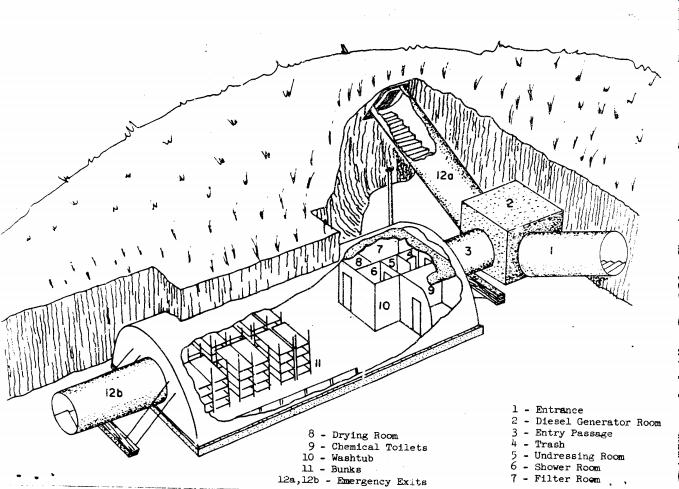
This diagram shows a prototype blast and fallout shelter constructed in 1961 at the National Naval Medical Center, now known as Walter Reed National Military Medical Centerin Bethesda, Maryland. It was used in various occupancy studies in which test subjects were housed in the shelter for various lengths of time. However, all of those studies were flawed in one respect: In a real attack, people need to go to the shelter with little if any advance notice or preparation. This condition is very hard to duplicate in a research experiment. It’s necessary to tell people in advance about the experiment in order to get their consent. So in 1963, the Navy came up with a test that would duplicate, as much as possible, the surprise factor inherent in a real emergency situation.

To conduct the test, the Navy recruited Naval Reserve Officers to participate in a seminar, ostensibly to last two weeks, involving lectures and field trips. They were told to bring work clothing, and because there would be extensive field trips, they were told not to bring their families or make plans for social engagements. The seminar would satisfy their two-week training obligation.

34 Officers volunteered, and attended a lecture the first morning. After lunch, they went on their first “field trip,” to the shelter shown here. After a tour, the seminar organizers made a presentation on the necessity of a realistic simulation of emergency occupancy. With no further ado, the group was requested to volunteer to remain in the shelter for an indefinite period. There was “no question that the participants were taken completely by surprise whn they were requested to remain in the shelter. Their faces betrayed a moment of disbelief followed immediately by the cooperative acceptance of an unexpected situation for which Naval officers are trained.”

The officers were informed that continued participation was completely voluntary. Only one officer departed at that time, since he was a University professor who was obligated to write some final examination questions. However, after he wrote his questions and mailed them to his school, he returned to the shelter the same day as a “casualty.”

The participants spent the next several days susbsisting on rations, taking simulated radiation measurements to estimate their departure time, and generally performing the tasks necessary for shelter occupancy. Because most of the officers had an engineering background, they were also tasked with making recommendations for improvements to the shelter.

The report of the experiment is available at the Defense Technical Information Center and contains numerous recommendations from the participants.

The participants’ reactions to the experiment were in four categories, of approximately equal numbers. One group viewed the experience as an interesting challenge and opportunity. Another group reacted with immediate and surprised anger at being “exploited,” even though they were still willing to volunteer. A few bordered on belligerence. Another group was initially unhappy and eventually either withdrew or became minimally cooperative. The natural leaders of the group emerged from those who viewed the experiment as a challenge, as well as among those who initially felt “exploited.”

Rations consisted mostly of survival biscuits, supplemented with tomato soup, peanut butter, and jelly. Coffee was provided, along with sugar and coffee creamer. The average calorie consumption was 1414 calories per day and the men experienced an average weight loss of 1.1 kg.

After 4-1/2 days, the simulated radiation levels had dropped to safe levels, and the confinement in the shelter ended.

Click Here For Today’s Ripley’s Believe It Or Not Cartoon


12 Volt Appliances on Sale at Amazon


On my “how to make coffee without electricity” page, I’m sometimes asked whether it’s possible to make coffee (or cook other things) with 12 volts. The answer is a qualified yes. There are cooking appliances that run on 12 volts, and for some applications, they can work extremely well. But there are definite limitations, and you can’t expect 12 volts to provide an exact duplicate of your normal cooking experience. Amazon currently has a number of 12 volt appliances on sale, so now is a good time to look at the possibilities and limitations.

The most important thing to remember about cooking with electricity is that producing heat requires a lot of electricity. Sometimes, people look at their toaster, coffee maker, electric heater, or other device and decide that because it is small, it must not use much electricity. This is not the case. As a general rule, any device that creates heat will use a lot of electricity. Therefore, your coffee maker uses more electricity than your television–a lot more. Your toaster uses more electricity than your computer–a lot more. Anything that produces heat will require a lot of electricity.

This means that, in general, you can’t use a battery to do any type of cooking. There is simply not enough energy in the battery. The battery will go dead.

However, if you have 12 volts available from your running vehicle, then you might have some options. But the vehicle will need to be running. Otherwise, you’re very likely to wind up with a dead battery.

For this reason, you’re usually better off using some sort of combustion to do your cooking, such as a gas stove. I have many options available on my coffee page.

But if you want to cook and you have a running vehicle, then 12 volts might be an option, and you should look into the possibilities on this page. For example, if you are a trucker, your truck is running anyway, and there are 12-volt appliances that you can use to cook while the engine is running. Or if you are on the road all day, you can have a cooker plugged in while you are driving.

On the other hand, if you are an RV’er and your rig has a 12-volt battery, that battery is more than adequate to run the lights for a long period of time. However, it is not nearly big enough to run any of the appliances on this page for other than a very short period of time.

Now that we have that out of the way, we need to talk about another limitation. It will take longer to cook food using 12 volts–a lot longer. The amount of heat produced is proportional to the voltage times the current. This means that if a home appliance produces a certain amount of heat in 1 minute, it will take a 12 volt appliance 10 minutes to produce the same amount of heat. The heat will come, eventually, but it will take longer–a lot longer. So if you want instant gratification, you shouldn’t try to cook with 12 volts. But if you’re willing to put in the food and let it cook while you drive around, then you might be interested in the 12 volt appliances shown on this page. Many of these are currently on sale at Amazon, so if you’re in the market, this is a good time to buy.

The first of these appliances is the RoadPro 12-Volt Portable Stove. In this case, the word “stove” is a misnomer. Strictly speaking, this is a stove, because it’s a device used to heat food. But as you can see, it doesn’t look like a stove. It looks more like a tackle box with a 12 volt plug. It doesn’t look like the stove at home, and it doesn’t have the same function as the stove at home. It will slowly cook food as you drive around. Functionally, it will work more like a crock pot or slow cooker. For what it is, it’s very useful, as long as you understand the limitations. It’s great for having a warm meal while you’re driving. You can put the food inside it in the morning, and you will have a hot lunch after driving around for a few hours. But if you expect to quicly cook a meal for your family while camping, it’s a very poor choice.


If you just want to heat liquids, then the Roadpro Hot Pot is a very economical option. Again, however, you need to understand the limitations. This will not heat nearly as fast as the stove at home. This hot pot will bring 20 ounces of water to a boil in about 35 minutes. Again, if you’re driving around and want to make a hot beverage, this will be great. But remember that once you’ve used the 20 ounces of water, it will take another 35 minutes to make more.

This 12V Frying Pan is small. It can be used to fy one, or maybe two eggs, or perhaps a hamburger. Even though it can be used to fry food, keep in mind that it will take much longer than the stove at home. Of all of the appliances on the page, this seems to be the least practical, since frying food means that someone needs to keep an eye on it, which you probably can’t do while driving. But perhaps for some uses, it might come in handy, and at the current sale price, it’s economical even for occasional use.

This 12 volt Sauce Pan and Popcorn Maker suffers from the same limitations. As noted above, it can really only be used while driving, and it would be difficult for the driver to attend to the popping corn.

Finally, and probably most useful, is this 12-Volt Coffee Maker . It will make 3 cups of coffee, although it might take almost an hour to make the full amount. So if you like brewed coffee, this is a good option. The carafe is made out of metal, so it will endure a certain amount of abuse in the car. For occasional use during power outages, this might be a good option for those who want brewed coffee. You will need to run your car for the time that it takes to make the coffee. If you had to do that every day, it would be a huge waste of gas. But for occasional use, the convenience might outweigh the added expense.


Free Download of 1962 Civil Defense Plan & Shelter Management Handbook

I now have available on my website a complete scan of the 1962 Civil Defense Operational and Survival Plan of the City of St. Paul, Minnesota.  This 104 page document goes into great detail as to how the city planned to survive the aftermath of a nuclear attack.  Of particular interest is the complete handbook for managers of public shelters.  The handbook would give the fallout shelter guidance on all aspects of operating the shelter.  There is some information in this document of practical guidance.  For example, the section on radiological defense contains some useful information.  However, the document’s main interest is as a fascinating historical look at civil defense plans fifty years ago.

Emergency 1943 Radio Receivers, Including Converting Lightbulb to Diode Tube

Converting dual-filament lamp to diode tube

A homemade diode vacuum tube.

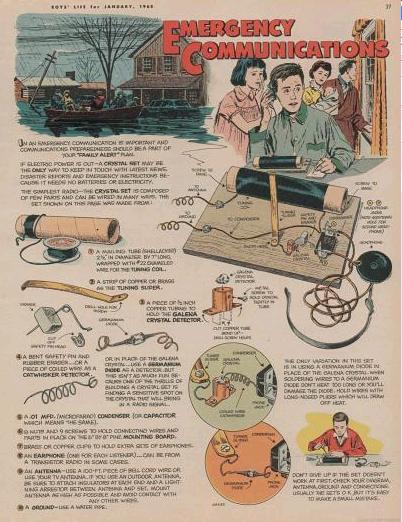
A wartime issue of Radio News, January 1943, includes an interesting article entitled “Emergency Radio Receivers.” The article notes that “‘horse and buggy’ receivers employing the simple detectors are just as workable today as they ever were.” With wartime tube and battery shortages, and the possibility of power line disruptions, “the present war emergency may yet recall these simple sets from their resting places on museum shelves.” Their greatest value in time of war was as emergency receivers. “Such sets may be placed into immediate service when power lines have snapped out and “B” batteries are not available for the family portable. They may be carried into bomb shelters where electric power is not available. Particularly unique is the fact that they may be made so small in size as to be carried easily in a pocket or handbag.”

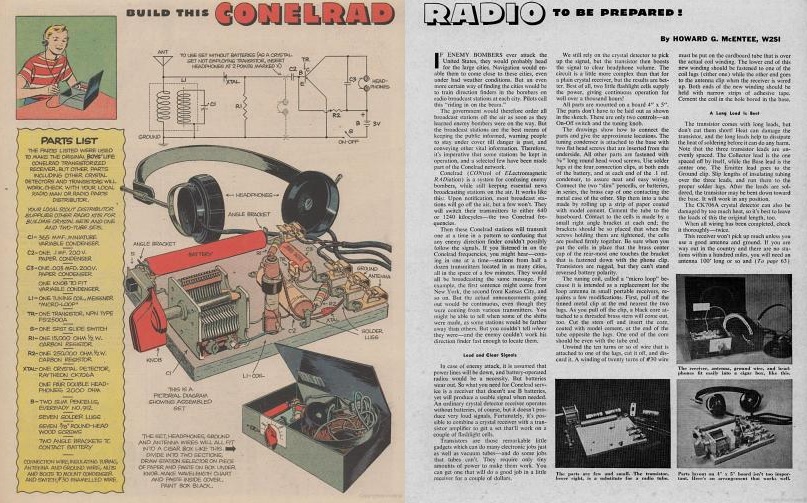
This was not the last time that the usefulness of crystal sets was considered for emergency preparedness. A 1963 Office of Civil Defense report noted that for the “economy minded,” even a crystal set would be adequate for receiving local broadcasts after a nuclear war.

The article then describes a number of possible crystal detectors that could be used in an emergency receiver. (One not mentioned was the razor blade of the foxhole radio, which made its debut the following year, in 1944.)

VHF Crystal Set

VHF Crystal Set

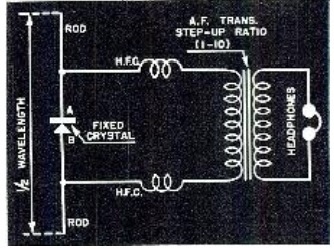
For those interested in experimenting with crystal sets, the article provides a good introduction to the subject. Three of the ideas shown are rather novel. The first is an “effective crystal circuit for fixed-frequency ultra-high-frequency reception,” shown here. The terminology has changed, and we would today call these VHF frequencies. It notes that this circuit provides “interesting possibilities for portable (personal) use in short-range civilian defense communications employing the ultra-high WERS (War Emergency Radio Service) frequencies” of 112-116 and 219-225 MHz. Contrary to popular perception, there’s no reason why a crystal set can’t be used on VHF. In fact, here’s one interesting example of a crystal set for the FM broadcast band.

CW Crystal Set

CW Crystal Set

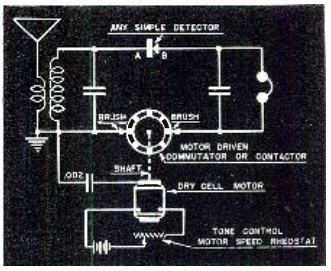
The article also shows a method for receiving CW signals on a crystal set, a task I would have thought to be impossible without some active component such as a tube or transistor. The article explains that to receive CW, it is only necessary “to include in the circuit some form of continuously-running, high speed interrupter.” It shows how to do this with a motor-driven commutator which interrupts the RF circuit. This makes the CW signal audible, with a pitch proportional to the speed of the interrupter. A rheostat controlling the speed of the motor thus adjusts the CW pitch.

Converting dual-filament lamp to diode tube

Converting dual-filament lamp to diode tube

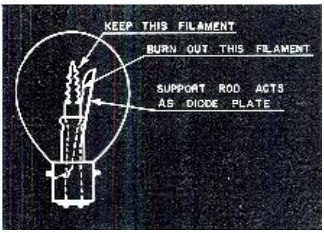
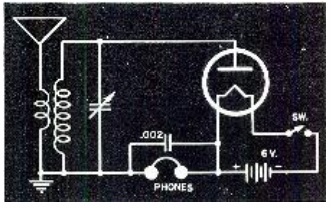
But the most remarkable idea in this article is making a homemade vacuum tube diode using a double-filament lamp. The article explains how a diode tube can be made from a type 1158 lamp. This lamp, which is still readily available, has two filaments, one brighter than the other. The brighter filament is intentionally burnt out by applying a high voltage. This leaves the other filament intact. The good filament is then used as a directly heated cathode. And the support rod for the burnt out filament acts as the plate of the tube. The result is that the automotive light bulb is converted into a diode vacuum tube. It is used in the circuit shown here as a radio receiver:

Radio circuit using light bulb detector

Radio circuit using light bulb detector

The article notes that the filament has a rather high current (about 750 mA for a modern example), but “this drawback should not be of monumental concern if the diode receiver is to be operated during rather short, emergency periods.”

Any dual-filament DC bulb should serve the same purpose, but the 1158 bulb specified in the article is still readily available. It’s probably available at a local hardware store, and it’s also available at a reasonable price from Amazon. Since six-volt automotive bulbs aren’t very common these days, it would probably be better to substitute the 12-volt version, the 1157, which should be available at a local auto parts store, or online at Amazon or WalMart
icon. Another possible option would be to use a 120 volt 3-way light bulb. In that case, of course, you should take care to keep the headphones isolated from the AC line.

For ideas on where to get other needed parts, you can check my crystal set parts page.


Atomic Bombs in 1914

1914AtomicBombs

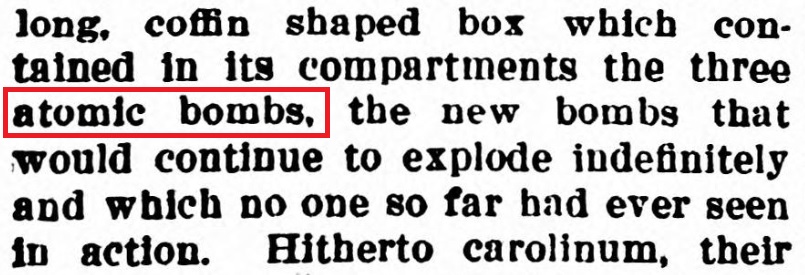
You probably wouldn’t expect to see the words “atomic bombs” in the newspaper a hundred years ago, but here they are, as they appeared in the Willmar (Minn.) Tribune a hundred years ago today, November 4, 1914.

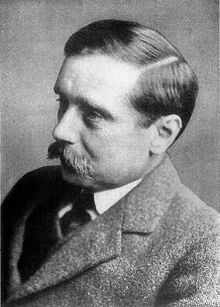
H.G. Wells (Wikipedia photo.)

H.G. Wells (Wikipedia photo.)

This actually isn’t a news story. It’s part of the serialized novel The World Set Free by H.G. Wells.

By the time the book was published, the war in Europe was well underway. Wells predicted it, but he saw it as not taking place until 1956. He did correctly predict that by that time, the combatants would be equipped with “atomic bombs.” The bombs in Wells’ book did use nuclear reactions, but he got some of the details wrong. Instead of releasing all of their energy in an instant, Wells’ versions continued to ignite for months or years, leaving much of Europe uninhabitable.  The previous peaceful use of atomic energy in the book had consisted of small amounts of the reaction material, the fictional element “carolinum,” used to power vehicles and machinery.

In the aftermath of Wells’ war, the people of the world united into a utopian one-world government. On the one hand, the new world government renounced monarchy. But on the other hand, the new government was presided over by the former kings, with the King of England at the helm of the new benevolent dictatorship.

If you don’t like plodding through old newspaper clippings, the entire novel is available as a paperback. It’s also available for free as a Kindle book. If you don’t have a Kindle, you can download the free Kindle reader app. It’s also available for free download at Google Books.

Other Books by H.G. Wells at Amazon


1939 British Gasproofed Room

Life18Sep39

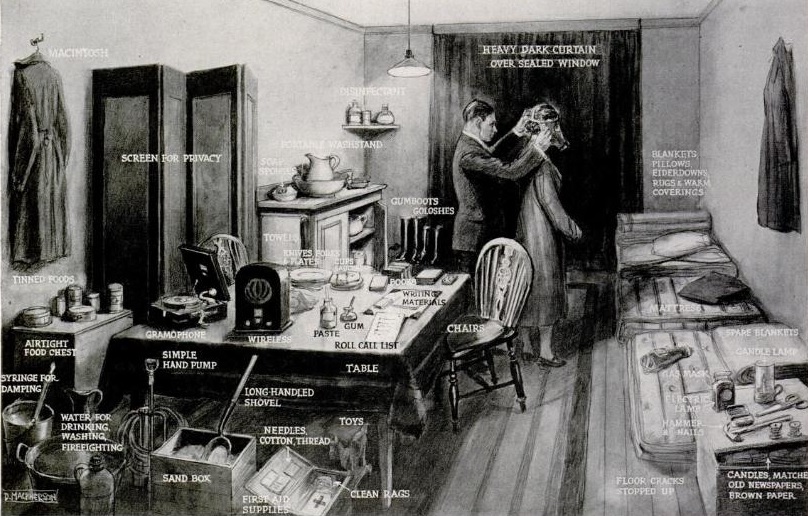
Seventy-five years ago today, September 18, 1939, Life Magazine carried this illustration from the British Home Office showing a basement room equipped and gasproofed. The caption notes that if the occupants remain quiet, there will be enough oxygen in the sealed room to accommodate five persons for twelve hours.

Presumably, the gramophone is to keep you entertained between bulletins from the wireless.


Civil Defense Postattack Broadcast Planning: 1963

1962XtalSets

“Perfectly adequate” civil defense receivers for those close to transmitters. 1962 Radio Shack Catalog.

In an earlier post, we looked at how the Defense Civil Preparedness Agency had been planning for emergency broadcast antennas in 1973. The agency and its predecessors had long recognized the need for dissemination of information by radio, and had commissioned a number of studies on the subject. One which took a comprehensive look at the subject was conducted by Technical Operations Incorporated of Burlington Massachusetts. The study culminated in a report issued on 7 January 1963, entitled “The Civil Defense Role of Radio Broadcasting in the Postattack Period.”

The report began by identifying three distinct phases of the postattack period. The first was the Buttoned-Up Period, during which time the population would be confined to shelter because of high radiation levels or because further attack was anticipated. This would be followed by the Emergence Period when some outside exposure would be possible. At such time as a full workday was possible outside of the shelter, the Recovery Period would begin and recovery would be the focus of the public’s activities. Each of these time periods had distinct requirements with respect to broadcasting, and the report then moved on to discuss the numerous broadcast needs.

The first broadcast information discussed related to fallout, which would need to be broadcast frequently during the Buttoned-Up Period to facilitate planning by shelterees. In addition to general forecasts, these would include warnings of local hot spots, instructions on methods of decontamination and identification of safe foods, and information on the length of time over which shelter supplies would need to be rationed.

Broadcasts would also need to convey a large amount of information as to how the public could access emergency services, and would also serve a role in alerting those furnishing those services. Locations of food and water supplies could be broadcast, along with admonitions to avoid hoarding of those limited supplies. Locations of emergency hospitals and medical supplies could be broadcast, along with pleas for blood donors and volunteers to staff the hospitals. Information as to sources of fuel and power could be broadcast. And if the electrical mains were operative, the instructions might include rationing instructions. If fires were burning out of control, the broadcasts might include calls for volunteers to assist in their control, as well as warnings of fires close to particular shelters.

Much educational programming would be necessary. In addition to broadcasts of food decontamination methods, emergency first aid instructions would need to be broadcast during the Buttoned-Up Period, since no outside medical aid would be available at that time. Since some shelters might be stocked with radiological instruments with no trained personnel, this training could be broadcast as well, along with training on sanitation, shelter management, rationing of supplies, and even disposal of the dead.

During the Recovery Period, a very high civil defense priority would be re-establishment of public transportation. Once again, broadcasting would play an important role, since it could be used to call drivers back to work, as well as to announce schedules.

Even apart from this vital information, radio would be important to the public morale. The report stressed the importance of morale-boosting messages from the President, as well as by state and local leaders. Similarly, to stop the spread of rumors and boost morale, it was deemed important to broadcast news of the attack and counterattack. This would also prepare the people for the conditions they would face upon emergence, and also instill a feeling in the people that this was not a personal disaster, but that the whole population of the nation was included. The report noted that good news is always best, but that even bad news is superior to no news at all, since it helps define the environment and diminish uncertainty. The report noted that any unaffected regions of the country should be kept up to date, in order to properly tailor relief and rescue operations.

Broadcasts should frequently give the time and date, since in such emergencies, people frequently lose track. In addition, program schedules should be announced, in order to facilitate conservation of scarce batteries.

Broadcasting could also play a role to re-establish normal commerce during the Recovery Period. Even during the Buttoned-Up Period, the report recommends that people be informed as to the rules and regulations over such things as “whether the needy will be allowed to take what they require without being charged with illegal looting.”

Radio would also play a role in the care of displaced persons, since stations could broadcast information to reunite families who were separated at the time of the attack. These broadcasts would include locations of camps, shelters, and displaced person centers. In addition, during the nighttime hours, lists of people safe in various shelters could be broadcast for the benefit of their families in other areas.

Evacuation instructions and warnings of another attack would obviously have a high priority for broadcast.

The report notes that broadcast stations would undoubtedly be used to call civil defense personnel and members of the National Guard to duty and provide some instructions. Broadcast stations could even be used to relay civil defense messages from one area to another. The nighttime hours, in particular, might be put to use relaying such official messages, and civil defense officials in other areas could be assigned to monitor broadcasts from neighboring areas.

Finally, the report recommends that some entertainment should be furnished, particularly during the time in which people are in shelters. It notes that “music properly chosen many substantially aid morale in the rebuilding phase.” The report warned, however, that people with battery-operated radios should be advised to conserve batteries by listening to only a minimum amount of non-essential programming.

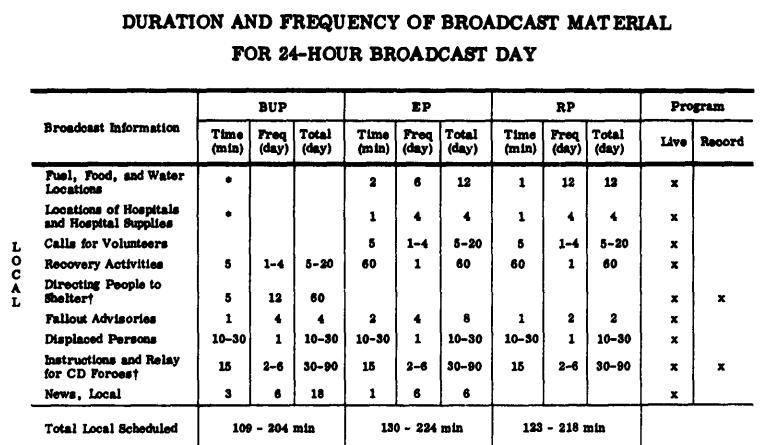
The overall contents of the broadcast day of a typical local station are shown in this chart:
CDbroadcastday

After identifying all of these needs, the report goes on to a discussion of how these needs can be satisfied. While some other options (such as public address systems) are briefly discussed, the only reasonable method of addressing these needs was with standard AM broadcasts. Virtually all American households had a radio receiver, and a large number had a battery-operated set. The report even notes that “for the really economy-minded, there are crystal sets selling for as little as $1.49,” which would be suitable for receiving local stations with no batteries, but with adequate antenna and ground. The footnote for this assertion is to the Radio Shack catalog, and the price obviously refers to the “Rocket Radio” shown at the top in the illustration at the top of this post.

The report did address many of the practical issues confronting broadcasting in the post-attack environment. Presumably, most information would originate at the civil defense Emergency Operations Center (EOC), and links would be necessary to studios or, preferrably, direct to the transmitter site. Since telephone lines would be vulnerable, mobile broadcast units would be advisable, although the report toyed with the idea of installing AM transmitters directly at the EOC, or the use of mobile or even airborne transmitters. Protection of station staff and equipment was addressed in this and other studies.

The report lamented the fact that the radio industry, even though some personnel served on relevant civil defense committees, largely lacked civil defense plans. For example, even radio station switchboards were poorly suited for civil defense needs. As addressed in my earlier post, vulnerability of transmitter towers to blast damage was a very big issue, as was fallout sheltering for station staff.

Station power was discussed, although the report noted that some stations already had emergency generator capability.

At the time of this report, public shelters were not stockpiled with radio receivers, and the report noted that this oversight should be rectified. This, of course, was never done, apparently the planners going along with the reasoning, “surely some people will bring radios to the shelter.”

 

Civil Defense Emergency Antenna Instructions, 1973

ExpedientHorizontalWire

In 1973, the Defense Civil Preparedness Agency was grappling with the issue of how to keep broadcast stations on the air after a disaster, presumably up to and including nuclear war. It was recognized that a station’s weakest link was its antenna. While most antennas are designed to survive normal environmental disturbances, they are the most exposed element of a station and could be destroyed by extreme disturbances. Therefore, the agency commissioned a study on the subject, the final report of which is available online.

In the report, the engineers propose that expedient antenna kits be supplied to stations, and proposed instructions are included. The report proposed kits for both AM and FM stations, along with instructions for station personnel to deploy them. The cost of the expedient AM antenna kit, a quarter-wave horizontal wire, would be $425.37. The expedient FM antenna kit would be about $1000. Both antennas would require installation at the station, prior to the disaster, the necessary utility poles that would support the antennas.

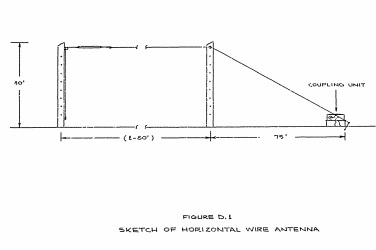
Recognizing, however, that the government might not want to bear this expense, the report also includes instructions for station personnel to construct an AM antenna using available materials. Once again, the recommended antenna is a horizontal wire, either the length of the destroyed tower or a quarter wavelength. The diagram of the recommended antenna is shown above.

Ideally, the feed point of the emergency antenna would be at the base of the fallen tower, but other options are discussed. A last resort, if the feed line were destroyed, would be to put the feed point of the antenna directly at the transmitter. The instructions caution that “it is possible to construct a transmission line, but don’t try. The performance of an antenna fed at a transmitter without a good ground will probably be better than the performance with a good ground and an improvised transmission line.”

These instructions also presuppose that the utility poles were never installed prior to the disaster. Instead, it advises to use “any existing structures available such as trees, buildings, and utility poles. A step ladder or even an automobile can be used if nothing else is available.”

Improvised antenna insulators.

Improvised antenna insulators.

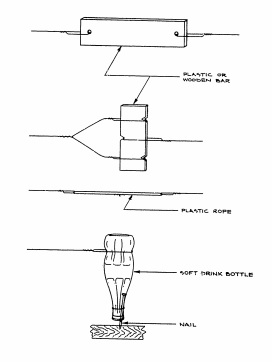
Since antenna insulators probably aren’t on hand, the instructions suggest some possibilities, shown here, using things that might be found around the radio station, such as the soft drink bottle.

The main idea was to get back on the air as soon as possible. “Time is more important than radiated power, so an inefficient operation in 15 minutes is better than full power in two hours.”


Portable Gas Refrigerator

Portable Gas Refrigerator

Portable Gas Refrigerator

On various outdoor and “prepper” forums, one common question is the availability of refrigeration in the absence of electric power. In most cases, the best option is to do as our ancestors did before the early 1900’s and simply live without this convenience. But in some cases (such as those with medicines that require refrigeration), a reliable form of refrigeration is needed.

Until recently, there were only three options, each with shortcomings. The first was to procure a generator to power a traditional home refrigerator. This is a poor solution, because the home refrigerator has an electric motor and thus requires a large generator (or very large inverter) and enough fuel to run it.

Another option is a “12 volt cooler” such as the ones shown here:

One of these can be a relatively good solution in many cases. While they don’t work as well as the big refrigerator at home, they are often adequate for the task. Compared to a home refrigerator, they require much less current. However, they draw enough current that they can’t simply be left unattended for long periods of time. The battery needs to be charged quite often, which entails having fuel to do so, or perhaps a relatively large solar charger.

The best solution has been the “3-way” Refrigerator. This type of refrigerator is commonly used in RV’s, and runs on 120 volts, 12 volts, or propane gas. They typically use about 1/2 pound of gas per day, meaning that a 20 pound tank will last about 40 days. In other words, storing fuel for long-term use is a definite possibility. Here are some examples:

The disadvantage of this type of refrigerator is that it is not portable. It is designed to be mounted permanently and, at a minimum, you would need to construct a cabinet to house it.

This objection has now been solved, however, with the following portable 3-way refrigerators:

Like the other 3-way refrigerators, these will operate on either gas, 120 volts, or 12 volts. But they are designed for portable use, and come with the hardware to hook it up to a portable LP tank, the type available everywhere. For those who absolutely need refrigeration “off the grid,” this is a very viable option.


Honeyville Discount Code for Emergency Storage Food

On my website, I have a number of pages regarding emergency food storage.  Even if, like me, you don’t own a single piece of camouflage clothing and don’t think of yourself as a “survivalist,” it is prudent to keep some food on hand in case of emergency.  You can find my food storage pages at these links:

One excellent source for bulk food for emergency storage, Honeyville Grain, has a sale this week (until August 26, 2014). By using coupon code SCHOOL14, you will receive 15% off your order.

No matter what size your order is, the flat rate shipping cost is only $4.99. Therefore, it is very economical to order food in bulk. To take advantage of the discount until August 26, 2014 use coupon code SCHOOL14 when you check out.

You’ll find a full selection of their food storage products at this link.Here are some of the products that I think are most useful.

Milk Alternative

Honeyville’s “Milk Alternative” is about the best way I know to store large quantities of powdered milk. It’s not actually whole milk, but it is a dairy product, and has nutrition very similar to milk. The first ingredient is whey, and the second ingredient is nonfat milk. While it doesn’t taste exactly like real milk, it’s actually quite close, and tastes much better than products such as Carnation instant milk. It’s also quite economical. It’s also available in chocolate and strawberry.

Fruit Smoothie Mixes

The fruit smoothie mixes  are excellent. You’ll use them regularly, and they’ll ensure that you have an emergency dairy product on hand.

Hot Cocoa Mixes

The hot chocolate mixes are about the same price that you’ll find for comparable products in the supermarket. But in my opinion, they’re better quality, and come in a variety of flavors.

Powdered Drink Mixes

The powdered drink mixes are comparable to what you’ll find in the supermarket. These are economical for storage large quantities.

9-Grain Cereal

The Honeyville Nine Grain Cereal is excellent. It makes a hot cereal that tastes much better than oatmeal and is more nutritious. It’s quite economical, and you’ll use it in your normal menu, as well as for emergency storage.

Powdered Eggs

Admittedly, most people have a bad reaction to the words “powdered eggs,” usually stemming from a prior bad experience. Fortunately, the Honeyville powdered eggs do not live up to that reputation. They are excellent, and when used in scrambled eggs or baking, they are indistinguishable from the real thing. They can make an excellent source of protein in an emergency.

The only downside is that they come in a large can. They’re good when you open the can, but after about a month, they once again start to live up to the reputation. Therefore, they are hard to use in your daily cooking. But for emergency storage, I highly recommend them.

Note: All of the above links are affiliate links, and I get a small commission is you make a purchase after following these links. But in my personal experience, the Honeyville products are all excellent, and I’ll probably be placing an order myself this week.