Category Archives: Emergency Preparedness

Emergency Lantern

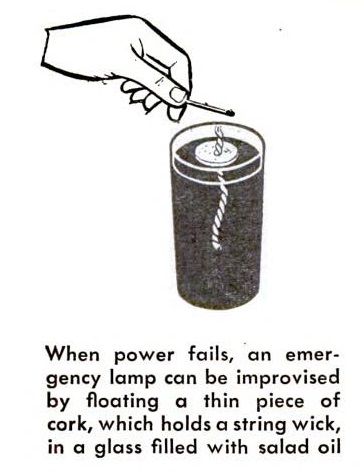
1949AprPM3This simple emergency lamp was shown in the the April 1949 issue of Popular Mechanics.  It consists of nothing more than a glass, a cork, and a piece of string.  Cooking oil is used as the fuel.

Slightly more elaborate designs can be found in Nuclear War Survival Skills, which reports that such a lamp consumes only an ounce of fuel in eight hours, yet provides enough light for reading.  Some strategically placed aluminum foil will assist with the light output.

Expedient Sled

1944FebPS
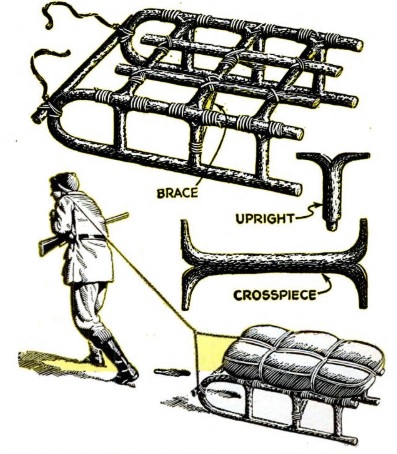
If you’re ever stranded in the wilderness in winter with an injured companion, then this idea could be a lifesaver. The February 1944 issue of Popular Science showed how to construct this expedient sled from a Chippewa design.

The magazine explained that ash was the best wood to use, since the green wood would bend without breaking.

The sled was lashed together, and the magazine explained that if you had no cord, you could use strips of ironwood bark. Or, if you were using the sled to haul your injured companion, you could use the laces from his boots.


1944 Expedient Winter Clothing

1944FebBL

Seventy-five years ago this month, the February 1944 issue of Boys’ Life gave some pointers on how to keep warm on a budget. The burlap foot coverings are the same general idea as what we previously offered for expedient winter footwear. And if your jacket isn’t quite warm enough, then lining it with a few layers of newspaper will surely do the trick.


“I Poured A Death Potion For My Sick Baby!” 1938

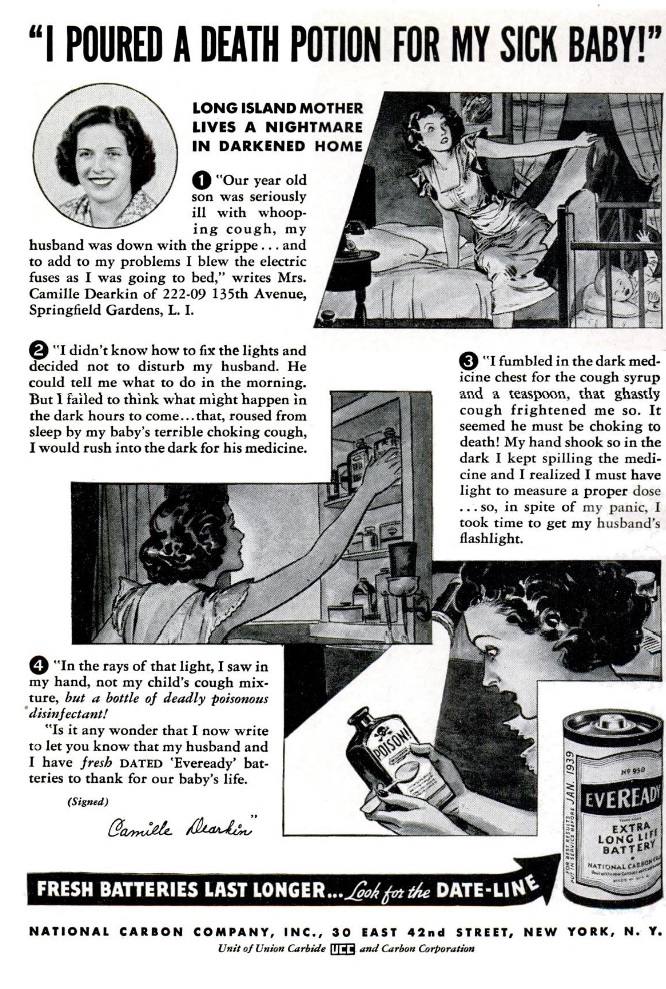
1938NovPMEighty years ago, an Eveready flashlight and Eveready batteries saved another life, as recounted in this ad from the November 1938 issue of Popular Mechanics.

The story was sent in by Mrs. Camille Dearkin of 222-09 135th Avenue, Springfield Gardens, Long Island. It was one of those nights. Her one year old son was seriously ill with whooping cough, and her husband was also “down with the grippe.” And while she was going to bed, she managed to blow a fuse.

Since she didn’t know how to replace the fuse, she decided to wait until the morning. But she was awakened by her son’s terrible coughing, and rushed in the dark to the medicine cabinet to find the medicine.

Her hand was shaking in the dark as she fumbled in the medicine cabinet until she encountered what she believed was the bottle. But her shaking was such that she spilled the medicine, and she realized that she needed light to properly measure it. So in spite of her panic, she took the time to get her husband’s trusty Eveready flashlight.

When she got it, to her horror, she realized that she had taken the wrong bottle! In her hand, she was holding not the cough syrup, but a bottle of deadly poisonous disinfectant! The Eveready batteries had saved her baby’s life.

Of course, it’s probably best not to store deadly poison right next to the medicine. But if you do, make sure you keep your Eveready flashlight handy.

People frequently Google their own names and names of family members, and I always enjoy hearing from them to follow up on these old stories.  So if you are the 81 year old Mr. Dearkin mentioned in this story, I would love to hear from you.  Please feel free to contact me at clem.law@usa.net, as I would enjoy sharing your recollections of this event.


Hurricane Michael Links

Hurricane Michael. NOAA image.

Hurricane Michael. NOAA image.

With Hurricane Michael bearing down on the Gulf coast, here are links to earlier posts on hurricane preparedness:


Another Flashlight Saves the Day

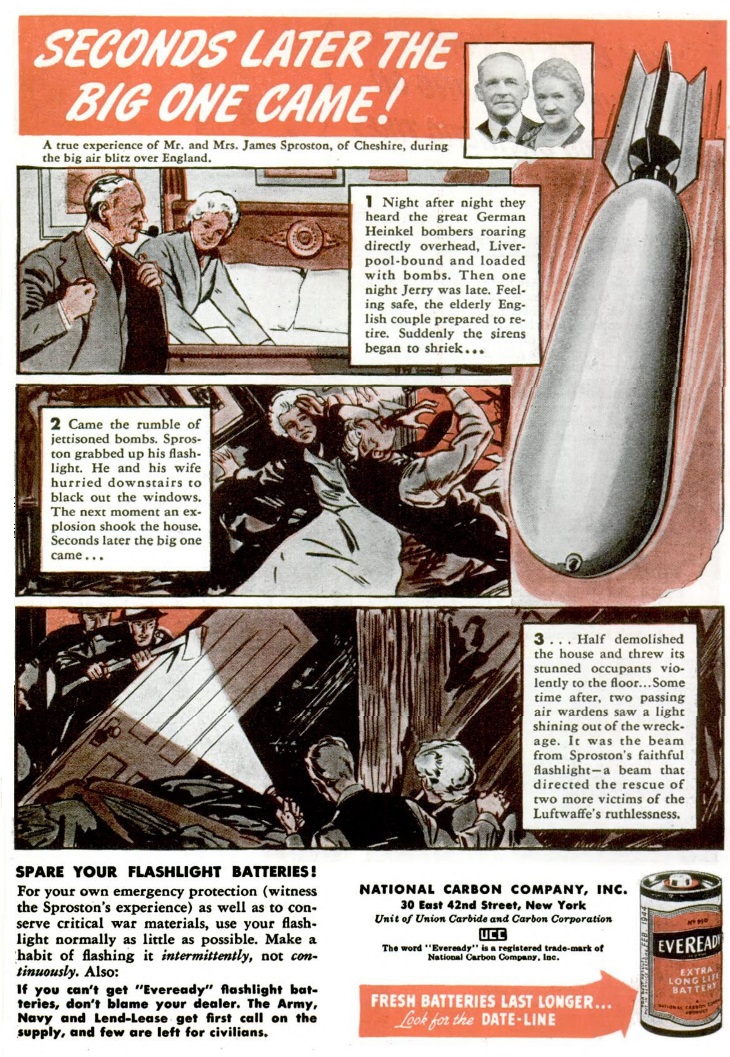
1943SepPMSeventy five years ago this month, the September 1938 issue of Popular Mechanics carried this Eveready ad with another harrowing tale with a happy ending, thanks to a flashlight with fresh batteries.

The ad recounts the tale of Mr. & Mrs. James Sponston of Cheshire, England. Night after night, the couple would hear the German bombers headed toward Liverpool. But one night, as they were preparing to retire for the evening, the elderly couple heard the sirens begin to shriek.

Mr. Spronston grabbed his flashlight, and they hurried downstairs to black out the windows. Then one explosion, and then another, shook the house. The house was half demolished, and the stunned occupants were thrown to the floor. Fortunately, Mr. Spronston remembered the faithful flashlight in his hand and began waving it. Two passing air wardens saw it and quickly directed the rescue.

Since the story was from England, there was no claim that Eveready batteries were involved. But still, American readers were encouraged to make sure their flashlights were loaded with fresh Eveready batteries. The ad cautioned, however, that you shouldn’t blame your dealer if you can’t get genuine Eveready batteries. The Army, Navy, and Lend-Lease had priority, and only a few were left for civilians. To conserve critical war materials, readers were cautioned to use the flashlight normally as little as possible. In particular, it advised making a habit of flashing it intermittently rather than continuously.


Toasters for Camping and Emergency Preparedness

Another Atlantic hurricane serves as a reminder of the need for emergency preparedness. Any number of emergencies can cause the power to go out, and if that happens, you’ll want your life to be as comfortable as possible.

Each year during hurricane season, our web page on making coffee without electricity gets lots of traffic. And there’s another electric appliance that people take for granted: The toaster.

The lack of electric power doesn’t mean that you have to give up making toast, since there’s an extremely inexpensive camping toaster available. I assumed that everybody knew about these, but the existence of this product often comes as a surprise. So whether it’s for camping trips or emergency preparedness, you might consider investing just a few dollars for one of these devices.

This toaster is nothing more than a metal plate that sits on any source of heat. You can use it on the stove at home or a camp stove. You can also use it on a charcoal grill or campfire. As long as you have a source of heat, you can make toast. Four wires fold into a frame, and you lean up to four slices of bread against the wire.

This kind of toaster only does one side of the bread at a time, so you will have to flip the bread halfway through the toasting process. But other than that minor inconvenience, the result is toast identical to what comes out of your normal electric toaster.

In addition to making toast, this toaster will cook anything that goes in your electric toaster. So it’s also good for things like Pop-Tarts, bagels, and English muffins.  Other foods such as Toaster Strudels and Toaster Scrambles don’t need to remain frozen, and can be stored in a cooler for a few days.  Therefore, with a camp toaster, these can be used for a very convenient hot breakfast.

Here are some of the available camp toasters on Amazon:


Wood Burning USB Charger

We recently featured a 1958 Soviet kerosene powered radio and lamented the fact that similar products are not available today.  It turns out, however, that we were wrong.
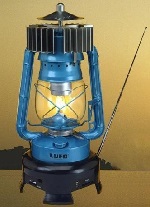
LufoFirst, a Facebook comment to our original post alerted us to the Lufo lamp, shown here.  This is a kerosene lantern, apparently developed as part of a UN project to provide radio receivers for Africa.  The heat from the lamp operates a Peltier effect device which powers the built-in AM FM radio.

These don’t appear to be manufactured currently, but they are reportedly available in Europe if you look hard enough.

There is, however, one device on the market currently, and it doesn’t even require kerosene!  At Amazon, you can purchase a wood-powered USB charger that uses the same principle. You can then charge your phone using sticks gathered from your yard.

The USB charger appears to be a bit of an afterthought, but also appears to be fully functional. It appears that the Peltier device power supply is intended mostly to power an internal fan that increases the efficiency of the stove. But it also provides usable power, which is available from the USB socket.

The stove also includes an internal 2600 mAh lithium-ion battery to store the charge. According to the Amazon reviews, the stove itself works extremely well.  According to one review, the stove will boil a pint of water in about four minutes, which is quite good for a stove burning nothing but small twigs.   The stove is useful for charging a phone or other device. The fan speed appears to be a trade-off. With the fan on high speed, the stove runs most efficiently, but it also uses most of the current that is produced. It appears that the best compromise for generating electricity is to run the fan on low speed.

For the do it yourselfer, it seems that producing a similar device should be relatively easy and inexpensive.  The Peltier elements are readily available on Amazon.  You can also order direct from China with free shipping at this link.  They’re normally intended for use in applications such as 12-volt coolers, where an electric current is run through the device, where it produces a difference in temperature between the hot side of the device and the cold side.  But this is a case where the physics works the same with a minus sign in front of the equation:  If you generate a difference in temperature, this will cause electric current to flow.

You’ll probably need more than one, and you’ll probably have to experiment with wiring them in series (to increase voltage) and parallel (to increase current) to get sufficient power.  You’ll also need some kind of heat sink mounted on the cold side.  The device will have maximum output when the temperature difference between the two sides is greatest.  So you need to get one side as hot as possible while keeping the other side of the thin device as cool as possible.

Once you have sufficient voltage and current, you can hook the output to a 12 volt USB charger.  Even if you don’t have a full 12 volts, most such chargers are little more than a voltage regulator, so as long as your output is more than 5 volts, you should have a fully functional USB power connection.

To use your new power supply to listen to the radio, you could add the small portable shown here.  When batteries are available, you can use standard AAA batteries.  During the day, you can run it with the built-in solar cell.  And at night, you can plug it in to your wood burning charger with its USB port.

Of course, most of our readers will want to listen to shortwave, and will probably opt for this inexpensive USB-powered receiver  which tunes AM, FM, and 4.75-21.85 MHz shortwave.

In addition to being useful for camping or emergencies, such a project would be excellent for a science fair project.


SWLing Hurricane Florence

HWNlogoIf you have a shortwave receiver (or even if you don’t), here are some frequencies you can keep in mind for tuning in to information about Hurricane Florence.  Modern news media do an admirable job of getting the information out, but there’s something to be said for being able to tune in first-hand reports directly.

The best option is the Hurricane Watch Net (HWN), a group of amateur radio operators who will be on the air more or less continuously during the storm, taking reports from stations in the affected areas.  Since most hams are able to get on the air without commercial power, this is often the first source of reports from damaged areas.

HWN formed informally during Hurricane Betsy in 1965, and now becomes active any time a hurricane approaches populated areas.

You can tune in to HWN on  14.325 MHz Upper Sideband (USB).  An alternate frequency, which will be more active during the evening hours, is 7.268 MHz, Lower Sideband (LSB).  Conditions on 20 Meters (14 MHz) have been poor in recent days, so it’s likely that there will be more reliance on the 7.268 MHz frequency.

Health and welfare messages from those affected by the hurricane will be heard on the Salvation Army Team Emergency Radio Network (SATERN), which will meet on 14.265 MHz USB.

If you have a shortwave receiver, you’ll want to tune to these frequencies for live updates.  Even if you don’t own a receiver, there are many connected to the web, and you can listen online.  Simply go WebSDR.org, find a receiver in North America, and tune to these frequencies.

For updated information about amateur radio involvement in the hurricane response, please check the ARRL news page.

You can also listen to live streams of many NOAA weather stations at this link.


Hurricane Shopping List

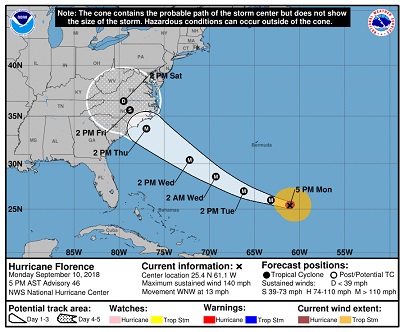
Storm forecast as of Monday afternoon. NOAA image.

Storm forecast as of Monday afternoon. NOAA image.

Yesterday, we posted some products that may make your life easier if your area is hit by Hurricane Florence, which is approaching the Mid-Atlantic states. We provided Amazon links to purchase some of the items, since in most cases, there was still time to order online and have your purchases delivered well before dangerous conditions hit your area. If it’s not already, it will soon be too late to order online and wait for items to be delivered.

But if past experience is a guide, local stores don’t get mobbed until the last minute. There are probably already crowds, but they are still manageable.

Update:  In some inland areas, it might still be possible to take advantage of the advice given on this page for online ordering.  But as early as Tuesday, some Walmart stores in the Carolinas, particularly in the Charleston area, already closed.  Before ordering, check the status of your store at this link.  Even if online ordering is no longer available, this page will give you some ideas of hurricane supplies you might have forgotten.

And to remove much of the stress, you can still order items online at Walmart, and then pick them up at your local store a few hours later. You’ll probably still have some gaps where you’ll need to go to the store and find an item or two. But if you go to Walmart.com and select items with  “free pickup today,” you’ll be able to save yourself a lot of time.

In some areas, you can use this service for all grocery items. But almost all Walmart stores offer this service for most items, including the non-perishable items you’ll need to weather the storm. To make things easier for you, we have the following shopping list of the most common items you might need. Simply click on the link, and if it’s what you need, you can place it in your cart. If you need to look for additional items, or if one particular brand name is out of stock, you can search for it on the Walmart site.

When you’re finished, simply check out as usual, but make sure you select pickup today, and pick the most convenient store. Within a few hours, you’ll get an e-mail or text telling you that your items are ready. You just go to the store with photo ID and pick up your items from the online counter, which is usually at the front of the store.

Your individual preferences will vary, but here’s a selection of many of the items you might need to weather the storm. If the link says that the item is already out of stock, you should still be able to search for different brands of the same product.


Note:  This page contains affiliate links, meaning that if you order after clicking on the links, this site will receive a small commission.