Category Archives: Education

Distance Education for Disabled Students, 1941

1946JuneService

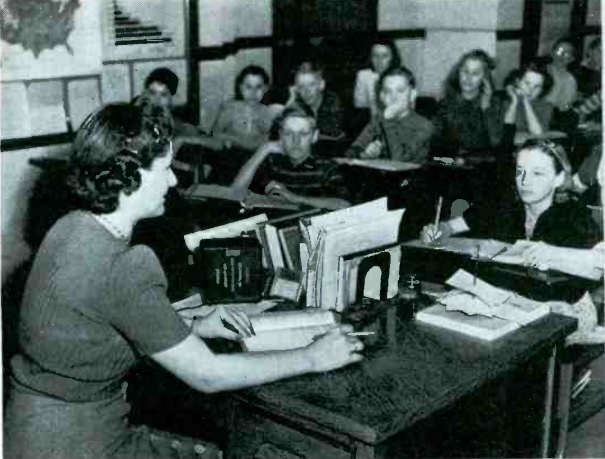
Shown here is Mary Ellen Lydon, a teacher at Monroe Junior High School in Mason City, Iowa, instructing her class 75 years ago. In addition to teaching the students in the classroom, you will notice an intercom sitting on her desk. With this device, she was able to bring instruction to shut-in students at home, as described in the June 1941 issue of Service magazine.

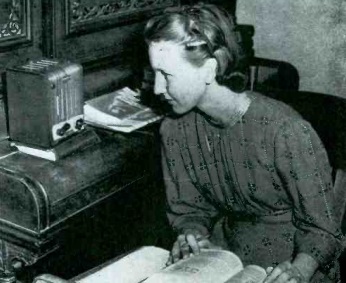
Mason City student Mary Brown receiving her instruction at home.

Mason City student Mary Brown receiving her instruction at home.

The article reported on the experiences of fifteen rural Iowa school districts which, mindful of their responsibility to furnish education to physically handicapped children, relied upon this method. The program began in Newton, Iowa, in 1939, when the school was unable to provide teaching facilities to a disabled student. The experiment proved a success. In particular, there was such a benefit to her morale and physical condition that she was able to return to school before the end of the semester, despite an earlier prognosis that she would be disabled for an entire year. In many cases, the shut-in students excelled academically, and in one cases, the shut-in was elected class president.  In total, over a hundred sets were in use in Iowa classrooms.

The equipment consisted of standard commerical intercoms, along with transformers to allow their use over standard leased telephone lines. At school, as the students went from class to class, the intercom was brought to the next teacher’s room to allow the student to attend the full schedule of classes.  The cost of equipment was about $40 per pupil served, and the phone lines were leased at a monthly rate of $1.25 for the first quarter mile, and 75 cents per each additional quarter mile. The longest distance served was about five miles.

Click Here For Today’s Ripley’s Believe It Or Not Cartoon


1936 World Explorers

1936FebRadioNews

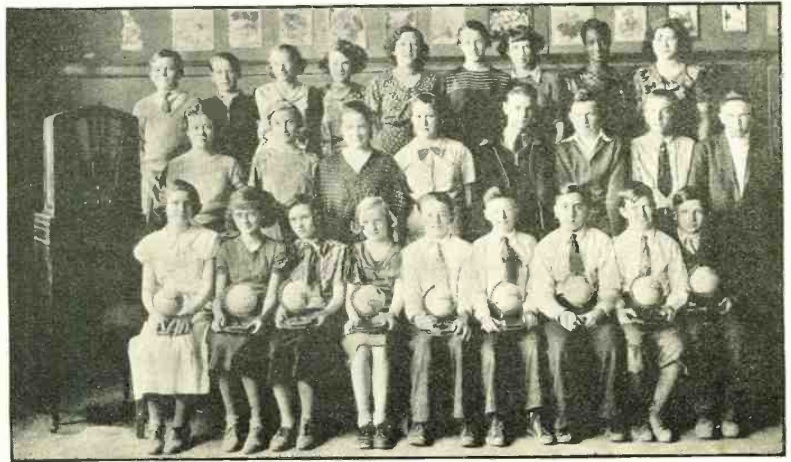
Shown here in the February 1936 issue of Radio News are the members of the World Explorers Club of Kern Road Junior High School in East Detroit, Michigan. According to the magazine, the club’s purpose was to enjoy and understand transmissions of the people of foreign lands over shortwave radio. The magazine noted that the list of stations they received regularly was too long to publish.


St. John’s School Fire, Oct. 28, 1915

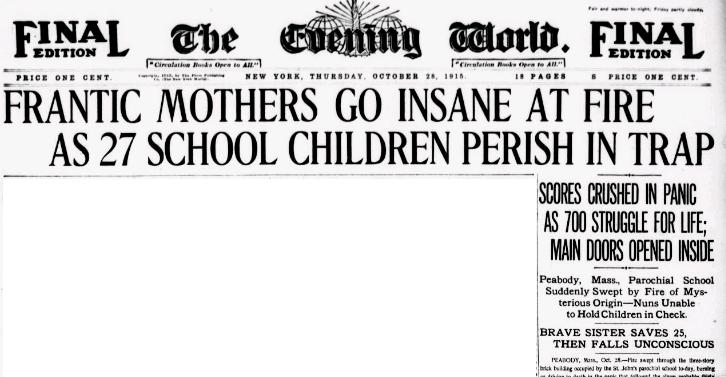
One hundred years ago today, twenty-one girls between the ages of 7 and 17 were killed in a fire at St. John’s School in Peabody, Massachusetts. Under the school’s established fire procedure, most students were to leave the building through a rear exit. But because the route was blocked by thick smoke, most instead tried to exit through the front door, where they became blocked in the vestibule. A major contributing factor was the fact that the front doors opened inward. The crowded vestibule was soon engulfed in flames, and the entire building was soon fully engulfed.

Most students were able to escape through first-floor windows, or even by jumping from higher windows. The school’s teachers, nuns of the Sisters of Notre Dame, acted heroically, by dropping many of the students to improvised life nets made of coats and blankets.

One lesson learned from this fire was that the exit doors of public buildings need to open out to avoid bottlenecks in case of fire. In the wake of the fire, Peabody became the first city to impose this requirement.

Every school with which I have been involved takes fire safety very seriously, and it is natural to ask the question of how successful these efforts have been. In other words, how often do we see a headline like the one at the top of this page?

The answer is that school fire safety has been extraordinarily successful. In the past half century, zero American schoolchildren have been killed by fires. There have, of course, been fires. But in over fifty years, there has not been a single fire fatality. Not a single one. And when we stop to think of why this is true, we can learn some lessons that will help prevent other tragedies.

The important thing to remember is that we cannot point to a single magic bullet that has prevented school fires. There is no one thing that we did to prevent them. We did a lot of things. And when we did them, we didn’t waste time worrying that we shouldn’t do them because that one thing wouldn’t prevent all fire fatalities.  Nobody would call us paranoid for taking all of those precautions against something that hasn’t happened in 50 years.  And nobody would argue that we shouldn’t take fire precautions because they might scare the children.

In the St. John’s fire, the critical lesson learned was that doors to public buildings should open out. But no sane person would stop there and conclude that by changing the doors on the school that we could prevent fire deaths. We fixed one safety hazard, but continued identifying other hazards. Here are some of the other things we have done for school fire safety over the years:

  • We use fire-resistant building materials.
  • Students and staff have routine fire drills.
  • Firefighters are familiar with the layout of the schools in their area.
  • Exits are well marked and the exit signs have backup power.
  • Adequate fire hydrants are in place near schools.
  • The locations of fire stations take into account proximity to schools.
  • Fire extinguishers and fire alarms are required.
  • Most schools are equipped with sprinklers.

There are probably others that I’ve forgotten. But you get the idea. We haven’t had any fire fatalities because we have multiple redundant layers of protection. And nobody says that doing all of these things makes us paranoid. We’ve had zero fatalities because we do them.

During the same half century of extraordinary success in school fire safety, there have been more than 300 deaths from school shootings.  Security expert Lt. Col. Dave Grossman makes the compelling case that we have to stop being in denial about school violence. Invariably, in the wake of a school shooting, the inclination is to come up with a single solution that will prevent the next one. But we need to take the same approach that we do to fire safety: What we really need are multiple redundant layers of protection. Some of the possibilities suggested by Grossman include:

  • Have an (armed) police officer in the school.
  • Have a single point of entry to the building and classrooms.
  • Have regular drills
  • Allow police officers to carry weapons off duty. Grossman points out that nobody considers it paranoid for an off-duty firefighter to have a fire extinguisher in the trunk of the car when dropping his or her kids off at school. And it would be no more paranoid for a parent who was a police officer to be prepared.
  • Equip all patrol officers with rifles and smoke grenades.
  • Be prepared to use fire hoses to deal with active shooters.
  • Finally, Grossman points out that “armed citizens can help.”

Will any one of these steps prevent every possible school shooting scenario? No. Having a police officer in the school is not the one magic bullet that will prevent every school shooting. Having the responding officer equipped with a rifle in his or her trunk is not the one magic bullet that will prevent every school shooting. And having a handful of random citizens armed is not the one magic bullet that will prevent every school shooting.

But having sprinklers is not the one magic bullet that will prevent every fire death. Having fire drills is not the one magic bullet that will prevent every fire death. Having doors that open out is not the one magic bullet that will prevent every fire death. But we did all of those things anyway, because if we do all or most of these things, then it is very likely that these multiple redundant precautions together will prevent most fire deaths. The last half century of American history proves that this is true.

A hundred years ago, when 21 girls were killed in a school fire, we learned one lesson, but we also kept on learning our lessons. Lessons were learned from the fire at Our Lady of the Angels School in Chicago on December 1, 1958 when 95 were killed. The net result is that we have learned these lessons, and we continue to have multiple redundant layers of security to prevent them. And because those measures have proven so successful, we keep at it.  Nobody says that we’re paranoid.  Nobody tells us to stop because we’ll scare the children.  We simply do what we need to do because it works.

According to findagrave.com, these are the names of the girls killed in the fire a hundred years ago today:

  • Agnes Ahearn
  • Mabel Theresa Beauchamp
  • Helen Theresa Bresnahan
  • Florence Burke
  • Nellie Elizabeth Carty-Burns
  • Patroni Chebator
  • Elizabeth Comeau
  • Catherine M. Compiano
  • Ann Daleski
  • Florence Doherty
  • Mary Ida Essaimbre
  • Mildred Fay
  • Marion Hayes
  • Annie Jones
  • Helen Keefe
  • Annie L. Kenney
  • Mary Elizabeth McCarthy
  • Mary Meade
  • Elizabeth Nolan
  • Annie E. O’Brien
  • Catherine M. O’Connell

At that same site, you can view the statue erected in 2005 in memory of the girls who were killed. It depicts two of them in the embrace of their Saviour.

Click Here For Today’s Ripley’s Believe It Or Not Cartoon


Introducing MathDoctor.net

It’s off to a modest start, but I’ve just started a new website, MathDoctor.net.  Obviously, I still have a lot of work to do, but I hope this new site meets a need.

Undoubtedly, other parents have encountered Common Core standards.  Of course, if you listen to the conspiracy buffs, Common Core is to blame for everything that’s wrong with education.  I don’t go quite that far, but I think I have identified a serious problem with Common Core.  There is a certain amount of material that every student is expected to master.  There’s absolutely nothing wrong with that principle, and I agree with it completely.

The problem with the concept is that every teacher at a given grade level is expected to teach those concepts, whether or not those concepts are within that particular teacher’s area of expertise.  The teacher is in an unenviable position:  He or she is presented with a certain set of material and is expected to teach it in a particular way, even if teaching slightly different material in a slightly different way would have a better outcome.  It’s another case of social problems being “solved” by taking discretion away from the very people who are best able to solve the problem.  In short, the teacher isn’t really allowed to use his or her expertise to teach.  Instead, he or she is asked to carry out directives handed down from politicians and bureaucrats.

So it’s not really the teacher’s fault, but the end result is that the teacher delivers poor instruction.  My son is facing this as he is expected to master the material that bureaucrats have mandated as being required for sixth graders.  And he’s expected to learn it in the manner dictated by those bureaucrats.  The net result is that he’s not learning the material unless I step in and teach it to him.

Some students undoubtedly thrive with the mandated instructional methods.  But not all of them do.  My son, even though he has a firm understanding of mathematical concepts that are far above his grade level, was not understanding instruction about elementary concepts, even though he had mastered the actual material years earlier.  He needed an approach different from the one mandated by Common Core, and I stepped in to provide it.

Since my son didn’t understand the material until I explained it, I assume that there are others in the same situation.  And since I need to explain it anyway, little additional effort is required to put my explanations on video and make them available to others, and that’s exactly what I decided to do.  The videos themselves are hosted on YouTube, and they’re all available at my new site, MathDoctor.net.  For now, there’s just one video, but as the school year progresses, I plan to create a comprehensive resource that will be useful for parents and students.

Not every student will thrive with my approach.  Some of them will prefer the mandated format, and if they do, they should continue to follow it.  Common Core works for them, and that’s a good thing for them.

But for those for whom Common Core is not working, I encourage you to seek out other approaches.  Perhaps MathDoctor.net will be the approach that works for your student.  Or perhaps it will be something very different.  But one size does not fit all, and it is my hope that I’ll provide instruction of a size that will be suitable for at least some.

This introductory video for parents explains more:


Click Here For Today’s Ripley’s Believe It Or Not Cartoon


Ahmed’s Clock

Irving, TX, Police Dept. photo, via NY Daily News.

Irving, TX, Police Dept. photo, via NY Daily News.

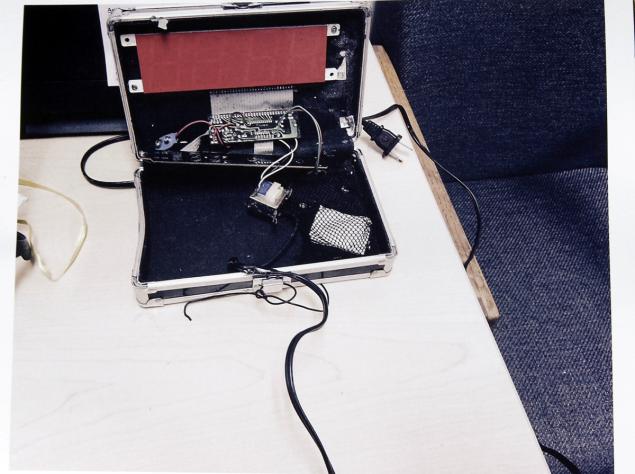
Ahmed Mohammed is a bright 14-year-old student in Irving Texas.  He made the digital clock shown above in a pencil case, and this week brought it to school.  He showed it to one teacher who was impressed.  He then put it away in his backpack, but it started beeping during another class.

The other teacher apparently believed that bright kids shouldn’t bring unusual looking things to school.  The principal was called, and then the police were called.  Ahmed was arrested for having what someone believed to be a “hoax bomb.”

Nobody thought it was a real bomb.  Ahmed didn’t think it was a hoax bomb.  It was a clock, and it presumably told time.  He told the police that it was a clock.  He didn’t elaborate any further, because there was nothing to elaborate about.  He could have said that it told time, but presumably the cops in Irving, Texas, already knew that clocks told time.  But because he didn’t elaborate further, he was arrested.

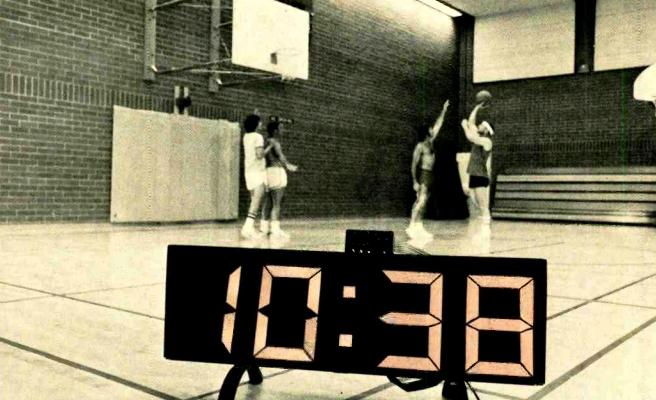
Last month, I posted on this site the digital clock shown below in a 1975 picture.

1975Scoreboard

As you can see, this clock is just like Ahmed’s, just a lot bigger.  As you can see, there are students in the background, and they don’t appear to be freaking out because there’s a big homemade clock in the room.  The teacher wasn’t alarmed.  The principal wasn’t alarmed.  The police weren’t alarmed.  They realized that it was a homemade clock, built from plans in a magazine.  And even though it presumably had a much greater explosive potential than Ahmed’s clock, nobody was concerned.

In 1975, there was nothing wrong with a kid making something unusual and bringing it to school.  Today, a kid might get arrested for doing the same thing.  And it’s a damn shame.

Stop it, people.  Use a little bit of common sense for a change.

Click Here For Today’s Ripley’s Believe It Or Not Cartoon


Radio Goes to School, 1925

RadioSchool1925a

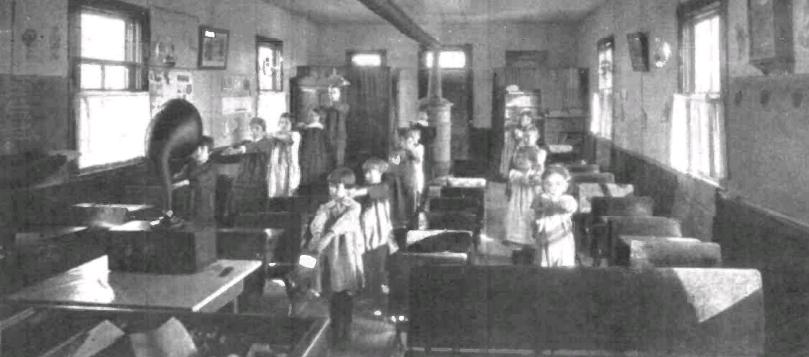
Ninety years ago, radio went to school, and these Kansas schoolchildren were starting their day by doing their morning calisthenics under the direction of Mike Ahearn, athletic director of the Kansas State Agricultural College. (Ahearn carefully avoided the word “exercise,” since he knew the children had been up for hours and had walked a mile or more to school.)  The same scene could be played out in any of the state’s 9000 country schools, but Ahearn was behind the microphone of the college’s radio station, KSAC in Manhattan.

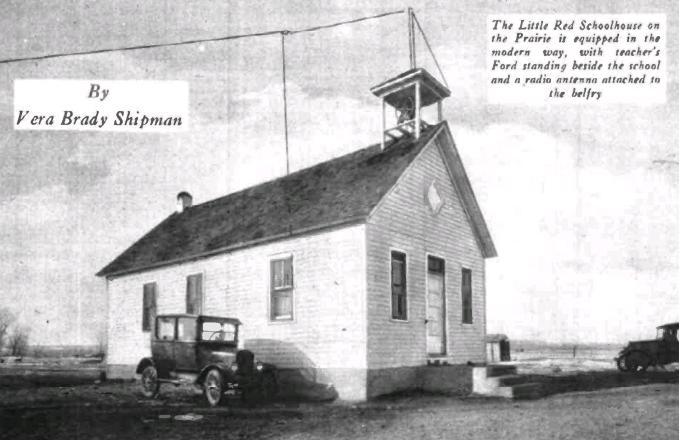
RadioSchool1925bBy September 1925, when these pictures appeared in Radio in the Home magazine, a good percentage of those schools had already been equipped with receivers, and plans were in place to add a radio set to all of them.  In the photo shown here, the antenna is mounted to the school’s belfry, and it is powered by the teacher’s Model T parked outside.

The college’s director of radio extension, Sam Pickard, was doing more with radio than just morning calistenics. The sets would be in place for Kansas farmers to attend statewide radio meetings of farm organizations, and they could be used on Sundays to receive church service broadcasts.  Pickard’s vision for radio saw him appointed two years later by President Coolidge as one of the first five commissioners of the Federal Radio Commission.

KSAC had first come on the air on December 1, 1924, broadcasting with 500 watts on 880 kHz. In 1928, it moved to 580 kHz. In 1929, the Topeka Daily Capital wanted to start a radio station, and asked the college whether it could share the frequency. Since the college couldn’t afford to keep its station on the air 24 hours a day, it quickly came to terms, and was able to boost its power to 5000 watts to match the new station, WIBW.

By the 1980’s, the college had been known as Kansas State University for 30 years, and KSAC got around to requesting call letters that would match the University’s name. However, the call letters KKSU had been assigned to a ship, and even though the ship was mothballed, the owner wasn’t willing to relinquish them. So the station became KEXT (Kansas Extension) for a time until finally getting the KKSU call letters.

Over the years, the commercial station, had tried to buy out the college station, but the college refused. It wasn’t until 2001 that they had relented. WIBW had carried Wildcat football, and the University was planning on moving it to another station. WIBW used the opportunity to point out a clause its 1969 contract with the University. In exchange for allowing WIBW to carry the games, the college had been allowed to extend its operating hours by an additional 15 minutes each weekday. Finally, the University agreed to sell out for $1.5 million. The games would go to the other station, and KKSU would sign off for the last time in November, 2002,

Kansas wasn’t alone in putting radio receivers in the schools. Radio was already installed in schools in Cleveland, Ohio, and the superintendant predicted that within a few years, American schoolchildren would be receiving ten percent of their lessons by radio. Some of the big stations were involved. For example, KGO was broadcasting to the schools in Oakland, California, and WLS in Chicago was broadcasting “Uncle Ben” Darrow’s Little Red Schoolhouse into 150 schools in Cook County, Illinois, and was also popular at schools in Illinois, Michigan, Wisconsin, and Indiana.

Click Here For Today’s Ripley’s Believe It Or Not Cartoon


1941 National Youth Administration Sound System Project

1941NYAspeakers

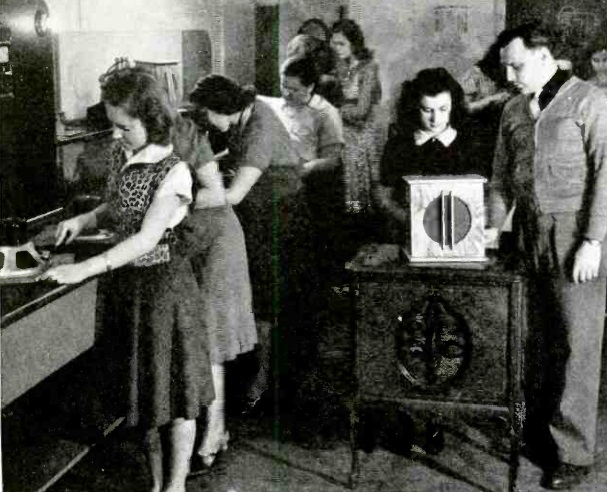
The Pennsylvania students shown here are assembling loudspeaker enclosures for the sound system at the Roaring Spring, Pennsylvania, High School. The project of installing the new sound system was entrusted to the National Youth Administration (NYA). As I wrote in an earlier post,
the NYA was a depression-era program designed to give youth to develop skills in order to take an active part in the national defense program. As reported in the October 1941 issue of Radio News, the program had recently been expanded to cover the radio field, and the high school sound system was one of the first projects undertaken by NYA youth studying radio.

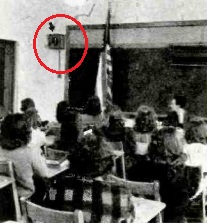
Roaring Spring classroom with new speaker in place.

Roaring Spring classroom with new speaker in place.

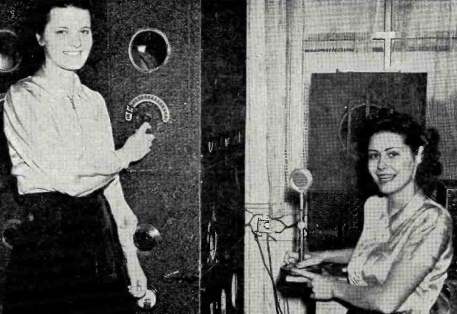
The installation covered 21 rooms in three buildings, one of which was across the street, necessitating the laying of an underground cable. The main console was located in the principal’s office, and included two microphone channels, an all-wave receiver, and a turtable capable of playing both 78 and 33 RPM transcriptions. In addition to its public address capabilities, the system was capable of two-way communication from any room. The powerhouse behind the system was a 15 watt audio amplifier employing two 6N7G tubes.

The students’ completion of the project was seen by all as a success, and dispelled any possible doubt as to the NYA radio shops’ ability to construct and install such equipment. After being placed in service, the equipment had required no service or adjustment.

1941NYAhamsAnother way in which the NYA was focusing on radio is shown in this photo from the September, 1940, issue of Radio News.  The Army was in the process of setting up an Amateur Radio network to link Army installations, and it was tapping NYA youth to build that network.  Shown here are Ruth Gaines and Jessie Suddath, both of Georgia, testing the ham gear that they had built.  According to the caption, both were licensed, although their call signs are not stated.

Click Here For Today’s Ripley’s Believe It Or Not Cartoon


Dr. Norman Barden 1892-1926

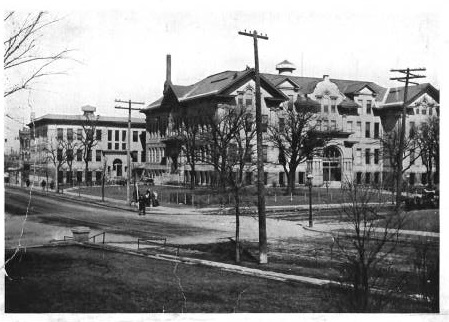
The June 1911 issue of Modern Electrics magazine carries an interesting article written by one Norman Barden, detailing experiments being carried on at East High School in Minneapolis. Among other things, the reason why the article caught my eye was that this school was the predecessor of my alma mater, Minneapolis Edison.

East High was opened in 1900 and operated under that name until 1927, at which time it was used as a vocational school for a number of years. It was located between University Avenue and Southeast Fourth Street on what was then First Avenue Southeast, which was later renamed Central Avenue. Edison opened in 1922 and Marshall High (in whose old building I had my office for a number of years) opened in 1924, eliminating the need for East High. So in a sense, I went to the same school.

Barden starts his article by pointing out that the “public has been startled” to learn that a high-frequency current can pass through the human body with no ill effects. He explains that “there are several different theories put forth to explain why high frequency current does not produce fatal results upon animals and the human body,” even though the same current and voltage at a lower frequency or at DC, “fatal results occur.”
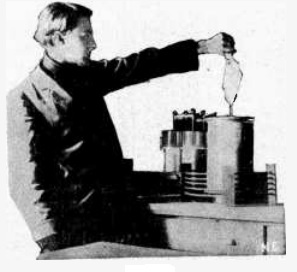
BardenTeslaUndaunted by the possibility of fatal results, and apparently oblivious as to the reason why they were non-fatal, Barden went ahead and sent the potentially fatal currents through humans, including himself, as shown in the picture here.

(It turns out that the explanation for the non-lethality is somewhat mundane.  The equipment appears to be an ordinary Tesla coil, meaning that while the voltages are very high and will generate a most impressive spark, the current passing through the human subject is extremely small.)

It turns out that this wasn’t the only dangerous science going on at East High.  Mr. Barden was apparently shooting guns in the photography lab, as detailed in other published articles.  In articles in the May 1911 issue of Popular Electricity and the 1914 Journal of the U.S. Artillery, he publishes photos of bullets photographed in flight after being shot from a .22 caliber rifle and a .32 caliber revolver.  Not surprisingly, he points out that when you fire guns at school, “a back-stop must be provided to keep the bullets from penetrating the wall.”  He used a piece of boiler plate behind a 2-1/2 inch piece of wood.  He also points out that you need to be careful, since you’re doing the experiment (including firing the gun) in a totally darkened room.  If you are going to replicate his experiment, it’s probably not a good idea to walk around after turning out the lights.  Barden is shown below with his co-experimenter, Loyle Dobbs.  The 1914 article also appeared in Scientific American.
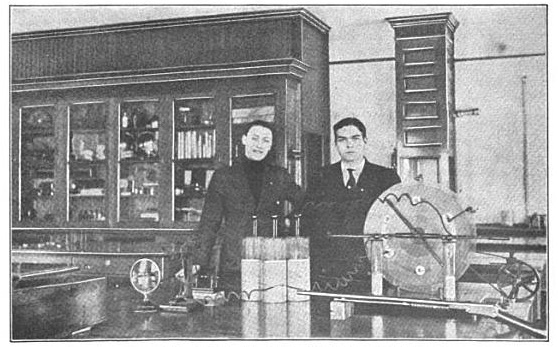
BardenDobbs

As you can see, the rifle is plainly visible in this photo.  Apparently, East High didn’t have a “no guns” sign on the front door.

In addition to these publications, Barden also had published in a 1910 issue of Popular Atronomy a photograph of a comet he had taken through a telescope he had constructed himself.

When I saw the original article, I assumed that Mr. Barden was a teacher at the school.  But it turns out that he was actually one of the students.  A hundred years ago, high school students could get their articles published in Scientific American.  Today, they’re not allowed to touch the experiments.

BardenYearbookThe first record of young Mr. Barden is an article in the the June 14, 1906 Minneapolis Journal, where he is listed as a seventh grade student at Holmes School.  He’s shown here in his East High yearbook photo, which shows that he graduated in January, 1912.   In 1913, he is listed as a sophomore at the University of Minnesota College of Science, Literature, and the Arts.  And in 1919, he graduated from medical school in Ohio.

He returned to Minneapolis in time for the 1920 census, and went into practice.  In this 1921 directory, he is shown as having an office in the Donaldson Building and a home address of 1209 7th St. SE.  According to the 1921 Journal-Lancet of the Minnesota State Medical Association, He was the assistant to Dr. C.D. Harrington, a “pioneer in the therapeutic use of radium and the x-ray,” and the rongenologist of Northwestern, Asbury, Abbott, and St. Mary’s Hospitals.

Unfortunately, Dr. Barden’s promising scientific career came to a tragic end with his mysterious death in 1926.

The newspapers of August 18, 1926  reported that one Mrs. J.D. McDermott, the wife of a Chicago millionaire contractor, was being held by Minneapolis police following Dr. Barden’s death. His body was found by police in a room occupied by the couple in a downtown hotel. According to news accounts, the doctor was found “fashionably dressed and wearing several diamond rings said to be worth more than $10,000.” Two days later, the papers reported that Mrs. McDermott had been released, the post mortem having determined that the doctor had actually died from “acute alcoholism.”

Dr. Barden is buried at Lakewood Cemetery in Minneapolis.

Click Here For Today’s Ripley’s Believe It Or Not Cartoon


1944 Teen Girls: Homework With the Radio Full Blast

1944TeenSeventy years ago, Life Magazine, December 11, 1944, featured the life of teen-age girls, and noted that all six million of them “live in a world all their own–a lovely, gay, enthusiastic, funny and blissful society almost untouched by the war.” Music stores bulged with girls listening to the singers and bandleaders they have made famous, and “half a dozen radio programs are aimed at homes where a daughter will cut off her father’s news to follow the fictional adventures of a contemporary.”

1944FullBlastShown here and above is Miss Pat Woodruff, a high school student from Webster Groves, Missouri, a suburb of St. Louis. She’s wearing her “after-school costume of blue jeans and a checked shirt,” undoubtedly getting ready to tune in one of those programs on the console radio in the parlor. She quickly gets to work tackling her homework, but with the radio playing full blast.

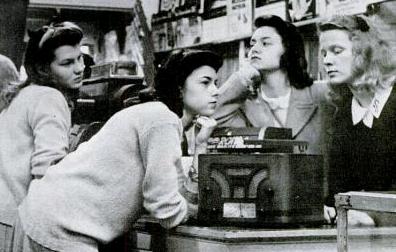
1944PhonographWhen the girls featured in the story were not listening to the radio or talking endlessly on the telephone, the phonograph occupied them. Here, a group of girls spends 2-1/2 hours listening to two dozen records at a record store, buying only one or two. Here, a group is completely engrossed listening to Dick Haymes‘ Together.

Dates were usually double, the article noted. Teen-age girls were primarily interested in themselves, with high-school boys running a poor second. Servicemen stationed near town rated last. An old high-school boy home on leave in uniform, however, was in a class by himself and rated tops.

Click Here For Today’s Ripley’s Believe It Or Not Cartoon



Minneapolis School A-V Equipment of the 1960’s and 1970’s

SetchellCarlsonTV

If you went to school in Minneapolis in the 1970’s, I bet these pictures look vaguely familiar. This is a 1972 ad from Setchell-Carlson, then known as SC Electronics, Inc., a subsidiary of Audiotronics Corporation, with an address of 530 5th Avenue NW, New Brighton, MN. This ad appears in the March 1972 issue of Broadcast Engineering.

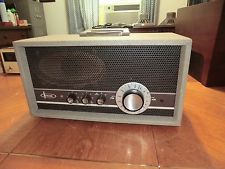
The Minneapolis Public Schools were equipped with what I believe was the model at the left.  I’m showing the one on the right to show the distinctive controls in the center, which are hidden behind the optional “tamper-proof control compartment door” of the black and white model on the left.  I don’t think that Minneapolis had the door, or else the doors were routinely left open.

At Waite Park Elementary School, I don’t believe that every classroom was equipped with a TV.  There were one or two of these that were wheeled in as needed.

AV750Every room, as far as I can recall, was equipped with a radio, although it was rarely used.  The radio, shown here, was the Newcomb Model AV-750.  This was an 8-tube AM FM receiver, and was obviously built for severe service.   I’m sure I’m the only kid who noticed, but it had a connection on the back for an external AM antenna and ground.  I was always jealous of that radio, since I dreamed of all the exotic broadcast band stations it would pull in if connected to an external antenna.  There was also a connection on back for audio input, so it could be used as an audio amplifier.

I’m not positive, but I believe this Audiotronics phonograph was the standard issue model in the Minneapolis schools.  Again, I believe one was issued to each classroom, and they saw a bit more use than the radio.

The televisions were made not far from the school.  Setchell-Carlson made some consumer radios in the 1940’s, and TV‘s in the 1950’s and 1960’s.  They were never a big name nationally, although they did have a strong presence in their home state of Minnesota.  By the 1970’s, they had abandoned the consumer market, but they continued to make the institutional models shown above.

There’s a good history of the company in the October 2008 issue of Radio Age.

bc1206

Photo courtesy of Ian O’Toole, VK2ZIO, Kurrajong Radio Museum. Used by permission.

The company was founded in St. Paul in 1928 by Bart Setchell and Carl Donald Carlson as “Karadio Corporation.” As the name suggests, the company manufactured auto radios. Setchell claimed later to have been the “first” to use vibrators to power the car radio. The author of this article disputes that claim, but it is clear that Setchell-Carlson was one of the pioneers. In 1934, the company became Setchell Carlson, Inc., and made a few radios before the war. During World War II, the company was a defense contractor, and made products for the military, the most famous of which was the aviation receiver shown here. (For more information on this device, see my earlier post.)

In 1949, the company moved to New Brighton,

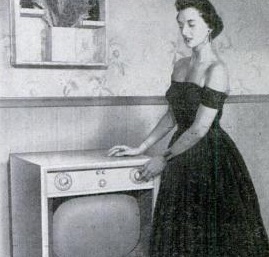
A Setchell Carlson TV from 1954, back when people apparently dressed up to watch TV. Popular Mechanics, Dec. 1954

A Setchell Carlson TV from 1954, back when people apparently dressed up to watch TV. Popular Mechanics, Dec. 1954

Minnesota, and went into the TV business, which lasted until the 1960’s. At its peak, the company employed about 500, and also had a plant in Arden Hills.  Setchell was later inducted into the Minnesota Broadcasting Hall of Fame.

One final note on the audio-visual equipment in use at my elementary school.  The Minnesota Historical Society has this photo  of the school’s public address system.  The photo is dated about 1955, but based upon the one or two times I saw it, this is the same console that was in use in the 1960’s and 1970’s when I was a student there.  Interestingly, the caption of this photo bills it as a “school broadcasting lab” and shows students at the mike.  I never recall the console being used by students, certainly not on a routine basis.

The couple of times I saw this, I was quite impressed.  It was in a separate room off the office, and in addition to the PA console, there was a radio receiver.  I remember one dial being for the standard AM band.  The other dial was calibrated in some numbers that did not look at all familiar to me.  In retrospect, it’s possible that they were FM channel numbers, which were used for a short time on some FM receivers.
Click Here For Today’s Ripley’s Believe It Or Not Cartoon