Author Archives: clem.law@usa.net

1934 Scout’s One Tube Radio

1934SeptRadioNews

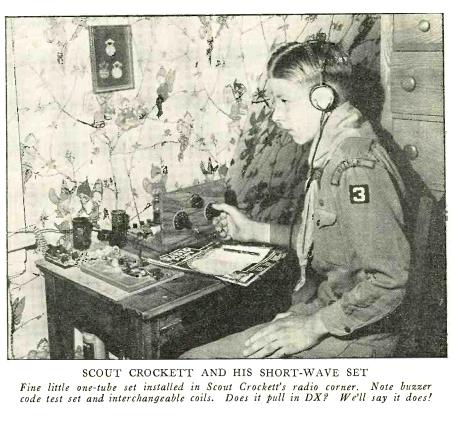
Shown here in the September 1934 issue of Radio News is Scout Robert Crockett of Troop 3 of the BSA Siwanoy Council, Pelham, New York. He is shown operating the receiver that he designed and built, based upon a design in an earlier issue of the magazine. His circuit uses a single type 30 tube and a handful of other components, all of which can be obtained fairly easily today. For ideas on sourcing the components, you can visit my page describing another 1930’s era receiver or my crystal set parts page.  Full construction details are included in the 1934 article.

The author of the article was Robert’s “Scout Radio Examiner,” which presumably means Radio Merit Badge Counselor. According to this 1935 newspaper, Robert did go on to complete the Radio Merit Badge.  The magazine article concludes by pointing out that as his daily Good Turn, the Scout would be glad to help anyone building the set with their problems, and that such letters can be sent in care of the magazine. The article notes that he had logged over 300 shortwave stations with the set.

According to the National Eagle Scout Association database, Mr. Crockett became an Eagle Scout on February 24, 1937. And according to this newspaper and this one, he was serving in the military in 1943 and 1944. According to his sister’s 1943 obituary, his service was as an Ensign in the U.S. Naval Reserve.


Portable Gas Refrigerator

Portable Gas Refrigerator

Portable Gas Refrigerator

On various outdoor and “prepper” forums, one common question is the availability of refrigeration in the absence of electric power. In most cases, the best option is to do as our ancestors did before the early 1900’s and simply live without this convenience. But in some cases (such as those with medicines that require refrigeration), a reliable form of refrigeration is needed.

Until recently, there were only three options, each with shortcomings. The first was to procure a generator to power a traditional home refrigerator. This is a poor solution, because the home refrigerator has an electric motor and thus requires a large generator (or very large inverter) and enough fuel to run it.

Another option is a “12 volt cooler” such as the ones shown here:

One of these can be a relatively good solution in many cases. While they don’t work as well as the big refrigerator at home, they are often adequate for the task. Compared to a home refrigerator, they require much less current. However, they draw enough current that they can’t simply be left unattended for long periods of time. The battery needs to be charged quite often, which entails having fuel to do so, or perhaps a relatively large solar charger.

The best solution has been the “3-way” Refrigerator. This type of refrigerator is commonly used in RV’s, and runs on 120 volts, 12 volts, or propane gas. They typically use about 1/2 pound of gas per day, meaning that a 20 pound tank will last about 40 days. In other words, storing fuel for long-term use is a definite possibility. Here are some examples:

The disadvantage of this type of refrigerator is that it is not portable. It is designed to be mounted permanently and, at a minimum, you would need to construct a cabinet to house it.

This objection has now been solved, however, with the following portable 3-way refrigerators:

Like the other 3-way refrigerators, these will operate on either gas, 120 volts, or 12 volts. But they are designed for portable use, and come with the hardware to hook it up to a portable LP tank, the type available everywhere. For those who absolutely need refrigeration “off the grid,” this is a very viable option.


1924: A Radio Summer

RadioCamping1924


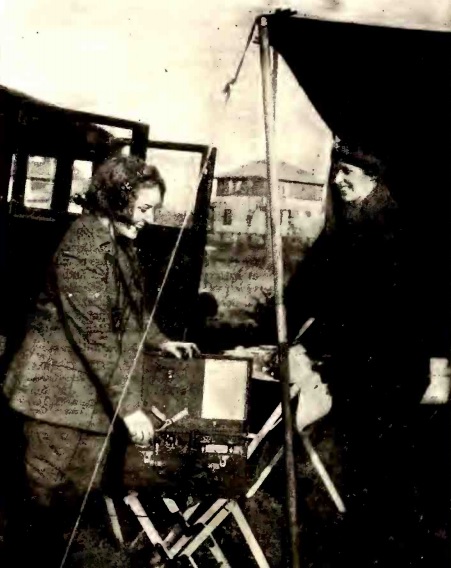
In 1924, it was going to be a radio summer. This picture, from the May 1924 issue of Radio Age, shows two motor tourists who made the radio receiver an important part of their roadside camp. The magazine points out that such portable sets are easily made or purchased.


Brothers Melvin and Peter Myhre, Casualties of WW1

Melvin and Peter Myhre

Melvin and Peter Myhre

Periodically, I use this page to remember some of the forgotten young American men who gave their lives in the First World War.  Private Melvin Myhre of Fosston, Minnesota, was killed in action on October 10, 1918, about a month before the armistice. He is buried in France with over 14,000 of his comarades at the at Meuse-Argonne American Cemetery.  He served in the U.S. Army, 327th Infantry Regiment, 82nd Division.

The Meuse-Argonne Offensive, in which Private Myhre gave his life, was the largest battle in U.S. history, and involved 1.2 million American soldiers. Over 26,000, including Private Myhre, were killed. In addition, some 70,000 French soldiers were killed, as were between 90,000 and 120,000 Germans.

His brother, Private Peter Myhre, also died in France on November 1, 1918, only ten days before the Armistice. He is buried at the St. Mihiel American Cemetery, along with over 4000 American soldiers.

According to Polk County Minnesota in the World War, Melvin and Peter were sons of Mr. and Mrs. Mikkel Myhre.  Melvin entered service on March 2, 1918. Peter entered the service on July 26 and was taken sick about October 15 behind the front near Clermont Woods. He died at the Mesves hospital.

Their pictures shown here, are from the three-volume Soldiers of the Great War (Vol. 2, p. 99).

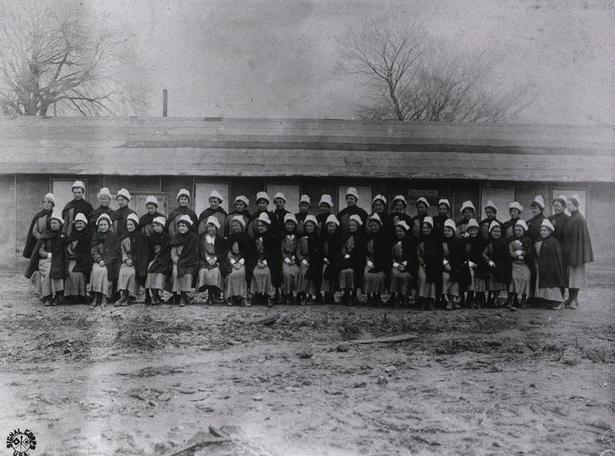
Nurses at U.S. Army Hospital, Mesves, France. (Nat'l Institutes of Health photo).

Nurses at U.S. Army Hospital, Mesves, France. (Nat’l Institutes of Health photo).


1964: The Last of the One Tube Radios?

Sept64EEFifty years ago, the vacuum tube was still king, although its days were coming to an end. The September 1964 issue of Electronics Illustrated contained several construction projects, most of which relied on tubes. The Micron Electron Tube Company advertised a few dozen common tubes for 37 cents each. Other tubes were available at reasonable prices. For example, hams looking for finals for their transmitter could find an 807 for a dollar, or a 6146 for $2.45.

Some transistor gear was starting to show up, but it was pricey. E.F. Johnson advertised two transistorized CB handheld radios. The 100 milliwatt version sold for $109.50, and the 1.5 watt version commanded $129.50.

The construction projects included a CB preamplifier and calibrator for tuning 11 meters on a shortwave receiver.  This article bears the byline of prolific author Len Buckwalter, whose CB call KBA4480 is shown. (Buckwalter was also a ham, and his byline for ham related books and articles included his ham call, K1ODH.) This circuit used a single 6U8 (one of the 37 cent tubes), a dual pentode-triode, one half of which was used as the preamp, the other half being the crystal calibrator.

For hams, the magazine featured a transmitter for 80 and 40 meters, which the article claimed could be built for five dollars. It used a 6V6GT and a 5U4G rectifier, both of which were on the 37 cent list.

And, as fitting for this site, the magazine featured the one-tube AM radio shown above, which used a 6AL11 dual pentode. Half the tube was used as a regenerative detector, the other half being an audio amp which would deliver a full two watts to the speaker. According to the text, the circuit “has only one tube but in terms of performance it’s a mighty far cry from that one-tube job of 30 or more years ago,” with sensitivity and tone that will surprise you.

What’s intriguing about this project is that it’s probably one of the last times that an electronics magazine would feature an article on how to build a standard AM radio that appears to be designed for everyday use. The 1964 Radio Shack catalog included an “all American five” AM radio for only $7.95, so even the most frugal builder would probably save very little by building his own.

Len Buckwalter seems to still be around.  He is listed as a founder of publisher avionics.com of Leesburg, Virginia.  It appears that he let his ham license lapse at some point, but he appears to be currently licensed as KK4GJX, which is listed as being issued in 2012.  According to a biography, he graduated from college in 1951, which would mean that he’s now about 85 years old.

If you’re interested in building this radio, most of the parts should be readily obtainable. Antique Electronics Supply is probably the best supplier for the power transformer.  They don’t carry the tube, but it can be found on eBay.  On another post, I have links to suppliers where you can find most of the other parts.

References

Len Buckwalter at semiconductormuseum.com



Belgian War Dead, 1914

090214Belgium

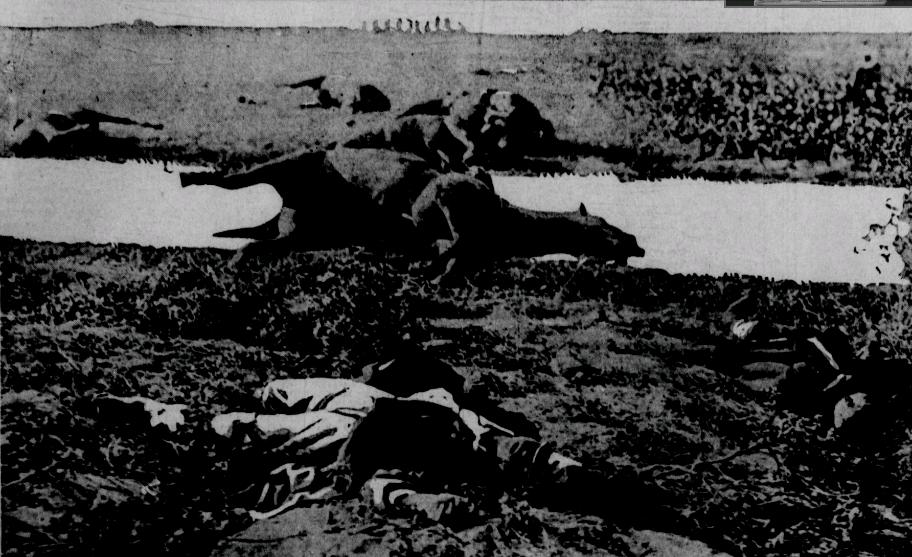
A hundred years ago today, the Seattle Star carried this photograph of the bodies of these men, among the 42,000 Belgian soldiers who died in the war.


The Cost of Leaving: Nazis, $60. USA, $2350.

According to the Milwaukee Journal, June 29, 1939, all 19-year-old “Reich citizens” living in the United States were ordered to register at the German consulate to register for compulsory military and labor service under the Reich. According to the report, no such orders had yet been received by Germans in Milwaukee, but those in Detroit had been directed to report to the German consulate in Cleveland. According to the proclamation setting forth the order, those failing to do so would be subject to a fine of 150 reichsmarks (about $60) or with arrest.

Seventy-five years later, the U.S. Government announced that the fee for renouncing U.S. citizenship had gone up to $2350, in addition to the steep “exit tax” which applies in many cases.

References:

Forbes, U.S. Hikes Fee to Renounce Citizenship by 422%


WW2 Begins, 1 Sept. 1939

1Sept39HeadlineSeventy-five years ago today, Hitler invades Poland, annexes Danzig, and the Second World War has begun.  The headline here is from the Milwaukee Sentinel of that day.

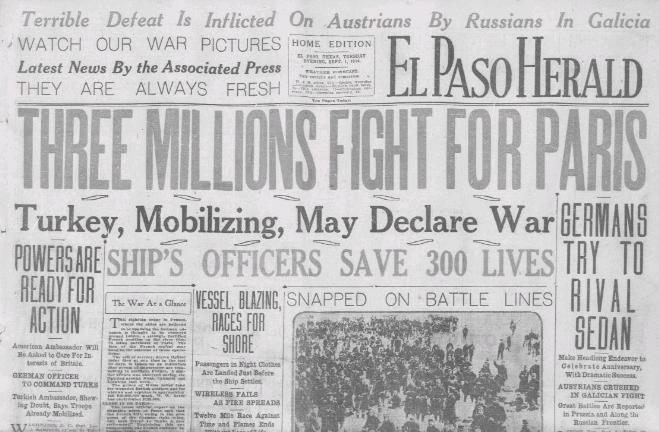
Exactly a quarter century earlier, the papers were reporting the greatest battle the earth had ever seen, as three million men fought for Paris.


Will U. S. Boy Scouts Be Used As Soldiers? A 1914 View

It’s not infrequent that some misguided person believes that Scouting has some sort of military connection, and that Boy Scouts are being trained to be soldiers. Of course, Boy Scouts are being trained to be soldiers. But they’re also being trained to be engineers or doctors or lawyers.

There are a handful of superficial similarities between Boy Scouts and soldiers. Boy Scouts salute, and soldiers salute. Unlike soldiers, Boy Scouts don’t salute one another. All the time I was a Boy Scout, the only thing I ever saluted was the flag.

And just like soldiers, Boy Scouts wear uniforms. Of course, never mind that postal workers, janitors, mechanics, and those of countless other occupations also wear uniforms. In some people’s minds, Boy Scouts look just like young soldiers, even though more of them probably go on to work for the Post Office or other uniformed services.

This misconception is apparently not new. The following editorial, originally from the Tacoma Labor Advocate, appeared in the Tacoma Times a hundred years ago, on August 31, 1914:

BOY SCOUTS ARE SOLDIERS

The Boy Scout movement has been opposed by members of union labor in almost all countries where it has been organized. Labor has claimed that this was simply being done to augment the army and navy and that in time of industrial strife the boy scouts would be used as soldiers wherever and whenever boys could be used. This has been denied, directly and directly, by many who were and are working for the boy scout movement. Now come dispatches to the effect that the boy scouts of some of the foreign countries are being used as soldiers in the war. Is it not plain that the same course will be taken here in the United States, that these boys will be used as soldiers whenever they can be to the advantage of those who profit by the use of the army or navy? Do not be fooled any longer, Mr. Working Man and Woman. The boy scout is merely one branch of the military forces of the country. They are simply being trained as soldiers by those who profit by the soldiery.