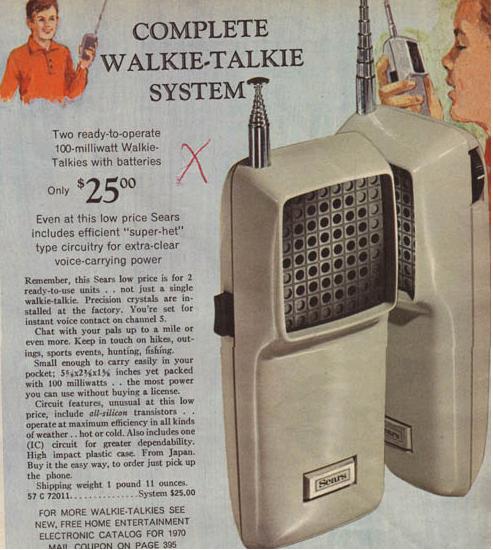
Like many aspiring young hams, I got my start in two-way radio with a set of walkie-talkies not unlike this set shown on page 561 of the 1969 Sears Christmas Catalog.
My set was a different brand, but quite similar to this set and millions of others like it. They all consisted of a crystal-controlled transmitter, usually on CB channel 14, along with a superregenerative receiver. The receivers on these sets were so wide that they could hear all 23 channels simultaneously, which meant that I could hear local CB’ers, as well as communicate with these and other toy walkie-talkies. And the superregenerative receiver meant that when a signal was not being received, the radio put out a constant rushing sound, undoubtedly to the great annoyance of millions of parents.
Despite hearing CB’ers, and despite valiant efforts on my part involving various attempts at external antennas, I never managed to make contact with any owner of a “real CB.” The antenna on mine was affixed to the case with a screw at the bottom, and to allow easy connection to an external antenna, I even put a Fahnestock clip on the outside of the case, attached to this screw. I could no longer set the radio down on its base, but it made for easy connection to various external antenna attempts.
There were two reasons for my lack of communication with the elusive “real CB’ers.” First of all, I was probably hearing all 23 channels at once, so even if the other station was quite close, he probably wouldn’t have been tuned to channel 14 to hear me. And even if he happened to be on channel 14, I would have been able to hear his 5 watt signal much further than he would be able to hear my 100 (if I was lucky) milliwatts.
One neighborhood kid claimed that he had made contact with a “real” CB’er with his toy walkie-talkie. I, of course, was extremely jealous of this accomplishment, although I didn’t let on. I had to content myself with contacting the other radio I owned, or those of other kids with whom I was playing, assuming we had enough pocket change to buy the requisite nine-volt batteries (or perhaps “borrow” them from other devices around the house). At this time, most of these radios came crystalled for channel 14, but since most had the wide receiver, it really didn’t matter which channel we were on. The typical range was from one side of the house to the other.
Interestingly, one friend’s walkie-talkie had a crystal for channel 9, which didn’t become the emergency channel until about 1970, as discussed in this February 1970 Popular Electronics article.
On those occasions when I didn’t have anyone to talk to, I sometimes used a rubber band to hold down the push-to-talk button and placed one near the TV. I could then listen in another room. Of course, I put an end to this practice when someone pointed out to me that I was at one point rebroadcasting a baseball game, without the express written consent of the Minnesota Twins, and suggested that doing this might land me in jail.
The era of these 27 MHz toy walkie-talkies came to an end with a change to the FCC rules in 1977, which is explained in detail in the August 1977 issue of Popular Electronics (page 46).
Until that time, these unlicensed radios were allowed on 27 MHz, as long as the input power was less than 100 mW. While many of these radios were equipped with a crystal for channel 14, there was no requirement that the radio opearate on any particular frequency. They were allowed anywhere in the range 26.97 to 27.27 MHz. Under the rules currently in effect (which I believe were the same as adopted in 1977), the limit for an “intentional radiator” of this type is now measured in terms of field strength, and the limit is 10,000 microvolts/meter at 3 meters. 47 C.F.R. §15.227. Since a 100 mW transmitter would exceed this limit by a very considerable amount, this regulation meant the end of toy walkie-talkies on 27 MHz.
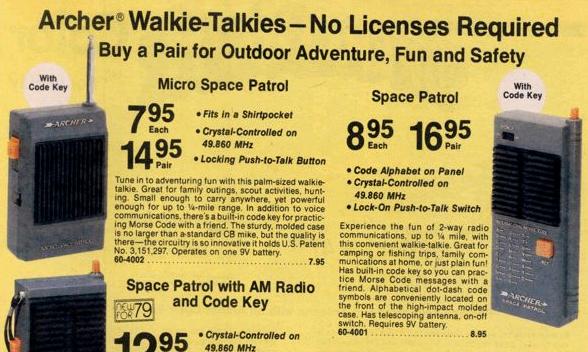
Instead, the new 1977 rules called for the move of these toy walkie-talkies to five specific frequencies in the 49 MHz band, 49.830, 49.845, 49.860, 49.875, and 49.890. Under the new rules, the toy 27 MHz walkie-talkies could not be sold after March 1978.
We can see the transition from the Radio Shack catalogs for 1978 and 1979. The 1978 issue showed these toy walkie-talkies for 27 Mhz:
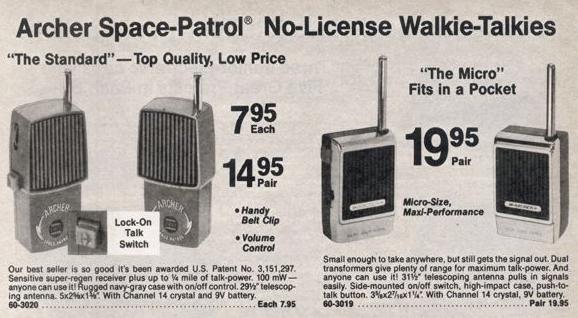
The 1979 issue showed similar models, but for 49 MHz:
One bit of confusion is added by the fact that 100 mW walkie-talkies for 27 MHz remained on the market. For example, if we turn in the 1978 catalog to the “toy” section to the “CB” section, we see a number of CB walkie talkies, some of which are 100 mW.
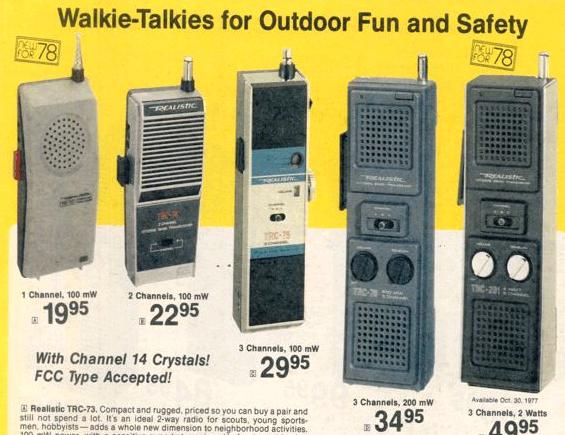
Under the old rules, these 100 MW units had a dual status. They could be used under Part 15 without a license, since they fully complied with the 100 mW limitation. However, these radios were also “type accepted” under Part 95 of the rules, meaning that they could be legally used by licensed CB’ers. (These “real” CB walkie-talkies also typically had a superheterodyne receiver, meaning that they didn’t make the annoying “rushing” sound when no signal was present.) The CB rules at the time allowed CB’ers to communicate only with other CB stations. Therefore, it was technically illegal to communicate between a “real” CB and a toy 27 MHz walkie-talkie. (Unlike the prohibition on retransmitting baseball games, nobody ever told me that my attempts to do so were illegal. However, I doubt if there were many prosecutions for this particular offense.) In the case of a cheap toy walkie-talkie, this would have been true even if the toy was being used by a licensed CB’er, since the radio wasn’t type accepted for CB use. But because of their dual status, the three100 mW walkie-talkies shown here could have been legally used to communicate with a toy walkie-talkie (since the radio was under 100 mW) or by a licensed CB’er to communicate with another CB’er (since the radio was type accepted under Part 95).
The 100 mW walkie talkies continued to be sold by Radio Shack and other retailers. In practice, some of these were sold as high-end toy walkie-talkies for kids, since the type-accepted units were generally of much higher quality. But technically, after 1978, the use of the 100 mW 27 MHz radios required a CB license.
In 1983, the FCC ended the requirement for CB licenses, as reported in the April 28, 1983, issue of the New York Times. (Technically, CB is now “licensed by rule,” meaning basically that a license is required, but if you follow the rules, you are automatically granted a license by 47 C.F.R. §95.404.)
Therefore, it once again became legal (as long as the user obeyed the CB rules) for an unlicensed person to use the 27 MHz radios, whether they were the 100 mW model or one of the more powerful ones.