
Author Archives: clem.law@usa.net

Canadian Flag Turns 50

The Canadian flag is fifty years old today.  As proclaimed by the Queen on January 28, at the stroke of noon on February 15, 1965, at a ceremony on Parliament Hill, the Red Ensign was lowered and the current Maple Leaf flag was hoisted.  The crowd sang “O Canada” followed by “God Save the Queen”

Click Here For Today’s Ripley’s Believe It Or Not Cartoon


Valentine’s Day 1915

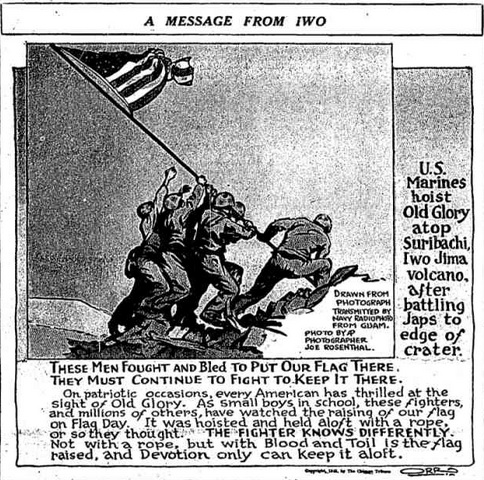
UncleSamValentineOn Valentine’s Day a hundred years ago, the cartoonist at the New York Tribune took advantage of the occasion to show this valentine received from Kaiser Wilhelm by Uncle Sam. The lace-adorned card warns the U.S. to stay out of waters around Britain.

Click Here For Today’s Ripley’s Believe It Or Not Cartoon


1935 3-Tube Broadcast Receiver Project

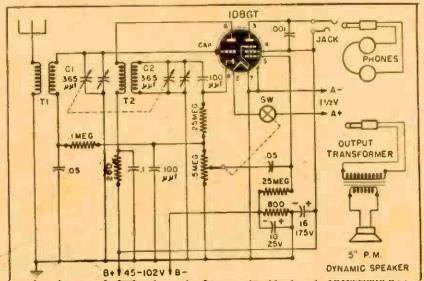
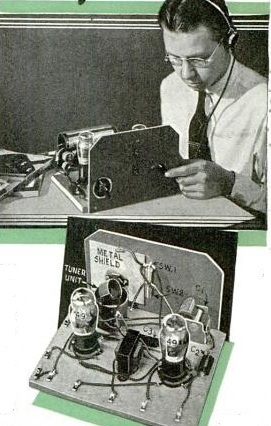
1935PM3tubeThe depression-era couple shown here are relaxing to the sounds of a three-tube standard broadcast receiver constructed according to plans which appeared eighty years ago, in the February 1935 issue of Popular Mechanics.

The three tubes served as an RF amplifier, detector, and audio amplifier. The 12A7 power amplifier also contained the rectifier, allowing the set to operate on either AC or DC household current. The filaments were wired in series, with a 300-ohm “curtain burner” cord used to drop the voltage. The article reported that the set would pull in stations up to 150 miles away during the daytime with a 20-foot indoor antenna, with reception of up to 1500 miles with good volume at night. The cost of parts was reported as being $6.50.

KnightG9503The least expensive radio in the Allied Radio catalog in 1935 appears to be the 4-tube model shown here, Knight Model G-9503.  Even though this Knight radio featured four tubes rather than three, the circuits were almost identical, since the Knight set had a separate rectifier, rather than the combined tube in the Popular Mechanics model. Therefore, the value-conscious buyer in 1935 could still save a few dollars by building his own radio.

The volume control of the Popular Mechanics receiver was actually an RF gain control, since it controlled the gain of the RF amplifier.

Click Here For Today’s Ripley’s Believe It Or Not Cartoon
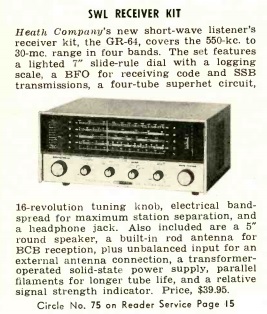


1955 Boys’ Life Radio Contest

Pedro delivering prizes to lucky winners in BL radio contest.  June 1955 Boys' Life.

Pedro delivering prizes to lucky winners in BL radio contest. June 1955 Boys’ Life.

60 years ago this month, Boy Scouts were busy trying to win valuable prizes, including a Hammarlund HQ-140-X receiver, a Hallicrafters S-85 receiver, or a National NC-88 receiver. Unlike prior years, licensed amateurs were not eligible for prizes (probably because they swept them earlier years). But these prizes were available for logging as many stations as possible. Each station counted for one point, each country and U.S. call area 10 points, each state 10 points, and each continent 50 points. There were also bonus points for logging all continents, all states, and all call areas.

There were two classes of entries: one for commercial or surplus receivers, and one for homemade receivers. The contest was in effect during the month of February, 1955. The full rules were contained in that month’s issue of Boys’ Life.

The winners were announced in the June issue.  In “Class A” (manufactured receivers), the HQ-140X went to Ralph Overton of Mechanicsville, NY. Norb Harnegie of Berea, Ohio won the S-86.Henry Weir of Charleston, West Virginia, John Bryant of Stillwater, Oklahoma, John Tull of Kansas City, Missouri, and Francis Jacobs of Anson, Maine, won either a Hallicrafters S-38D or a National SW-54.

In “Class B” (homemade receiver), the winner of the Hammarlund was Gary Dobbs of Arlington, California, and Jay Hall of Maplewood, New Jersey took the second place prize of a National NC-88. Winning either an S-38D or SW-54 were Walter Piper of Ravenna, Ohio, Paul Stein of Uvalde, Texas, Don Cannon of Lubbock, Texas, Howard Ferber of Brooklyn, New York, and Bob Samson of Chicago, Illinois.

Over 200 other prizes were awarded to some of the 1049 entrants.


Unlike earlier contests, licensed hams were not eligible for prizes in this run of the contest.  However, at least two of the winners went on to become licensed hams.  As explained on my website, only a few call books are available for online searching, and the first one after this contest is from 1972, sixteen years later.  There might have been more, since some had common names, and some might have moved to different call areas.  But Norb Harnegie of Berea, Ohio, who won the S-86. was licensed in 1972 as W8FCV.    And Francis Jacobs of Anson, Maine, was licensed in 1972 as W1EST.

It would be interesting to know how these rather generous prizes affected the winners.  If you Googled your name and found this page, I would love to hear from you in order to write a follow-up.  You can reach me at clem.law@usa.net, or leave a comment below.

Click Here For Today’s Ripley’s Believe It Or Not Cartoon


Sleep Alert: Warning the Public of Nuclear Attack at Night

A 1969 report prepared for the Office of Civil Defense details a proposal that was never adopted for a program called CHAT: Crisis Home Alerting Technique. In recognition of the fact that this military acronym wouldn’t be of much use with the public, a more descriptive name was proposed for dealings with the public: Emergency Broadcast System Sleep Alert.

The Emergency Broadcast System was designed to alert the public through normal broadcast stations of enemy attack. Sirens were available in many areas, but large portions of the population would be unable to hear them, especially at night. And at night, most Americans would be asleep, and not listening to radio or television. A nighttime attack would catch Americans by surprise, unless they were sleeping in shifts to listen to the news.


In a “bolt out of the blue” attack, the problem of nighttime alerts remained problematic. But during periods of strategic crisis, such as the Cuban Missile Crisis, CHAT or “Sleep Alert” provided an answer. During such a crisis, Americans could get their sleep, but also be able to receive warning. Upon determining that a crisis existed which might require warning the population, the President would activate the system, and the public would be notified to tune to participating stations in their area. The President would then make the following announcement, probably at 11:00 PM Eastern Time:

In a moment my voice will begin to fade; merely turn your volume up until you can hear me again. This is part of a system which will permit you to receive later emergency information. Please leave your receivers on constantly; when you wish to sleep, turn the volume down to a comfortable level, and I will be able to reach you my means of your radios and televisions.

The stations would then reduce their modulation to 10-20%. VHF TV stations would reduce the audio to zero. Viewers tuning in after 11:00 would know that they were tuned in, because they would see a message on the screen explaining that the station was operating in the sleep-alert mode. In addition, the detent tuning of VHF television receivers would ensure that the viewer was properly tuned in.

AM radio stations presented a problem, because listeners tuning in after 11:00 would need to know that their radio was tuned in to the proper station. Therefore, it was decided that “subdued materials” could be broadcast. The report noted that “the more exciting up-tempo kinds of music or the strident, demanding voice delivery techniques employed at many rock and roll stations” should be avoided. Instead, the program would be soft music or perhaps a clock ticking, with occasional station identification by “an announcer speaking softly but with calm authority” with the following message:

You are listening to the Emergency Broadcast System Sleep Alert. Stay tuned for a possible emergency warning from the United States Government. Adjust your radio volume to a level at which you can sleep. This station will resume broadcasting more loudly if warning is necessary. See your newspaper for more information.

Station personnel would then monitor the AP and UPI wires for warning messages. Stations without wire service would monitor Emergency Broadcast System primary stations. In the event of that fateful message, the station would turn up the volume to normal modulation, meaning that all of the listeners would confront a radio playing at full blast, which would presumably be enough to wake them. The station would then transmit a loud alert signal, followed by the following message:

Attack–Attack. The United States is Under Nuclear Attack. I repeat–the United States is under nuclear attack. Take shelter. Take shelter immediately. You are in danger–you can save your life if you take shelter immediately. This is the emergency broadcast system.

Assuming that there was no attack during the night, the station would gradually increase its modulation at 7:00 AM, and resume normal programming.  CHAT was viewed as an interim measure, and had the advantage of not requiring any new equipment either on the part of broadcasters or the public. The plan was to replace it eventually with a more reliable system. But as a stopgap, it had the advantage of being able to be adopted readily. It was, however, never adopted.

It was at least a decade before the first 24-hour warning system came into effect, in the form of alerts broadcast on NOAA weather radio in the mid-1970’s. However, it was always subject to question how well NOAA weather radio was integrated into the national warning system. However, NOAA now makes clear that it will broadcast Presidential alerts during a national emergency, and it appears to be well integrated into the National Warning System. Modern NOAA weather receivers, such as the one shown here, take advantage of digital encoding (SAME), which will limit the number of false alarms for weather events in surrounding areas.

Click Here For Today’s Ripley’s Believe It Or Not Cartoon


Soviet Deportations of Poles, 1940

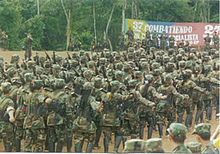
Workers constructing the Kolyma highway.  While the nationality of these men is unknown, they very well could have been Polish deportees.  Wikipedia photo.

Workers constructing the Kolyma highway. While the nationality of these men is unknown, they very well could have been Polish deportees. Wikipedia photo.

200px-Herb_Polski.svgIn 1940 and 1941, more than 1.2 million Poles were forcibly deported from Poland to remote areas of the Soviet Union. Those deportations began in earnest 75 years ago today, when more than 220,000 Poles, mostly women and children, were rounded up and sent to northern European Russia. While the USSR never declared war on Poland, at the time of the Nazi invasion, the German-Soviet nonagression pact was still in place. When the invasion began, the Soviets stopped recognizing Polish sovereignty, and started simply dividing up Poland with the Germans.

Many Poles were simply killed, but at least a million were deported, and hundreds of thousands of those deported died. Many of those deported worked on the construction of the Kolyma Highway which extends 1262 miles from Nizhny Bestyakh to Magadan. The road is known as the “Road of Bones,” as most of the thousands of workers who died during its construction are interred within the roadway itself.

The deportations began 75 years ago today.

References


Read More at Amazon

Click Here For Today’s Ripley’s Believe It Or Not Cartoon


How To Start a Cleaning Business A Hundred Years Ago

McCreeryVacuum

A hundred years ago, the McCreery Manufacturing Company of Toledo, Ohio, had just the thing for the entrepreneur who wanted to earn $20 to $30 a day. While the price of the equipment was not disclosed in this ad from the February 1915 issue of Popular Mechanics,  the company could set you up with one of its B.B. Power Vacuum Cleaners, which would allow you to go into business for yourself. In fact, the enterprising man could acquire two or three such machines “and profit from others labor. No doubt that is what someone is doing with you.” The ad noted that thousands of homes will never own a vacuum cleaner of their own, and they “will never think of owning them when they can depend on you.”

The machine gave the owner the ability to start small. “Start with one home on a street–soon half the homes in the neighborhood want regular service.” In addition, there was the promise of trade from churches, lodge rooms, dance halls, hotels, and hundreds of other places.

You could send a letter or postcard for full details, or just show up on their doorstep at 1010 Front Street in Toledo.  The ad offered to reimburse your travel expenses (up to 300 miles) if you bought.

Presumably, you left the machine on the street outside, and ran the hose into the house, much as carpet cleaning businesses do a century later.

Click Here For Today’s Ripley’s Believe It Or Not Cartoon


Don’t Be A Sqeal Hound!

SqealHound

Miss Helen Dickinson of New York, shown seated here at the table, might not have won any spelling bees, but in 1924, she was a crusader against radio interference. The regenerative receiver, like many of the one tube radios featured on this site, contain a regeneration control, and by turning up this dial, the receiver becomes more sensitive. But once it reaches a critical point, the set breaks into oscillation and becomes a transmitter. It causes an annoying squeal to be heard through the headphones. But to the dismay of the neighbors listening to the same station, it causes the same squeal to come over their receiver.

For this reason, Miss Dickinson took it upon herself to rid the airwaves of this scourge, and got her neighbors to sign a pledge to be more careful, and thus not be “Sqeal Hounds.” Here, her neighbors are lining up to sign the pledge. For those wanting tips on how to avoid interference, the February 1924 issue of Radio Age, from which this photo is taken, gives tips on doing so.

Click Here For Today’s Ripley’s Believe It Or Not Cartoon


Zero-G Construction Project, 1920

ZeroGEquator

This hypothetical view of a construction project is from near the equator of an alternate Earth whose period of rotation is 1.41 hours, rather than the customary 24. A lot of work can get done during that shorter day, since the effects of gravity are cancelled out by the increased centrifugal force. Here, a worker is shown tossing a steel beam to his colleague.

The caption notes one disadvantage, namely, that the guy on top needs to be a good catch, since if he misses, the beam will simply keep flying, never to return.

The image appears in the December, 1920, issue of Science and Invention.

The workers must have adapted well to their new environment, since presumably all of the air would have also floated away long ago.

Click Here For Today’s Ripley’s Believe It Or Not Cartoon


Shipwreck of the Hanalei, 1914

Wireless operator Lovejoy signalling rescuers.

Wireless operator Lovejoy signalling rescuers.

A hundred years ago this month, the February 1915 issue of Popular Mechanics reported the story of Loren A. Lovejoy, the wireless operator of the steamer Hanalei, shown here in this artist’s rendition.

The Hanalei suffered a shipwreck on November 23, 1914. While the incident is almost forgotten today, more than twenty of the 63 aboard the ship perished off Point Bolinas, 14 miles north of the Golden Gate. Even though the ship was within 500 feet of land and it was daylight when it hit the rocks, the rescue proved difficult. The ship initially made an incorrect report of its position. By the time rescuers realized the correct location, fog was setting in, and it was late at night before any rescue could be attempted. By then, the ship’s radio had been destroyed.  Trucks transporting the rescuers had to travel 60 miles on poor roads in heavy fog.

To communicate with the rescuers, Lovejoy was able to signal using Morse code with a flashlight. Those ashore were able to send “words of cheer” with automobile headlights. With a mortar, the rescuers would shoot a lifeline to the ship. Lovejoy then sent messages back such as “windward and too low. Send her higher.”

The Secretary of Commerce later sent a personal letter commending Lovejoy for “his courage and ingenuity, measuring up to the high standards of the wireless service.”

Lovejoy was born in Hillsdale, Kansas, on June 27, 1891, and graduated from high school in Seattle. He entered service with the Marconi Company in 1912.  He died in 1977.

The Seattle Star reported in the next day’s paper that Lovejoy was killed in the shipwreck. In fact, it was the Star’s reporter who communicated that sad news to Lovejoy’s father. The newspaper account, however, was greatly exagerated, and Lovejoy lived another six decades, Lovejoy survived the wreck. He is pictured in the 1960’s in White’s book linked below.  His First Grade operator’s license was listed as being renewed in December, 1916.

According to the Social Security Death Index, Lovejoy died in 1977 at the age of 86 in the Seattle area. He is buried at Acacia Memorial Park in King County, Washington.

Adolph Svenson. Wireless Age, Jan. 1915.

Adolph Svenson. Wireless Age, Jan. 1915.

The Hanalei was originally constructed for the Hawaiian sugar trade, but was in service at the time of its wreck hauling lumber and passengers between Northern California and San Francisco.

The Hanalei’s assistant wireless operator, Adolph J. Svenson, who sent out the first SOS, was among those killed in the wreck.  He drowned when the ship broke up.  Lovejoy later recounted of his colleague, “throughout our terrible experience he remained cool and resourceful, upholding in an exemplary manner the traditions of the Marconi service.”  Svenson’s name is among those inscribed in the Wireless Operators Memorial in Battery Park, New York, which was dedicated on May 12, 1915.

References