Author Archives: clem.law@usa.net

One-Tube Wartime Receiver, 1945

RadioCraftFeb45

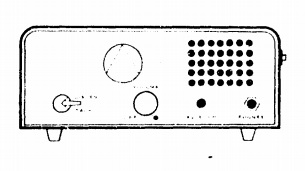
Radio parts were in short supply during the War, and radio enthusiasts had to make do with what they had. “H.T.,” a resident of Bothell, Washington, apparently had in his junk box a 1D8GT tube, and a low-impedance earphone, and wanted to know what he could do with them. So he wrote to the editors of Radio Craft magazine asking for a diagram of a receiver covering the broadcast band making use of the parts he had. He wanted to mount the earphone in the cabinet for use as a small speaker.

The editors indulged him and provided this diagram in the February 1945 issue. It was reprinted from the July 1940 issue, and showed how the combination diode-triode-pentode tube could be used in this circuit. The triode section of the tube was an RF amplifier, followed by the diode detector, with the pentode serving as an audio amplifier. Unfortunately for H.T., the low impedance earphone would need to be used in conjunction with an audio transformer. This set would drive a pair of high-impedance headphones, but to use it with his low-impedance earphone, it would need to be wired as shown for the speaker. So H.T. had to find himself either a set of hi-z headphones, or the output transformer, in addition to what he already owned.

The other hard-to-obtain part would be the variable capacitor. The circuit here shows a ganged condenser, but the response pointed out that two separate condensers would provide better results.

Click Here For Today’s Ripley’s Believe It Or Not Cartoon


1940 Two-Tube Two-Band Receiver

1940FebPM75 years ago, Popular Mechanics, February 1940, carried the plans for this simple two-tube, two-band receiver, which could be run off flashlight batteries, 8 for the B+, and one for the filaments. It used two Type 49 tubes, and tuned both the broadcast band and short wave. The short wave band covered the then-police freuencies, as well as the 160 and 80 meter ham bands. It was mounted on a wooden chassis and had a wooden front panel.  It was a very simple design, with one tube serving as the regenerative detector, and the second as audio amplifier.

This particular receiver would be difficult to duplicate, since the coils are unobtanium. The article notes that the coil is a “three-circuit tuner” which did away with “tedious coil winding, often a stumbling block for beginners.” The coil came with a pre-marked terminal strip which made wiring errors next to impossible. The rotating tickler coil was included. It even had a built-in switch wired to the taps on the coil for easy switching from broadcast to short wave.

As was often the case, the Popular Mechanics project was available in kit form from Allied Radio. The 1941 catalog shows this kit as selling for $4.70, plus $1.39 for the tubes and batteries.

Click Here For Today’s Ripley’s Believe It Or Not Cartoon


Battle of Iwo Jima, Feb. 23, 1945

IwoJima

The iconic photo of U.S. Marines hoisting Old Glory on Iwo Jima was taken 70 years ago today, February 23, 1945. It appeared on the front page of the Chicago Tribune, February 28, 1945, as the drawing shown here. As the artist wrote, “Not with a rope, but with Blood and Toil is the flag raised, and Devotion only can keep it aloft.”

Click Here For Today’s Ripley’s Believe It Or Not Cartoon


The Real Reason Scouting Is Important

MeasureDistancePeople sometimes ask what is the most important thing that youth learn from Scouting. They usually expect to hear something along the lines of that it “builds character.” In some cases, it is probably true that Scouting builds character, but I honestly can’t point to too many people who would have wound up being bad characters if they hadn’t been in Scouting.

A better reason why Scouting is important is summed up in this diagram, which appeared in Boys’ Life magazine 70 years ago, February 1945.  That’s not to say that measuring the width of a river is a particularly important skill in the scheme of things. In fact, I don’t recall ever being taught this particular method. But it’s illustrative of something I did learn, without knowing that it was being taught. What I really learned was that when I’m faced with some obstacle, it is usually possible to achieve the desired result, by applying a little bit of thought. But the first step is to know that there is a solution to the problem. Once a person realizes that, then finding the actual solution (or more often, one possible solution out of many) is usually pretty simple.

In this illustration, the Scout needs to know the distance across the river. The article, written by William “Green Bar Bill” Hillcourt, explains the method being used here. He starts at point A, which is directly across the river from a given point with a convenient object, in this case, a tree. He then walks along the river a set distance, such as 100 paces, and places a stick at that point. He then keeps walking that same distance. When he reaches the point marked C, he walks at a right angle, and keeps going until he’s along the same line containing the tree and the stick. At that point, the distance he’s walked away from the river is equal to the width of the river.

There are certainly other methods to figure out the distance, another one of which is also shown. But one method, which seems to be the most commonly used these days, is to consult outside information. It’s usually possible to ask someone who knows the answer. And it’s even possible to go to Google Maps, look at the image, and get the exact width. Those are very valid methods, and in many cases, they are more convenient and better methods. But the Scout learns that they are not the only methods. Even if outside assistance is not available, it is possible to figure things like this out on your own, without outside help.

I never really realized this until a few years back, when I started hearing from RV’ers that they couldn’t possibly camp in a non-electric site. I happen to enjoy the convenience of electric power, and if it’s available, I gladly take advantage of it. But I don’t view it as a necessity. When pressed, these people invariably come up with the same rationale for needing electricity: They need it in order to plug in their electric coffee maker.

Now, I drink a lot of coffee, and I probably drink more coffee than most of those people. So I understand their need for coffee. But I also realize one thing that they don’t know: I know that there are many methods of making coffee that don’t involve the friendly local electric utility. In response to their concerns, I even created a website entitled “How To Make Coffee Without Electricity.”  That website is written in a somewhat tongue-in-cheek style. But it’s also full of information that people don’t know, even though I always assumed that it was just common sense. It’s probably common sense to me because I was in Boy Scouts. I know that I can figure out the width of a river even if Google Maps is unavailable. So it stands to reason that I can figure out how to make coffee even if the power happens to be out.

There must be a lot of people who weren’t Scouts. Whenever a hurricane is bearing down on some part of the English-speaking world, my coffee page starts to get hundreds of hits. A day or two before the storm, these are from desktop computers. The day after the storm makes landfall, the number of hits increases, but most of them are from mobile devices. In other words, the power goes out, and only then they realize that they don’t know how to make a cup of coffee. I’m glad their mobile device is still working, and I’m glad that Google is still working, and I’m happy to impart my lifesaving knowledge that it is, indeed, still possible for them to make a cup of coffee.

But I worry about these people if Google ever becomes unavailable for some reason. Maybe they should have been Boy Scouts. I’m sure these people are of fine character, and they didn’t need Scouting to build it. But learning the lesson that self-reliance is usually possible probably would have served them well.

Click Here For Today’s Ripley’s Believe It Or Not Cartoon


Heathkit CB-1 “Benton Harbor Lunchbox”

HeathCB1

Most hams who have been around a while have encountered the “Benton Harbor Lunchbox.”  This was a series of transceivers from Heathkit, and the most common were the HW-30 “Twoer,” which covered two meters, and the HW-29 “Sixer” for six meters.  Less common was the HW-19 “Tener” for, you guessed it, ten meters.

These were very popular in their day.  They were a single-band transceiver.  The transmitter put out about 5 watts of AM, and the receiver was superregenerative.  The tuning was very broad, but once they locked on to a signal, they were surprisingly sensitive.

By the time I became a ham in the 1970’s, VHF AM was virtually gone.  There was one six-meter AM net in the Twin Cities that hung on, and I was a regular check-in with my Sixer and later a Gonset Communicator.  But FM had taken over two meters by then, and Twoers were basically given away for practically nothing, even though they were often in pristine condition.  I owned many of these little rigs, and at one time I owned a complete collection.

My collection included the lesser-known cousin, the Model CB-1 CB transceiver shown here.  The CB model came out in about 1960, and is shown here in this ad in the February 1960 issue of Popular Electronics.

It sold in kit form for $42.95, and was also available wired for $60.95.  It featured one crystal-controlled channel (the crystal was included).  The receiver was the same superregenerative receiver used in the other Lunch Boxes, and was calibrated for channels 1-23.  It had a built-in power supply for 120 volts.  For mobile use, it used an external power supply, which consisted of a vibrator and transformer.  The power was supplied to an octal plug on the back (the same as the bottom of a tube).  The 120 volt power cord and the DC power supply had  octal sockets on them, along with appropriate jumpers.

Click Here For Today’s Ripley’s Believe It Or Not Cartoon


WW2 Shortwave Broadcasting

CBS Short Wave Listening Station, Long Island. Wikipedia photo.

CBS Short Wave Listening Station, Long Island, 1941. Wikipedia photo.

In earlier posts, I’ve looked at the shortwave broadcast bands, and short wave listening during World War 2.   75 years ago, the Saturday Evening Post carried an interesting look at the war of words that was then filling the short wave bands. It gives a fascinating and detailed look at what the bands must have sounded like for short wave listeners as Europe was at war. The original article is now available at the Saturday Evening Post website.  There is a link to the original 1940 article, “The War of Lies and Laughs: The Story of Radio’s 24-Hour A Day Word Battle,” which was written by freelance writer J.C. Furnas, and appeared in the February 3, 1940, issue of the magazine, at page 16.

In addition to the informative text, it contains a couple of photos of the CBS shortwave listening station on Long Island, New York, complete with at least three National HRO receivers. From the look of the listening station in 1940, it appears that the station was thrown together hastily by CBS. The tables are unfinished wood, and the staff are making use of folding chairs.

Shown operating the receiver at the CBS listening post was one Carl Schutzman, and CBS newsman Elmer Davis is shown combing through the news picked up from the short waves.

Furnas begins his account of the propaganda war with the reaction of a loyal German-American Iowa farmer, who is outraged to hear an old acquaintance, one Fred Kaltenbach–or someone claiming to be him–persoanlly addressing the Iowa farmer on the Berlin radio. The speaker, ostensibly a German immigrant who returned to the old country, mentions the Iowan by name and even mentions the name of his old schoolteacher in an effort to establish his bona fides. He tells the Americans that they shouldn’t fall for the British propaganda cooked up by that liar Winston Churchill, and stay out of Europe’s war. (Kaltenbach was indicted in absentia,  for treason, but died in Soviet custody after the end of the war.)

The scuttling of the Graf Spree in Montevideo harbor was still fresh on the American mind, and Furnas’ article points out the contradictions of the various short wave accounts coming from Europe. The article discusses both broadcasts directed to America, as well as broadcasts directed by the beligerents to the other warring nations. It notes that in neither case is it possible to determine exact numbers of listeners. It points out that listening to foreign radio is a criminal offense in Germany, and notes that a four-year sentence was reportedly handed down recently for that offense.

Furnas does point out that prior to the war, NBC received about 600 letters a month from German listeners, which dropped to six per month after the war began. But he’s quick to concede that the drop in mail volume was probably because the Germans didn’t want to get caught listening–not because they actually stopped listening. And according to Furnas, very few Americans actually listened to German broadcasts, despite the fact that 40% of American receivers tuned the short wave bands. “When crack receivers with expert staffs, working for broadcasting companies, have trouble getting clear reception for days on end, what can the man in the average living room expect?” He answers this question by saying that their likely to revert to Charlie McCarthy.

Lord Hawhaw, 1943 artists' conception. Wikipedia image.

Lord Hawhaw, 1943 artists’ conception. Wikipedia image.

The most interesting part of Furnas’ article, except possibly for the photos, is the accounts of the English-language programs coming from each side. At that time, the identity of Lord Hawhaw was not known, and Furnas speculates that it was Norman Baillie-Stewart.  Baillie-Stewart had actually been connected with the broadcast until 1939, but had been replaced by the time the article was published by William Joyce,
who was executed for treason in 1946.

Despite the fact that few Americans were listening to foreign broadcasts, Furnas points out that the situation was better for the Germans in South America. Many South American newspapers, unable to afford wire services, were said to collect most of their news from foreign broadcasts, and the Germans capitalized. But even before the U.S. entered the war, the Americans made a concerted effort to target South America, with much success, probably for the same reasons that the Germans were successful–it was an easy source of news for small papers. And the American stations came in a lot stronger.

The article details the propaganda styles in use between Germany and Britain. British broadcast contained quite a few recordings of Hitler, in the hopes of pointing him out as a liar with his own words. German broadcasts to England, on the other hand, were heavy with insults such as “England will fight to the last Frenchman,” and various insults against “the old liar” Churchill, whose initials, the German announcers were quick to point out, were the same as those of a Water Closet.

Germans also concentrated on the empire. “Berlin loves to put eminent Hindus on the air,” and broadcasts to South Africa did their best to incite the Boers.

Britain broadcast the names of German prisoners of war, and the Germans followed suit. (For more information on prisoner broadcasts, see my earlier post.)

Of course, in 1940, American SWL’s had no means of making recordings of broadcasts, but Furnas’ descriptions to some extent make up for the paucity of recordings. In the 2015 update to the article on the magazine’s website, there are, however, a handful of recordings, both before and after America entered the war.  But Furnas’ article itself is one of the best I’ve seen to depict what an American SWL might have been able to hear during the war years.

For a look at Japanese shortwave propaganda later in the war, please see my recent post on Japanese propaganda directed toward African Americans.

Click Here For Today’s Ripley’s Believe It Or Not Cartoon


Our Built-In Admiral TV

AdmiralBuiltInTVI’ve shared previously about my deprived childhood. We didn’t have a color TV. We didn’t have a real fireplace–we had a carboard fireplace. I didn’t have a TV in my room. We didn’t even own a robot, which I was convinced that most more affluent families owned. Yes, it was horrible.

But before you express too much sympathy, I guess I had better ‘fess up. We had a built-in TV. That’s right, down in the basement rec room, we had a TV that was permanently built in to the wall. As far as I know, it came with the house. In a small locked room, which we called “the TV room,” for want of a better name, the chasis of the set was there in all of its glory, with a piece of twin-lead cut as an antenna.

I remember that the set was an Admiral, and I’ve been able to figure out that it was a 1958 model, designed to be built in. The set tuned VHF only, meaning that it couldn’t be used to watch the fleeting signals of our only UHF station, channel 17.

I was able to find out some information thanks to the apparent practice of the Miami News to simply run a company’s press release as news. The August 4, 1957, edition of that paper carries a story under the headline “Built-In TV Announced By Admiral,” which almost certainly describes the model that was embedded in our wall. The article/press release enthusiastically reports that Admiral’s television sales manager, Ross D. Siragusa, Jr., had just announced the set’s 110-degree angle picture tube, along with the slim chassis depth of only 16 inches, made it the first nationally advertised set suitable for built-in applications or custom cabinetry.

The article identifies our set as being Admiral model B121F1, and that it included the “Imperial 440 chassis.” I found the image of this set, identical to the one in our basement, in a furniture catalog, apparently from 1958.

AdmiralMilkmanOur TV even made Life Magazine. The April 7, 1958, issue carries an Admiral advertisement masquerading as an article, given away by the tiny word “ADVERTISEMENT” at the beginning. (We see that Admiral was able to quite successfully push the envelope when it came to publicity.) The “article” recounts the experiences of an Elgin, Illinois, milkman who found himself inspired by visiting the modern kitchens of the well-to-do residents of Elgin. He was very impressed by the built-in appliances in their homes. He came to the realization that he could duplicate the effect in his own kitchen on a milkman’s salary by using free-standing Admiral appliances with the “built-in look.”

In the picture shown here, we can see him being inspired in one of those upper-class kitchens. And sure enough, one of the luxuries enjoyed by those high-class Elgin residents was a built-in Admiral TV. They were so rich that they were able to incongruously put the $239 21-inch TV right in the kitchen.

Both renditions had the dual speakers mounted in a grill right above the set, just like ours.

Those of us who weren’t quite so well to do didn’t have a TV in the kitchen, much less a gigantic 21-inch model. We had to settle for having it in the basement, and we couldn’t even get the elusive Channel 17. But that stands to reason, since we didn’t even have our own robot like those rich folks in Elgin probably did.

Our built-in B121F1 appears to be identical to the T21E21 which came with cabinet. It also appears to be identical with the console shown in this ad.

Click Here For Today’s Ripley’s Believe It Or Not Cartoon


Fare For All: A Nonprofit that Makes Cents

Review of Fare For All

For those of you who were following me during the SNAP Challenge, you recall that I ate for a week with less than $31.50 per week in groceries, the average amount received by SNAP (formerly known as Food Stamp) recipients.  It wasn’t particularly difficult, but you undoubtedly noticed that I didn’t have much in the way of meat, and I didn’t have any fresh produce.   This year, that was even more true, since I relied almost entirely on foods that could be used for emergency food storage.  But even the previous year, when I had the run of the supermarket, these items were mostly lacking, simply because they were too expensive.  People having to feed themselves on a tight budget often can’t afford these items.

FareForAllI recently became aware, however, of a non-profit organization called Fare for All.  They are part of The Food Group,  formerly known as Emergency Foodshelf Network.  But Fare for All is not a foodshelf.  They are more like a cooperative that purchases food wholesale and sells it to the public.  They rely on volunteers, and they have distribution locations at neighborhood locations such as churches and community centers.  Each month, they put together pre-packaged baskets of food which they sell at a fixed price.  The exact contents of these baskets vary from month to month.  They have two main products.  The first is a produce package consisting of fresh fruits and vegetables, which sells for $10.    The second is a meat package consisting of about four meat and fish items, which sells for $11.  If someone buys both packages together, the total price is discounted to $20.

Here are the two packages that were for sale this month.  First, here is the $10 produce package:

20150217_161854

I didn’t price this at the supermarket, but it seems like it would cost considerably more than $10.  (The large loaf of bread shown to the right is also included for those purchasing both packages together.)

The $11 meat package is shown below.  It consists of turkey sausage (about 13 ounces), frozen fish, chicken breasts, and frozen meatballs.

20150217_161132

Some months, additional items are available.  For example, in November and December, they have holiday packages containing a turkey or ham, as well as other items, for $30.  They apparently had some left over, and were selling them this month for $27.  In addition to the ham, they included a whole chicken and some other items.

20150217_162404

I decided to check them out today, so I visited one of their distribution sites to buy some of their food.  Of course, I was already thinking the question that they probably get asked a lot, since it’s on their FAQ’s:

Q: If I purchase food through this program, am I taking away food from someone else who may need it more than I do?

A: Absolutely not. The more people who participate in Fare For All, the more purchasing power the program has. This means that greater savings will be passed onto our customers.

Emboldened by this reassurance, I decided to give them a try.  I purchased the items shown above:  One produce pack, one meat pack, and one holiday pack.  The total was $47.

The process is quite simple.  Their website lists their sites and gives the dates and times.  Most of the locations are open one day a month for about two hours.  Most are during the day, but some are evenings.  They have about 30 sites in the Twin Cities and outlying areas.  The closest one to me was Real Life Church in Roseville, although there are others that are conveniently located in Minneapolis, St. Paul, and suburbs.  That church appears to be affiliated with the Assemblies of God, but the distribution event was not in any way geared toward proselytizing.   In fact, the volunteer I spoke with wasn’t affiliated with the church himself.  The church appears to serve mostly as a location for the distribution.

The event began at 3:00, and I arrived at about 3:30.  There was a short line, but I only had to wait about five minutes.  Samples and photos of the various baskets are displayed, and you pick out which package(s) you want.  At the end of the line, you pay, and you’re given a ticket which you hand to another volunteer.  (They accept cash, credit and debit cards, and EBT cards.)  The volunteer then loads up your cart, and another volunteer helps you take it to your car.

You get your food in a sealed box, so I was slightly skeptical that the produce inside might be blemished somehow.  But it wasn’t, as you can see from the photos above.  They look like the same ones I would have picked out from the display at the supermarket.  The only difference seems to be the price.

On the way out, those making a purchase above a certain amount pick out a free loaf of bread.

Overall, this program performs a very real service to the community:  It makes high-quality food available to all at a reasonable price.  Furthermore, I’ve only been able to find one negative thing said about Fare For All.  A 2012 Pioneer Press article contains reports from a few naysayers who believe that this is unfair competition to retailers.  They don’t mind poor people buying food from a nonprofit, but they think that people should have to qualify by being poor enough.

I don’t think that criticism is well founded.  Fare for All does have a clear price advantage.  But retailers can still compete easily, because of wider selection, more convenient hours, and any other advantage they can think of.  For-profit corporations are quick to point out that a nonprofit such as Fare For All is tax exempt.  However, a for-profit corporation pays income taxes only on its profits.  If a cooperative organization voluntarily decides to operate on a non-profit basis, there are no profits to tax.  Grocery stores pay property taxes, but since Fare For All is operating from its locations only a few hours a month, any lost property tax revenue is minuscule.

It seems to me that there are some great advantages of having this program open to everyone, regardless of need.  First of all, there is absolutely no stigma associated with it.  I have no idea whether the other people in line were low income persons who desperately needed the food, or whether they are simply taking advantage of the reasonable price.  I assume most were in the latter category.

And more importantly, having the program open to all makes the program more economical for everyone.  As the Fare For All website points out, the additional buying power benefits everyone.  If nonprofits were required to “stick to helping the needy,” as one critic said they should, this would actually add more costs, as the nonprofit would have to verify need.  The end result would be that the truly needy would receive less and pay more.

With its current model, it seems to me that Fare For All is a win-win situation for all.


Another Crystal Set for CONELRAD Reception

EmergencyXtalSetRadioTVExperimenter1955

60 years ago, CONELRAD was the system planned for keeping the American public informed in the event of a nuclear attack. As I’ve explained previously, the idea was for designated broadcast stations to operate on 640 or 1240 kHz. Stations would not transmit station identification, transmissions from individual stations would be short, and enemy bombers would be presented with a cacophony of signals useless for navigation purposes.

But power might be out. Battery-operated sets were rare, and most of those that existed sucked through expensive batteries quickly, since they had to power the filaments of the tubes. Undaunted, radio enthusiasts realized that a crystal set could be put to use. As I previously reported, Boys’ Life magaine touted a crystal set that could be put to use in an emergency.
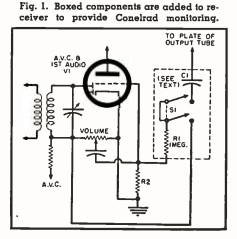
Another Boys’ Life article included a CONELRAD receiver with one transistor that could run on two penlight batteries. And in a pinch, that set could be used without a battery, operating as a simple crystal set. And during the 1956 CONELRAD test, a Heathkit crystal set performed surprisingly well at receiving the emergency broadcasts, even outperforming commercial tube and transistor radios.

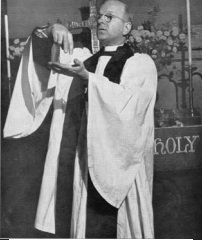
EmergencyXtalSetRadioTVExperimenter1955SchematicAnother example of crystal sets for emergency use is shown here, in the 1955 edition of Radio-TV Experimenter.  Author George P. Pearce (probably shown in the illustration above) describes the need:

If flood, tornado or air raids cause power failures, could you get emergency directions from the Conelrad stations the government has at 640 and 1240 on the dial? Even battery-powered sets couldn’t operate over an extended period of weeks, so why not build a crystal set that needs no power except the broadcast signal.

The author describes this set, which uses two 1N35 diodes along with two .001 uF capacitors in a voltage-doubler circuit. It uses basket-wound high-Q coils to pull in weak signals. It recommends a 100 foot antenna and good ground. He also suggests the use of the house wiring as an antenna, using a lamp cord, capacitor, and plug going in to the 120 volt house wiring. This ought to work, but if the power is on, you would be putting a lot of faith in that capacitor not being leaky as you put the headphones hooked to that antenna onto your head, just like they place the electrode of an electric chair.

The author notes that there’s nothing to wear out, and his set has operated for over three years.

Click Here For Today’s Ripley’s Believe It Or Not Cartoon


Japanese Short Wave “Negro Propaganda Operations” of WW2

African-American soldiers preparing to fight the Japanese. US Gov't photo.

African-American soldiers preparing to fight the Japanese. US Gov’t photo.

Most Americans believe that Axis propaganda during World War 2 was basically unsuccessful, since America and the Allies relied on truth, whereas the Axis relied on deception. I generally take this same view, but as with many oversimplifications, it is not entirely true. An interesting article detailing a Japanese propaganda campaign that was somewhat successful can be found in a scholarly journal, the Historical Journal of Film, Radio and Television, Volume 19, Number 1, March, 1999. The article, by Sato Masaharu of Shobi University and Barak Kushner of Princeton University, is entitled “Negro Propaganda Operations: Japan’s short-wave radio broadcasts for World War II Black Americans.” It’s not available free anywhere online, but it is available at most University libraries, and your public library should be able to obtain a copy by interlibrary loan. The article is a look at a Japanese propaganda operation that did have a measure of success.

The authors concede that the Japanese campaign was by no means successful in the sense that any appreciable number of African Americans were swayed to the Axis side. But the existence of such propaganda, largely based upon truth, did force the United States Government to confront those realities. Some groups, such as the NAACP, used this propaganda as a tool, even though  quick to concede that it couldn’t simply be accepted at face value.


In addition, the Japanese propaganda was successful to some extent in diverting U.S. Government resources to unproductive use. During the War, almost all African-American newspapers were investigated by the FBI.  FBI Director J. Edgar Hoover, in part because of the existence of the Japanese propaganda, was convinced that these newspapers were disloyal.

Some Americans were also convinced that the Japanese were responsible for racial agitation. An officer stationed in Little Rock complained to the War Department that the “Negroes of Little Rock were being organized and incited by the Japanese.” There was, of course, no evidence that any such Japanese agitation had occurred, but that didn’t stop the belief, which was in part fueled by the Japanese propaganda.

African-Americans, like other Americans, were well aware of what the Japanese had been doing in China. W.E.B. DuBois, for example, who provided a certain amount of overt support for the Japanese propaganda, opined: “It is not that I sympathize with China less but that I hate white European and American propaganda, theft and insult more. I believe in Asia for the Asiatics and despite the hell of war and the fascism of capital, I see in Japan the best agent for this end.”


Black Americans were also cognizant of the fact that Japan had been on our side in the First World War, and had brought to the table at Versailles matters of racial equality. These concerns were quickly brushed aside by President Woodrow Wilson, who was in very many ways a typical Democrat racist, who had segregated the Army. White Americans were generally not cognizant of this, but African Americans were. So there was a certain amount of natural sympathy on which the Japanese could play.

The U.S. military was certainly aware of this image problem, and was doing its best to counter it. For example, in 1944, it released the film, The Negro Soldier, produced by Frank Capra, which is available on YouTube.

The focus of Japanese broadcasts was that only Japanese victory could ensure Blacks of the elimination of racial discrimination. To reach this conclusion, the Japanese broadcast largely true accounts of discrimination, violence, and even lynchings.  In addition, comparisons were frequently made between Japanese leaders and African Americans such as Frederick Douglass and Booker T. Washington.

Throughout the war, Japanese embassies in neutral countries were tasked with researching American news for items of interest regarding discrimination against Blacks, and this news made up much of Tokyo’s propaganda content.

An additional source of program material came in the form of African-American POW’s, and there were plans in place to include them in programs discussing discriminatory conditions in American civilian and military life, reactions to conditions supposedly prevailing in Japan, and the humane manner in which Black POW’s were supposedly treated by the Japanese.

The first POW broadcast took place on December 2, 1943, during the Hi No Maru Hour program, which was beamed to America on short wave. It’s unclear whether any actual POW’s appeared on the program, or whether they were African American. But they were passed off as being POW’s.

POW’s were “encouraged” to take part in these broadcasts, and the Japanese pointed out that “we do not guarantee the life of those who refuse to cooperate.” Some prisoners did cooperate, and were tried after the War for doing so. They were able to point to this portion of the order to demonstrate that they had done so only under duress.

Unfortunately, as might be expected from a scholarly article of this type, the authors do not go into any detail as to the details of the broadcasts or the extent to which they were heard. It does note that the U.S. Government extensively monitored them, but it doesn’t address the critical question of how many Americans–Black or otherwise–actually listened to them.

1944TokyoListingsBut the Axis stations were easy to hear by anyone in the U.S. with a short wave receiver.  I’ve noticed that the short wave listings in many American newspapers stopped carrying listings of Axis stations after the U.S. joined the war.  But the clipping here, from the February 1943 issue of Radio Guide, clearly shows the times and frequencies of English broadcasts from Tokyo.

Despite the lack of information that the SWL historian might like to see, this article is an interesting look at the program content during the war, and it does a good job of refuting the notion that Japanese propaganda was ineffective.  The article is extensively footnoted, and those wishing to learn more about this forgotten chapter in war history will have many sources available.

For more history of radio and short wave listening during the war, please see the following earlier posts:


Click Here For Today’s Ripley’s Believe It Or Not Cartoon