Author Archives: clem.law@usa.net

1915 Military Mobile Wireless

1915MCA hundred years ago, the setup shown here was the state of the art in mobile military communication. The illustration, which appeared in the June 1915 issue of Popular Mechanics, is a combination radiotelegraph and radiotelephone station which was carried in a motorcycle sidecar. It was powered by a DC dynamo run by a separate motorcycle engine mounted in the sidecar. It contained two transmitters, one for radiotelegraph, and one for radiotelephone. The transmitting range was stated as being approximately 100 miles for telegraphy and half that distance for telephony.

The outfit included a telescoping steel mast, which was transported strapped securely to the side of the machine.

Click Here For Today’s Ripley’s Believe It Or Not Cartoon


Margaret Donahue, Wireless Pioneer

MargaretDonahue

Shown here in this 1917 press photo is Miss Margaret M.A. Donahue of Boston. According to the Tombstone (Ariz.) Epitaph of May 6, 1917, and other newspapers carrying the feature, she was believed to be the first woman in the United States to get a first class commercial radio operator’s license. With war declared only weeks earlier, in a letter to the federal radio inspector, she said that she would be willing to accept active duty in any branch of the service.


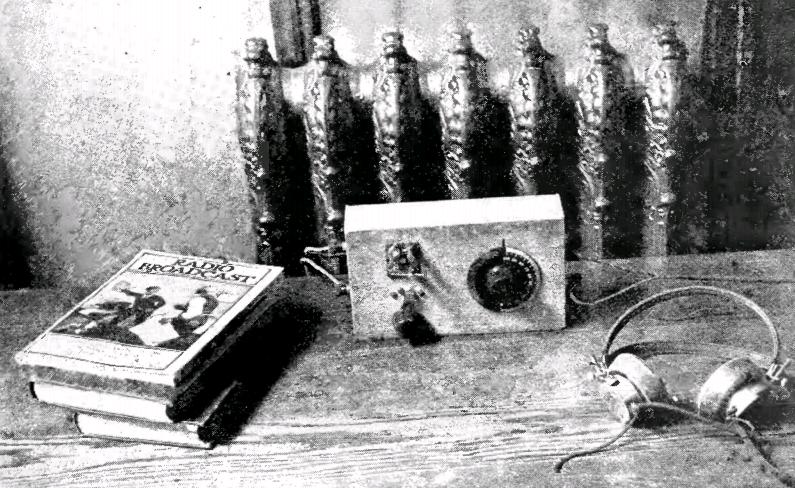
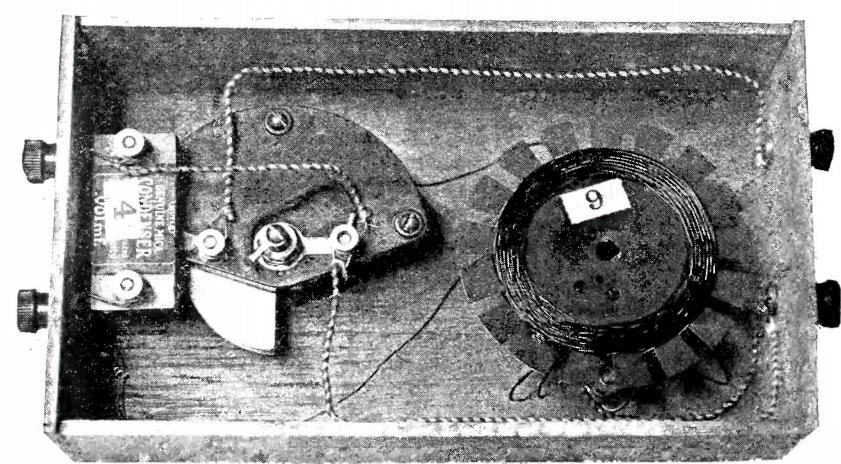
1922 Beaver Baby Grand Crystal Set

1922Beaver2

In an earlier post, we showed the Beaver Baby Grand crystal set
manufactured by the Beaver Machine & Tool Company of Newark, N.J. The company appeared to be primarily involved in manufacturing electrical switches, which are shown around the margin above. The crystal set was a sideline. In 1924, the set was selling for $3.40, and was being marketed as a gift for less fortunate friends who couldn’t afford a tube set.

I happened to find this ad from 1922, at which time the set had a retail price of $10. It appeared in the June 1922 issue of the trade publication Electrical Record.

This ad was directed toward dealers, and calls the set a “new harvest in radio profits.” The company notes that it had uncovered a demand that had been growing under the surface for months of “veteran fans who want a portable set to take along on hikes, picnics, to camp, etc.” The ad also notes that if dealers show off this handsome little instrument to other customers, “you will sell many people who cannot afford the vacuum tube sets.”

At the top of the page is an admonition: “Dog Ear this page. The boss will want to see it.”

The product was also featured  editorially in the “new products” section of the magazine:

1922Beaver1

Click Here For Today’s Ripley’s Believe It Or Not Cartoon



Marie Louise Gombier, Belgian Heroine

MarieLouiseGombierNormally on this page, we recognize the pioneers of wireless communications who facilitated the development of radio. We don’t normally recognize people who smashed radio equipment with an ax. But we make an exception in the case of a forgotten heroine of the First World War, Mlle. Marie Louise Gombier, a Belgian girl who bravely did her part to free her country from its German invaders.

At the start of the war, two days before the Germans took Brussels, Mlle. Gombier along with two other girls escaped from a convent and fled to her father’s home at Dickenbusch Farm (Dikkebus) near Brussels. Unbeknownst to her, a German officer was billeted there, and there was a German wireless station installed there.

She awaited an opportunity to slip into the room with the wireless, and did so when the German soldiers had left it unattended. With a shoe, she managed to put the station out of commission, but repairs were effected within 48 hours.

Undaunted, she awaited another opportunity, which presented itself a few days later. Acting under direction of Belgian military authorities, she returned with an ax and completely destroyed the station. Unfortunately, the commotion didn’t escape the attention of the German soldiers, who caught her in the act. She was taken before the commanding officer, who ordered that she be shot as a spy.

Croix de Guerre. Wikipedia photo.

Croix de Guerre. Wikipedia photo. This file is licensed under the Creative Commons Attribution-Share Alike 3.0 Unported license.

Fortunately, the officer billeted in the house intervened and commuted the sentence to imprisonment. She was imprisoned, but managed to escape five weeks later. She worked her way to the British lines, and attached herself to a Canadian unit, where she worked as a nurse until the end of the war.

During her work as a nurse, she was befriended by an American, Mrs. Lita Dowdy, a Y.W.C.A. worker from Los Angeles. At the conclusion of the war, Mrs. Dowdy adopted her, and she arrived in America on the French steamer La Lorraine in August 1919.  She became a U.S. citizen in 1925.

Mlle. Gombier was awarded the Croix de Guerre with two palms by the Belgian government.  Her home appears to have been near the location of the British Huts cemetery.  Mlle. Gombier was reported as being 21 years old at the time of her arrival in New York, meaning that she would have been about 16 at the time she smashed the radio.

References


Click Here For Today’s Ripley’s Believe It Or Not Cartoon



Radio in Puerto Rico, 1924

1924AprilRadioAge

In 1924, Radio was fast becoming a popular fad in Puerto Rico, as shown in this photo from the April 1924 issue of Radio Age.  The island did not yet have any broadcast stations of its own, but the three young women shown here, Srtas. Lydia Rexach, Adela Gomez, and Emilia Rexach, are listening to a concert they’re pulling in from the States.

Click Here For Today’s Ripley’s Believe It Or Not Cartoon


Dancing to Radio on the Chicago L, 1922


1922ChicagoLIn 1922, the Chicago Elevated Railroad was equipping its cars with a radio system. Shown here in the March 1922 issue of Science and Invention are a “dozen pretty girls” from the offices of the railroad line, dancing with road officials to the strains of jazz music transmitted from the radio station on top of the City Hall.

1922 L Cars like the one shown above. Wikipedia photo.

1922 L Cars like the one shown above. Wikipedia photo, © Jeremy Atherton, 2007; file is licensed under the Creative Commons Attribution-Share Alike 3.0 Unported license .

The receiving antenna consisted of wires run atop the train car, and the radio was powered by a high voltage DC dynamo.

Click Here For Today’s Ripley’s Believe It Or Not Cartoon


1915 Ketchikan, Alaska, Wireless Station

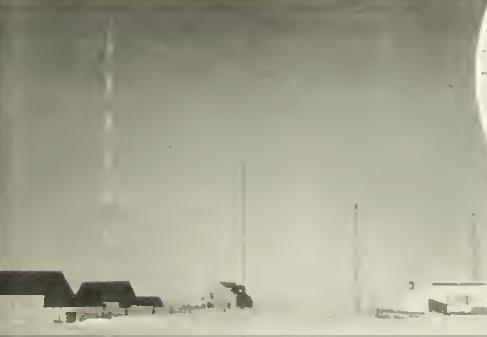
1915KetchikanMarconiThis illustration of KPB, the Marconi Wireless station in Ketchikan, Alaska, appeared in The Wireless World a hundred years ago this month, June 1915. The U.S. Government already had wireless stations in place in Alaska, but the rate for private correspondence was extremely high, and the Marconi Company set out to provide private competition. Stations leased from Marconi were in place at canneries and mines in Chignik, Naknek, Kodiak, Nushagak, Koggiung, Clark’s Point, and other locations. In addition, most of the ships serving the canneries were equipped with Marconi wireless stations.

The hub of Marconi’s Alaska network was the Ketchikan station shown here, and another under construction at Juneau. They, in turn, were linked to the station under construction at Astoria, Oregon.

The four 300-foot self-supporting towers of the Ketchikan station stood at the corners of a rectangle measuring 300 by 600 feet. The wire antennas were afixed to 14-foot wooden masts at the top. Three thousand pounds of zinc plates were buried in a circle around the station’s power house. Due to the heavy rainfall, the plates were continually wet.

2300 volt power came from the city power plant two miles away and powered a 25 kW rotary disc. The receiving station was 75 feet away, with two tuners covering 100-4000 meters and 100-7000 meters.

References

Click Here For Today’s Ripley’s Believe It Or Not Cartoon


WLW’s 500 Kilowatt Transmitter, 1935

WLW tower. Photo by R.P. Piper, licensed under the Creative Commons Attribution 2.0 Generic license, via Wikipedia.

WLW tower. Photo by R.P. Piper, licensed under the Creative Commons Attribution 2.0 Generic license, via Wikipedia.

Off and on from 1934 to 1942, WLW in Cincinnati operated with 500,000 watts. For a time, it held the title as the world’s most powerful radio transmitter, and it was the most powerful broadcast station to ever operate in the United States. Other stations sought permission to boost their power to similar levels, but permission was never granted. In fact, WJZ in Newark, NJ (currently WABC), had gone as far as to order a 500 kW transmitter, but was never given permission to put it on the air. The WJZ transmitter was later sold to the British government, which put it to use during the war as the world’s most powerful mediumwave station.

500,000 watts is a lot of RF, and WLW had its work cut out to deal with it. One of the first problems was adjacent channel interference to CFRB 375 miles away in Toronto, which on 690 was only 10 kHz below the behemouth transmitter. This was solved by a passive element which WLW constructed across the road to limit the signal toward Toronto.

1935WLWThe other issue was all of the RF floating around near the transmitter site in Mason, Ohio, and those problems were detailed in a Popular Science article 80 years ago this month, June 1935. The photo here shows a WLW engineer drawing a spark from the metal fence that surrounded the tower. The arc would sing in time with the station’s modulation.

WLW programming could be heard from metallic objects for miles around. And if a man held a pair of wires attached to a 100 watt bulb in his hand near the gate to the tower site, enough electricity would pass through his body to light the lamp. A number of residents near the site erected antennas to tap the free energy and run lights or small appliances.

Much of the old WLW transmitter is still intact,  The video below shows a 2013 tour of the old facility:


References

Click Here For Today’s Ripley’s Believe It Or Not Cartoon


June 1945: Publishers Appeal for War Bonds

1945JuneRadioCraft

Seventy years ago this month, every newsstand in America was a billboard for war bonds.  Almost every magazine published that month carried the same message, shown here on the cover of Radio Craft, June 1945, urging Americans to continue buying war bonds.

The identical message was carried on the cover of most magazines and was signed by the five-star generals of the army and the admirals of the navy:

TO THE AMERICAN PEOPLE:

Your sons, husbands and brothers who are standing today upon the battlefronts are fighting for more than victory in war. They are fighting for a new world of freedom and peace.

We, upon whom has been placed the responsibility of leading the American forces, appeal to you with all possible earnestness to invest in War Bonds to the fullest extent of your capacity.

Give us not only the needed implements of war, but the assurance and backing of a united people so necessary to hasten the victory and speed the return of your fighting men.

Most magazines also included a message from the publisher urging readers to buy bonds.  QST, for example, had the following commentary:

With victory in Europe the war is half won–but only half, for there are numerous treacherous Japs still to be beaten. The surest way that we can help finish the job is to buy War Bonds–and keep buying them. It is in this cause that the five-star generals of our Army and admirals of the Navy have addressed to the American people the appeal reproduced on the cover this month. Won’t you help put the “Mighty Seventh” War Loan Drive over the top, so our fighting men can raise the American flag in the heart of the enemy’s domain?


Click Here For Today’s Ripley’s Believe It Or Not Cartoon


Ellensburg, WA, CATV, 1955

1955fringeantenna

Sixty years ago, this was the community television antenna in Ellensburg, Washington, located about 100 miles east of Seattle, with a mountain range in between. It consists of sixteen stacked yagis, half for channel 4, and half for channel 5.

The system was shown in the June 1955 issue of Radio-Electronics,
which reported that the people of Ellensburg were receiving nearly perfect pictures with the new antenna system. The two Seattle stations were KOMO-TV on channel 4, and KING-TV on channel 5.

The same issue lists KCTS as being on the air on channel 9 in Seattle. That noncommercial educational station had just gone on the air in December 1954.

More information about the antenna system can be found in the Ellensburg Daily Record, March 9, 1954.