Author Archives: clem.law@usa.net

Bombing of Hiroshima, 1945

Seventy years ago today, August 6, 1945. the United States dropped the atomic bomb on Hiroshima, Japan, killing at least 129,000.  The gun-type weapon (one sub-critical mass fired into another subcritical mass) exploded 2000 feet above the city, unleashing the power equivalent to 12 to 15 thousand tons of TNT.

The Potsdam declaration, demanding unconditional surrender, had been broadcast directly to Japanese civilians over KSAI radio, and millions of leaflets had been dropped.

Preparations were underway for an invasion of the home islands, and U.S. planners estimated U.S. casualties between 130,000 and 220,000, with between 5 and 10 million Japanese deaths. Nevertheless, the Japanese leadership did not heed the Potsdam Declaration, and made preparations to continue defending against an apocalyptic invasion.

On August 14, only after the bombings of Hiroshima and Nagasaki, Hirohito addressed the nation by radio:

Moreover, the enemy now possesses a new and terrible weapon with the power to destroy many innocent lives and do incalculable damage. Should we continue to fight, not only would it result in an ultimate collapse and obliteration of the Japanese nation, but also it would lead to the total extinction of human civilization.

Such being the case, how are We to save the millions of Our subjects, or to atone Ourselves before the hallowed spirits of Our Imperial Ancestors? This is the reason why We have ordered the acceptance of the provisions of the Joint Declaration of the Powers.


References


Click Here For Today’s Ripley’s Believe It Or Not Cartoon


1975 Electronic Scoreboard Project

1975Scoreboard


When I show vintage electronics projects on this site, it’s usually just for the nostalgia value, since the modern replacement is usually much better and much cheaper than recreating the old version. Today’s project, however, turns out to be an exception. It’s such a niche product that there’s really not much available off the shelf. Forty years ago this month, August 1975, Popular Electronics carried the plans for this electronic scoreboard-timer for use in athletic events. The display could be toggled between showing the score or showing the time, and the clock could count either up or down. There was provision for adding a horn to sound when the clock got to zero.

The display board shown here measured 48 by 14 inches, and would be easily visible in a large gymnasium. But the entire device, including the display, was homemade, and it could easily be adapted to a larger size.

Interior detail of the display.

Interior detail of the display.

The individual digits each contained seven 7.5 watt christmas tree bulbs, along with two extra bulbs to serve as the colon when the time was being displayed. Each segment was turned off and on by a relay, making the basic design adaptable to an even larger scoreboard.

The guts of the unit consisted of 24 integrated circuits, most 74xx series TTL. The unit included a power supply (which used the AC power at timer for the clock) for the TTL voltages, and the lamps in the display unit ran directly off 120 volts.


The article billed the parts as costing about $100. Most of the parts (or modern equivalents) should be readily available from suppliers such as Jameco Electronics, probably for less money.  While the price of a complete comparable scoreboard is probably lower today than it was forty years ago, a comparable one such as the one shown here is still considerably more expensive than the component parts for making one yourself.


Click Here For Today’s Ripley’s Believe It Or Not Cartoon


1925 Summertime Radio

1925AugustWirelessAgeBeach

Based upon the available photographic evidence, the conclusion seems inescapable that American girls of the 1920’s spent most of their time at the beach listening to the radio. Here, we see another piece of evidence supporting that proposition, from Wireless Age magazine of August 1925.  This young lady, according to the caption, is listening to her Radiola portable between dips at the seashore.

According to the accompanying article, there was more interest in summertime radio than there had ever been before.  In addition to being the perfect adjunct to swimming, it also went perfectly with boating, motoring, picnics, or the “nineteenth hole” at the golf course.

For use while boating, the article gave a number of ideas for dealing with the question of erecting an antenna and ground.  For a larger craft, a suitable aerial could be erected from the mast.  But for smaller craft, the article suggested the arrangement shown here, the general principle of which should be self-explanatory.

1925AugustWirelessAgeBoatAntenna

 
Click Here For Today’s Ripley’s Believe It Or Not Cartoon


1945 War Plant Workers

1945AugustWarWorkers

Seventy years ago this month, the cover of the August 1945 issue of Radio News showed two more Chicago war workers doing their part to finish the job in the Pacific.  These women are riveting wire lead preassemblies for transformers at the Standard Transformer Company’s plant in Chicago.  The colorful bundles of in front of their work station are color coded leads.

Click Here For Today’s Ripley’s Believe It Or Not Cartoon


1940 Popular Science One-Tube, One-Control Radio


1945AugustPSreceiverSeventy-five years ago, the August 1940 edition of Popular Science provided an admittedly ingenious solution to a nonexistent problem, in the form of this one-control radio.  The set is a rather unremarkable crystal detector followed by a one-tube audio amplifier.  In other words, it will pull in about as many stations as any other crystal set, only louder.

The gimmick is that the set has but one control, a tuning knob combined with an on-off switch.  In other words, instead of turning the set off by clicking the volume control (which it doesn’t have), you turn it off by rotating the tuning control to the bottom of the dial.

This was accomplished by coupling the shaft of the variable condenser to a rheostat.  Before doing so, you flow solder over the windings of the rheostat, turning it into an on-off switch.

I suppose this adds a certain level of convenience.  But whatever seconds are gained by not having to disconnect the battery are lost by the set’s having three separate antenna connections.  One connection is for maximum selectivity, another is for maximum sensitivity at the expense of selectivity, and a third is for use with a short antenna.  The antenna switching is done not with a switch, but by manually moving the antenna to a different connector.

Still, it’s an attractive little minimalist set.

Click Here For Today’s Ripley’s Believe It Or Not Cartoon


Leafleting of Japanese Cities, 1 August 1945

1 August 1945 leaflet.  From CIA website.

1 August 1945 leaflet. From CIA website.

70 years ago today, August 1, 1945, five days before the bombing of Hiroshima, the United States dropped millions of copies of this leaflet on 35 Japanese cities, including Hiroshima and Nagasaki.

The Japanese text on the reverse read as follows:

Read this carefully as it may save your life or the life of a relative or friend. In the next few days, some or all of the cities named on the reverse side will be destroyed by American bombs. These cities contain military installations and workshops or factories which produce military goods. We are determined to destroy all of the tools of the military clique which they are using to prolong this useless war. But, unfortunately, bombs have no eyes. So, in accordance with America’s humanitarian policies, the American Air Force, which does not wish to injure innocent people, now gives you warning to evacuate the cities named and save your lives. America is not fighting the Japanese people but is fighting the military clique which has enslaved the Japanese people. The peace which America will bring will free the people from the oppression of the military clique and mean the emergence of a new and better Japan. You can restore peace by demanding new and good leaders who will end the war. We cannot promise that only these cities will be among those attacked but some or all of them will be, so heed this warning and evacuate these cities immediately.

This warning had been preceded, starting on July 26, of transmission by by 50,000 watt KSAI Radio in Saipan the contents of the Potsdam declaration, warning the Japanese people of the “prompt and utter destruction” of Japan if the Japanese government failed to surrender.   KSAI’s medium wave signal (1010 on the standard broadcast dial) was as strong as any Japanese domestic station, and could be heard by millions of Japanese.

After the bombing of Hiroshima, an updated leaflet was prepared, stressing the special nature of the Hiroshima bomb, and warning of the same fate to other cities.  Similar warnings were transmitted by KSAI and repeated every fifteen minutes.

For more information on leafleting and other allied propaganda operations, see my earlier post.

References


Click Here For Today’s Ripley’s Believe It Or Not Cartoon

Armenian Genocide, 1915

Armenians being marched to their death by Ottoman soldiers, 1915. Wikipedia photo.

Armenians being marched to their death by Ottoman soldiers, 1915. Wikipedia photo.

A hundred years ago today, the U.S. Ambassador at Constantinople, Henry Morgenthau, sent the following telegram to Washington:

Telegram Received.
From Constantinople
Dated July 31, 1915
Recd. August 3, 10 AM.

Secretary of State,
Washington.

898, July 31, 5 p.m.

My 841 and 858. Doctor Lepsius, President of German-Orient Mission which maintains six Armenian orphan asylums in Turkey, has information from reliable source that Armenians, mostly women and children, deported from the Erzerum district, have been massacred near Kemakh between Erzinghan and Harput. Similar reports comes from other sources showing that but few of these unfortunate people will ever reach their stated destination. Their lot inexpressibly pitiable. The Doctor proposes to submit matter to International Red Cross for common action to try to induce Germany to demand cessation of these horrors. He earnestly requests access to information Embassy has on file. Will give him if department has no objection.

Read More at Amazon


Click Here For Today’s Ripley’s Believe It Or Not Cartoon


USS Indianapolis

Front page story announcing ship's loss, Chicago Tribune, Aug 15 1945.

Front page story announcing ship’s loss, Chicago Tribune, Aug 15 1945.

Today marks the 70th anniversary of the greatest loss of life in American Naval history, the sinking of the U.S.S. Indianapolis on July 30, 1945. On July 16, the Indianapolis left San Francisco with the enriched uranium which would be used in the Hiroshima atomic bomb. She reached Pearl Harbor on July 19 and raced on to Tinian with the cargo, where she arrived on July 26. After delivering this top secret cargo, the ship continued to Guam and then Leyte, where the crew was to receive training.

USS Indianapolis in 1937. Wikipedia photo.

USS Indianapolis in 1937. Wikipedia photo.

Shortly after midnight on July 30, she was struck by two Japanese torpedoes, sinking in minutes. About 300 of the 1196 crewmen went down with the ship. The remainder were set adrift with few lifeboats and many without lifejackets.

Due to radio silence and general miscommunication, the ship was not missed when its scheduled arrival time passed. The 880 men drifted forgotten. Most perished from exposure and dehydration, although the attack is most famous for the sharks the men had to contend with. Undoubtedly, some of the men were killed by sharks, but it is more likely that most of the victims succomed to exposure and dehydation, with the dead being driven off by sharks.

The men were discovered by accident three and a half days later when Lt. Wilbur “Chuck” Gwinn and Lt. Warren Colwell spotted the men adrift during a routine patrol fight.

Only 317 men ultimately survived. Over 800 men lost their lives.

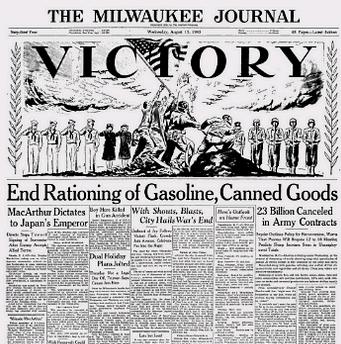
Ironically, the disaster was not reported by the newspapers until August 15.  The greatest naval disaster in American history was decidedly a less important news story that day, since the papers also reported Japan’s surrender and the end of the war.

Of interest to radio amateurs is the recreation of the ship’s radio installation (whose call letters were NABD) at the USS Indianapolis Memorial.

References

History at USSIndianapolis.org


Click Here For Today’s Ripley’s Believe It Or Not Cartoon


1935 Rowboat Portable Receiver

1935RowboatPortable80 years ago, the September 1935 issue of Radio Craft magazine carried plans for this rowboat portable, shown here in use in Central Park, New York.  The four-tube superhet broadcast set was fully self-contained with a built-in loop antenna, and made use of newly available miniature B batteries which were mounted inside the cabinet.

The set was billed as ideal for the romanticist who was bound for one of the tens of thousands of lakes within the domains of Uncle Sam.  The set was small enough for easy transport in a rowboat or canoe.  The builder of this set could take radio programs along for accompaniment by waves gently lapping at the sides of the boat.

Click Here For Today’s Ripley’s Believe It Or Not Cartoon


1940 Philco Portable

1940PhilcoPortableSeventy-five years ago today, this ad appeared in the Milwaukee Journal, July 28, 1940, for what was one of the smallest, or perhaps the smallest prewar portable radios. The Philco Model PT-89C featured four tubes, and the loop antenna was inside the carrying strap. A surviving example can be found at this link and some other photos and a schematic can be found at this link.

Click Here For Today’s Ripley’s Believe It Or Not Cartoon