Quick Links:


If you have advance warning of a hurricane or other emergency situation, it’s a good preparation to use your bathtub to store emergency water. Even if you take no steps to sanitize the tub, simply filling it with water is a good idea, since you can use the water for many purposes, such as cleaning. However, unless you clean the tub thoroughly before filling it, you probably don’t want to actually drink the water from the bathtub. Also, the tub is uncovered, so the water can be contaminated. Finally, there’s the possibility that some of the water will leak down the drain. The plug is designed to hold the water long enough to take a bath. If it leaks even a tiny amount, the water could be gone in a few days when you need it.
The products shown here are designed to solve those problems, and they do. For some people, having one of these on hand could be cheap insurance. If you live in hurricane country, you should consider the problem, and having one of these might be part of the solution.
The products shown below are normally available on Amazon. The first is the AquaPod, and the second is the WaterBob. However, at the first hint of a hurricane approaching the U.S., they quickly sell out. If you’re reading this before hurricane season, then it’s a good idea to order now if you think you will need one of these. If you need a water storage solution and it’s too late to order, continue reading, since this page shows many alternatives.
For a less expensive alternative, see our later post about disposable bathtub liners such as the ones shown here:
Essentially, each of these products is the same: A large plastic bag, made of food-grade plastic, that fits inside your bathtub. The bag itself would burst under the weight of the water, but cradled by the bathtub (which was designed to hold water in the first place), the bag serves simply to keep the water sealed up safely. It also prevents the water from leaking in case the tub’s drain doesn’t have a perfect seal.
Each of these comes with a spout to fill the bag from the tub’s normal faucet. To get the water out, each of them comes with a hand pump to transfer the water to more convenient containers. So overall, each of these products is a good idea, since it gives you a convenient way to store between 65 and 100 gallons of drinking water. For some people, having one of these could be a good solution.
There are a couple of downsides, however, that you should consider. First of all, all of these are really only good for a single use. There’s no way to completely empty it. So once you’ve used it, you need to dispose of it. For that same reason, there’s really no way to test it. I’ve never heard of one of these having a leak. They appear to be well made, and it’s very likely that they will serve the intended purpose. But if it proves to be defective, there’s no way for you to know until the hurricane is bearing down, at which time it’s probably too late to get a replacement.
In addition, there is the matter of cost. While the prices are very reasonable, it’s still something that you hope you never need to use. And it’s possible that you’re reading this hours before a hurricane is expected to strike your area. If you don’t have one of these stored away, it’s probably too late to get one. So it’s important to think about alternatives.
Other Water Storage Alternatives
Obviously, clean water is one of your most critical needs during an emergency. Many emergencies could cut off your supply of tap water. These could be a local water line break, a hurricane, a winter storm or blizzaard, or many others. If one of these is approaching, you should store water in all available containers, whether or not you have one of these. Your kitchen probably contains many pots, pans, and other containers, all of which were designed to hold items for human consumption. Your first order of business should be to fill them with tap water while that water is still safe to drink. Also, if you believe that the water might become unsafe at some point, it’s a good idea to turn off your water heater and turn off the intake valve. Then, you can get safe water from the tap at the bottom. (You’ll probably need to open a hot water tap on a higher floor in order for air to enter the system as you draw out the water.)
In addition, you can probably find additional containers in your recycling bin by making use of soft drink bottles. Simply clean them thoroughly and refill them with water. (Plastic milk bottles probably can’t be cleaned sufficiently to use for drinking water, although they also represent a way to store water for other purposes.)
If you are still expected to have power for a few hours, fill your refrigerator and freezer as completely as possible with water containers. The ice and cold water will keep the other contents of the refrigerator cold, and it’s another source of clean water.
Even without a special liner, the bathtub can still be used for water storage. You can clean it thoroughly for use. Presumably, if you get every last bacteria, then you can simply drink the water. However, you have no way of knowing whether you cleaned it well enough. But even if the water is questionable, you could later purify it with bleach.
You’ll also need water for things other than drinking. So even if you have plenty of drinking water stored elsewhere, filling the tub is cheap insurance.
If you do use the tub without a liner, you’ll want to make sure that the drain is completely closed and makes a good seal. If you’re not sure, a piece of plastic and caulk can ensure that the tub will remain full.
Emergency Bathtub Water Storage With Garbage Bags
After filling all other containers in the house with water, you can also make your own bathtub liner in one of two ways. The easiest would be to line the tub with clean plastic sheeting. Then, simply fill it as usual. It won’t be covered, but you can take care of that with additional plastic sheeting.
If you don’t have any plastic sheeting, you can also use normal garbage bags. Of course, such a bag will quickly burst if you just started filling it with water, because it was never designed to hold that much weight. But it will still keep the water contained. And the tub will provide the required support.
The process of filling them is not particularly difficult. Take enough bags to completely cover the surface of the tub. With a normal household garbage bag, you will probably need four or five. Place them in the empty tub, and open them up the best you can. If there is any sharp edge in the tub, such as the drain, it’s best to cover it up with something like a washcloth.
When you have them placed, you’ll need to start filling them. But you can’t immediately fill one of them all the way, because it won’t hold the weight. The bag will need to be supported by the tub, and by the other bags.
Therefore, you need to take turns filling them partially, while they’re already in their assigned spot. You won’t be able to get water from the faucet into the bags at the rear; so you’ll need to come up with another method. If you have some kind of hose that you can attach to the bathtub faucet (or another nearby faucet), that would be easiest. Lacking that, you’ll need to use another container.
Fill one bag part way, and then fill the one next to it to the same level. Once you’ve filled all of the bags to the same level, go back and add more to the first one. Eventually, all of the bags will be full, and snugly fitting in the tub.
When you pick the bags to use, make sure that you’re using ones that don’t have any kind of insecticide. This is a case where cheaper is better.
When all of the bags are full, you can tie off the tops to keep them sealed. Getting the water out will be slightly challenging, but not too difficult. A pump of some kind would be ideal. But if you don’t have one, you can simply use another container to remove water as needed.
Just as you filled them evenly, you’ll need to take the water out evenly. You’ll need to take turns taking water out of different bags so that the water level stays about the same.
If one of the bags springs a leak, that’s not a major emergency. You won’t be able to use that water for drinking, but it will still be safely contained in the tub for other uses. And because the other bags are separately sealed, you can still drink that water.
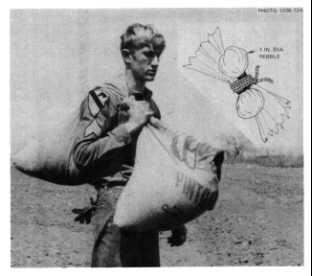 If you need more ideas for storing water in an emergency, a good source of ideas is chapter 8 of Nuclear War Survival Skills. Despite the title of the book, it is also an excellent source of information for practical ideas for other emergencies. For example, the illustration here is from that book, and shows a man carrying ten gallons of water in burlap bags lined with a plastic trash bag. You might not have burlap bags around the house, but you probably have pillowcases, and they will work as well. You can also use a trash can or heavy cardboard box with a garbage bag as a liner. (All of these will be heavy once filled, so you’ll want to put them where you need them prior to filling.)
Other Water Containers
Of course, if you know that a storm is coming, rather than relying on expedient solutions, it would be a good idea to have some containers designed for the purpose. The links below show just a few of the many possibilities:
Other Helpful Links
- Instructions from Clorox for purifying water using bleach
- Water Storage and Purification Information from Nuclear War Survival Skills–good information for any emergency
For more information on emergency preparedness, please visit some of the following pages on my website:
- Solar Showers
- How to make coffee without electricity
- Emergency communications primer
- Battery powered and 12 volt televisions
- Cheap cell phones for emergency use
- Food storage basics
- Free emergency preparedness books
Click Here For Today’s Ripley’s Believe It Or Not Cartoon 



 , but there do seem to be examples available on eBay and elsewhere. It’s a small battery-operated device that contains in its internal memory (with some limitations) the full contents of the English language Wikipedia.
 . The book is available in the usual places, such as
  , or your
  or in my own novel
  ), the survivors of the disaster have at their disposal the spoils of the earlier civilization. It’s a relatively simple matter to eat canned food, set up generators, and take advantage of what was left behind. In some cases, such as pandemic, that grace period might extend for generations. In other cases, such as nuclear war, there will be fewer benefits available from the earlier civilization, and survivors will need to get to work right away tending to their immediate needs.