Author Archives: clem.law@usa.net

1946 FM Converter

1946AugService

After the War, the FCC moved the FM band from its old home at 42-49 MHz to its current position at 88-108 MHz. This shift delayed the popularity of FM broadcasting, since all prewar FM receivers were rendered obsolete. For the serviceman dealing with frustrated owners of prewar FM sets, one possibility was examined in the August 1946 issue of Service magazine.

The magazine contained the plans for the converter shown here, which would allow owners of the prewar sets to listen to the stations appearing on the new FM band. For simplicity, the converter had its own tuning dial, and the old receiver was left on 43 MHz. The converter consisted of an oscillator containing a single 6SA7. The author noted that this tube wouldn’t function at 100 MHz, but it worked in this circuit since it was merely oscillating at 45-65 MHz, well within its published specifications. By tuning this local oscillator, the result was an IF of 43 MHz, which would be picked up by the old set.

In addition to construction details, some discussion was given to antennas for the new band. The author noted that in most cases, an outdoor antenna consisting of brass, copper, or aluminum tubing about 4-1/2 feet long would suffice. This was mounted outside, horizontally, and fed at the center with twisted pair. For locations with strong signals, an indoor antenna, perhaps an existing curtain rod, would suffice.

1946AugServiceSchematic

Click Here For Today’s Ripley’s Believe It Or Not Cartoon


Ray’s Radio Service, Glendale, CA, 1941

1941JulAugNatlRadioNews

Here’s what the inside of a prosperous radio shop looked like 75 years ago, as shown in the July-August 1941 issue of National Radio News.

It shows Ray’s Radio Service, 108 W. California St., Glendale, California, owned by Ray R. Linganfield. In his letter to the magazine, Linganfield reported that his wife was the inspiration for getting into radio when she asked, “why don’t you try to get into the radio business.” He took a $25 a week job at a music company, and spent all of his remaining time to National Radio Institute’s course. Based upon the practical experience and theory, he found that radio cam very easy.

Soon thereafter, he opened his own repair store and showed a net profit of $1200 in the first six months. He quickly built up the store shown here, and reported grossing over $2000 a month.


Click Here For Today’s Ripley’s Believe It Or Not Cartoon



United Press Shortwave Monitor Station, Valhalla, NY, 1941

1941Aug11BC

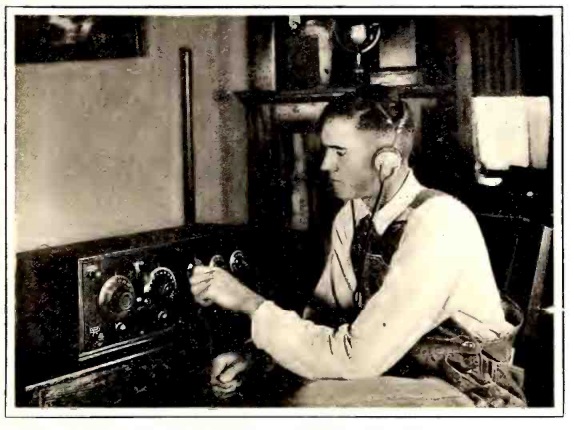
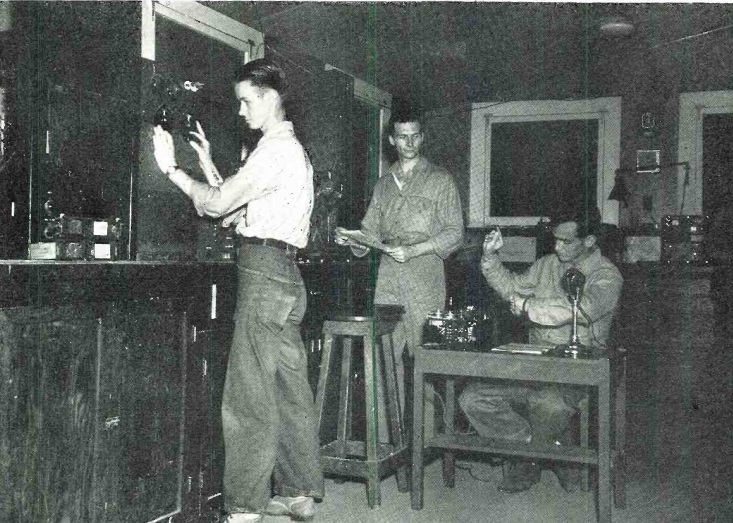
Seventy-five years ago today, this days issue of Broadcasting, August 11, 1941, carried this image of the shortwave listening post and receiving station of United Press at Valhalla, Westchester County, New York.

The magazine noted that the station’s existence had previously been a rather well kept trade secret, but had only recently been revealed by the press agency. The station had originally started in 1933 with a single operator, whose sole duty was to copy a Morse broadcast from Paris. By 1941, the station employed a dozen operators, and received scores of broadcasts daily from 15 to 20 capitals around the world.

The station was connected to the wire service’s network by a high speed printer connection to New York, and on a busy day for European war news, carried as many as 40,000 words per day.

The station was housed in a farm house, with the surrounding acres dotted with receiving antennas.

Click Here For Today’ Ripley’s Believe It Or Not Cartoon


1941 Car TV

1941AugustRadioCraft

New York probably didn’t have a distracted driving law in 1941, and the August 1941 issue of Radio Craft proudly proclaimed that “Car Television is Here!”  The first commercial TV broadcasts took place on July 1, 1941, and according to the cover photo, the gentleman shown here was able to tune them in, even though he was driving around the city.

But upon closer examination, it appears that the motoring public wasn’t in any danger when TV hit the airwaves.  According to the magazine, the cover photo is a “composite illustration,” and car TV was a coming thing.  The magazine promised, however, that a future issue would show how to build one.

Click Here For Today’ Ripley’s Believe It Or Not Cartoon


FDR and Churchill Meet, 1941

On this date 75 years ago, Franklin Roosevelt and Winston Churchill had their first in-person meeting of the war, aboard the U.S.S. Augusta, in Newfoundland.  While it was their first meeting as world leaders, the two men had actually met once earlier, in 1918, although Churchill didn’t recall the meeting.

The Lend-Lease Act had passed in March of that year, and it was clear that America would be involved in the war.  At their meeting, the two men drafted the Atlantic Charter, which included eight common principles to which the two countries were committed.  They agreed to a postwar world in which neither country would seek territorial expansion, and with liberalized trade, freedom of the seas, and international labor, economic, and welfare standards.  Both men agreed to the need for restoration of self-government for the occupied countries.

Churchill announced the Charter in this speech given a few days later:

Click Here For Today’ Ripley’s Believe It Or Not Cartoon


A Radio For Every Recruit, 1941

1941AugustRadioNews

With the United States having its first peacetime draft, there were a lot of inductees away from home needing a way to stay connected and entertained.  The August 1941 issue of Radio News pointed out the opportunity this afforded radio dealers in the form of a “radio for every recruit.”

The article noted that most–but not all–draftees had an income of $21 per month, hardly enough to splurge on a radio.  Instead, the article noted that most sales were made to the families of the soldier.  In fact, one dealer had the fortunate circumstance of having his ad for portable radios happen to appear on the same page of the newspaper listing the names of draftees.  He did record business as the families of those servicemen hurried to his store to buy one of those portables.

Army officials cautioned that it was best for soldiers to wait until after their permanent placement before buying one more belonging to drag around.  But battery portables and compact sets were proving popular, and some men were using radio-recorders to make records to send home instead of letters.

Click Here For Today’ Ripley’s Believe It Or Not Cartoon


Endorsements: Craig Foss for Minnesota Supreme Court, Ryan for Congress, in the August 9 Primary

I’m sure most OneTubeRadio.com readers have been eagerly waiting for my endorsement for the contested Minnesota Supreme Court seat, so here it is.

There are three candidates running in the primary election. Voters are asked to vote for one candidate. One will be eliminated from the race, and the remaining two candidates will appear on the November ballot. This is the only statewide primary election.

The incumbent is Justice Natalie Hudson, who was appointed to the bench in 2015 by Governor Dayton. Prior to her appointment to the Supreme Court, she served from 2002-2015 on the Minnesota Court of Appeals, and before that as an Asistant Attorney General. She began her legal career in 1982 as a staff attorney for Southern Minnesota Regional Legal Services. I will probably be voting for Justice Hudson in the November general election. You can read her response to questions by the Minnesota State Bar Association at this link.

Justice Hudson faces two challengers, Craig Foss and Michelle MacDonald.

Mr. Foss unashamedly states that he wants to become an appellate judge because “the demand for legally blind attorneys is not high. So I decided to see if I could get elected to a job.” He is a duly licensed attorney in the State of Minnesota, and has been since 1995.  He therefore meets the minimum legal and constitutional requirements for the position he seeks.

Ms. MacDonald is also a duly licensed attorney and has been since 1987.  Therefore, she also meets the minimum legal and constitutional requirements to appear on the ballot.  Ms. MacDonald also ran for Supreme Court in 2014 and sought, and obtained, the Republican endorsement. I was present at the 2014 state Republican convention when she was nominated, without discussion, after the now dissolved judicial elections committee recommended her nomination. (For the record, I did not vote for her during the otherwise unanimous voice vote.) Unfortunately, the committee recommended her without disclosing that she was then facing criminal charges. She was ultimately found guilty of some (but not all) of those charges. When her criminal charges came to light, the party backpedaled its support and refused to offer her a spot at the Minnesota State Fair. Ms. MacDonald showed up anyway and created a scene.

In 2016, she once again sought the Republican endorsement. This time, with her record known to all of the convention delegates, the party wisely decided not to endorse. In fact, it went a step further and disbanded the judicial nomination committee.  I voted with the majority on both of those votes.

For these reasons, I recommend voting against Ms. MacDonald in the upcoming primary. It is very likely that Justice Hudson, because of her incumbent status, will be one of the two top votegetters in the August 9 primary. Therefore, to ensure that Ms. MacDonald does not appear on the November ballot, I will be voting for Craig Foss. There will be two candidates in the November general election. In my opinion, Ms. MacDonald does not have the required judicial temperament to serve on the state’s high court. On the other hand, I have no reason to believe that Mr. Foss would not serve fairly and impartially. Indeed, his disability would probably bring an unrepresented point of view to the high court. I doubt if I’ll vote for him in November, but if he’s elected, I have every reason to believe that he will take his position seriously and will serve with distinction. He would not be an embarrassment to the state or to the legal profession.

Therefore, I endorse Craig Foss for Justice of the Minnesota Supreme Court in the August 9 primary election.

I also endorse Greg Ryan in the Republican primary for U.S. Congress in the 4th District (St. Paul area).

Attorney Richard P. Clem is solely responsible for the content of this page. This page is prepared and paid for by Richard P. Clem, and is not paid for by any candidate or candidate’s committee.

1941 Chicago Talking Juke Box

1941TalkingJukebox

Seventy-five years ago today, the Chicago Tribune, August 7, 1941, offered an interestingly candid look at the juke box industry in Chicago. Typically, a juke box would contain 20 records, and the patron put in a nickel in exchange for playing one of them.

Things changed when the K.P. Music corporation of 1057 Wilson Avenue came along with talking juke boxes known as “automatic hostesses.” Instead of twenty records, the patron had a choice of 680 records.  When the patron inserted his coins, he was connected, via leased telephone line, to a hostess at 1057 Wilson Avenue, with whom he could exchange banter, make a request, and even dedicate a particular number to his friends.

Eighteen taverns quickly signed up and junked their old jukes. This went over well with everyone, with one exception, and that was Michael J. Boyle, also known as the “Umbrella Man,” the head of the Electrical Workers’ union. He had two objections. He first argued that the new jukes were too good, and that hundreds of traditional juke boxes were in other taverns, with hundreds of dollars tied up. The new talking juke boxes would cut in too heavily, making the investment a “dead loss.”

Umbrella Mike got his name from his practice of hanging an umbrella from the bar when making a visit.  The owner of the tavern could then conveniently deposit an envelope into the umbrella so that Mike could be on his way with a minimum of fuss.

The old machines were serviced by, and more importantly, in the territory “belonging to” the Apex Cigaret Company of 4220 Lincoln Avenue. Depiste the name, Apex wasn’t in the cigarette business. Its business was juke boxes.

The newspaper identified Joseph “Gimp” Mahoney as the nominal president of Apex, “but Eddie Vogel, old time Capone gangster, is known as the power behind it. Those gentlemen’s relations with Mr. Boyle are cordial.”

To express their displeasure, the union’s business agent, along with about a half dozen members of the union, showed up at the 18 bars in question. They carried signs announcing that the talking jukes were “unfair to organized labor.” After picketing for a bit, the business agent would slip inside and unplug the machine. He also left some advice to the owners that “it was in their best interests that the boxes remain silent.”

Eleven of the 18 taverns took the advice, but at seven others, “the tavern owners showed the agent the door and the talking jukes went on talking.”

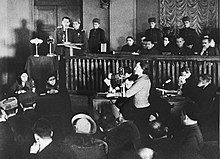
The newspaper reporter visited the talking jukebox studio and described the operation. The “hostess,” Miss Mickie Martin, shown above at the microphone, would be signaled by a light that some business was coming in from one of the taverns. Another indicator would show how many nickels had been fed in. Confirming that payment had been received, she would flip the switch and say sweetly, “hello, what can I do for you?”

The reporter noted that many voices would come over the wire, both old and new. “Some were those of strangers, some those of old friends who’d built up an acquaintance thru many nickels with Mickie.”

In one case, the connection was interrupted, and Mickie advised that they were having trouble at that establishment, since the business agent was there.

The firm’s attorney was dispatched to the bar in question, but by the time he arrived, the agent had pulled the plug and left the scene. The attorney lamented, “I’ve got 17 cousins on the police force, but what can you do when you run up against this kind of stuff?”

And not insignificantly, the old juke boxes were serviced by members of his own union.

Click Here For Today’s Ripley’s Believe It Or Not Cartoon


1956 Two Transistor Shortwave Regen

1956RadioElect

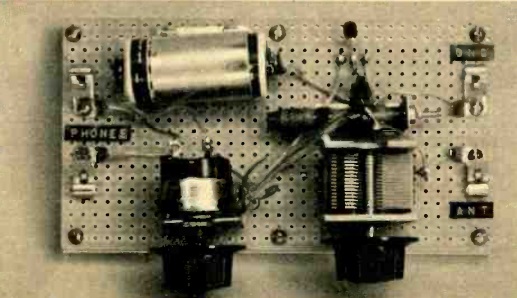
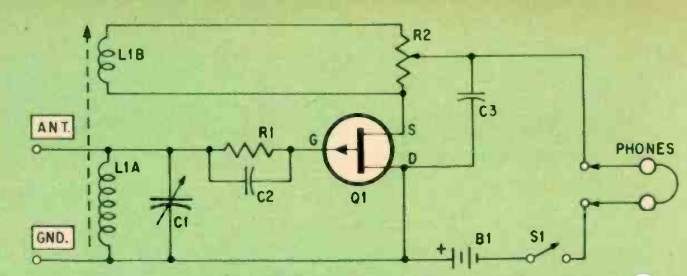
Sixty years ago this month, the August 1956 issue of Radio Electronics carried the plans for this receiver, which was probably the first, or one of the first, examples of an all-transistor shortwave receiver. Up until this point, high-frequency oscillation had been the stumbling block for a transistorized receiver. But GE had just put on the market the 2N137, and the circuit shown in the article could oscillate up to 12 MHz, and could even function at higher frequencies with less sensitivity.

The transistor had a steep retail price of $6.50, but this was predicted to drop as demand and production grew.

The author described the set as “a real ‘red hot,'” and reported that the dial was usually crowded with hundreds of stations. With an antenna consisting of 8 feet of wire on the floor, the set consistenly pulled in European and Asian stations and could keep pace with many communications receivers. It also performed well on the standard broadcast band.

The set used band switching, and had tuning ranges of 800-1600 kHz, 3.8-6.5 MHz, and 6-13 MHz. Regeneration was adjusted by means of variable inductive coupling, and the author reported smooth operation, even better than most vacuum tube circuits. The tickler coil was mounted on a plastic shaft, and could be rotated from the front panel to adjust the orientation with respect to the antenna coil. One stage of audio amplification (with a 2N107, kept the headphones isolated from the detector and almost eliminated the tendency for movement of the headphone cord to affect tuning.

The author suggested that the use of plug-in coils might push the operation of the set to higher frequencies, but the plans shown were a good starting point for anyone interested in the use of transistors at high frequencies. It resulted in a good portable radio that was both rugged and had very low power drain. He noted that these attributes made the set attractive for emergency or disaster use.

1956RadioElectSchematic

Click Here For Today’s Ripley’s Believe It Or Not Cartoon


Wartime B Battery Eliminator

1943AugPM

Despite appearances to the contrary, Junior is not trying to do anything untoward, and it’s clear from the picture that the father’s fingers are safely on the low-voltage connections. What this wartime father and son are doing is getting their battery portable back in commission, despite the unavailability of B batteries due to the war.

They are working on an emergency power supply, following the plans contained in the August 1943 issue of Popular Mechanics.

Even though B batteries were unavailable due to the war, the perfectly good radio could be put back into operation thanks to this power supply, which could be assembled from noncritical materials found in the radio enthusiast’s junk box.

Two different diagrams were provided, adapted to the needs of the particular set. Rectification was accomplished by using one or more radio tubes. If triodes were used, the grid and plate were tied together. The filament voltage for those tubes was obtained by wiring them in series with one or more 60 watt light bulbs. For a filter choke, the secondary winding of an old audio transformer could be used. Two or three electrolytic capacitors were required for filtering. In addition, a couple of 1 watt resistors were used as a voltage divider for supplying the various voltages required by the radio.

The 1.4 volts for the filaments of the radio could be supplied by a flashlight battery, or two wired in parallel.

As shown below, despite wartime parts shortages, this ingenious device successfully brought an otherwise useless portable receiver back to life.

1943AugPM2

Click Here For Today’s Ripley’s Believe It Or Not Cartoon