Author Archives: clem.law@usa.net

1977 Wrist Calculator

1977MayEEForty years ago, electronic calculators had been on the market for a few years, and they were starting to get smaller and cheaper. Those who wanted the smallest calculator might have given some consideration to this kit advertised in the May-June 1977 issue of Elementary Electronics.

Offered by Sinclair (the same people who put out one of the first inexpensive home computers), the wrist calculator sold in kit form for only $19.95. The ad noted that a pocket calculator was good, but goes only where your pocket goes. “Take your jacket off, and you’re lost.”

The wrist calculator, on the other hand, was always with you whenever you had calculating needs.

The calculator featured an eight digit display, and to squeeze in the keyboard, it used ten keys “do the work of 27.” The digits 1-0 were marked on the keys. But on the side of the case was a three position switch. In the center position, the keys entered the numbers. But when set to the left and right, the keys became function keys. In addition to the normal four functions, the calculator boasted percentage, square root, reciprocal, and square. It also had a five-function memory.

A set of readily available hearing aid batteries were said to give weeks of service. All parts were included, and assembly required only a fine-point soldering iron.


Coronation of King George VI, 1937

The Coronation of King George VI and Queen Elizabeth (the mother and father of the current Monarch) took place on this date 80 years ago today, on May 12, 1937.

King George V had died on January 20, 1936, at which time Edward VIII assumed the throne. Shortly thereafter, he caused a constitutional crisis after announcing his plans to marry American divorcee Wallis Simpson. The crisis was resolved by his abdication on December 11, 1936, at which time George VI assumed the throne.

Edward’s coronation was originally scheduled for May 12, 1937, and the event went on as scheduled, with George rather than Edward being crowned.

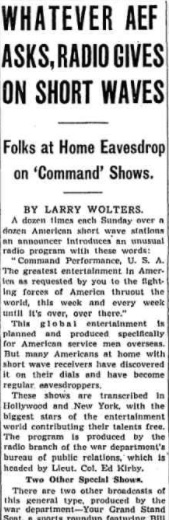
1937May15RadioGuideThe event was broadcast live by radio in America. Radio Guide for the week ending May 15, 1937 predicted that the event would be “without doubt, radio’s biggest show–the ‘crowning event’ in the twenty-odd years of radio broadcasting’s existence.” The magazine reported that there would be a battery of microphones in place to bring the scene to listeners all over the world.” NBC and CBS planned six hours of continuous coverage.


Battle of the St. Lawrence, 1942

This day 75 years ago marks the beginning of a little remembered part of the Second World War, the Battle of the St. Lawrence, which brought fighting to North America. In the early morning hours of May 12, 1942, a German U-boat sunk the freighter Nicoya.

While the Kriegsmarine had no formal plans to attack shipping in the St. Lawrence River and Gulf of St. Lawrence, the German submarine U-553 had been operating off the Canadian coast and made its way into the Gulf of St. Lawrence.  On May 12, it torpedoed and sank the Nicoya at the mouth of the St. Lawrence River.  Between 1942 and 1944, a total of 23 ships, including four Canadian warships, all well within the territorial limits of Canada.

Sources


1947 Toaster

1947ToasterThis ad for a humble toaster appeared 70 years ago in the May 12, 1947, issue of Life magazine.

Made in the USA, in a factory owned by General Electric, the toaster is undoubtedly well made.  It’s undoubtedly heavy, reliable, and probably made excellent toast.  The accompanying text touted the fact that it was adjustable, and the toast would be done exactly how you wanted it, light, medium, or dark.  The snap-in crumb tray allowed it to be cleaned in ten seconds.  And it even had another feature not found in modern toasters, the ability to have the toast either pop up when finished, or stay inside to keep warm until it was needed.

In the unlikely event that it broke, there were shops where you could take your toaster to be repaired.

In short, it was probably better than a toaster you would buy today, and it’s easy to pine for that simpler time when toasters were better.  Until you look at the price.

This simple toaster cost $17.75.  To put it another way, you could buy it with eighteen silver dollars, and those silver dollars would set you back exactly $18 in paper currency.  Those same eighteen silver dollars today would cost you over $300.

So yes, the toaster 70 years ago was better than the typical toaster you would buy today.  Today, you would probably buy a model similar to the ones shown below.


Yes, the 1947 version was probably better. But it was also a lot more expensive.


1937 Radio Facsimile

1937MayAllWaveRadio1

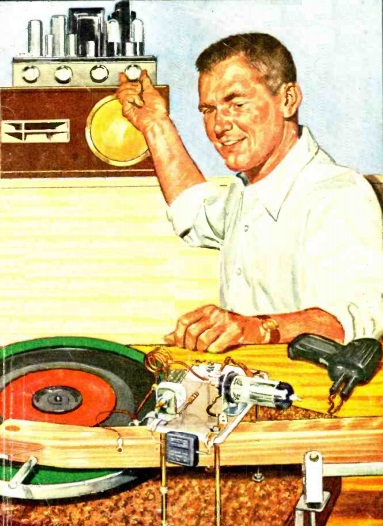
Eighty years ago this month, the May 1937 issue of All Wave Radio magazine carried a description by J.F. Gordon, W7CNP, of his method of sending facsimile by radio. The received image is shown above. While the system was quite simple in theory, it does appear to be quite labor intensive.

1937MayAllWaveRadio2The received image, shown above, is reproduced on photographic film. The original transmitted image, drawn in pencil, is shown at the left. Since the entire image is drawn in pencil, it is conductive, and can be scanned by a conductive stylus. There needs to be continuity between all points on the image, and for this reason, the letters are all linked by a pencil line. Before transmission, these lines are covered up with coil dope or another insulating substance.

The image is then scanned on a normal phonograph turntable, powered by a synchronous motor to keep the speed at both ends of the circuit exactly the same. The image is scanned by a stylus riding on a threaded rod geared to the turntable motor.

An audio signal is sent through the circuit from the pencil lead to the stylus, and this signal is used to modulate the transmitter.

1937MayAllWaveRadioTX

At the receiving side, an identical turntable is employed. For receiving, the stylus is replaced by a neon lamp. A piece of photographic film is placed on the turntable, which of course needs to be in a darkened enclosure. A second neon lamp is placed outside the box to make sure the system is receiving properly.

1937MayAllWaveRadioRX

The neon lamp is driven by the receiver audio. Assuming everything is working properly, when the film is developed, it sould reveal a negative image of the original pencil disk.


Science Fair Idea: How Lightning Rods Work

1937MayPS

For today’s science fair idea, we go back 80 years to find this idea from the May 1937 issue of Popular Science. Junior can demonstrate how lightning rods protect a building from fire caused by lightning. If the teacher insists that Junior answer a question, then he can use the experiment to answer the question, “do lightning rods protect buildings from fire?” Hopefully, Junior will discover that they do. But in the process, he gets to set fire to a paper model of a house using high voltage electricity.

The pictures should be self-explanatory.  At the left, the spark is being applied directly to the model house, which quickly bursts into flame after the simulated lightning bolt strikes.  At right, the structure is protected by a lightning rod, which safely carries the current to ground.

To generate the spark, the magazine recommends a “neon-sign transformer or a spark coil.”  If you don’t have a spark generating device around the house, the Internet is full of plans.  If you’re in a hurry, you can just purchase this Tesla coil at Amazon, and get the best of both worlds.  Junior doesn’t have to build the coil, but he did build the lightning rod, so he did the work to prove his hypothesis.  As a bonus, he gets sparks, flames, and smoke.  The teacher will certainly be impressed, and Junior will come home with a blue ribbon.

The decorations on the house are a nice touch, but are optional.


1927 Balloon Jumping

1927MayPMNinety years ago this month, the cover of Popular Mechanics, May 1927, shows a sport that inexplicably never caught on:   Balloon Jumping! As described in the magazine, a balloon of about 18 feet in diameter was attached to the jumper’s shoulders. In his pockets, he would carry lead weights. The balloon and ballast would be balanced so that the man’s net weight was about four pounds. Thus equipped, the jumper could leap to a height of about 40 feet and travel about a hundred yards. In favorable wind conditions, jumpers were known to travel over a quarter mile in one stride.

The balloon was filled with 3500 cubic feet of gas. In the event that the gas expanded in the hot sun, the balloon was fitted with a valve, allowing the jumper to vent excess gas, preventing uncontrollable lift.

After the jump was complete, the complete outfit could be packed into a large suitcase.

This video shows the sport in action, although it doesn’t look quite as graceful as depicted in the magazine:


Training Wireless Operators, 1917

1917MayPMA hundred years ago this month, the May 1917 issue of Popular Mechanics showed this image of woman students at Hunter College, New York.  The women were looking forward to the possibility of wartime labor shortages that would allow them to serve the government as wireless operators.


Fall of Corregidor, 1942

Japanese landing on Corregidor. Wikipedia image.

On this day 75 years ago, May 6, 1942, the island of Corregidor fell to the Japanese, not to be recaptured until 1945.

After the fall of Bataan on April 9, only the heavily defended island of Corregidor stood between the Japanese and control of Manila harbor.  In the first months of the war, the island was under aerial attack, and on May 5, Japanese landing craft began their assault. On May 6, General Johnathan M Wainwright sent a message to President Roosevelt, “There is a limit of human endurance, and that point has long been passed.”


Marine Direction Finding, 1957

1957MayPE

The mariner shown here 60 years ago on the cover of the May 1957 issue of Popular Electronics is demonstrating two methods of radio navigation described in the magazine, using a National NC-66 receiver and its optional external loop antenna.

Using the receiver alone, she is using the method that required no special direction finding antenna, and that provided accurate results even in a small bouncing boat.

That method used the “A-N” longwave radio ranges which were still operating between 200-400 kHz. While these aeronautical radio ranges were most often used by pilots, there was no reason why they couldn’t be used by boaters, as long as the craft had a longwave receiver aboard.

As we described in an earlier post, each of these beacons transmitted two signals in a four-leaf clover pattern. In two quadrants, the Morse letter A (dot-dash) could be heard. In the other two quadrants, the letter N (dash-dot) could be heard. At the intersections of the two signals (“on the beam” normally followed by pilots), the signals would merge and be continuous.

1957MayPE2For example, a boater shown at the position marked 1 near the bottom of this map would first tune to 227 kHz to beacon HEM at Mitchell Field, Long Island. She would hear the A. Then, she would tune to 248 to listen to the beacon IDL at Idlewild and hear the N. Finally, she could tune in EWR Newark on 341 kHz, where N would be heard.

By consulting the chart and using the process of elimination, this would narrow her location down to the relatively small quadrangle off the New Jersey coast.

The magazine also described the next logical step in navigation skill as use of the optional loop antenna and null meter shown at the top of the picture.  As we’ve described previously, such an antenna would allow an exact bearing to any station, using either a marine beacon or standard AM broadcast station.