Author Archives: clem.law@usa.net

Lafayette, Nous Sommes Ici!

File:Pershing at Lafayette Tomb.jpg

Gen. Pershing at Lafayette’s Tomb. Wikipedia image.

On this Fourth of July a hundred years ago, 1917, American troops had just arrived in France, and they used the occasion of the anniversary of American independence to march through Paris.

Col. Charles E. Stanton made a speech at the grave of Marquis de La Fayette at which he famously announced:

America has joined forces with the Allied Powers, and what we have of blood and treasure are yours. Therefore it is that with loving pride we drape the colors in tribute of respect to this citizen of your great republic. And here and now, in the presence of the illustrious dead, we pledge our hearts and our honor in carrying this war to a successful issue. Lafayette, we are here.

General John Pershing was present, and the quote is often mis-attributed to him. But it was Stanton who spoke these words.


Planning for Eclipse Gridlock

C3 Hotel & Convention Center

OneTubeRadio.com eclipse headquarters.

The official eclipse headquarters for OneTubeRadio.com is the C3 Hotel & Convention Center in Hastings, Nebraska. If you happen to be in Hastings for the eclipse, please stop by and say hello. We’ll be viewing the eclipse, and participating in some citizen science regarding radio propagation. We’ll be posting more details in coming weeks.


Quick Links


We’ll be staying in what looks like a very nice hotel with an indoor pool. While we haven’t decided on our exact viewing location, the hotel parking lot appears to be perfectly adequate. The cost of the hotel room was very reasonable, and we’re paying the normal nightly rate. Since Hastings, Nebraska, isn’t normally a major tourist Mecca, the normal nightly rate is quite low.

However, if you decide that Hastings, Nebraska, is where you want to be, there’s a zero probability that you’ll be able to find a hotel room within a hundred miles (although there are still a handful of hotel rooms available in some cities in and near the zone of totality.) We made our reservations last August, but now it’s too late.

How Many Last-Minute Eclipse Chasers Will There Be?

return to top of page
1911 Eclipse Crowds. Library of Congress.

1911 Eclipse Crowds. Library of Congress.

There has been very little media coverage so far of the eclipse, and most Americans probably haven’t heard about it yet, or have only vaguely heard about it. It seems likely that there will be a lot of media coverage in the week or two immediately prior to the eclipse. And many Americans will realize that they live within driving distance of the eclipse, and that the eclipse is a big deal. I predict that millions of them will decide, perhaps on the spur of the moment, to go see it.

According to Michael Zeiler of GreatAmericanEclipse.com, 174 million Americans, 53% of the population, live within 400 miles of the total eclipse. I happen to be in that category, since I’m just under 400 miles. At his website, Zeiler makes some estimates as to how many of those people will decide to get in their cars and go visit. To come up with an estimate, he makes some assumptions, and those assumptions sound reasonable to me. Zeiler estimates that persons living within 200 miles of totality will have between a 0.5% and 2% probability of deciding to go visit.

This certainly seems reasonable. Think of a group of between 50 and 200 people that you might know. Think about the people where you work or where you go to school. If there was an eclipse 200 miles away (normally, about a four hour drive), do you think that there is one person in that group who would take the day off and go see the eclipse? Obviously, I’m in that category myself. I’m even an early adopter, since I made my hotel reservation last year. Most people will be late adopters. They’ll see posts on social media a week before. They’ll start hearing about it in the news. And some of them, like me, will decide to go see it. And I think one person in 200, or even one person in 50, is a very reasonable estimate of how many such people there are.

Zeiler adjusts his estimates as people are further away from the total eclipse. For people in my category (200-400 miles away), he cuts the estimates in half. He estimates that the probability of their deciding to go is between 0.25% and 1%. Again, think about a group of people you know, such as people at work or school. Do you think that if you took a group of between 100 and 400 people, that there is one person who would drive 400 miles (normally, about an 8 hour drive) to go view the eclipse? That seems like a reasonable estimate to me.

As the population gets further away from the eclipse, Zeiler’s estimates go down. For example, he estimates that those 400-600 miles away have a probability between 0.125% and 0.5% of going to see the eclipse.

All of these estimates sound relatively conservative to me. Again, it’s not too hard to imagine that out of a group of 200 people, one or two will decide to take the day off from work to see a free event that’s being heavily hyped on social media.

But the effect of even this small percentage deciding to see the eclipse is quite staggering: If these conservative assumptions are correct, then between 1.85 and 7.4 million people will go visit the path of totality.

Where WIll the Visitors Go?

return to top of page

Where will these people go? They will probably drive to the closest point where the total eclipse will be visible. They’ll look at a map, determine the closest point, and then figure out the shortest route to get there.

In my case, the closest point where I can view the total eclipse is near Lathrop, Missouri, population 2086, just northeast of Kansas City. I go to Google Maps, where I am told that it’s a 403 mile drive from Minneapolis to Lathrop, and that it normally takes just under 6 hours. So in theory, I can get up early the morning of August 21, drive to Lathrop, Missouri, and view the eclipse. Then, I simply turn around, and get home by early evening.

But there’s a problem. A lot of other people will be descending on Lathrop, Missouri. It’s the closest spot for me, because it is where Interstate 35 intersects the path of totality. But it’s also the closest point for 12.5 million other people who live close to Interstate 35, including most of Minnesota and Iowa, as well as parts of Missouri, Kansas, and Oklahoma.

Here is Zeiler’s map showing the shortest travel route for these people to the eclipse, and every single one of those people has a preferred destination of Lathrop, Missouri:

Caption goes here.

Map courtesy of Michael Zeiler, www.GreatAmericanEclipse.com.

If one percent of those people decide to make a day trip to view the eclipse, then there’s a good chance that many of those 125,000 people will descend on Lathrop, population 2086.

That’s not quite as bad as it sounds, because those people don’t need to drive all the way to Lathrop. They’ll be perfectly happy being on a 70 mile stretch of highway north and south of Lathrop. That works out to 1785 people per mile. If we assume that there are two people in each car, that means 893 cars per mile. Since the freeway is two lanes, that’s 446 cars per mile in each lane. That’s about 12 feet per car. But according to Wikipedia, a full size car is about 16 feet long.

This means that if Zeiler’s predictions are correct, there could be a monumental traffic jam of greater than 70 miles, meaning that some Americans will miss the eclipse because they’re stuck in traffic just a few miles away from the path of totality.

And Lathrop, Missouri, is not the worst choke point. Zeiler has idenified many others that will be traffic nightmares the day of the eclipse, since they represent the point where major highways cross the path of totality. Lathrop is only the ninth worst. The largest choke point is where Interstate 95 meets the path of totality near Santee, South Carolina. This represents the closest point for most of the Eastern Seaboard. If anyone in New York or Philadelphia or Washington or Miami wants to visit the eclipse, then Google Maps will send them to Santee, South Carolina. For 74.6 million Americans, Santee, SC, population 740, is the best place to go.

For example, if you live in Jacksonville, Florida, and want to see the eclipse, then Google Maps will send you to Santee and tell you that it’s 240 miles and you’ll get there in 3-1/2 hours. But Google Maps will potentially also send 74.6 million other people there.  There will be a traffic jam.

Then How Can You See the Eclipse?

return to top of page

Does this mean that you should skip the eclipse? No, it does not. It doesn’t even mean that you shouldn’t make a day trip. After all, even in the worst case scenario, most (but not all) of the people stuck in the traffic jam on Interstate 35 near Lathrop will be stuck within the zone of totality. For those people, the traffic won’t be moving anyway, so it won’t really do any harm to get out of the car and look when the eclipse happens. And almost certainly, some of the people stuck on the freeway will take an exit as soon as they are within the path of totality and find a legal parking place on some other road.

But if you do decide to make a last-minute trip to view the eclipse, you’ll need to allow much more time than it ordinarily takes. If you don’t have a place to stay (and unless you act fast, you won’t have one), I think the best strategy is to leave Sunday and plan on driving through the night. Take turns driving, and sleep when you can.

I also encourage you to avoid the choke points, most of which are located along major north-south interstates. For example, from the Minneapolis-St. Paul area, it seems that Nebraska is a much more convenient destination, even though it’s more miles. Nebraska’s main choke point is in the extreme southeast corner of the state, and actually lies mostly in Kansas, since most potential visitors from Texas and Oklahoma will be routed to this point. Notably, a full 252 miles of Interstate 80 are within the path of totality. So even if you get stuck in a 252 mile traffic jam, you still won’t miss the eclipse.  But you do need to plan your route, and do your best to avoid the inevitable choke points

How Else to Prepare

return to top of page

The other thing to remember is that the communities in the path of totality may have seriously underestimated the number of people coming. Lathrop’s Wikipedia page optimistically states that “plans are in the works for Lathrop to host observers that come to Lathrop to view the eclipse.” But I wonder whether Lathrop (population 2086) is really prepared for 125,000 people.

Apparently, a solar eclipse festival is being planned for Lathrop, but according to the festival’s website, they still need volunteers, food vendors, and local land leases for camping, viewing, and parking. They do have buses scheduled from Des Moines and Kansas City.

Those buses will certainly help, but the Des Moines bus leaves at 5:25 AM and is scheduled to arrive at 8:00 AM.  It will probably make it in time for the eclipse, but if Zieler’s predictions are correct, it might not.  I predict that it will not arrive as scheduled at 8:00 AM.   (Update 8/13):  Since I originally wrote this post, I see that the organizers have changed the Des Moines bus departure time to 4:00 AM, which I think was a good idea and means that it will get there in time for the eclipse.)

The massive number of potential visitors to a small town highlights another point: It is very likely that there will be shortages of gasoline, food, water, and toilet facilities. If you are making a last-minute trip (or even one like mine that’s been planned for months), it seems wise to bring enough food and water for yourself, without having to rely on potentially strained local resources. Also, fill your gas tank before you leave home, and keep it topped off. It seems very likely that gas stations will run out of gas at some points close to the line of totality. At the very least, there will be long lines as those 125,000 visitors decide to fill up their tanks.

Since you don’t know exactly where or when the gas will run out, it’s a good idea to keep your tank as full as possible.  I would fill it up when you’re a hundred miles away, and then again when you’re 50 miles away.

Make Travel Plans Now!

return to top of page

Vista Inn & Suites Airport EastIt is still possible to make hotel reservations in and near the zones of totality. This is especially true in the eastern United States, where you can still get hotel rooms. I have links to available hotel rooms at this link. The situation in the western U.S. is much more tight, but some hotels are still available at this link.

Camping is now the only option in some areas, and will be soon in most other areas. Temporary campgrounds are being set up in many areas. I don’t think the current number of campsites will meet the demand, but there are quite a few campsites where you can make a reservation, guaranteeing yourself a spot. Even if you don’t normally camp, knowing that you have a safe place to sleep will allow you to make a much more leisurely drive on Saturday or Sunday, before the huge crowds arrive. Even an inexpensive tent and sleeping bag and a reserved campsite will be preferable to the uncertainty of having to sleep in your car in an unknown parking lot or at the side of the road. Since camping reservations are still available, this seems like inexpensive insurance. I have links to available campgrounds within the eclipse area, many of which are taking reservations.

Eclipse Opportunity for Churches and Non-Profits

return to top of page

Black-church-clip-art-free-clipart-imagesFinally, the possibility of large numbers of unprepared travelers seems like an opportunity for churches, schools, organizations, and even businesses within the eclipse area. If you are within the area of the eclipse, it seems quite possible that your area will be besieged with persons in need of food and lodging. While licensing requirements might not allow you to go into the hotel or restaurant business for profit, you can potentially provide a valuable service to eclipse travelers. Thousands of people might be grateful if you gave them a place to park, a safe place to sleep, food and water, and a place to view the eclipse. And frankly, most of those grateful people will probably be inclined to make a donation to your organization.

It seems to me that if your place of worship in the eclipse area has a parking lot, a fellowhip hall, a kitchen, and a restroom, then you should be prepared to extend your hospitality by using them. It might not be necessary. But if you make some minimal preparations before the eclipse, then you would be prepared if the need arises. The main preparations would be to have some of your members be willing to volunteer, and perhaps purchase enough non-perishable food to feed a large group of people.

If I were doing this, I would stock the church kitchen with pancake mix, syrup, spaghetti, canned spaghetti sauce, and powdered drink mix. It would not provide a gourmet meal, but it would give your unexpected visitors a filling breakfast and lunch if the local restaurants and grocery stores are overwhelmed by the crowds. And, of course, don’t forget the coffee.  Even if you don’t need to house anyone, a coffee pot set up outside the church will be a welcome sight to many visitors, and the accompanying basket for free-will offerings will probably fill up rapidly.

If I am right, then all you’ll need to do the night before or the day of the eclipse is to have your pre-arranged volunteers come to the church (where they can view the eclipse along with your visitors). If the town is gridlocked and unprepared, then all you need to do is put a sign out front reading, “Sleeping Space and Meals: Free Will Offering.”  And if I’m right and you tell the chief of police or mayor, “we can take a hundred people,” then I think you’ll have their gratitude as well.  If you are in the eclipse area but off major highways, then an announcement on local radio stations may allow you to take the pressure off overwhelmed neighboring communities.

If I am wrong, you have little invested, and you can donate the food items to the local food shelf.  But I think I’m right, and if I am, you want to be in a position where visitors to your town can tell you, “I was hungry and you gave me something to eat, I was thirsty and you gave me something to drink, I was a stranger and you invited me in.”

See Also:  Omaha World Herald article.


1942 One Tube “Beginner’s Special” Receiver

1942JulyPMSeventy-five years ago this month, the July 1942 issue of Popular Mechanics carried the plans for this simple one-tube regenerative receiver. The set was designed with wartime parts shortages in mind, and most parts were non-critical, and could be found in most junk boxes.

Future issues of the magazine would carry improvements, and most parts would be reused. In addition, the suggested breadboard layout was such that there would be room for more advanced designs to be built on the same board.

The set used a single 1Q5GT tube. It used one flashlight battery to run the filament, with four in series to provide the 6 volts B+. A battery eliminator was promised for the next issue.

Coils were wound on the cardboard tubes salvaged from D cell flashlight batteries. The article called for an external antenna and ground. Tuning was accomplished by setting regeneration to maximum, and then tuning until a squeal was heard. At that point, you would turn down the regeneration control just enough to listen to the station.

1942JulyPMschematic


1937 Weather Balloon

1937JulSWTV

Shown here from 80 years ago this month is a weather balloon from the cover of the July 1937 issue of Shortwave and Television magazine.

1937JulSWTVschematicThe accompanying article explains the operation. The transmitter consisted of two type 30 tubes operating push-pull, as shown in this schematic. The system was developed under the direction of National Bureau of Standards physicist Dr. L.F. Curtiss, who chose the type 30 tube due to their low cost, since there was no guarantee that the set would be recovered, and also due to their low filament drain.

The 45 volt B battery was specially designed and built by Eveready, and represented the lightest weight B battery ever built.

When the hydrogen balloon was launched, it began transmitting pressure, temperature, and humidity. Keying was done by an electric motor. While the article didn’t provide details, it appears that the length of each signal encoded the data. On the ground, a superregenerative receiver hooked to a strip recorder was used, allowing the duration of each pulse to be measured accurately. A vertical dipole was used for reception of the signals, which were on exactly 55 MHz.

Not surprisingly, the airborne signals could be received over a long distance, despite the low power. The article noted that signals had been received over a hundred miles, and from altitudes as high as 127,000 feet (24 miles). When the balloon reached maximum altitude, it burst, with the transmitter descending on a small parachute. The article noted that the parachute was mostly to prevent damage to persons or objects on the ground, recovery of the transmitter apparently being a secondary concern. Dr. Curtiss noted that it was his hope that the transmitters would soon be made so cheaply that it would no longer be worthwhile to attempt recovery.


Dominion Day, 1867

220px-Canada_flag_halifax_9_-04Today marks the 150th anniversary of the formation of the Dominion of Canada. The British North America Act, which served as Canada’s constitution until the constitution was “patriated” with the Canada Act of 1982, was approved by the British Parliament in February 1867, and received the assent of Queen Victoria on March 29, 1867, with an effective date of July 1, 1867. The Act united the colonies of Canada (which was divided into Ontario and Quebec), Nova Scotia, and New Brunswick.


1957 Underwater TV Camera

1957JuneRadioElecCover

Shown here on the cover of the June 1957 issue of Radio Electronics is a demonstration of an underwater TV camera, namely a special version of the Hancock Vicon IV made by HEC Corp., Redwood City, California. The camera was housed in a stainless steel cylinder with a small window on one end.

The camera itself was billed as extremely sensitive and not requiring additional lighting in most situations. The entrie camera weighed 95 pounds on land, but dropped to 12 pounds in the water. It came with a 500 foot cable, and could either be maneuvered by a diver or lowered by crane.

One valuable application was said to be in offshore oil drilling, or for inspections of canals, dams, irrigation canals, and ship hulls.

The original customer was the Department of the Interior, Fish and Wild Life Service, for underwater exploration of marine life. The Navy’s bureau of ships had also placed an order for hull inspection and salvage operations.

The camera, compatible with U.S. broadcast standards, came with a 500 foot cable leading to the associated controls and monitoring equipment.


2024 Eclipse Campgrounds

This is a listing of camping that will be available prior to the April 8, 2024 eclipse.  We maintained a similar list in 2017.  Some of the listings were for organized events, and some were merely property owners making their property available.  If you would like your camping facility listed here, please contact me at clem.law@usa.net with the relevant information.

If you are new to camping, see my page with advice on camping with inexpensive gear.

Note:  I don’t have any direct knowledge of any of these links, other than what they have on their websites.  Please contact the owners directly and ask any questions before making reservations.  The sites listed here range from very expensive “glamping” locations to inexpensive spots to pitch a tent in someone’s back yard.  Some will take self-contained RV’s only and no tents.  Others will take tents only and not RV’s.  So do your homework! Most of the listings explain whether or not toilet facilities are available.  If you’re not sure,  be sure to ask the owner.

Texas

Arkansas

Missouri

Indiana

Ohio

  • Findlay, OH.  Tent and RV sites, $185 per night, 2 night minimum.

Pennsylvania

  • East Springfield PA, Liars Den Fishing Lodge.  10 tent sites, 13 RV sites, lodging.  $115 per night, two night minimum.  Contact 541-530-0812 or crouchwendy at icloud dot com.

Oklahoma

Illinois

Kentucky

Michigan

New York

Vermont

New Hampshire

Maine

Ontario
Québec
New Brunswick
Nefoundland
Prince Edward Island

Mexico


ISO Certified Eclipse Glasses: $3.99 with Free Shipping. Made in USA.


2017 Listings

The links shown below are not current.  This was a listing I made prior to the 2017 eclipse.  I’m leaving the links here for the time being, mostly for the benefit of property owners interested in offering camping in 2024.  While most of these links no longer work, some of them do, and you’ll get an idea of what prices were charged in 2017, what amenities were offered, etc.

Oregon (2017)

Idaho (2017)

Wyoming  (2017)

Nebraska  (2017)

Kansas  (2017)

  • Robinson, KS – tent sites on football field
  • Summerfield, KS – Campers, $30, tents $15, for reservations call 402-xxx-xxxx. Taco bar benefit supper Sunday evening, 50+ campsites.

Missouri  (2017)

Illinois  (2017)

Kentucky  (2017)

Tennessee  (2017)

Georgia  (2017)

North Carolina  (2017)

South Carolina  (2017)

Advertisement:


Other Eclipse Links

Here are some links with more information regarding the August 21, 2017, solar eclipse:

General Eclipse Information:

Radio Links

Since radio propagation is affected by solar radiation interacting with the ionosphere, the brief period of “night” in the middle of the day can have measurable effects on radio signals, and some of these effects are not completely understood.  For that reason, there are some opportunities for citizen science by amateur radio operators during the eclipse.

I haven’t decided exactly how I am going to participate, but what I will probably do is send some beacon transmissions which will be picked up by stations of the Reverse Beacon Network.  This will allow me to participate with relatively little attention required by me while I watch the eclipse, but I’ll be able to review the data later and see how the eclipse affected my radio signals.

I will make this information available live during the eclipse, and you will be able to monitor how the eclipse is affecting the propagation from my transmitter.  At this point, I’m considering doing these experiments on 30 meters (10 MHz).  Effects will probably be more pronounced on lower frequencies, but higher frequencies will allow a more efficient antenna.  I think that 10 MHz probably represents the best compromise, but I’d welcome any input.

The following links include information on radio experiments to take place during the eclipse:


1957 Boys’ Life Hallicrafters Ad

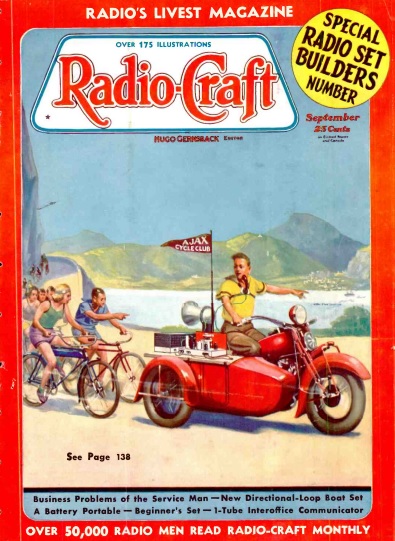
1957JuneBLHallicraftersAdSixty years ago this month, the June 1957 issue of Boys’ Life carried this Hallicrafters ad, highlighting the excitement available on the shortwave bands.

The comic book style ad featured a young hero with the unlikely name of Billy Hallicrafters. Billy and his friend Tim have been out boating and were securing their boat after a quick storm blew up. Billy agrees that the storm is a bad one, and invites Timmy to come tune the marine frequencies on his Hallicrafters S-85.

An amazed Tim asks whether it’s really possible to listen to the fleet talking, and Billy assures him that it is. In addition to the exciting traffic from ships, he tells Tim that he can tune in police, fire, amateurs, planes, and foreign stations.

They get to Billy’s receiver, where on an international emergency frequency they hear a desperate distress call from a ship run aground on a reef and sinking. The ship tries in vain to raise the Coast Guard, but to no avail.

Our hero Billy quickly gets on the phone to the Coast Guard and gives the ship’s position. The Coast Guard tells him that they didn’t pick up the SOS, but had a cutter and plane in the area. Twenty minutes later, the Coast Guard has rescued the ship, which included an injured man.

In the next scene, Billy and Tim are down at the dock talking to the grateful Coast Guard officer, who tells them that this proves that shortwave listening is both exciting and fun.

An ambulance is seen waiting to take the injured man to the hospital, and it turns out that Billy had taken it upon himself to have the ambulance standing by.

Tim adds that he’s going to get his own Hallicrafters shortwave set.

Billy’s S-85 is revealed to have a list price of $119.95. For the more budget conscious Scout thinking of listening for distress calls, the ad also showed the venerable S-38D with a list price of $49.95.


June 26, 1917: First U.S. Troops Arrive in France

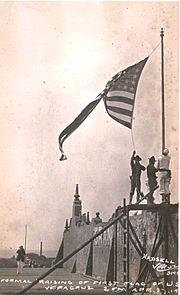
On this day 100 years ago, the first American troops of World War I set foot in France.  The landing location had been kept secret, but on that date, 14,000 American inantry troops landed at the Port of Saint Nazaire.  Despite the secrecy, an enthusiastic crowd was gathered at the port to greet them.  General Pershing quickly set up training camps in France to prepare the new recruits for war, and it would be four more months before they would enter combat.

References


1937 Field Day

1937FieldDay

This weekend was Field Day, an activity in which Amateur Radio Operators set up portable equipment and make as many contacts as possible during a 24 hour period.

My own effort this year was very minimalist. I operated as I did for most of my National Parks On The Air (NPOTA) activations, with my 5 watt Yaesu FT-817  with a Hamstick antenna mounted on the car. I only operated for about an hour, but made 13 CW (Morse Code) contacts to places such as Quebec, Florida, Kentucky, and North Dakota. My power supply consisted of my 12 volt fish finder battery,

Back in the day, both the equipment and the power supplies were much more intimidating, and a successful Field Day operation almost required a team effort. This video shows Field Day eighty years ago in 1937. The film shows W8NCD/8, the Charleston (WV) Amateur Radio Club. It is narrated by W8NCD, who is now a Silent Key.

Field Day has always been primarily a fun social activity, but it also has a serious side. It shows that amateurs are ready for emergency situations. In 1937, hams were able to set up at a remote location, without external electric power or any other infrastructure, and be in contact with the rest of the world. In 1937, there weren’t any cell phone towers, but hams managed to communicate around the world. Today, there are cell phones available, but in the location I was at today, at the bottom of the St. Croix River Valley at William O’Brien State Park, cell service is not available. But with five minutes of setup, I was on the air and communicating, just like they were in 1937