Seventy-five years ago, these high school students in Watertown, N.Y., were seen as a resource that would help the radio industry deal with wartime labor shortages. An article in the October 1942 issue of Radio Retailing explained the plan by which high school students could be trained to fill the gap. A group of servicemen in northern New York were planning to run an intensive course in radio servicing, open to high school seniors with a year of physics. The course was to be offered five nights per week, two hours each night, for ten weeks, and was taught by local servicemen who would both lecture in the classroom and offer periodic trips to the shop to tackle real receiver problems.
Classes would be small, and after it was completed, one or two students would take over the shop of an owner who had entered the military, running the shop on an evenings-only basis. The student would be paid a weekly wage based upon volume. Repairs would be paid by check or money order. The idea was to keep the shop open as a community service, with enough income to cover the shop’s rent, overhead, and cost of equipment.
The students would continue to attend school during the day and work at night.
Sixty years ago, domestic tranquility was restored in this household, as shown in this picture from the October 1957 issue of Popular Science. Dad and Junior can watch the fight, while Mom and Little Sister work on the piano lessons.
This major breakthrough was accomplished after extensive testing by the editors of the magazine. Every TV owner had been waiting for the good news: “a simple way for each member of the family to turn the sound off or on, to suit himself, without annoying anyone else.”
The magic that made this possible was the inductive loop. Because the headset was wireless, “there’s no dangling cord to tether you to the console.” The headsets could be made in a couple of hours, and the magazine proposed three varieties.
The modification of the set and the installation of the loop was an almost trivial matter. The magazine warned to unplug the set and let it sit for 15 minutes “for the tubes to cool off” (and hopefully for the electrolytics in the power supply to lose some of their charge). Then, the lead to the speaker was snipped and hooked to the inductive loop, as shown here. The magazine recommended adding the closed-circuit jack shown in the circuit here, so that the loop could be unplugged on those occasions when the speaker was desired.
The loop could be run under the carpet, as shown here, tucked away near the ceiling, or even placed in the joists in the basement below. While reception was best when the headsets were at the same level as the loop, the magazine’s tests showed that any of these arrangements would work well.
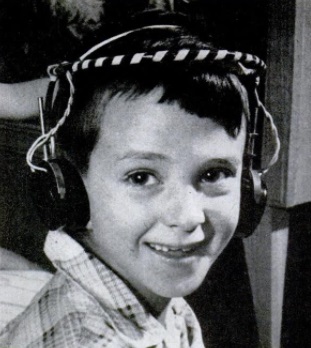
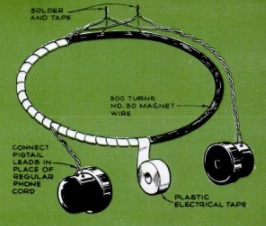
This loop formed the primary winding of a room-sized audio transformer. The secondary windings would be in the individual headsets. For the kids, the magazine recommended the spaceman style shown here, with the assurance that the kids would love them.
As revealed by the diagram below, these headsets were simplicity itself. The coil was worn around the head, and hooked directly to the headphones. The magazine suggested that Mom should be put in charge of suitably decorating the loop with colored tape. No other electronics were necessary for these headphones for the kids. The output of the coil was sufficient to drive the headphones.
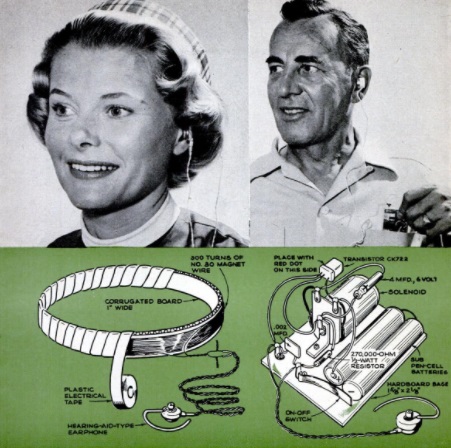
Mom and Dad warranted somewhat more discrete looking receivers, and these could be either of the models shown below. Mom had a version similar to the kids’ version, but the loop was not worn. It was apparently thought that she could set it in a convenient spot, and it was hooked directly to a small earphone. The magazine noted that the earphone was so small that it could hardly be seen. The only problem that might result would be forgetting to take it off before going to bed!
Dad is seen using a slightly more complicated version, but still easily within the capabilities of anyone able to wire up a lamp cord. It used a much smaller coil, amplified with the venerable CK722 transistor. It was the size of the proverbial pack of cigarettes, and the two penlight batteries would keep it running for a thousand hours.
Those wishing to duplicate this idea today can save a great deal of coil winding time by using a telephone pickup coil instead of winding the coils for the individual receivers. If a set of high-impedance headphones is available, it could be fed without any electronics. The CK722 is more or less unobtainium, except at very high prices. But any small audio amplifier could be put into service. If you want to make your own, hundreds of circuits are available using the readily available 2N2222 transistor.
It’s been 70 years, so perhaps they’re out of catalogs. But it won’t hurt to print the coupon, send it in, and see if they still have any. This ad for Fahnestock clips appeared in Radio News in October 1947.
Just in case they’re out of catalogs, there’s no need to worry. You can still get them at Amazon:
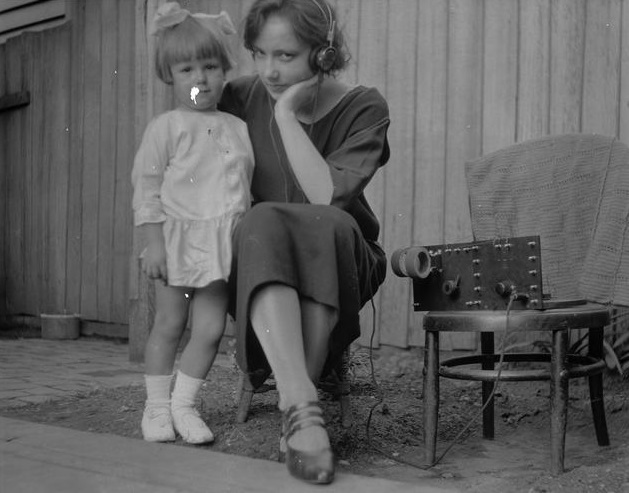
Shown here in 1923 is 17-year-old Florence “Dot” Cheers of Brunswick, Victoria, Australia, listening to a crystal set accompanied by her young sister Jean. The set had been constructed by their brother Ronald.
Florence went on to become a radio announcer known as “Aunty June” on station 3KZ in the 1930’s and 40’s. She married Smoky Dawson in the 1940’s, and the two achieved fame in country music in both Australia and the United States. The video below is a performance by Smoky Dawson.
Smoky Dawson died in 2008, and Dot died in 2010 at the age of 104.
The public-domain photograph, donated by Dr. Christina Cheers, is in the collection of Museums Victoria.
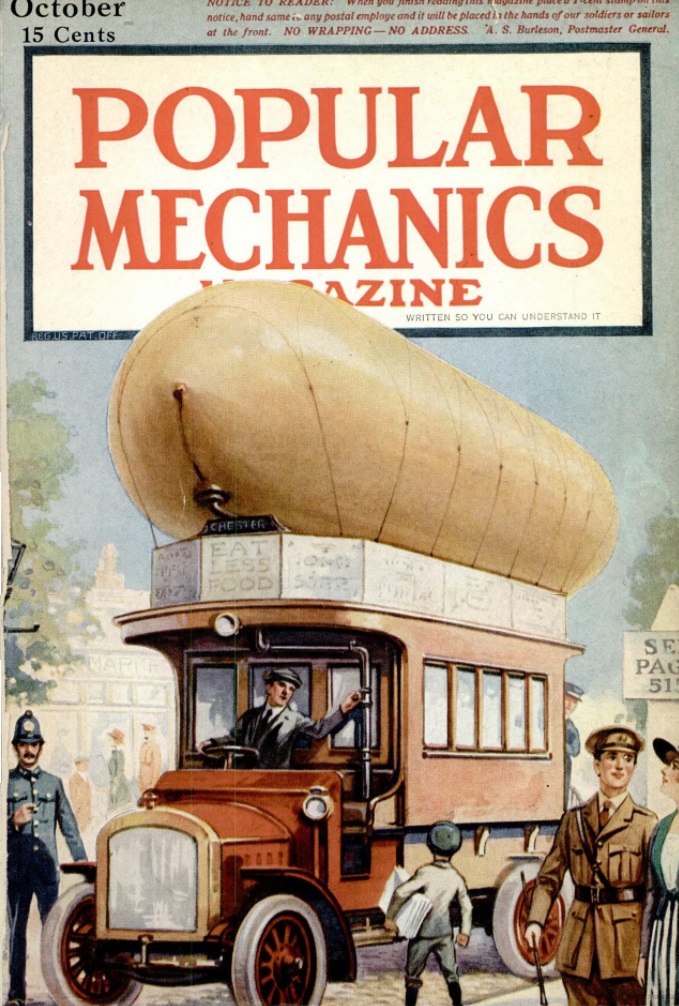
A hundred years ago, wartime conditions in England were such that there weren’t sufficient liquid fuels (gasoline or methyl alcohol) to run the buses. Undaunted, they switched to the same gas that was used to run the streetlights, conveniently stored in rooftop bags, as shown on the cover of the October 1917 issue of Popular Mechanics.
Complete information was apparently not available to the editors of the American magazine, since they noted that “the amount of power obtained from the lighting gas depends upon a number of things, and a reliable estimate could not be made without more detailed information thanis at hand. It is also not altogether clear why unwieldly bags are being used instead of compact steel cylinders which could carry gas under high pressure.”
But since the streets were already wired for gas, adding filling stations along the route was a minor matter. Indeed, some of the filling stations consisted merely of existing lamp posts situated near the curb.
Shown here as it appeared 70 years ago is the sales room of Concord Radio Corporation in Chicago. The picture appeared on the cover of the October 1947 issue of Radio News, which notes that complete stocks of radio parts, well displayed, were the secrets of the distributor’s success.
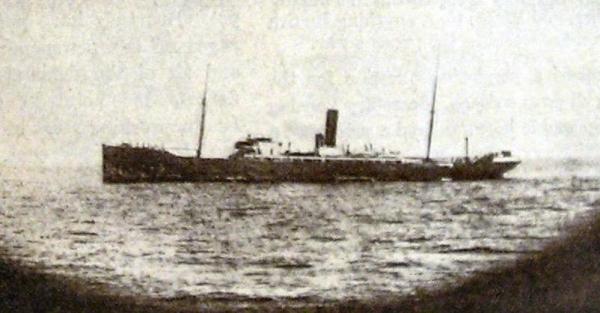
A hundred years ago today, the October 16, 1917, edition of the Chicago Tribune carried the story of Walter Smith of Norway, Connecticut. Earlier in the year, Smith, who had worked as a brakeman on the New Haven railroad, signed on as a muleteer on the British Cargo steamer Esmeraldas, which was sailing from Newport News to Liverpool with a cargo of 950 horses. At about 2:00 AM on March 10, the twelfth day of the voyage, the ship was overtaken by the German commerce raider SMS Möwe, shown above.
Smith was awakened by another crew member who announced, “they’ve got us,” to see the Möwe lying astern. Smith reported that the Möwe “looked like a tramp steamer, but it could travel, believe me. It had eight guns forward under a folding deck, and when it fought they raised the ship sides. They lowered them after battle and then it looked harmless.”
Soon, the ship was swarming with Germans, three of whom carried bombs. They took the 350 crew and passengers off and proceeded to blow up the Esmeraldas.
Smith reported that the prisoners were treated well aboard the Möwe, but also served as unwitting participants in five more battles as the Möwe continued her raids. On March 21, the ship reached harbor at Kiel, which was “full of warcraft, battleships, and hydroplanes, and it was a pretty sight to watch the hydroplanes darting down to the water like gulls.” The prisoners remained in Kiel for four days, and then another two weeks in Durmen. From there, they were taken to a prison camp near Brandenburg on April 4, and “we were in that dump until early in May. They pushed us and shoved us a good deal and called us swine and some other things.” Food consisted of “one chunk of bread daily and turnip soup. That turnip soup was good water spoiled.”
At some point in May, Smith and several hundred other prisoners were transferred to Lubeck, where they were put to work on the docks loading ships bound for Sweden. When the German freighter Undine was being loaded, Smith came up with his escape plan.
Prisoners were marched to the deck in groups of twelve at 6:00 AM, but Smith noted that men who had reported sick were not seen until later in the morning. So Smith reported himself sick. When the men were marched to the dock the next morning, he waited until a group had been counted, and then slipped in. The guards didn’t bother counting during the march, and they didn’t expect an extra man. At the dock, he joined in the loading. As soon as he was aboard, he hid himself in the hold along with the load of fertilizer. He remained there from Saturday morning to Friday morning of the next week. “It was dark, but I had a pocket lamp that lasted quite a while.”
Smith had brought some food, some crackers, but didn’t bring any water. Therefore, he was unable to eat “because my mouth and throat got so dry I would not swallow them. I tried to eat them, but they were like sand in my mouth and would not go down. All the time I was afraid and my tongue was getting bigger and bigger. It felt a foot thick.”
A few times, Smith considered going up and turning himself in, but after remembering the conditions at Brandenburg, he decided to wait.
On Thursday night, the ship docked at Norrköping, Sweden. In the morning, “looking like a wildman, a week’s growth of beard on his face, his tongue swolen from six days’ raging thirst, eyes blazing with fever, body shaking with nervous chills, but still full of fight,” Smith made a leap from the deck of the ship into the arms of a Swedish dock policeman. The Swedish stevedores, realizing the situation and manifestly sympathetic, shouted to the policeman to hustle Smith away from the ship.
After Smith’s imploring gestures, he was ushered to a hydrant “where he thinks he must have drunk a gallon of water without stopping, the policeman patting him on the shoulders the while.” He was taken to the police station and a telegram was sent to the U.S. Consulate in Stockholm.
The Chicago Tribune correspondent and a few others chipped in to buy Smith a suit of clothes, after which “Smith began to look really respectable.” The American Vice Consul went to the station to get Smith, saying that “I thought he’d proved himself a good American and deserved welcome,” and the consulate was making arrangements to send him home.
The following German propaganda film shows a number of the exploits of the Möwe, which was the most successful German raider of both wars.
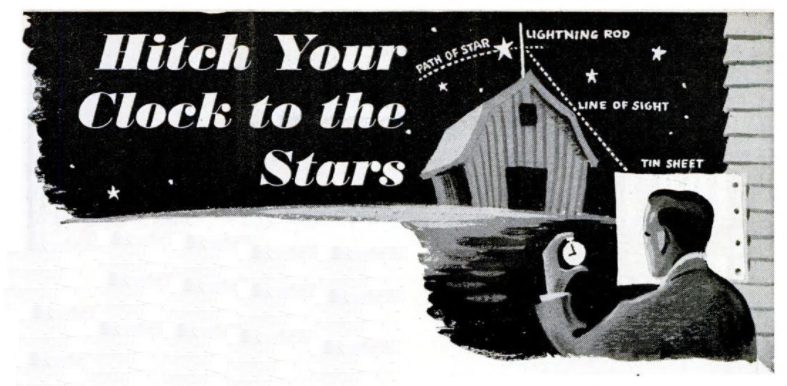
Seventy years ago, the October 1947 issue of Popular Science showed this method of making sure your watch was accurate.
While this method would not, by itself, give you the exact time, it would very precisely tell you the elapsed time.
The method was very simple. You simply installed a piece of tin with 1/16 inch hole on some fixed location, such as the side of the building. You used it to sight a vertical fixed object, such as a lightning rod or distant skyscraper. Then, you observed the exact time that any star was occluded by the object. Since the star is essentially a point of light, it would disappear suddenly. You noted the time.
Then, the next evening, you would observe the same star. It would be occluded exactly 23 hours, 56 minutes, 4.09 seconds later–one sidereal day. In other words, the time on your watch should read exactly 3 minutes 55.91 seconds before the previous night’s figure. (For all practical purposes, a sidereal day is 364/365 of a solar day. This makes sense, since the Earth itself has moved 1/365 of its way around the sun in 24 hours.)
Depending on whether your watch was fast or slow, you could thus adjust the spring.
If you knew the exact time the first night, then you could also create a table showing the exact time of occlusion subsequent nights. As long as you didn’t move the piece of tin, you would always know what time it is.
This method has two applications. After the zombie apocalypse, presumably WWV will be off the air. The stars give you a method to keep your clock calibrated very accurately. It could also be the basis for a very interesting science fair project.
Shown here in 1943 is eleven-year-old Beverly Ann Grimm of Buffalo, New York, taking a break from sweeping to listen to the radio. Beverly was largely forced to take care of herself and her five younger brothers and sisters. Her mother was widowed, and worked all week as a crane operator with Pratt and Letchworth. The mother’s name isn’t shown on the photograph caption, but according to the 1940 census, she was Thelma Grimm, and in 1940 lived at 60 Newman Street, Lackawanna, New York. According to the photo caption, Mrs. Grimm was 26 years old in 1943, but according to the census, she was 26 years old in 1940.
The photographer was Marjory Collins of the Farm Security Administration. The photo, taken here from Wikimedia, was digitized by Yale, and more information is available at this link. In the photo below, Beverly is shown bringing home the groceries purchased from her mother’s list.
I’m not able to make out the brand of the radio, which makes identifying it difficult. If anyone has any clues, please let me know! You can also find more information about this family and some of the artifacts in the pictures at this link.
The war effort of the United Nations depended on many minor miracles, and according to this ad in the October 12, 1942, issue of Life magazine, one of those minor miracles rolled off the assembly lines of the United-Carr Fastener Corporation of Cambridge, Mass.
That minor miracle was the banana plug, or as it was called here, the banana pin. The cause of war was calling Americans to every corner of the globe, and their communications depended on American radio equipment. And those sets contained banana plugs, lots of banana plugs. Hundred of thousands of banana plugs were in constant operation in planes, ships, and tanks, under all conditions of weather and battle. The banana plug was unseen and inconspicuous, but it insured the constant contact to keep the far-flung forces in touch with their commands.

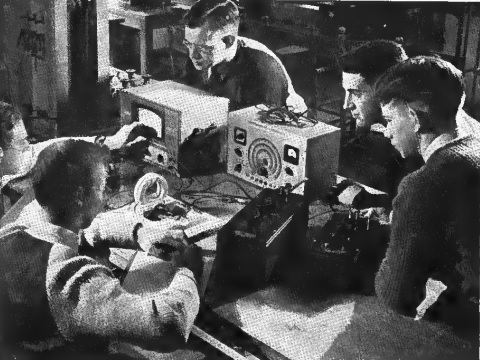 Seventy-five years ago, these high school students in Watertown, N.Y., were seen as a resource that would help the radio industry deal with wartime labor shortages. An article in the October 1942 issue of Radio Retailing explained the plan by which high school students could be trained to fill the gap. A group of servicemen in northern New York were planning to run an intensive course in radio servicing, open to high school seniors with a year of physics. The course was to be offered five nights per week, two hours each night, for ten weeks, and was taught by local servicemen who would both lecture in the classroom and offer periodic trips to the shop to tackle real receiver problems.