Author Archives: clem.law@usa.net

How To Change Your Picture Tube: 1959

1959MarEESixty years ago, the March 1959 issue of Electronics Illustrated showed how to change your own picture tube, including diagrams for common configurations of both horizontal and vertical chases. The article explained how to short out the capacitors in the power supply, lest the handyman get zapped by high voltage from a set that wasn’t even plugged in. And it also explained how to avoid shards of glass flying everywhere if the tube imploded.

But it was the magazine’s cover that offered the reminder that to do this sort of job, you really ought to put on a sport coat. And while it’s not visible in the photo, it seems likely that this home repair man is wearing a tie.



Charles D. Tandy, 1918-78

1979MarEEForty years ago this month, the March-April 1979 issue of Elementary Electronics carried this tribute to Tandy Corporation founder Charles D. Tandy, who had died of a heart attack at the age of 60 in November 1978. Tandy was best known in the electronics world as having purchased the fledgling Boston Radio Shack chain in 1963. The author of the magazine was none other than Lewis Kornfeld, the president of Radio Shack both before and after Tandy’s purchase.

According to Kornfeld, nothing made Tandy angrier than empty hooks in the parts department. He questioned why there could be even a single out-of-stock item when “I’ve made your life simple by eliminating thousands of slow movers.”

Tandy got his start in the leather business, and while serving in the Navy during World War 2, he noticed sailors being taught knitting and needlepoint as part of their recuperation. He believed the men would prefer leatherwork, and established a system of craft work for the hospitalized men.

The author of the tribute took over Tandy’s role in the company. The company’s monthly flyers included a “Flyer Side Chat,” in which Kornfeld would offer his opinions on some subject of interest. Interestingly enough, most (or perhaps all) of the Flyer Side Chats have been collected into a single volume. In addition, students of marketing would be well advised to read Kornfeld’s classic, “To Catch a Mouse, Make a Noise Like a Cheese.”
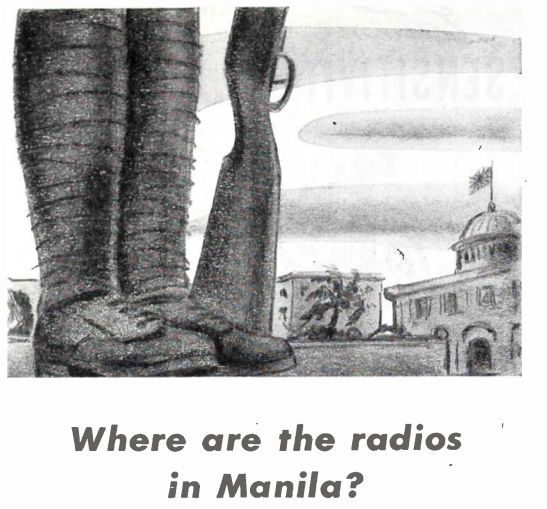


Where Are the Radios in Manila?

1944FebServiceSeventy-five years ago this month, this ad in the February 1944 issue of Service magazine asked where all of the radios in Manila were.  The Japanese flag and soldier gave the answer, namely, that the invaders took them.

The ad noted that of all war weapons, radio was one of the most important. “it unites the free peoples in a common purpose and links them instantaneously with their Governments. It maintains the power to resist of the conquered. It unites and aims the hammer blows of armies.”

America had 59 million radios, and it was the patriotic duty of the radio serviceman to keep those receivers functioning. The reminder came from the Jackson Electrical Instrument Company of Dayton, Ohio, which provided the tools to do just that.


Solar Eclipse of February 26, 1979

1979 eclipse 3.tif

1979 eclipse as seen in Bozeman, Montana. Wikipedia photo.

Today marks the 40th anniversary of the solar eclipse of February 26, 1979.  The path of totality passed through Washington, Oregon, Idaho, Montana, and North Dakota before entering Saskatchewan, Manitoba, Ontario, Quebec, and the Northwest Territories. From Canada, the path of totality entered the north Atlantic before ending in Greenland.

The path through Winnipeg, Manitoba, was tantalizingly close to my home in Minnesota, but I was unable to travel to see the spectacle. I had to settle for 90% coverage (in other words, millions of times more sunlight) where I was. I did vow that I would see the next one, in 2017, and I did.

This video shows coverage of the eclipse as totality passed through Winnipeg:


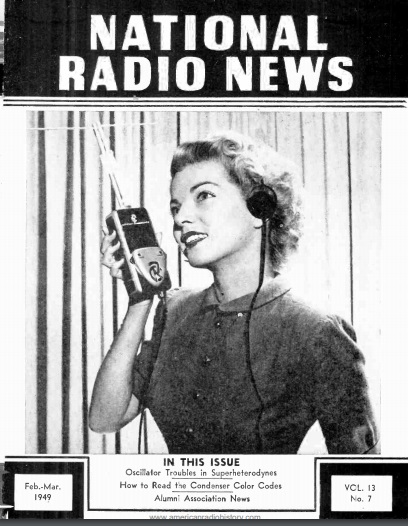
Citizens Radio Corp. Model 100-B, 1949

1949FebMarNRNShown on the cover of the February-March 1949 issue of National Radio News is the model 100-B citizen’s radio transceiver from the Citizens Radio Corporation of Cleveland, Ohio.  The set operated in the new Class B citizen’s radio service on 465 MHz, running an input of 3 watts with a 6K4 subminiature tube.  The superregenerative receiver used three 1V5 tubes.  The set itself weighed in at 11 ounces including antenna, but the total station equipment including batteries weighed 2-1/2 pounds.


RCA “The Floater” Radio 1969

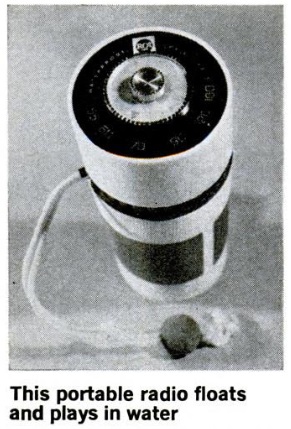
RCAFloater1968Fifty years ago, the February 1969 issue of Popular Science showed “The Floater,” an AM radio in the shape of a buoy that, well, floated.

It was billed as being suitable for pools and lakes, or even the bathtub, but the magazine noted that it was not suitable for use in salt water.  The set sold for about $20.

If you’re looking for a modern replacement, the following radios available at Amazon have varying levels of water resistance.


1919 Milk Skimmer

1919FebPSA hundred years ago this month, the February 1919 issue of Popular Science showed this simple device for skimming milk. It consisted of a glass tube and a rubber lid for the milk bottle. While the principle was not explained, it appears that the tube rests in the top layer of cream. When pressure is applied, the cream is dispensed through the tube.

For those too young to understand the concept, milk straight from the cow is not homogenized.  This means that if the bottle is left to stand, the cream will rise to the top, and the skim milk will settle to the bottom.  This device allows you to “skim” the cream, hence the name of the liquid left over.


Expedient Sled

1944FebPS
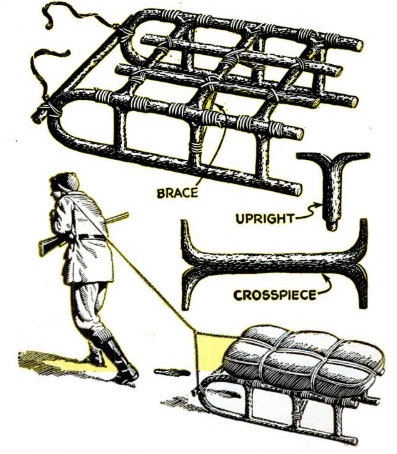
If you’re ever stranded in the wilderness in winter with an injured companion, then this idea could be a lifesaver. The February 1944 issue of Popular Science showed how to construct this expedient sled from a Chippewa design.

The magazine explained that ash was the best wood to use, since the green wood would bend without breaking.

The sled was lashed together, and the magazine explained that if you had no cord, you could use strips of ironwood bark. Or, if you were using the sled to haul your injured companion, you could use the laces from his boots.


1909 Electric Car

1909FebPopElect1909FebPopElect2One hundred ten years ago, this electric automobile was taking a charge in an uncluttered garage.  The charger employed a mercury arc rectifier, the operation of which was described in the accompanying article in the February 1909 issue of Popular Electricity.


1949 Television

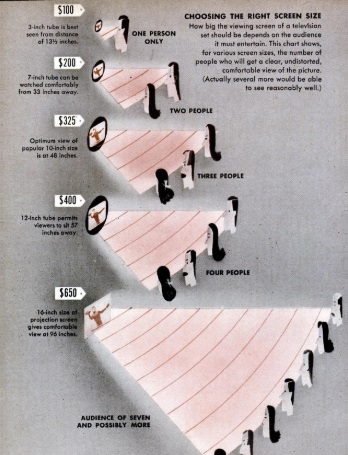
1959FebPS11959FebPS2Seventy years ago, television was the center of every family’s interest, and the February 1949 issue of Popular Science provided numerous pointers on buying a set. As shown in the graphic here, a key concern was the size of the screen, which would limit the number of people who could watch. A hundred dollars would buy a 3-inch (diagonal) set, suitable for a single viewer. For two people, you could expect to pay $200 for a seven-inch set. And the most popular option for families was the 10-inch set, which would cost around $325.

The set was likely to need service, and the article recommended that a one-year guarantee would be worth any additional cost.