Author Archives: clem.law@usa.net

Treaty of Versailles 1919

Fighting in the First World War ended on November 11, 1918, with the signing of the Armistice. And one hundred years ago today, the war officially ended with the signing of the Treaty of Versailles. Confident that he had made the world safe for democracy and ended all wars, President Wilson set sail for home.

It’s likely that the news headline shown above made its way to the American press (the same day as the treaty was signed, no less) via the key of Don Wallace, later W6AM, who served as Wilson’s radio operator.


1934 One Tube Shortwave Receiver

1934JuneSWCraftCoverEighty-five years ago this month, the June 1934 issue of Short Wave Craft showed how to put together this one-tube receiver, which the magazine promised would pull in foreign stations with a ten foot antenna.

The set used a type 19 dual triode, one half of which was detector, with the other half serving as audio amplifier to drive the headphones. The set could be used either as regenerative or superregenerative. This meant that it had excellent sensitivity on AM signals in the superregenerative mode, but it could also be set as a standard regen to copy CW signals.

The author, George W. Shuart, W2AMN, reported that on the first night after building the set, he was pulling in German stations in the heart of downtown Manhattan. He promised that anyone who built the set would be more than pleased with its smooth performance and simplicity.

1934JuneSWCraftSchematic


Radio Goes to School: 1944

1944JuneTuneIn11944JuneTuneIn2Seventy-five years ago, the over 170,000 students in the Philadelphia schools were getting a good dose of the fourth “R.” In addition to reading, ‘riting, and ‘rithmatic, the schools were taking full advantage of Radio. Thanks to the community spirit of the city’s commercial radio stations, regular lessons were scheduled. For example, for the elementary grades, WFIL carried “Studio Schoolhouse,” an educational program three days a week. The Monday program allowed the students, left, to participate in dramatized scripts about how they could help the war effort.

The pictures and accompanying article appeared in the June 1944 issue of Tune In magazine.


1929 Soviet One Tube Amplifier

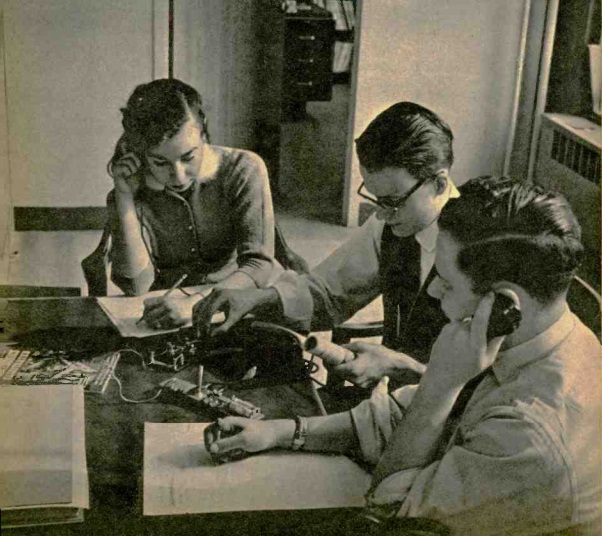
192906RadioL192906RadioL3Ninety years ago this month, these three Soviet radio experimenters were putting together what appears to be an audio amplifier, following the plans contained in the June 1929 issue of Радиолюбитель (Radio amateur) magazine.  Apparently, they’re either small experimenters, or they’re using a very large tube.

Unfortunately, the scan is rather low quality, but the word усилитель (amplifier) appears in the title.  There are headphones hooked to the plate, so it must be an audio amplifier.  The circuit is simple, with the only control being the rheostat on the front panel to control the filament voltage.  It’s likely that the input of the amp would be hooked to a crystal set, with the tube amplifying the volume to a more listenable level.

Not to be outdone, these Soviet girls are shown in the same magazine putting the finishing touches on another electronic project.

192906RadioL2


Majestic Model 130 Portable, 1939

1939JuneRadioTodayEighty years ago this month, the young woman shown here was pulling in some musical entertainment on her way to the beach, courtesy of her Majestic model 130 portable radio.  The “camera style” set, billed as the world’s smallest portable, featured a superheterodyne circuit, with a 3-tube lineup consisting of 1A7GT, 1N5GT, and 1D8GT, powered by a 60 volt B battery and a 1.5 volt battery to light the filaments.

The ad here appeared in the June 1939 issue of Radio Today.  You can see a restored example of the set playing at this video:

https://www.youtube.com/watch?v=lhrNX9HVt5o


1949 Radio Hat

1944JuneRadioElectSeventy years ago this month, the cover of the June 1949 issue of Radio Electronics showed the very stylish and useful Radio Hat, a product of the American Merri-Lei Corporation of Brooklyn, New York. I’ve only seen one of these in person, and I was always curious as to how well it performed. The magazine put the set to a test, and declared it to be a good performer.

With a price of under $8, the editors assumed that the original market was for children. But for travelers or sports fans, the set was quite adequate for adults. The magazine reported that in New York, it pulled in all of the stations well, especially outdoors, and even performed quite well inside steel buildings. The hat weighed only 12 ounces and was adjustable. The batteries, a 22.5 volt B battery and two A batteries, were carried in a pocket and connected to the hat with a cord. An earphone was in the hat over the left ear, but it was possible to move it to the right.

The two-tube set used a 1S5 as regenerative detector, with a 3V4 amplifying the audio.  The tubes were coated in plastic to prevent them from shattering in their exposed position.

If the model wearing the hat looks familiar, it’s because she is a 15-year-old Hope Lange, who went on to become an actress, probably most familiar as Mrs. Muir in the Ghost and Mrs. Muir.  You can also read more about the Radio Hat at its Wikipedia article, which is based largely upon the Radio Electronics article.

1944JuneRadioElectschematic


1959 British One Valve Radiogram

1959JuneRadioConstrSixty years ago this month, the June 1959 issue of British magazine Radio Constructor showed how to put together this one valve radiogram.  For readers on this side of the pond, that means a one-tube radio-phono combination.  A single ECL80 dual tube served as audio amplifier for both the radio and phonograph.  A simple crystal set using a germanium diode pulled in the local stations on either long wave or medium wave.

In addition to showing how to put together the simple circuit, the magazine promised that the cabinet work would be lucidly explained so that no difficulty would be experienced, even by a beginner.  A power transformer assured safe operation, and a single DP3T switch was used to select longwave, mediumwave, or gramophone.

1959JuneRadioConstrSchematic


Radio Direction Finding

1959JuneElecWorldCoverSixty years ago this month, the June 1959 issue of Electronics World carried a good basic introduction to marine direction finding (DF).  The cover image shows a number of commercially made DF units, and the article explains how they work.

While the technology looks archaic, it actually still works quite well, and will continue to do so as long as there are AM radio stations on the air.  While commercial direction finders are no longer readily available, virtually any AM radio will work well, as long as the antenna is directional.  And if the radio has an internal loop antenna, it will be directional.

For example, the inexpensive portable shown at the right will perform very well.  (It’s available at Amazon at this link, but any other inexpensive portable will work just as well.)  You simply rotate the radio until the signal is the weakest.  At that point, the internal antenna (usually in parallel with the top of the radio) is in a straight line with a station.  You place a ruler on the map over that station’s location, and draw a line in that direction.  You repeat the process with a second station, and where the lines meet is your location.  You’ll need to orient the map, so if you don’t know what way is North, it’s a good idea to have an inexpensive compass.  And you don’t really need a ruler.  You place the map on a table oriented with the Earth–the top of the map facing North–and then use the top of the radio as your ruler.

1959JuneElecWorld

This method is surprisingly accurate.  It’s very easy to find your location within a mile, and with some practice, you’ll be able to narrow it down even more.  It’s not quite as accurate as GPS, but if GPS ever becomes unavailable for any reason, this is an excellent backup method.  The example shown at the left is typical.  By knowing the exact location of radio stations in Chicago, Milwaukee, and Benton Harbor, MI, the boat can find its location within a few hundred yards.

Radio station locations are shown on maritime and aeronautical charts.  You can also find the exact locations of AM radio stations from the FCC database.


Sparton Model 590-1 Portable, 1939

1939JuneRadioRetailing

Eighty years ago this month, the June 1939 issue of Radio Retailing carried this ad reminding dealers that they should stock up on portables for campers, collegiate-ers, picnic-ers, and swingsters.

The set shown is the Model 590-1. The superheterodyne set featued a tube lineup of 1A7G, 1N5G, 1H5G, and 1A5G, with a 35Z5GT rectifier for use at home.  The set switched automatically from household current to battery by removing the line cord.


Milwaukee Girls Make Batteries, 1944

1944June18MilwJourSeventy-five years ago, wartime labor shortages meant that critical defense industries had to be creative when it came to staffing their plants. A logical source of labor came in the form of high school students, who eagerly took up the cause of defending the nation, and getting some spending money in the process. Today, there would probably be a great deal of hand wringing if kids were sent in to work with lead and acid, but these Milwaukee teens were eager to lend a hand.

Hundreds of students, both boys and girls, ages 16 and 17, were working for the Signal Battery Co. plant. Shown above cleaning batteries are Midge Wagner (left) of 2471 Fratney St. and Patsy Lee of 3219 N. Bartlett Ave. Both girls were students at Riverside High School. Also shown testing battery current is Mary Lou Burke of 2563 N. Farwell Ave., a student at Holy Angels Academy.

Northern Michigan University has on its website an interesting 1989 oral history interview with another teen worker at the battery plant, Evelyn Cieslick. She recounts:

I worked in a battery factory, in the summer when I was 16 years old, and we filled the acid that went into the batteries to make them work, and there weren’t enough boys around, so the girls took the summer jobs…. We worked in the factory and felt that we were doing our part in, for the war, along with everything else that was involved with giving up sacrifices for the war.

I had to take a bus to get there … in the mornings and, of course, work all day long, it was a summer job, and, like I said, all of us young people felt that we were doing our part by helping out. The name of the company was the Signal Battery Company. I’m sure they were for walkie talkies, and radios … for the war.

These photos appeared 75 years ago today in the June 19, 1944 issue of the Milwaukee Journal.  These young women are about 91 years old today.  We realize that people Google their own names, and we always enjoy hearing from people we have featured.  Please leave a comment below or e-mail me at clem.law@usa.net.  If you are one of the students shown here, thank you for your service to your country!