Author Archives: clem.law@usa.net

NUTS! 1944

Nuts194475 years ago today, during the Battle of the Bulge, four German soldiers, two officers and two enlisted men approached the American lines waving white flags. They had a message for the American commander. They were blindfolded and led to headquarters in the encircled town of Bastogne, Belgium, where they delivered the following message for Brig. Gen. Anthony C. McAuliffe:

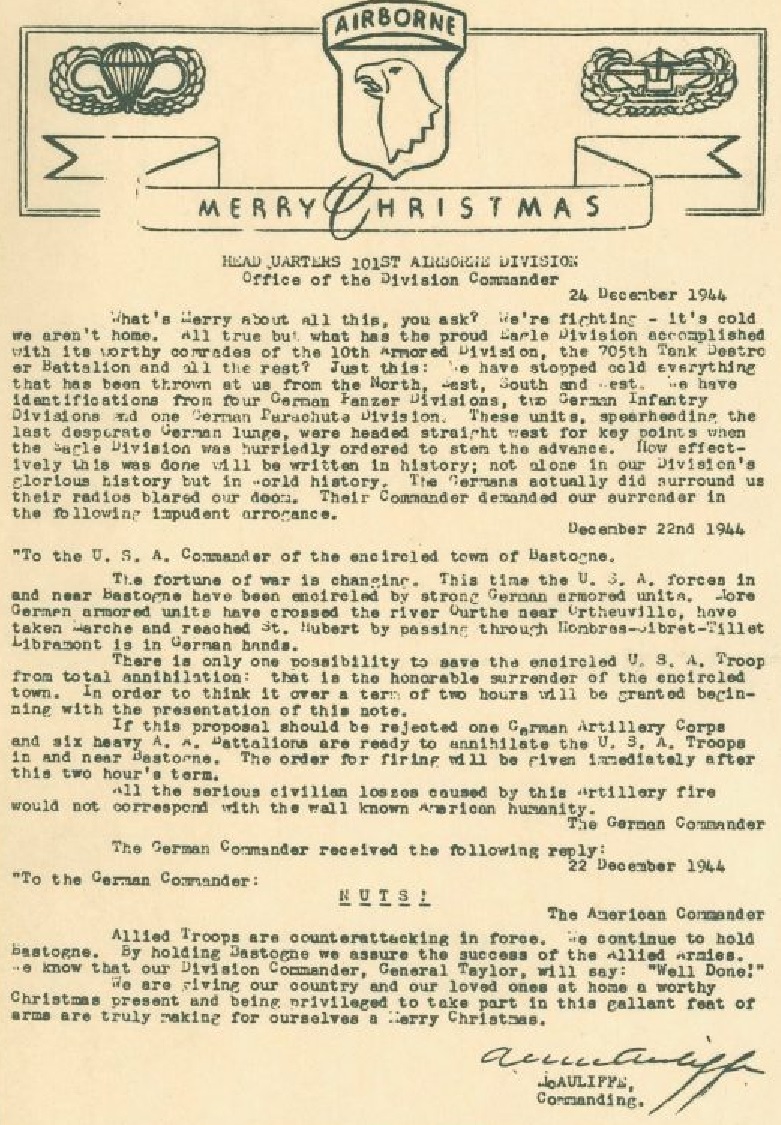
December 22nd 1944

To the U.S.A. Commander of the encircled town of Bastogne.

The fortune of war is changing. This time the U.S.A. forces in and near Bastogne have been encircled by strong German armored units. More German armored units have crossed
the river Ourthe near Ortheuville, have taken Marche and reached St. Hubert by passing through Hompre-Sibret-Tillet. Libramont is in German hands.

There is only one possibility to save the encircled U.S.A troops from total annihilation: that is the honorable surrender of the encircled town. In order to think it over a term of two hours will be granted beginning with the presentation of this note.

If this proposal should be rejected one German Artillery Corps and six heavy A. A. Battalions are ready to annihilate the U.S.A. troops in and near Bastogne. The order for firing will be given immediately after this two hours’ term.

All the serious civilian losses caused by this artillery fire would not correspond with the well known American humanity.

The German Commander.

The general, still half asleep, said “Nuts!” as he climbed out of his sleeping bag.

Since a written message was received, it was only fitting to deliver a written reply. After some consultation as to the exact language, someone suggested that the general’s initial response was the best. A typist was summoned, and the following reply was made:

December 22, 1944

To the German Commander,

N U T S !

The American Commander

It was explained to the German officers that the message essentially meant, “Go to hell,” and the Germans communicated this to their commander.

In his Christmas message to his troops, the general included the exchange, as shown above. As US Army Signal Corps photo, Wikipedia.we saw in a previous post, even though the town was cut off, it had a reliable VHF communications link, and supplies were being air dropped. And there was even a mimeograph machine which could be used for a Christmas message. If the German commander had known these things, it’s doubtful that he would have expected a surrender.
References


The North Russia Intervention and Christmas 1919

US troops guard Bolshevik prisoners. Wikipedia photo.

I had never known until recently that the soldiers of the U.S. Army had battled communists, on Russian soil, but they did, just over a hundred years ago. In fact, 83 U.S. soldiers were killed in action, and another 84 died of disease or accidents. An additional 29 were missing in action, and 12 were captured.

The U.S. entered the First World War after the abdication of Tsar Nicholas II. The Russian Provisional Government pledged to keep fighting, but the Bolsheviks came to power in October 1917, and the Russian Soviet Federative Socialist Republic (RSFSR) signed a peace treaty with Germany and the Central Powers a few months later.

The British and French felt the need to intervene and support the White Russians, who would continue the war on the eastern front, and keep supplies in Arkhangelsk from falling into German hands.

In July 1918, they persuaded President Wilson, against the advice of the War Department, to send U.S. troops as the American North Russia Expeditionary Force. The campaign was known as the North Russia Intervention, or informally as the Polar Bear Expedition. Allied troops sailed in to Arkhangelsk in August 1918. The Americans ultimately withdrew in April 1919, leaving the White Russians in a most precarious position.

A hundred years ago, a small band of those White Russians set off on skis to Finland, hundreds of miles away. Among their number was Anatol von Spakovsky. In a Wall Street Journal article, his son recounted the Christmas Eve spent during that retreat. It’s reprinted a number of places, including the Heritage Foundation, and it’s well worth reading.


1930s Five Meter Transceiver

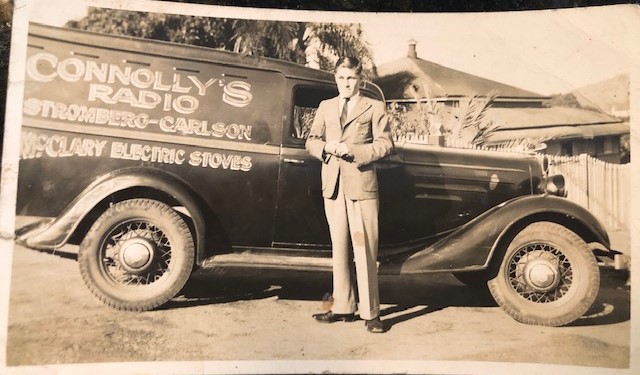
Uncle Jim Pearson with van

I received an interesting e-mail from Bob Miller, the nephew of the gentleman shown above, Jim Pearson of Townsville, Queensland, Australia. As you can see from the truck, he worked in the 1930s as a radio serviceman for Connolly’s Radio. According to this 1945 ad, the company was located at 128 Flinders Street.

According to the truck, the company sold Stromberg-Carlson radios. The American company started its Australian subsidiary in 1927 by importing American sets. But the subsidiary, Stromberg-Carlson (Australasia) Pty. Ltd., was autonomous, and soon began manufacturing its own sets for the Australian market. The McClary Electric Stoves advertised on the truck were possibly similar to this one.  Stoves by that name were also made in Canada.

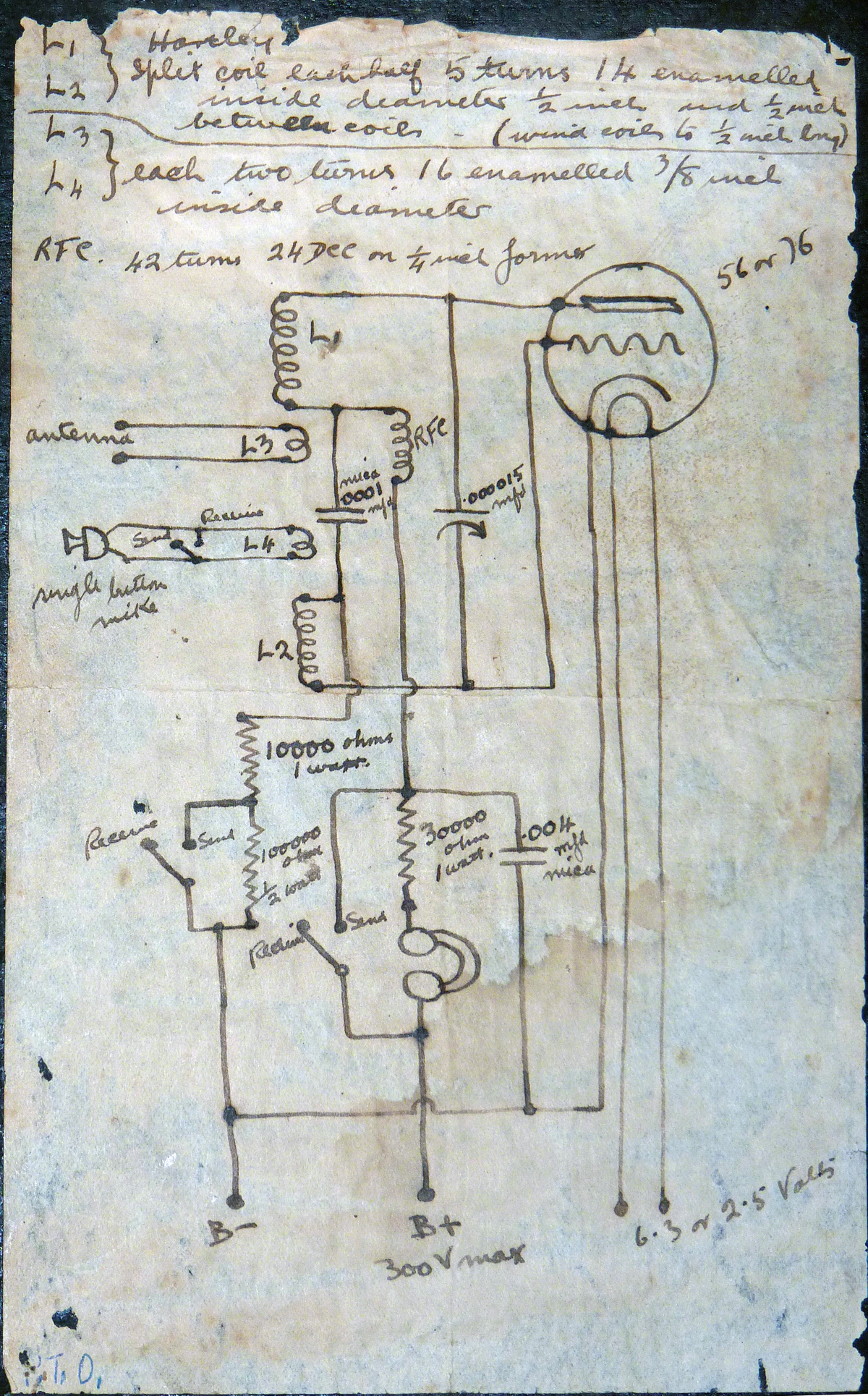
Uncle Jim's diagramPearson was killed in action in RAF Bomber Command in 1942. The reason I was contacted is the schematic shown at left, which was found in Pearson’s effects. For a larger version, from most browsers, click twice on the image. Miller correctly guessed, probably from the presence of both a microphone and headphone, that the circuit was for a transceiver.

The size of the main coils is specified as 5 turns, a half inch long, with an inside diameter of a half inch. This led me to believe that it was for VHF, either 5 meters or 2-1/2 meters. We’ve previously shown similar circuits for amateur and WERS transceivers, such as this one, this one, and this one. Some of those circuits have two tubes, the second one being an audio stage used both transmitting and receiving. But they all employed the same simple idea–a single tube is used for a transmitter, and by switching a few components around, as a superregenerative receiver.

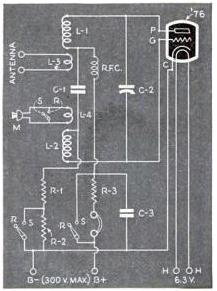
But something looked very familiar about this particular version. I did a little more digging, and realized that we had previously shown an identical circuit, the schematic shown here. The circuit was the design of Stanley Johnson, W9LBV (later W0LBV), of Grand Island, Nebraska, and appeared in the December 1935 issue of Popular Science.
The diagrams and parts specifications for the two sets are virtually identical, so the Pearson drawing must have originated with the Popular Science article. The only difference is that the article uses a type 76 tube, but Pearson’s diagram calls for either a 56 or a 76. The two tubes appear to be identical, with only the filament voltage being different. Perhaps the 56 was easier to find in Australia.

Johnson, the American author, went on to write a number of other construction articles over the years, such as a novice transmitter in the October 1951 issue of Popular Mechanics.  He died in 2003.

Miller didn’t know whether Pearson ever got his ham ticket or if he ever built the radio.  I checked the 1938 callbook listings for Queensland, and didn’t see any listing under his name.   Perhaps he was licensed elsewhere, or perhaps he planned on getting his ticket after the War.  That, of course, never happened, as his life was cut short by the War.

One of the reasons why Amateur Radio exists is because of its ability to promote international goodwill.  And I find it remarkable that a design by a young man in Nebraska, USA, made its way to another young man in Queensland, Australia, long before the Internet made such a thing commonplace.  Maybe Pearson or one of his friends subscribed to the American magazine.  But more likely, some American ham was talking with an Australian ham about his new five-meter rig, sent a copy of the diagram, and the diagram made its way, via the grapevine, to a young man in Queensland who decided to give it a try.


Source of Power Supply Inductors

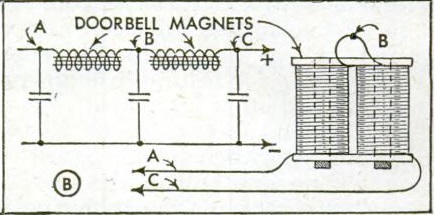
1944DecPM2Wartime parts shortages were the inspiration for this idea from the December 1944 issue of Popular Mechanics. If you were building a power supply, you might not be able to find filter chokes, but you did have an old doorbell or buzzer. As shown here, that could be turned into two inductors and used with capacitors to filter the output of a rectifier.


GE Model HJ-628 and Trav-Ler “War Reporter” 1939

1939DecRadioToday3

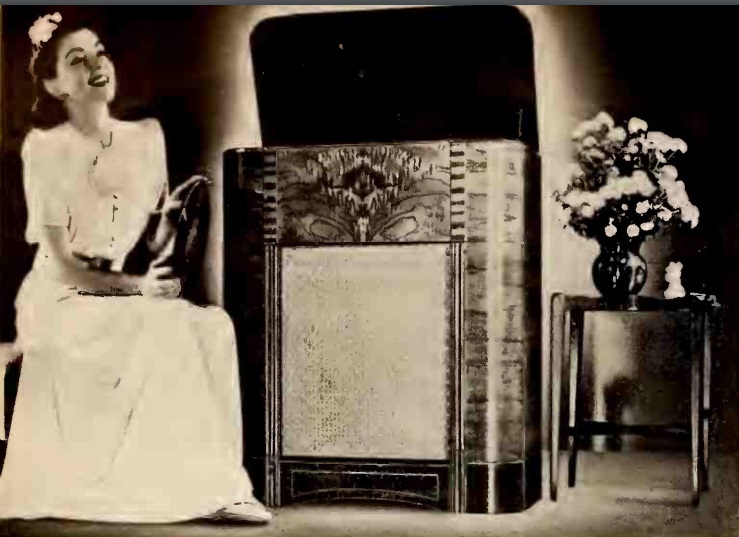
There was a time when people dressed up to listen to the radio, as shown from this picture in the December 1939 issue of Radio Today.  This young woman is listening to her GE model HJ-628 six-tube radio-phono console with its walnut cabinet.

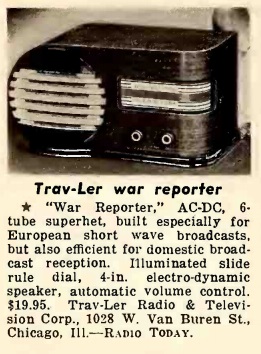
1939DecRadioToday4The set featured six pushbuttons, “feathertouch tuning keys” to be specific. The phonograph was automatic. Unfortunately, it didn’t tune the short waves; it covered only the standard broadcast band. For those wishing to tune in the war news straight from Europe, the Trav-Ler Radio & Television Corp. had just the thing they needed highlighted in the same magazine. Shown at left is the Trav-Ler “War Reporter,” a six-tube set designed specifically to pull in European broadcasts, in addition to the standard broadcast band.


Television Controlled Machine Gun: 1944

1944DecRadioCraftCover

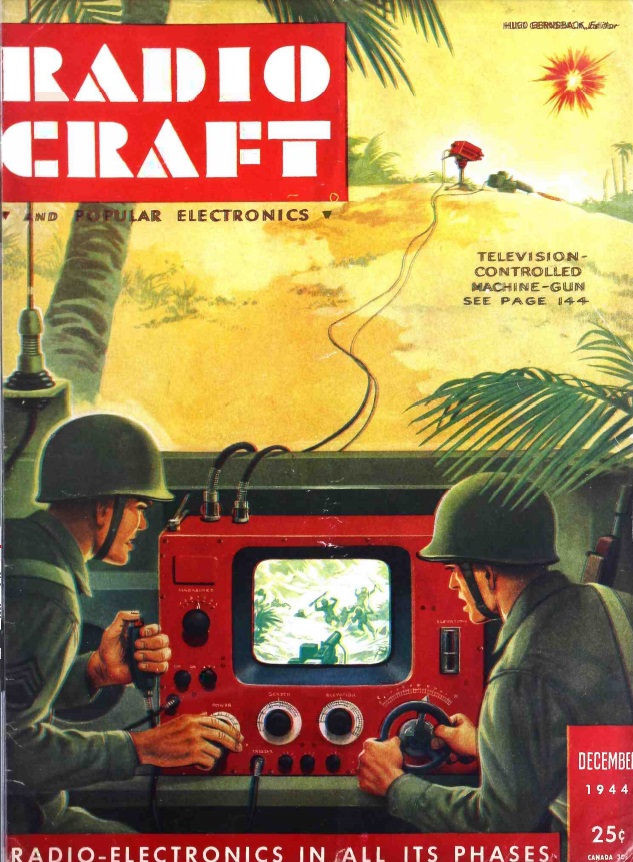
This self-explanatory “television controlled machine gun” appeared on the cover of the December 1944 issue of Radio Craft.  It was not, however, an existing weapon system.  Instead, it was the vision of publisher Hugo Gernsback, who wrote the accompanying article describing the system.

It was intended for a defensive position, and Gernsback admitted that it might eventually be overrun.  But when that happened, he noted, there would be no casualties.  And a second and third layer could then take over.

Gernsback also anticipated active night vision equipment.  He pointed out that his system could be used at night simply by installing some infrared floodlights, which the TV camera would pick up with no difficulty.


1944 Boys’ Life Hallicrafters Ad

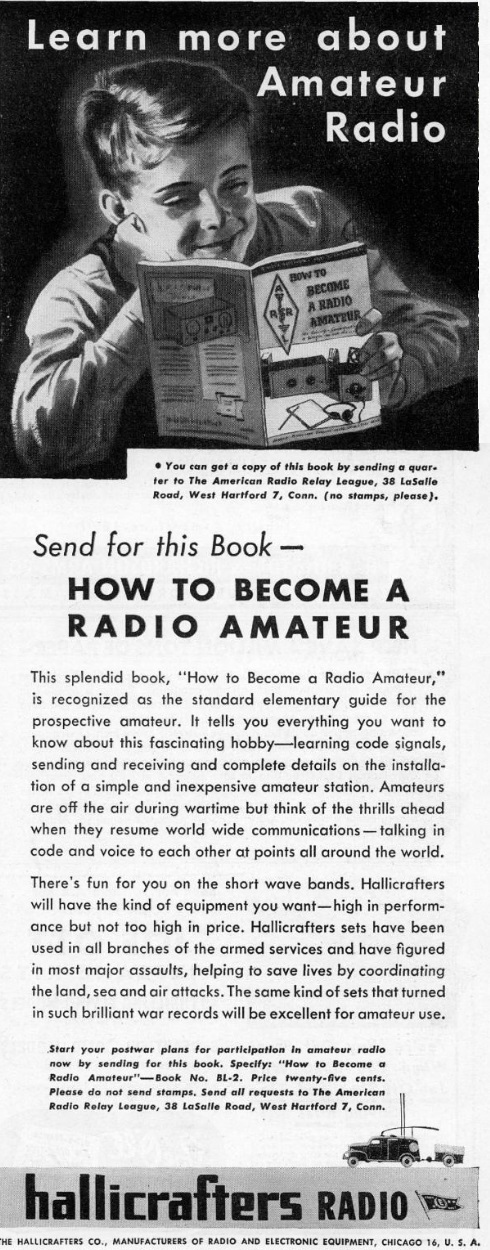
1944DecBLIn 1944, with wartime bans in place, Hallicrafters didn’t have any equipment for sale to civilians. But they were gearing up for a postwar boom, and they figured a lot of Boy Scouts would be in the market for radio equipment as soon as the war was over.

This ad appeared 75 years ago this month in the December 1944 issue of Boys’ Life. It encourages young radio fans to send 25 cents to the ARRL to get the most recent edition of “How to Become a Radio Amateur,” a splendid book.


Maurice Goldberg: Minnesota Radio Pioneer

1944DecRadioRetailingShown here in 1944 is Maurice G. Goldberg, the owner of Beacon Radio Service Shop, 142 East Fourth St., St. Paul, MN. The shop had been in business for 20 years, and even before the war had concentrated on service. Indeed, the sign outside read, “if we can’t fix it, throw it away.”

Even with wartime parts shortages, the shop was living up to its reputation of being able to fix anything. And since new sets were not available for sale, his decision to concentrate on service proved profitable.

Goldberg had been able to keep many radios operating by interchanging tubes, with often meant having to rewire the set. He was so flooded with business that backlogs ran about three weeks. He did, however, prioritize oldtime customers. His reasoning was that when conditions returned to normal after the war, many customers would return to local dealers. But the long-term customers would appreciate the loyalty shown to them.

Greenberg also taught at the Dunwoody Institute in the Army training program. He did occasionally get students who were available to help out in the shop, but he did the bulk of the work himself, working long hours.

Goldberg was indeed a Minnesota radio pioneer. He’s listed as of 1924 as the licensee of KFOY, with broadcast 250 watts on 1350 kHz (222.1 meters). This frequency was shared with WAMD Minneapolis, licensed to one Stanley E. Hubbard. The stations were bought in 1928 by the National Battery Company, which merged them together under the new call sign KSTP, with Hubbard as general manager. Power increased to 25,000 watts, and Hubbard re-acquired a controlling interest in 1941.

The photo above appeared 75 years ago this month in the December 1944 issue of Radio Retailing.


Printed Circuits: 1959

Screen Shot 2019-12-04 at 11.45.38 AM
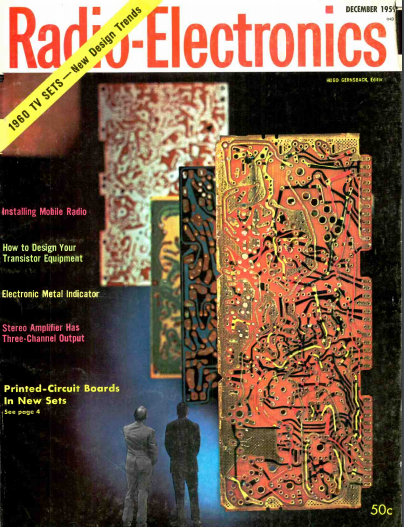
These two television servicemen, pictured on the cover of Radio-Electronics, December 1959, realize that printed circuits are here to stay.  Fortunately for them, as the magazine explains, the boards are becoming very reliable, and are designed to make servicing of television sets easier.


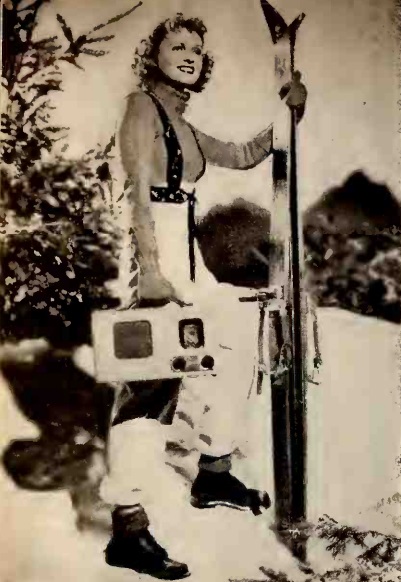
Skiing With the Portable Radio, 1939

1939DecRadioToday2Eighty years ago, this skier didn’t want to be out of the loop when she hit the slopes, so she brought along this Philco portable radio.  She appeared in the December 1939 issue of Radio Today, which noted that the well-equipped ski fan now carries along a portable radio.  It also pointed out that such persons are a new prospect for dealers.