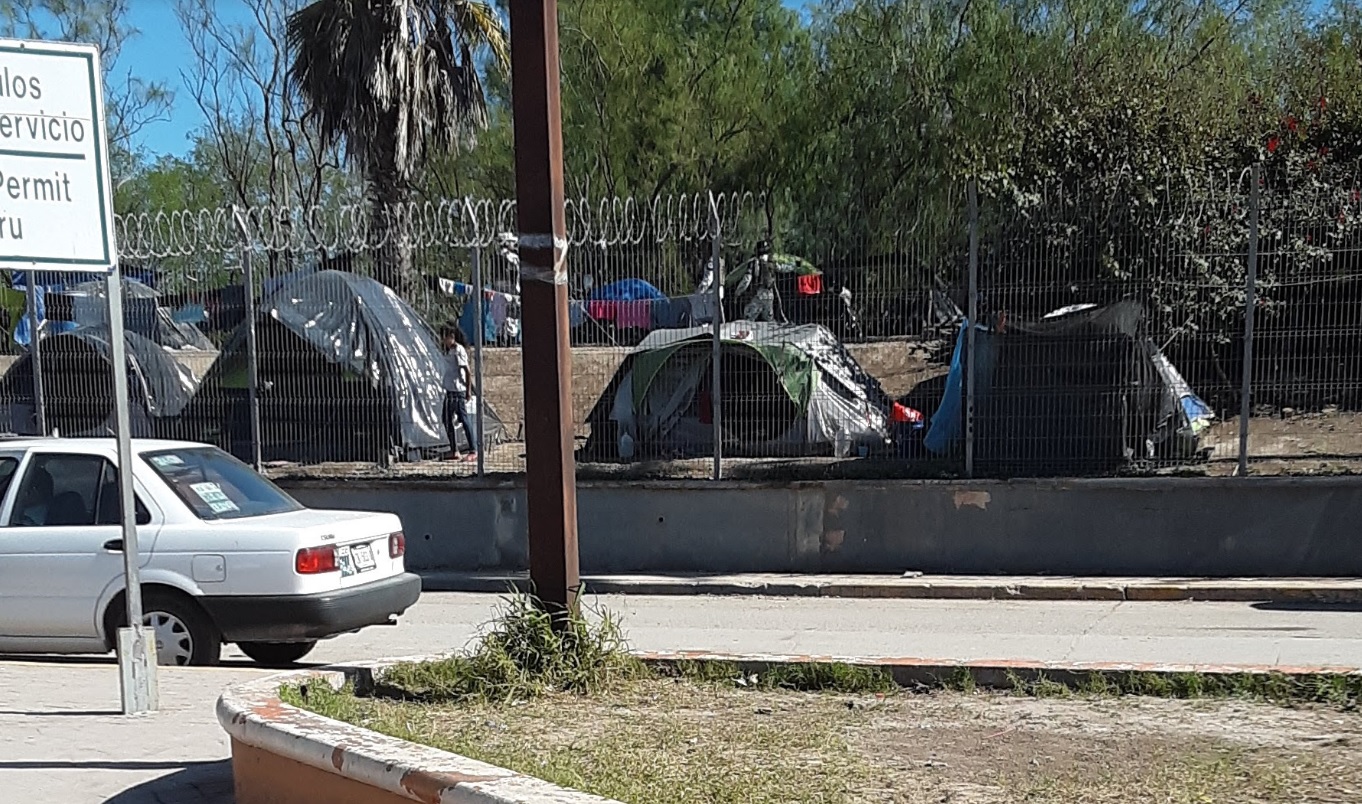
 This week, we were visiting Matamoros, Mexico, which is the border city adjacent to Brownsville, Texas. When driving across the international bridge, one of the first sights is a fairly large encampment of refugees from Central America. Most are from El Salvador, Honduras, and Nicaragua, but there are exceptions. Inexplicably for people who ostensibly came on foot, some are reportedly from Cuba and even Africa. They came as part of the migrant caravans. The picture above shows part of the camp. (Click on any of the images for a larger version.)
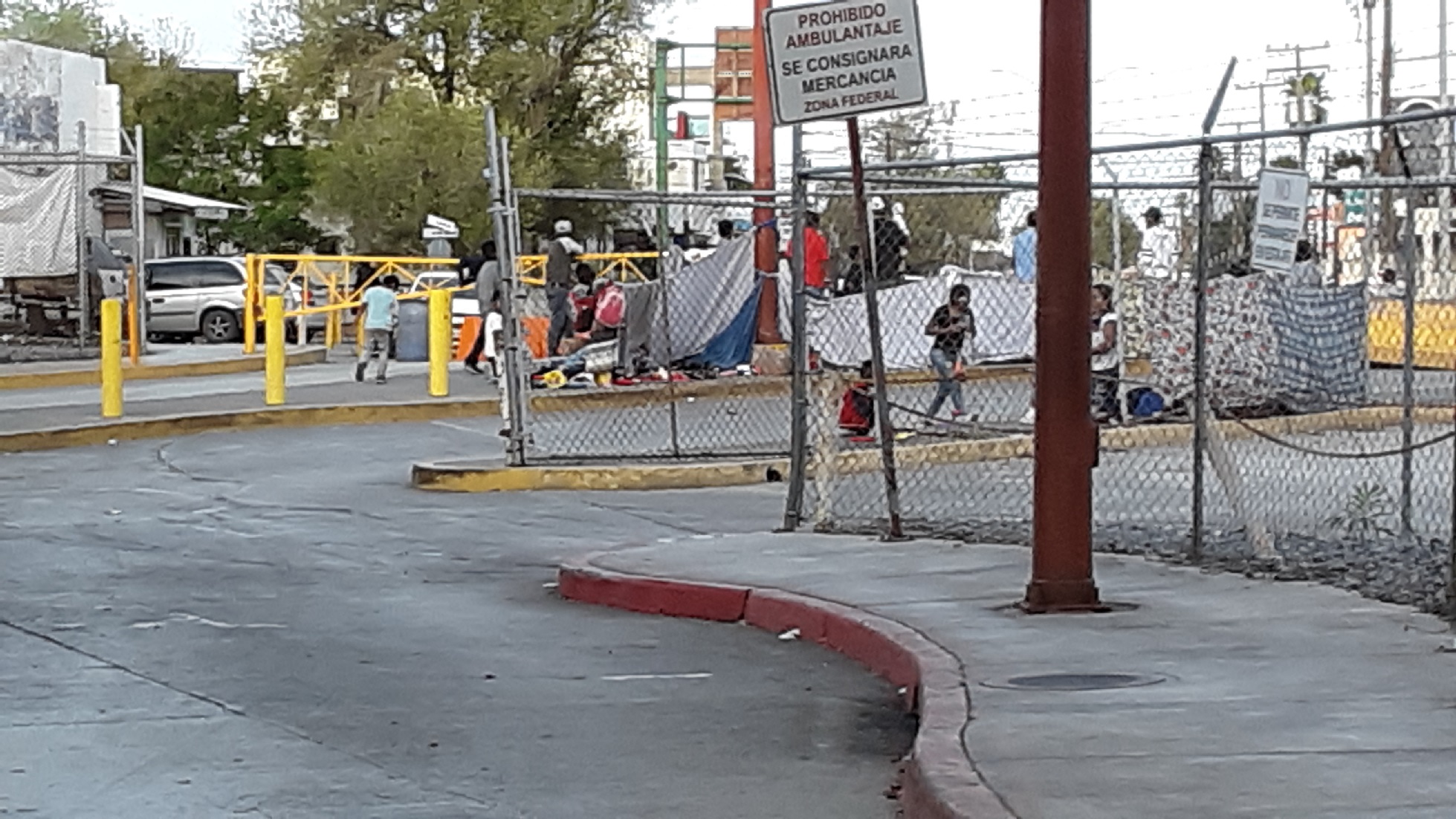
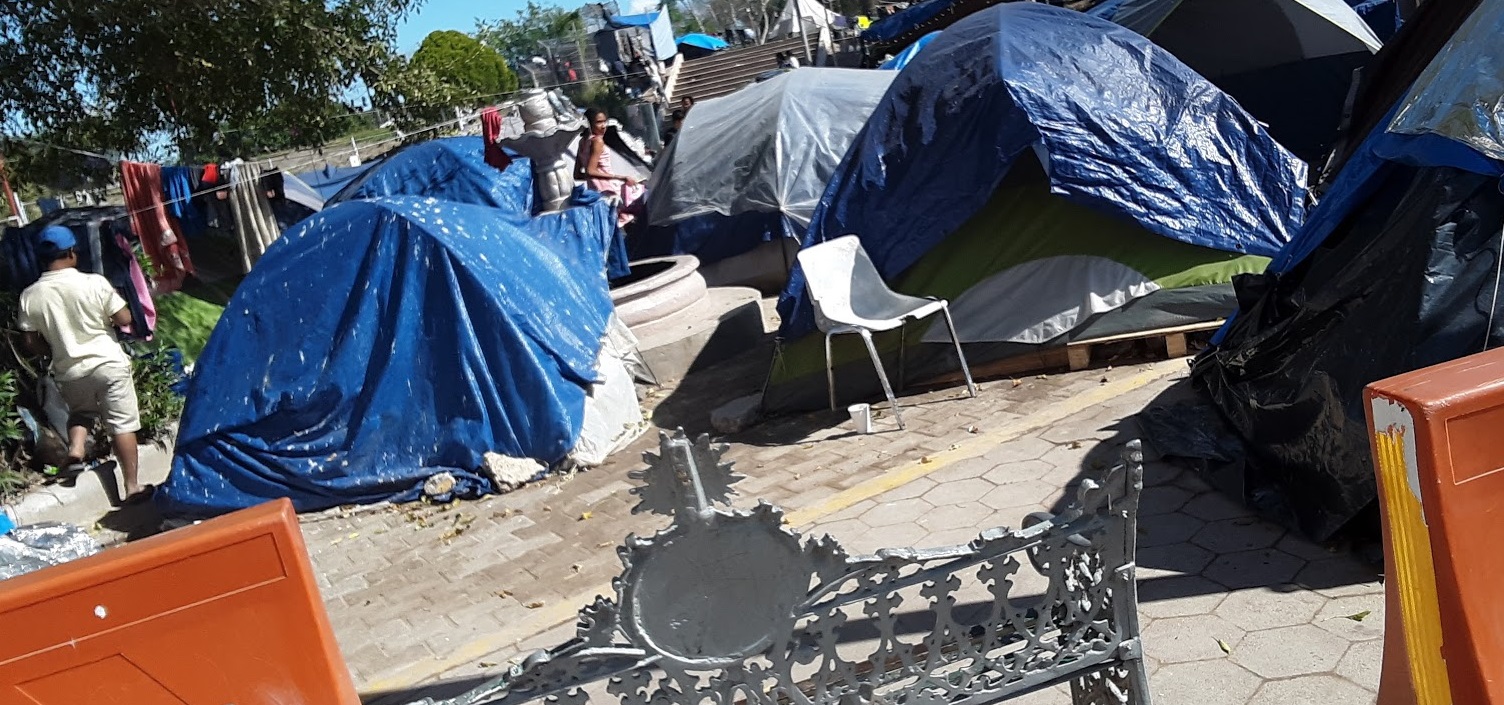
 These persons are living in small tents, all set up in the border zone under the control of the Mexican federal government (indicated by “Zona Federal” on the sign in the bottom picture). A few yards further south, the area is under the jurisdiction of the State of Tamaulipas, and the state authorities do not allow them to make camp there. The camp is orderly, and there is a strong armed military presence. A hundred yards to the north is the United States. I should note that the fence is pre-existing, and is not there to keep the people inside. The area is open on other sides. This picture is taken on the sidewalk leading to the international bridge, and the fence is there to serve as a barrier between the line leading to the bridge, and the rest of the town.
I asked around whether it would be a good idea to speak with any of the refugees, and the consensus was that I shouldn’t. However, I’m not one to listen to consensus, and when the opportunity presented itself, I took advantage of it. Part of the camp is immediately adjacent to the sidewalk leading to the international bridge, and we were only feet away from people on the other side of a fence.
I had the opportunity to speak with a woman named Sandra, who told me that she had come from El Salvador. She has two daughters with her, 11 and 7 years old. She also has an 18 year old daughter and an older son, both of whom are already in the U.S. She was living in one of the tents shown at the top of the page.
When I asked if they had walked all the way, she said they had, but there might have been a misunderstanding, because it sounded like she had rides for at least part of the way. But in any event, she had come a very long way, and I asked her why.
Her story sounded very compelling and very honest. She said that the government in El Salvador was unable or unwilling to protect its people from gang violence. When the government did try to crack down and imprison gang members, some of them infiltrated the elementary schools to recruit new members to replace them. When they asked, they wouldn’t take no for an answer. She told the story of one gang member who branded his own infant son with the gang’s symbol, to show that the gang would pass on to another generation.
The last straw for Sandra came as she was running her business, which sounded like selling something in the marketplace. One day, gang members came to her, shoved a gun in her side, and told her that she worked for them now, and that she would start handing over her profits. She feared for her life, so she said yes. But that night, she decided to sell all she owned and start heading for the United States. The same thing had happened to some of the daughter’s classmates. The children were told that they had to join the gang. Instead of doing so, they left on their own and headed north.
I did get the impression that she had been misled by someone to at least some extent. She told me that she was disappointed when she got here and not immediately allowed to enter the U.S., because someone told her that the “law had changed” from when she started until when she arrived at the border. She told me that before she left El Salvador, someone told her that she would “get right in” to the U.S. When she got here and that wasn’t the case, someone explained it away by saying that the law had changed.
I asked about conditions in the camp, and she didn’t seem to have complaints. I asked her if she had food and water. She told me she did, and even pointed out a 5-gallon bottle of drinking water inside her tent. It looked to be a commercial bottle of water of the type found in most Mexican homes. She didn’t mention what food she had, but she wasn’t complaining at all. She said that she had many donated goods such as food and blankets. She pointed to the wood fire that she used to cook. It looked to be made up of scavenged branches.
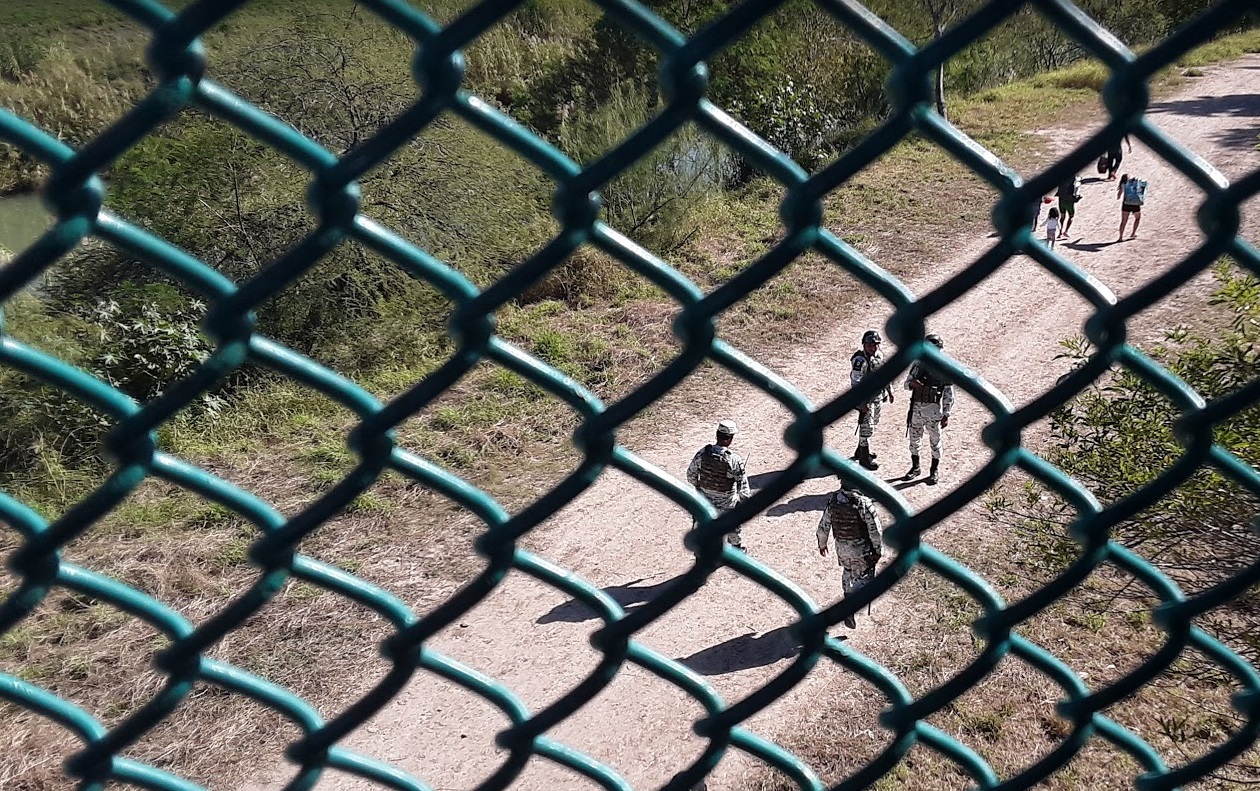
 She specifically mentioned the military, and seemed genuinely thankful that the Mexican authorities were there providing protection. She was quite clear that she viewed the military presence as a positive. There was no hint that the heavily armed presence was there to keep her in. In this picture, you can see some of the military near the river. Most of the tents appeared to be up at street level, but people did go down to the river, presumably to wash (and likely, to go to the toilet, as I didn’t see any evidence of portable toilets in the actual encampment). The military presence (marines and sailors, I’m told) was there keeping a watchful eye. She said that she felt safer inside the camp, with the military presence, than she did outside.
Sandra had even found work in Mexico, but I doubt if it paid particularly well. She and some of the other refugees had been recruited to hand out flyers for TelCel, a Mexican cellular provider. It sounded like this was just a one-time opportunity, but she was at least able to earn a few pesos. And it shows that even though she had to make her residence in the federal border
zone, she was able to move about the city freely.
She had already had one appointment with U.S. immigration, and had another scheduled in about six weeks. At some point, she was given a list of lawyers, but so far, she hasn’t found one who would take her case. I asked her what Americans could do if they wanted to help. She didn’t ask for anything. She was quite adamant that her material needs were being met, and she seemed grateful as she pointed to the donated items in her tent. But she did start to cry, and told me that she just wanted a safe place for herself and her children, and to be reunited with the older children who were already in the U.S.
I asked Sandra if I could take her picture, and as I suspected she would, she said no, because she was afraid. When I first introduced myself, she had told me her last name, but I told her I wouldn’t use it. I gave her my card, and pointed out the address of this website where her story would appear. I also pointed out that I’m a lawyer, but not an immigration lawyer, and not in Texas, so I wasn’t in a position to provide much practical help. My wife (who was serving as my interpreter) and I both asked God to bless her before we went our way. After I left, I wondered if I should have given her something, perhaps a treat for her children. But she wasn’t asking for anything like that–she was asking only for safety, something I didn’t have to offer.
I still have little doubt that Sandra and her children are pawns in someone else’s political game. But I also have absolutely no doubt of her sincerity, and that she is fleeing an impossible situation of lawlessness in El Salvador. It seemed clear to me that she has a well-founded fear of
persecution there, and I hope whoever is assigned to hear her case sees it the same way.
The residents of Matamoros with whom I spoke were generally sympathetic, but did have a somewhat different perspective. From them, I learned that of those who originally arrived in these caravans, about 80% have returned home. It seems apparent to me, and to those I talked to, that most of these people were themselves victims. They were victims of people who, for whatever political motivation, made promises that they knew they wouldn’t be able to keep. Eventually, it dawned on most of the people waiting at the border that they were victims. They presented themselves to the Mexican government, and were given a bus ticket back to the border with Guatemala.
Most of those like Sandra who remain at the border–about a fifth of the original number–already have appointments with U.S. Immigration for an asylum interview, and they are waiting to take their chances and plead their case.
Many Mexicans have strong feelings on the subject. There’s a certain amount of anger based upon reports–all secondhand, I should add–that assistance has been rejected by the members of the original caravan. Not only in Matamoros, but as the caravan passed through Mexico, Mexicans were generous, and offered food and other supplies. In many cases, these were personal gifts from residents who were sharing the food from their own table. There are stories that this aid was rejected as not being good enough. Naturally, after this happens a few times, the presence of the newcomers is resented. (I should add that Sandra seemed genuinely grateful for the donated goods she had received.) Mexicans also point out that the caravans entered Mexico illegally, and that their continued presence is in violation of Mexican law.
There’s also a sense that the caravan is there for the specific intent of destabilizing Mexico, the United States, and Canada. The reports of gifts being rejected seem to have certainly fed this sense.
I think it’s an important distinction that many, but not all, of the migrants have returned home. They got to the border, and it was soon apparent that they weren’t going to get easy entry. At best, they would need to stay at an austere camp within sight of the border. It seems reasonable that if someone had only a tenuous claim on asylum, that it would make sense to turn around and head home. On the other hand, if one truly had a valid claim of fear of persecution, then it would make perfect sense to remain–even in poor conditions–until their case is heard. Sandra’s story sounded credible to me. And one of the things that made it credible was the fact that she was willing to live in a tiny tent until she had an opportunity to present her case.
Also, as far as I can tell, Sandra has violated no law. She seeks to become a legal immigrant to the U.S., based upon a claim of asylum. As far as I can tell, she scrupulously complied with U.S. law–she presented herself to the authorities at the border and told them why she was there. They set an appointment for her, and told her that she would need to wait outside the United States. That’s exactly what she did, and then she showed up for her appointment as scheduled. She was told to go back and wait for her next appointment, and that’s exactly what she did. And she gave me every indication that she was grateful for the opportunity.
Under U.S. law, a person is entitled to asylum if they have a credible claim of persecution. I have no doubt that this is true for Sandra, and I have no doubt that she will be given a fair hearing to prove her case. Eighty percent of the refugees apparently went home after learning how the system worked. She did not, and that adds to the credibility of her case.
I asked residents of Matamoros what Americans can do to help. We don’t want to encourage the opportunists who convinced people to make a dangerous journey. But on the other hand, the people who remain need help to meet their basic needs.
The consensus is that the local Roman Catholic churches–in both the United States and Mexico–are doing the best to meet this need. This article (in Spanish) describes part of that relief effort, a joint effort between the two neighboring dioceses. Interestingly, the Mormon Church also got high marks for the humanitarian services it provides to refugees, as shown by this article about the cooperation between the two denominations.
If you would like to donate, one charity that is making a very real difference in the lives of these refugees is Catholic Charities of the Rio Grande Valley, who are spearheading efforts on the U.S. side of the border. You can make a monetary donation by clicking on this link. If you want to donate needed supplies, they have a wish list on Amazon, and orders will be shipped directly to them. When ready to purchase items on their list, please select the “Humanitarian Respite Center (In-Kind)” address listed for the shipping. As Sandra made clear, at this point, there’s not a pressing need for material goods on the southern side of the border. Catholic Charities is busy processing those whose applications were approved, and donations are needed at their respite center on the northern side of the border.
The same Savior after whom Sandra’s country is named said, “I was hungry and you gave me something to eat, I was thirsty and you gave me something to drink, I was a stranger and you invited me in.”


 This young woman is getting ready to tune in a favorite program, thanks to the radio designed to look like a book, described in the January 1940 issue of Popular Science. The design was intended to “appeal to all builders who prefer housing their receivers in some unusual type of cabinet.” It was perfect for the library table, where it would make an attractive decoration while pulling in the local stations.
 showed the design at right. It was a three-tube regenerative set featuring a small two inch speaker. Like the book radio, it covered the broadcast band. It was also an AC-DC set, with the filaments in series powered by the ubiquitous curtain burner.



 This
This