Author Archives: clem.law@usa.net

Radio Repairman, 1941

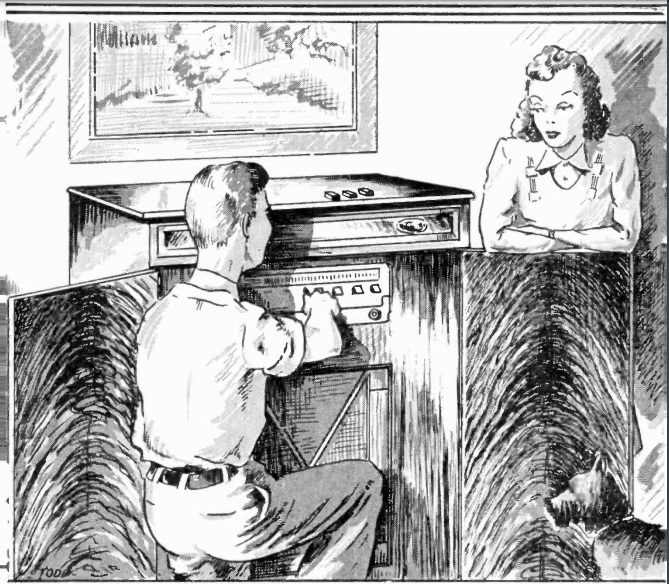
1941AprNrnEighty years ago, the radio repairman was a heroic figure, as shown by this illustration on the cover of the April-May 1941 issue of National Radio News.  While the lady of the house and faithful canine companion look on, he is getting this set back into operating condition.

Perhaps he had to replace a tube, or perhaps he was resetting the set’s pushbuttons.  This was necessary since the FCC had just changed the frequencies of most U.S. radio stations on March 29, 1941.  An article in the magazine included a timely feature going into detail on the circuits involved.


1921 25 Cent Crystal Set

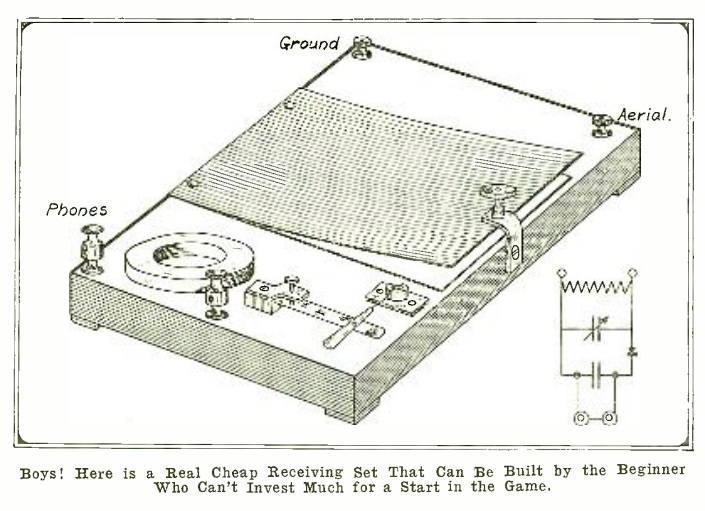
1921AprRadioNews1A hundred years ago this month, the April 1921 issue of Radio News showed how to build this simple receiver, said to have a cost of only 25 cents. Tuning was accomplished with a variable capacitor consisting of aluminum plates separated by waxed paper. By compressing the plates, the capacitance was changed.

The magazine lamented that there were probably thousands of lads who looked wistfully at the catalogs, only to be discouraged by the high prices. The thought was that if they got a chance to listen in with this inexpensive set, they would be sold on the idea of radio and would soon figure out a way to put together a more impressive station.

Accroding to the magazine, almost every town had a good amateur station holding court on 200 meters, and receiving them even with this simple crystal set would be a simple matter.

I have no doubt that the parts shown here could be had for a quarter. The problem, however, is that the prospective radio ham would still need a headphone with which to connect the set. Looking through the magazine, the least expensive was $4.50, or about $66 in today’s money, according to this inflation calculator.

Those headphones, of course, would still be good when the listener was bit by the radio bug and upgraded to a better set. But the cost of entry to the hobby was $4.75, and not the 25 cents promised by the magazine.


1971 Grocery Prices

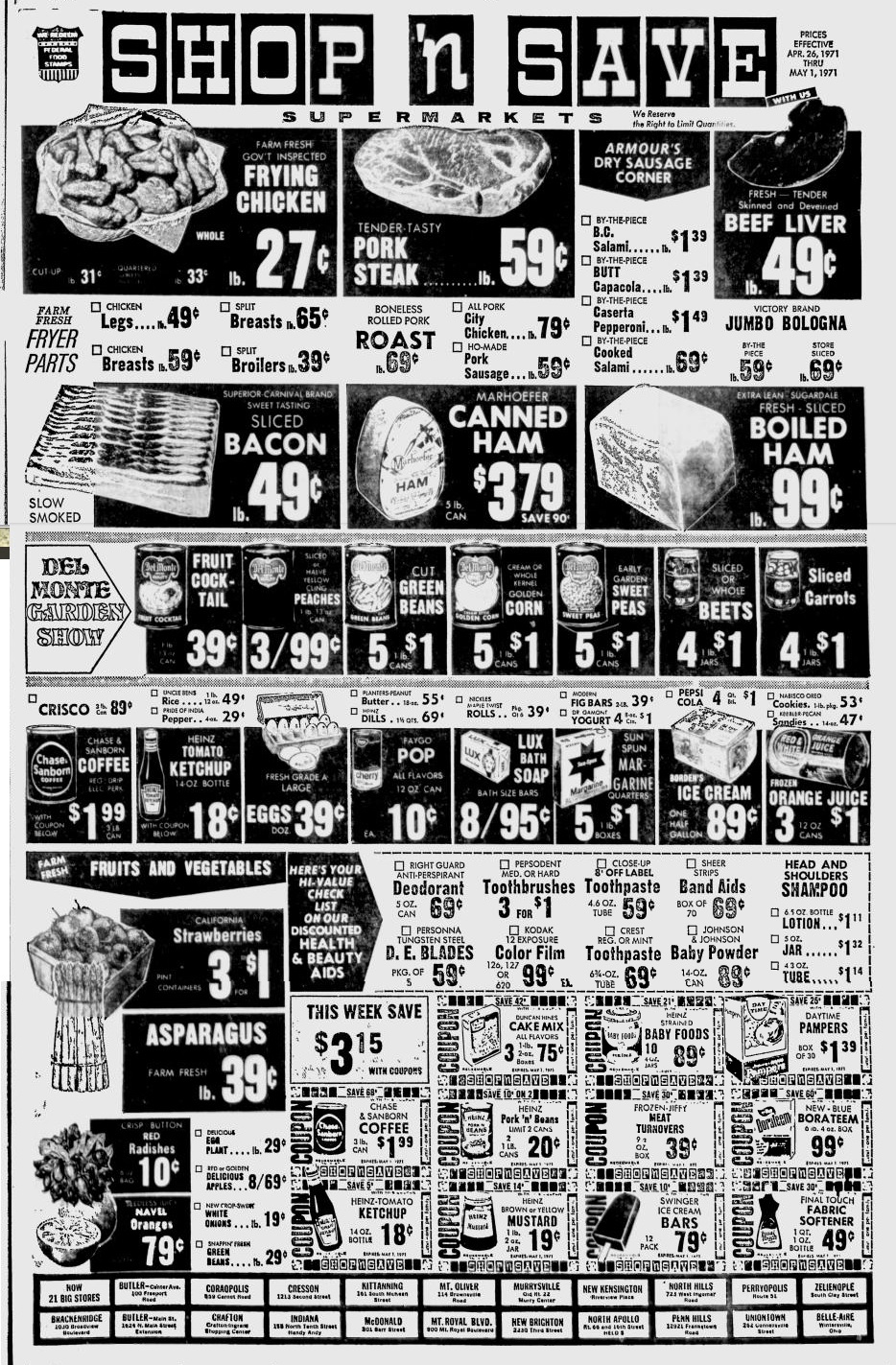
1971Apr25PghPressHere’s a snapshot of grocery prices fifty years ago in 1971, from this ad for Shop ‘n Save Supermarkets in the April 25, 1971, issue of the Pittsburgh Press.  From most browsers, you can click twice on the image above for a larger image.

While these prices might look like bargains, there has been a lot of inflation in a half century. According to this inflation calculator, the 1971 dollar is equivalent to $6.54 in 2021 dollars. So the eggs at 39 cents a dozen are the equivalent of $2.55 in today’s money.


1941 Electrical Science Fair Ideas

1941AprilPSbuzzerIf Junior wants to take home the Blue Ribbon in the science fair, there’s plenty of inspiration to be found in the April 1941 issue of Popular Science. Some of these ideas might look difficult to some kids today, but the smart students will realize that they are really quite simple. One or more of these ideas is sure to impress the judges.

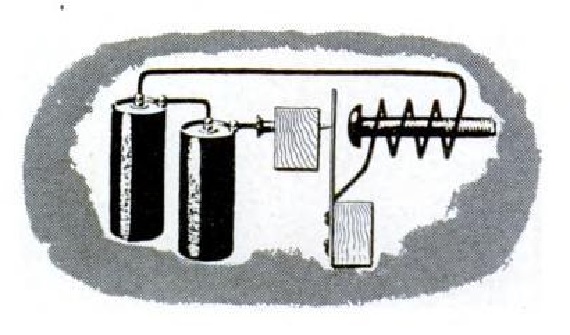
The idea shown above is a simple buzzer. When the battery is connected, the electromagnet pulls the strip of metal away from the screw. This breaks the contact, and the strip snaps back into place, and the whole process is repeated.

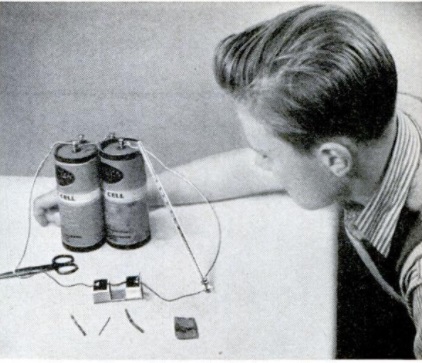
1941AprilPSthermostatShown at left is a simple thermostat.  It’s made of a strip of iron and a strip of copper or brass, bolted together.  When the temperature changes, they expand or contract unequally, causing it to bend to one side.  Simply add an electrical contact at just the right spot, and a circuit will turn on or off at a given temperature.

The self-explanatory experiment to the right uses a thin strip of foil to demonstrate1941AprilPSfuse how a fuse works.  Simply cut it narrow enough so that it blows when a short-circuit is applied.

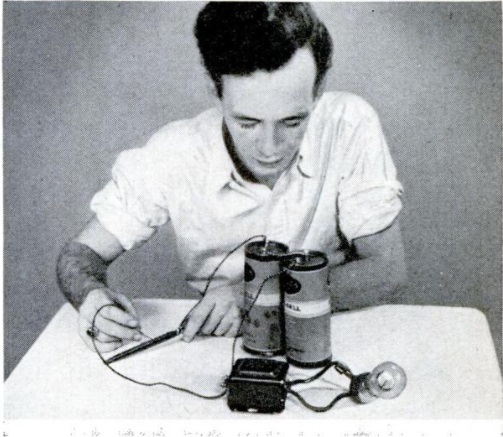
The experiment shown below is similar to one we featured recently.  It uses a transformer designed to convert 120 volts to 6 volts, but shows that the process can be reversed to change a low voltage to a high voltage.  As in the experiment we showed earlier, a wire is run along a file to create a pseudo-alternating current at the low voltage.

1941AprilPStransformer

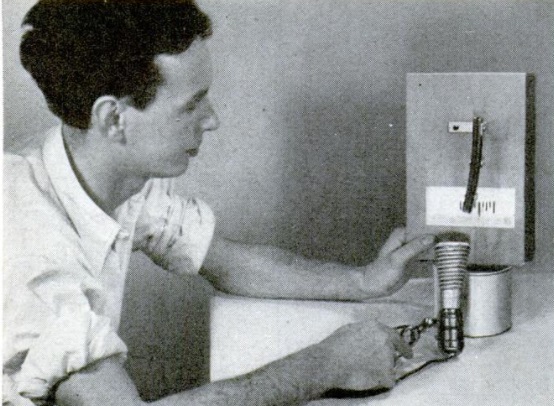
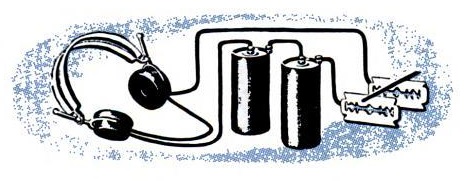
The final experiment is also similar to one we’ve shown previously.  A homemade microphone is made by balancing a pencil lead on two razor blades.

1941AprilPSmicrophone

Even though all of these experiments use the old-school large dry cells, they will work just as well with alkaline D cells.  The hookup will be easier if you purchase battery holders.  And don’t forget some wire.

Some links on this page are affiliate links, meaning this site earns a small commission if you make a purchase after clicking on the link.


1941 Radiola Ad

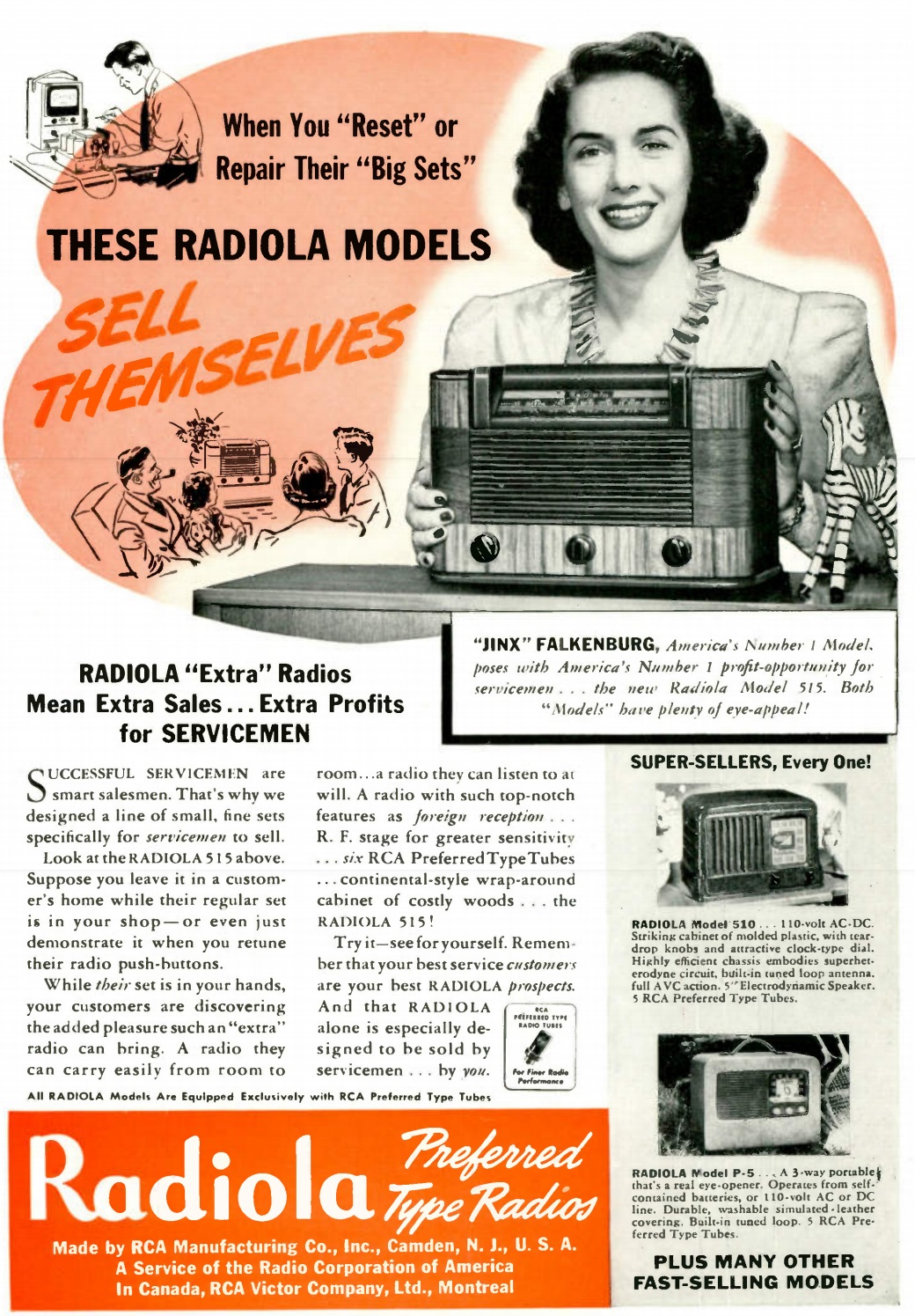
1941AprilRSDEighty years ago this month, the April 1941 issue of Radio Service Dealer carried this ad from RCA reminding servicemen that Radio radios could sell themselves. It suggested, for example, that when bringing a set into the shop, they could leave behind a model such as the Radiola 515, a six-tube set retailing for $24.95. While it was there, customers would discover the convenience of a second set that they could easily carry from room to room. And, of course, since the set pulled in the shortwaves, the customers would be able to listen to the latest war news direct from Europe.

Also shown was the Model 510 in striking molded plastic, and the model P-5 three-way portable. The multiband set is being shown off by Eugenia Lincoln “Jinx” Falkenburg, America’s number 1 model, who went on to have a radio show with her husband Tex, undoubtedly heard over many Radiolas, after the war.

The ad mentions that the serviceman might be in the customer’s home to set the pushbuttons on the radio. This is because on March 29, 1941, most North American radio stations changed frequency. Sets with pushbutton tuning would need the buttons reset to the new frequencies.


High School, 1946

1946Apr22LifeShown on the cover of Life Magazine 75 years ago today, April 22, 1946, is Marilyn Rights, a junior at Denver East High School, in her Latin class. She would have been in seventh grade for Pearl Harbor, and most of her high school career took place during the war. The magazine profiled the school, and also took a look at the tension between two competing points of view.
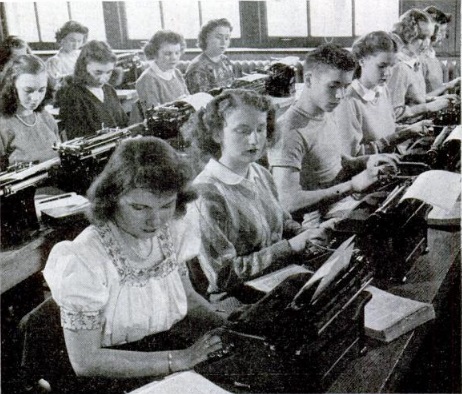
1946Apr22LifeTyping One view, championed by the National Education Association, called for more practical program for high school. Harvard University, on the other hand, called for more emphasis on cultural and academic subjects. The magazine’s focus was on how well the school was measuring up under the two competing plans. Harvard would be pleased to see Miss Rights’ studious attack of Latin, whereas the NEA would probably be pleased with the typing class shown here. The magazine noted that the class was one of the most popular at the school. While it was originally intended for “commercial students,” it was open to other students who learned typing in order to prepare neater homework.
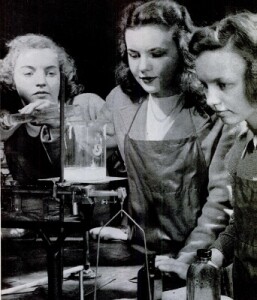
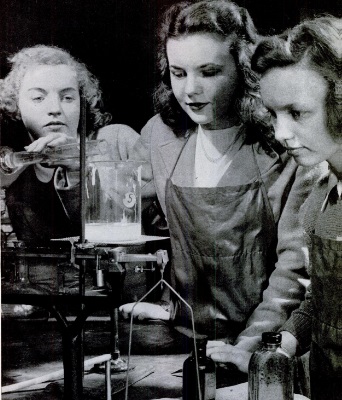
1946Apr22LifeColdCreamAt least one of the courses, practical chemistry, allowed students to learn about cosmetics by manufacturing their own cold cream, probably with a formula such as this one involving borax.

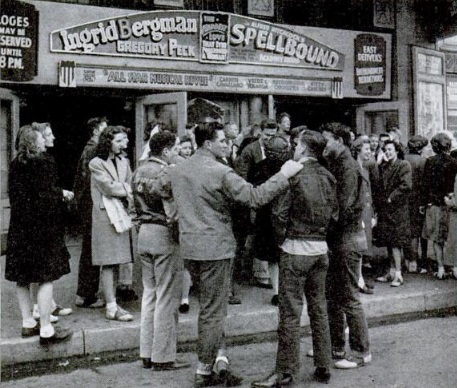
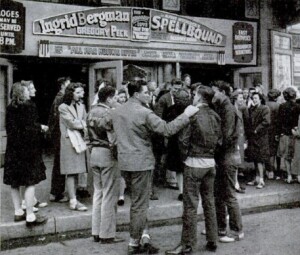
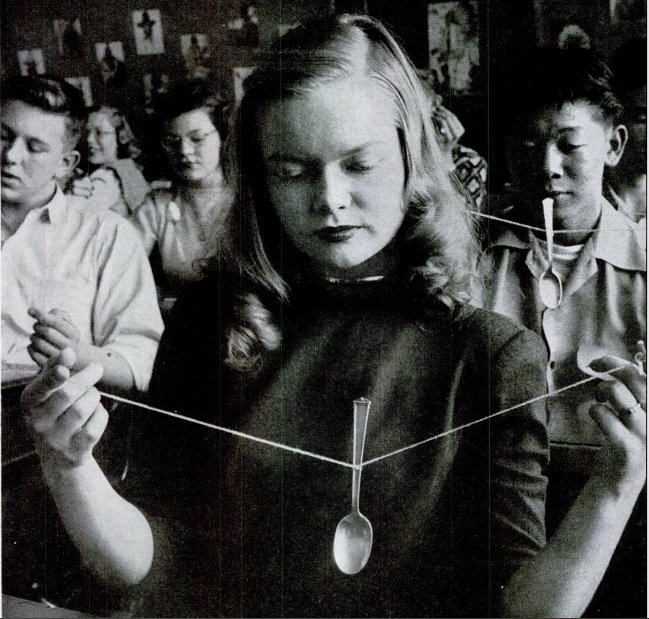
The psychology class appears to be much more interesting than the one I took in college. Here, we1946Apr22LifeMovie see the class on a field trip to see Ingrid Bergman in Spellbound, which deals with psychiatry. They discussed the film in class, and were critical of its superficial psychiatric approach. Those same students were also engrossed in the simple science experiment shown below, demonstrating how sound is transmitted to the ear. The spoon was tapped to the desk to make it vibrate, and the string held to the ear to demonstrate how the vibrations traveled through the string. In fact, elementary students looking for a simple experiment for the science fair can conduct this experiment, which you can see described at this site.
1946Apr22LifeSpoon

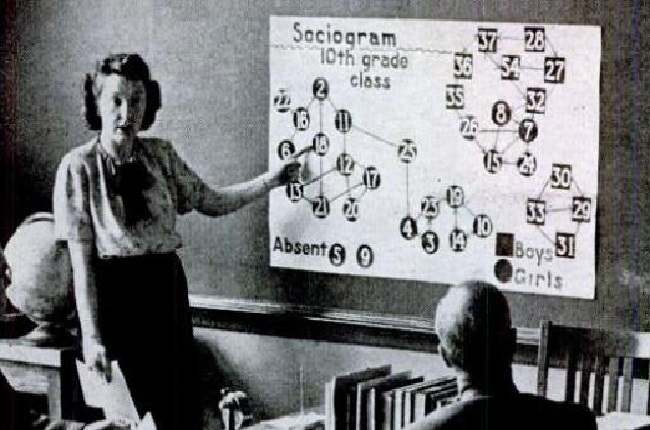
Another interesting activity in the psychology class is shown in the sociogram of the class below. Each student was asked to name their two best friends in the class, and these links were plotted on the chart. This revealed that the class consisted of four distinct “cliques,” which were largely independent. Girls 12 and 15 were revealed to be the most popular, with four students each identifying them as a friend. Interestingly, each was member of a separate clique. Girl 25 is identified as a “typical lonely student,” who chose students 4 and 11 as her best friends, but was herself chosen as best friend by no other student. Interestingly, though, she is the only student who links two cliques. One of her friends, 11, is a member of the clique at the left, and her other friend, 4, is a member of the lower clique.

1946Apr22LifeSociogram


GE Models L-500 and LB-502, 1941

1941Apr21LifeEighty years ago today, the April 21, 1941, issue of Life magazine carried this ad from General Electric reminding readers such as this businessman and his efficient secretary that his desk would be an excellent spot for a radio, for keeping up with news and stock reports affecting his business.

Their suggestion was the model L-500, which sold for only $9.95 (according to this inflation calculator, $162.17 in 2021 dollars).  The  “All American Five” set had the then-standard tube lineup of  12SA7, 12B7, 12SQ7, 50L6GT, and 35Z5GT.  According to the ad, the set had excellent tone. We previously featured the L-500 at this link.

The ad also featured the portable model LB-502, a five tube ( 1R5 1T4 1S5 3S4 35Z3) camera-style portable that would run from either batteries (1.5 and 67.5 volts) or household current.  It carried a list price of $21.95, or almost $400 in today’s money.


1951 Two Tube Receiver

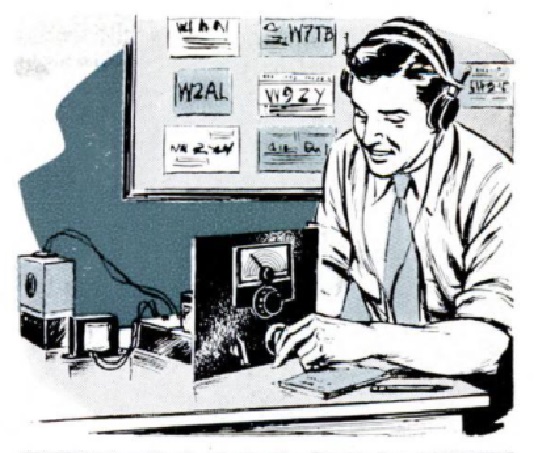
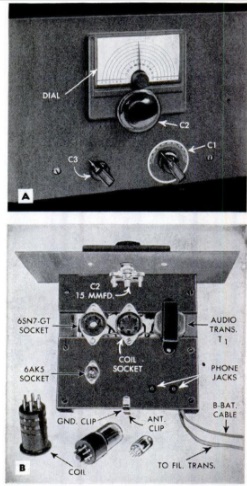
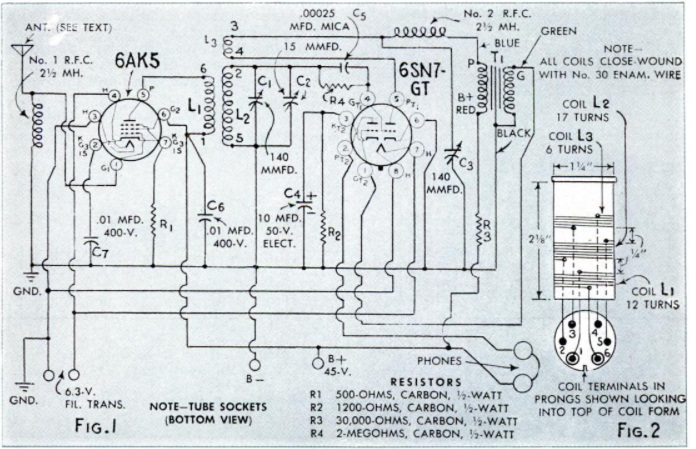
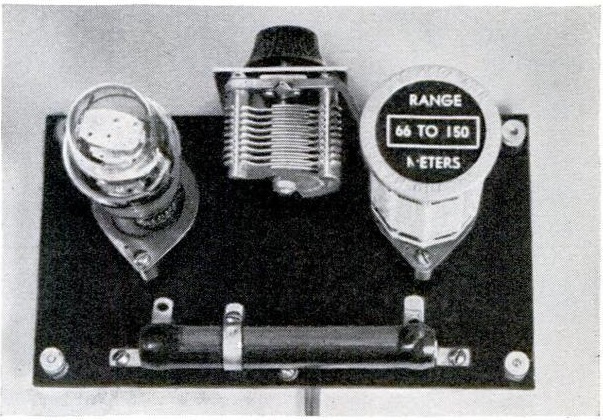
1951AprPM21951AprPM3The September 1951 issue of Popular Mechanics showed how to put together this simple two-tube receiver. It was earmarked especially for the new ham, since it covered the 80 meter ham band. But it would also pull in a wider range of frequencies, including police calls and the 49 meter international broadcast band.

The timing of the article wasn’t a coincidence, since the circuit was specifically targeted at those interested in the Novice class amateur radio license. That new license, which required only a 5 word per minute code test, had just been announced by the FCC, which started issuing them on July 1, 1951. Armed with this receiver, and a key and buzzer, the prospective Novice would be able to pass the test with ease. The magazine promised that the October issue would include an accompanying transmitter.

Construction was simple, as it used two pieces of hardwood mounted on wooden cleats. There was a gap between the two boards, allowing for easy mounting of the sockets for the two tubes and one plug-in coil. Power came from a 45 volt battery, but to prevent having to replace A batteries, a 6.3 volt transformer was used to light the filaments. No power switch was provided, and the magazine noted that a switch could be mounted somewhere on the operating table in line with the transformer.

The magazine recommended a 10-15 foot indoor antenna and ground for the two-tube regenerative set. One variable capacitor was used to control regeneration, with another one serving as the main tuning dial. The procedure for using the set was to advance the regeneration until the set came to life, and then tune the main tuning dial until 80 meter stations were heard. At that point, the larger bandspread dial would be used for tuning.

1951AprPM4


One Tube Radio Using Rectifier

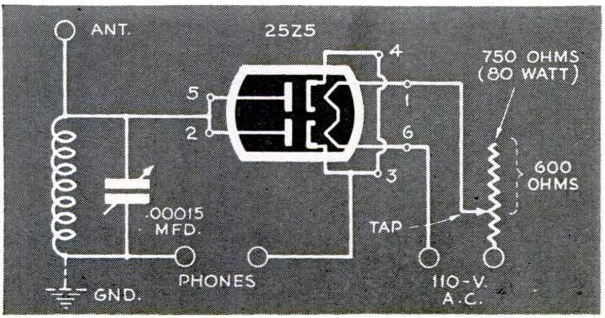
1941AprilPSEighty years ago this month, the April 1941 issue of Popular Science showed this novel little one-tube receiver. Even though it’s basically a crystal set, it qualifies as a one-tube radio since it uses a rectifier tube, a 25Z5, in place of the crystal.

The article points out two things that might not be obvious. First of all, even though the set is running on AC power, there is no hint of 60 cycle hum. The electric power does nothing but heat the filament, and the heated cathode and plate serve as the detector, with no electrical connection to the power. The magazine also notes that it’s safe to use a ground connection, since there’s no direct connection.

Even though the filament normally runs on 25 volts, it should be under 6 volts in this circuit. An 80 watt resistor is used to drop the voltage, although I bet an incandescent light bulb could be used.

1941AprilPS2


1941 Prices: Western Auto

1941WesternAutoHere’s a snapshot of the cost of living from 80 years ago, on the eve of World War 2, from the April 16, 1941, issue of the Pittsburgh Press, courtesy of this ad for Western Auto Stores.  (For a larger image, from most browsers, click twice on the image.)

According to this inflation calculator, one dollar in 1941 was the equivalent of $18.02 in 2021 dollars. Here are some representative prices, with the modern equivalent in parenthesis:

Western had its own brand of radios, Truetone. A portable, which could operate on battery or household current, sold for $14.45 ($260.39), not including the battery. A single-unit car radio, with pushbutton tuning, could be had for the same price. A three-piece unit sold for $27.95 ($503.66), which included installation. The six-tube set had a chassis that mounted out of the way, with separate control unit and speaker.  Whichever car radio someone bought in 1941, there’s a good chance that they would be taking it inside to listen to when gas rationing meant the car spent most of its time in the garage.

Spark plugs would set you back a quarter ($4.50), but they were guaranteed for 10,000 miles. Fan belts started at 34 cents ($6.13). A new battery for the car would be $4.45 ($80.19) and was guaranteed for two years. A bicycle was $18.75 ($338), but if you needed just a tire, that was $1.62 ($29.20). Tires for the car started at $6.44 ($116.05), but they included a free tube. If you wanted to go fishing, a complete outfit could be had for just 98 cents ($17.66).