Author Archives: clem.law@usa.net

Jewel Model 5050: 1951

1952JanRadioRetailingSeventy years ago this month, the January 1951 issue of Radio Retailing carried this ad for Jewel’s combination table model/portable set, the model 5050.  The ad notes that whether on a table or being carried, the dial is always in a convenient position, and the sound is always pointing in the right direction.

The set operated on household current or battery, and featured a ferrite core antenna. The set had four tubes, 1R5, 1U4, 1U5, and 3V4


1942 Code Practice Oscillator

1942JanPMCPOEighty years ago, these gentlemen probably realized that they would soon be serving in the armed forces, and their stint would probably be more comfortable if they came to their induction in possession of a skill useful to Uncle Sam. Therefore, they have undertaken to learn Morse Code, thanks to this one-tube oscillator described in the January 1942 issue of Popular Mechanics.

The set used a single 117L7-GT tube, whose 117 volt filament meant that it could run straight off the AC power lines, without worrying about dropping resistors or transformers. It had plenty of volume, which could be controlled with a volume control, to drive a speaker or up to 20 pairs of headphones for group practice.

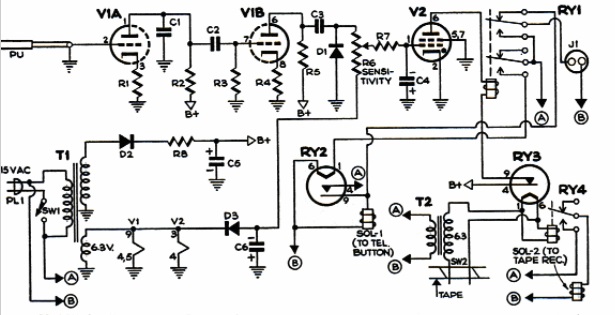
1942JanPSCPOschematic


Re-use of N95 Masks

Most N95 respirators are intended to be disposed of after a single use. However, during the first months of the COVID-19 pandemic, there were insufficient numbers of respirators for healthcare workers, and strategies for preserving the supplies were necessary. Therefore, the Centers for Disease Control published strategies for reusing masks, rather than disposing of them after each use. Those strategies were published online.

As of May 2021, that agency reported that the supply of approved respirators has increased significantly, and most healthcare facilities should resume conventional practices, namely, disposing of masks after one use.

However, with the increased availability of N95 masks, many consumers are using them for protection outside of the healthcare context. We have previously published a review of some of the available N95 and KN95 masks.

While they are now readily available, the cost might be prohibitive if a whole family wears them all day and then has to dispose of them. Therefore, many consumers may want to employ the same strategies to be able to use a single mask for more than a single use.

I rarely wear an N95 mask for more than a few minutes at a time, and it’s usually in relatively low-risk situations, such as a supermarket. Therefore, it would be extremely expensive to discard it each time. Therefore, I store the mask and re-use it at a later time. I use a procedure similar to these instructions from the North Dakota Department of Health, which show the approved procedure for re-use.  Basically, I carefully remove the mask in a brown paper bag until the next use.  This video from the University of Nebraska is a good overview of the procedure:

If you are looking for particular masks, I have used and recommend all of the following, all of which are made in the USA. You can view my full review of these masks at this link. (Note that availability varies, but all of these are usually available at Amazon. You may need to search for different colors or different size packages.


Some links on this page are affiliate links, meaning that this site earns a small commission if you make a purchase after clicking on the link.
Happy New Year!

Happy New Year from OneTubeRadio.com!

We’ve had a tough couple of years, but it wasn’t “Siege of Leningrad” tough. The picture shown above was taken 80 years ago today at the Leningrad Children’s Hospital, where the children were celebrating the new year 1942.  Despite their predicament of being surrounded by the German army, these young comrades seem stoic and determined to endure.

While these children were all born before the start of the siege, the fierce battle surprisingly marked the beginning of a baby boom within the city. In 1943, the number of marriages in the city were up 13%, leading to a 1944 birth rate that was 23.6% higher than the pre-war level. From the start of the siege, special efforts were made to ensure nutrition for infants, and surprisingly, infant mortality actually declined in 1942.

You can read more about this aspect of the siege of Leningrad at the Russian Wikipedia.  Google should provide a good translation of the fascinating article.


Your 2022 Calendar

As you prepare for the new year, you’re undoubtedly in need of a good 2022 calendar. But there’s no need to run out and buy a new one, as you can re-use this 101 year old calendar from 1921. This one was provided courtesy of the Atlanta Tri-Weekly Journal.


William F. “Billy” White III, K5CBZ

I am not old enough to have to have worried about contracting polio, but I am old enough to have known people who suffered from the effects of polio. Amateur radio has always served as a window on the world for those with many types of disabilities, and I had the pleasure of meeting many hams who were handicapped as the result of polio.

Thanks mostly to the vaccines of the 1950s, North America saw its last case of polio in the 1970s, and children and their parents no longer had to worry about contracting it. But there were still many survivors of the disease when I was growing up in the 1960s and 1970s, and largely because I was a ham, I had the pleasure of meeting many of them.

One example was profiled in the December 1961 issue of QST, thirteen-year-old William F. “Billy” White III, K5CBZ, of Corpus Christi, Texas. White had been confined to an iron lung for eight years, and it was from that location where he spent all of his time, doing his school work, reading, and watching television. But recently, he had added to his repertoire the magic of amateur radio.

His first novice station was installed by a group of local hams, but could be operated only when he was out of the respirator, meaning that the time on the air was extremely limited. When he passed the Conditional test, a permanent solution had to be found. And thanks to the local hams, it was. It was decided that a Collins KWM-2 transceiver would be a good choice since it was relatively lightweight at 18 pounds and completely self contained. It was possible to mount the transceiver directly on the iron lung using fittings that were normally used for items such as mirrors and book holders. The set was mounted vertically, and could be removed and reinstalled in a matter of seconds.

Billy was able to operate the controls using a spatula held in his mouth. The only exceptions were the band switch and transmitter tuning. But when those were set, he could operate the set by himself.

During Hurricane Carla, Billy handled a considerable amount of emergency traffic from his station. When power at his house failed, the local hams delivered a generator, which powered both the radio and the iron lung.

Billy died in 1967 at the age of 19. But for the last six years of his life, as the article notes, “daily he traveled the airwaves, visiting friends, meeting new people, and filling his time through the magic of amateur radio.”

For people with disabilities who are interested in learning more about amateur radio and other assistive technology, we recommend you contact the Courage Kenny HandiHam Program, which has carried out that mission since 1967.


KIRO Seattle; Milton Shaw, 1917-1944

1941Dec29BCEighty years ago today, the December 29, 1941, issue of Broadcasting showed Private Milton Shaw of Cleveland, Georgia, standing guard over the 50,000 watt transmitter of KIRO, Seattle, sited on Vashon Island. The soldier was one from the 41st Division. The magazine claimed that the station was “located in the center of a large colony of Japanese nationalists.” The magazine noted that the station was the only 50,000 watt station north of San Francisco and Salt Lake City.

free-vector-poppy-remembrance-day-clip-art_106032_Poppy_Remembrance_Day_clip_art_smallAccording to this source, Shaw was killed in Action in New Guinea on June 17, 1944, and his remains are buried at Oakwood Cemetery, Oakwood, Georgia.


Plain Facts About Fallout Shelters: 1961

1961DecPS1Yesterday, we featured some fallout shelter designs from the December 1961 issue of Popular Mechanics. The public relations department at the Office of Civil Defense must have been working overtime, because that month’s issue of Popular Science also carried a feature entitled “Plain Facts About Fallout Shelters.” The Popular Science article was written mostly in Question and Answer format. It started by noting that those who build fallout shelters in the past kept it secret for fear they would be considered crazy. But according to the magazine, “safety precautions against the ravages of atomic war no longer reveal old-maidish nervousness but admirable prudence.”

Unfortunately, the magazine lamented that many buyers, as well as builders, of shelters didn’t know what they were doing. So the article is devoted to dispelling some misconceptions and providing good information.

The chart above illustrates that radiation is not necessarily fatal, but the dose is the key factor. The stress on fallout shelters was because much of the country would be free from the immediate effects of the blast, but would be subject to deadly fallout. The general idea was that if you were in the “probably die” category, you would want to move yourself up to “sick,” or even better yet, to “safe.” And a fallout shelter would do that for millions of Americans.

After explaining the basics, the magazine urged readers to write to the Office of Civil Defense for further information. It also made the reminder to check local building codes before starting work.


1961 Fallout Shelter Designs

1961DecPM1Sixty years ago this month, the Cuban Missile Crisis was still almost a year off, but protection from nuclear weapons was already on the minds of many Americans, and the December 1961 issue of Popular Mechanics carried construction details for four fallout shelters. The deluxe model shown above, with an estimated cost of $1841 (about $17,000 in 2021 dollars) was typical of that offered by commercial builders. It was an underground room that could be used in peacetime for some other use, with an attractive patio on top, complete with a built-in grill.

1961DecPM2The other end of the cost spectrum was represented by the design shown at left courtesy of Prof. R.M. Stephenson of the University of Connecticut’s nuclear engineering program. He estimated that the design would reduce radiation levels by a factor of 200-1000, meaning that it would save lives even in areas of high fallout. The material consisted of 100 sandbags, 10,000 pounds of dry sand, and some miscellaneous lumber, with a cost of only $30 ($279 in 2021 dollars).

1961DecPM3The next least expensive was the design shown at right, with an estimated cost of $97 (about $900 in 2021). The initial construction of this design was done prior to the emergency, requiring about 33 hours of labor. A wooden frame was mounted to the wall with a hinge for the ceiling, with the concrete blocks stored nearby. In time of emergency, the construction could be completed in about two hours, assuming you were in a hurry, which you probably would be. To save space in this shelter, food and water was to be stored outside, with the occupants brining in a one or two day supply.

The final design, shown below, could shelter four persons at a cost of $280 ($2600 in 2021 dollars). This design was made mostly of concrete block. Some lumber was used, and the designers recommended that any lumber in contact with existing basement floor or walls be coated with tar or white lead paste to prevent rot.

The magazine offered a booklet with more details about the designs, and also directed readers to the Office of Civil Defense for more free information.1961DecPM4


Party Game Idea

1961DecRadioConstrSixty years ago this month, the December 1961 issue of the British publication Radio Constructor gave some ideas for devices to liven up a Christmas party or, for that matter, any party. According to the author, the self-explanatory design here was an “oldie,” but was largely forgotten. To play the game, one needed to move the ring from one side to the other without touching the metal rod.  According to the magazine, this feat required a remarkably steady hand, and was no doubt good for many hours of fun as the guests made an attempt.

The magazine noted that if the party was one for charity, then the guests could be charged a fee to play, earning a refund if they were able to successfully move the ring from one side to the other without sounding the bell.

Perhaps if Junior is looking for a science fair project, this one could be used as a basis for determining which of their classmates had the steadiest hand.