Author Archives: clem.law@usa.net

Toshiba 6TC-485 Clock Radio, 1962

1962JulyPMThis handsome travel clock radio, the Toshiba model 6TC-485, appeared in Popular Mechanics
60 years ago this month, July 1962. The six-transistor set featured a push-pull final audio stage, and had an earphone jack for private listening. The arrow in the picture points to a light to illuminate the clock or radio dial. (The switch for the light is being pushed by the thumb.) The set ran on 4 AA batteries, and featured a 2.5 inch speaker. In Canada, the RCA Victor model GP628C appears to be identical.

The price tag was $59.95. Adjusted for inflation, that works out to $520 in 2022 dollars. The modern version appears to be more affordable:


1942 Handheld Transmitter-Receiver

1942JulPMradioEighty years ago this month, the July 1942 issue of Popular Mechanics showed off this completely self-contained transmitter and receiver. The magazine noted that the set weighed only four pounds and wasn’t much larger than the handset of a “French” telephone. The manufacturer was making it available to government agencies, utilities, and fire and police departments. Range of the battery powered unit was about a mile with a “fishpole” style antenna.


1952 Omaha/Council Bluffs Floods

The spring of 1952 brought record floods to Omaha, Nebraska, and Council Bluffs, Iowa. One of the critical needs was patrolling the dikes, and local hams were pressed into action for the job. For ten days and nights, volunteers manned the dikes constantly, reporting any leaks or signs of weakness back to city hall. From there, emergency crews were dispatched to shore up any weak spots.

The equipment used here consisted of Motorola Walkie-Talkies. The equipment was supplied by the Union Pacific Railroad, and operated on the railroad’s frequency of 160.29 MHz.

This report appeared in the July 1952 issue of Radio News, July 1952,


1967 Grocery Prices

1967JulyKrogerFor a snapshot of grocery prices 55 years ago, this Kroger ad appeared in the Pittsburgh Press on July 5, 1967. The prices look very low, but there’s been a lot of inflation over the intervening years. According to this online inflation calculator, one dollar in 1967 was the equivalent of $8.75 in 2022 dollars. So the loaves of bread look like a bargain for a quarter, but that’s the same as $2.19 in today’s money. What would you have for dinner if you bought your groceries in 1967?

Click on the image above to view a full-size copy of the ad.


1922 Radio Listings

1922Jul4WashStarIf you were the owner of a radio a hundred years ago, here’s an idea of what you would have been able to tune in, as listed in the Washington Evening Star, July 4, 1922.

Being the Fourth of July, it’s not surprising that most of the commercial stations have listings for patriotic readings and music. Of course, unless you were close to one of the cities with a station, it might have sounded a bit cacophonous, since all commercial stations at that time were on 360 meters (833 kHz). Naval station NAA in Arlington, Virginia, would have been in the clear, with its transmissions on either 2650 or 2950 meters (113 or 102 kHz).

The commercial stations listed are WGI BostonKDKA PittsburghKYW ChicagoWJZ Newark, and WJH Washington.


1962 One-Tube VHF Receiver

1962JulPEI’m not so sure that this little receiver is a good idea, but it is from the July 1962 issue of Popular Electronics. It’s a one-tube receiver covering 122-144 MHz, meaning that it mostly covers the air band. The problematic feature is that it’s a superregenerative receiver. And superregenerative receivers, in addition to being excellent receivers with great sensitivity, they also radiate a signal, in the form of a rushing noise, on the frequency that they are tuned to. So in addition to being able to hear airplanes in flight, the airplanes in flight might be able to hear you.

The author is aware of the problem, but asserts that “the power input to the detector is in the vicinity of 300 microwatts or less, so radiation should be of little concern.” That might be true, but I don’t think I’d want to risk it. Back in the day, I could hear my friend turning on his Heathkit Sixer a block away, since that receiver was also superregnerative. And if you used this receiver a block away from the airport, I bet you might have some splainin’ to do.

In any event, it’s a nice little receiver, which uses a 12EC8 tube. Since that tube was intended for use in car radios, it runs fine on 12 volts, and works well into the VHF range.

1962JulPE2


1942 Emergency Receiver

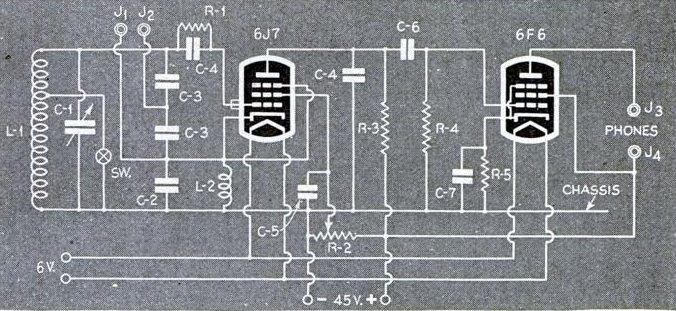
1942JulPSEighty years ago this month, the July 1942 issue of Popular Science showed how to make this compact emergency receiver, designed to meet the requirements of defense organizations. The key to the design was the elimination of bulky B batteries. Instead, the set used only about 9 volts of plate voltage, and also cut the filament voltage in half.

The circuit could be used with either metal 6SJ7 tubes or glass 1SA6GT interchangeably. The glass tubes provided better battery economy, but the metal tubes were more durable for rough service in the field. Filament votages were extremely critical. In fact, the circuit would not function at all at the tube’s normal filament voltage. A rheostat was used to get the exact voltage needed.

With suitable plug-in coils, the set could tune from 16 to 1000 meters. One tube served as detector, with the other two amplifying the audio.

1942JulPS2


1922 Watercycle

1922JunPMA hundred years ago this month, the June 1922 issue of Popular Mechanics showed this watercycle, invented by Edward Bellman of Evansville, Wisconsin.

According to the magazine, the craft was made of aluminum tubing, and could be quickly taken out of storage and assembled with thumbscrews. Buoyancy came from two inflated tubes which slipped into the frame. A propeller was driven by bicycle pedals, and the rudder was controlled by a handlebar.

The entire craft weighed only 20 pounds and could be packed in an ordinary suitcase. The inventor envisioned the craft for use as a pleasure craft or for lifesaving purposes.


Young 1922 Radio Listener

1926June26If she is still with us, the young woman wearing headphones in these photos is about 101 years old. This item appeared 100 years ago today, June 26, 1922, in the Bridgeport (CT) Times and Evening Farmer.

The young listener is the daughter of Charles C. Kolster, then the radio instructor for the First Naval District. He went on to become Supervisor of Radio for the Boston office of the Federal Radio Commission, and later Inspector in Charge of the First District of the Federal Communications Commission.

In this photo, the young Miss Kolster had the headphones placed on her head to her initial puzzlement. But this was quickly replaced by delight when she realized that she was hearing her father’s voice.


1937 Trailer Intercom

1937JuneRadioCraftI’m sure this picture would be a violation of today’s traffic safety laws. At the very least, I’m sure it would result in a ticket for not wearing a seatbelt. But 85 years ago, it was a different story, and cooking breakfast in a moving trailer wasn’t anything to worry about.

But there was a matter of telling the driver that breakfast was ready, and the intercom shown here would solve that problem. The accompanying article, from the June 1937 issue of Radio Craft points out that there were 250,000 trailers in the country, and it was an untapped market for radio sales. The trailers were practically begging to have a radio installed. It would have to be a heavy-duty unit to survive the vibrations. And equipping it with an intercom would allow the driver of the car to listen to the radio (with the radio mounted away from the ignition system and its possible interference) and also communicate back to the trailer.