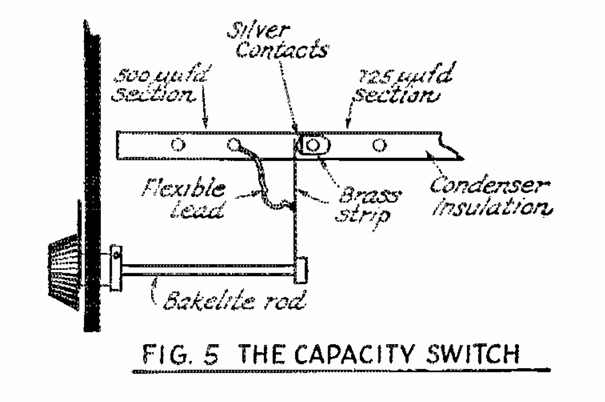
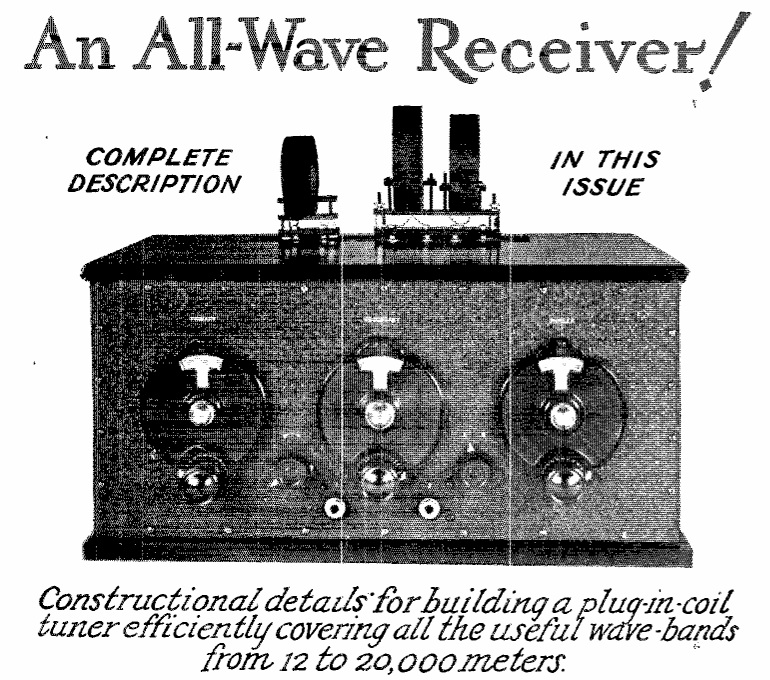
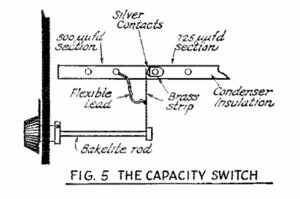
 One hundred years ago this month, the October 1926 issue of QST showed how to build this receiver covering 12 through 20,000 meters. That works out to 15 kHz to 25 MHz. Band shifts were accomplished with plug-in coils, and the article contains full coil information. The article noted that the scale of the capacitors needed to be entirely different on both ends of the range. While a 125 pF capacitor would work well at 20 meters, it would be useless at the low end. On the other hand, a 625 pF capacitor would be useful at the low end, but impossible to tune at the upper range. The solution was to use a ganged tuning capacitor, with the two sections placed in parallel when needed, by use of the low-loss switch shown at right.
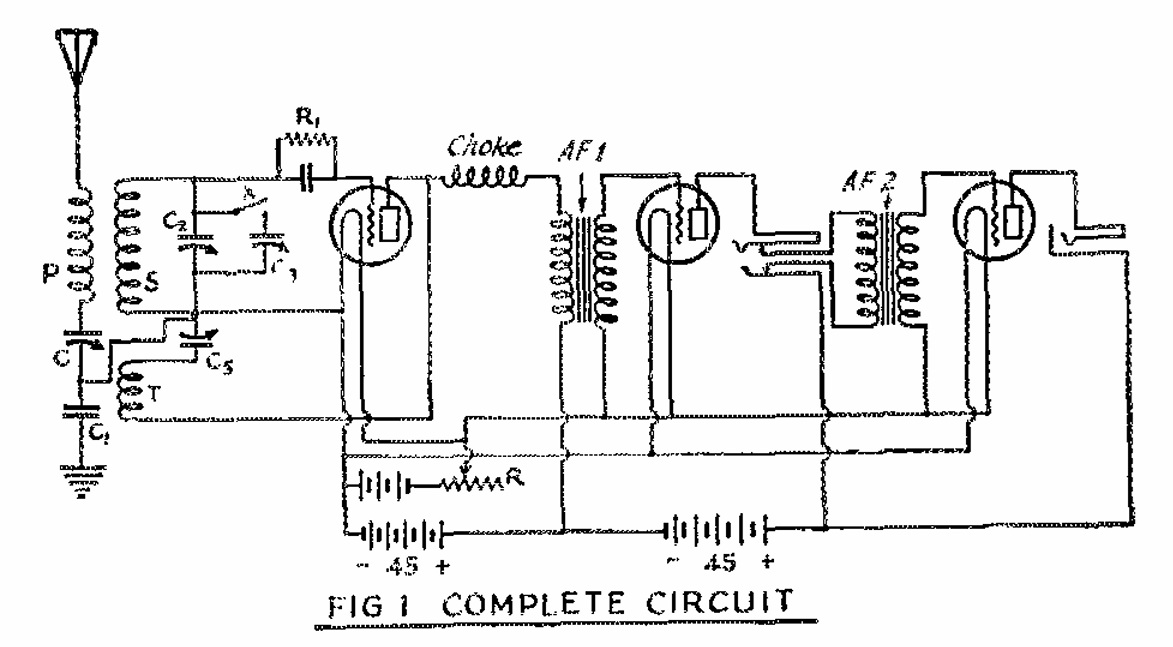
The basic circuit used one tube as regenerative detector, with two stages of audio amplification. Since hams were at 200 meters and down by this time, the author told about what signals could be heard on the longwaves in those days:
Who’s Who
Unless you have kept track of communication in bands other than the ham ones for the past few years you may miss out on a lot of things because you are not listening in the proper place. The broadcast band is pretty well known. Ship calling, answering, SOS work and messages relating to traffic handling occur on 600 meters. Actual traffic between smaller ships and land occurs on 660, 731 and 874 meters. The radio compass wave is still 800 meters. On 952 meters the government has a wave where a number of naval vessels and naval land stations can be heard batting them off hour after hour. Radio beacons (those things making bunches of dashes and never signing) are found on 1,000 meters. Then come the intermediate waves where high power land stations work high power ships. These waves are around 1052, and 1578 to 2499 meters. In this band will be found the high power tube stations WCC, WSH, WAX, KPH and so on, working the large liners. An other band from 2499 to 3156 finds only government stations, among them being the ever faithful NAA on time ticks, weather, hydrographic information and press. NAA’s time still comes off at 10 P.M. (E.S.T.) followed by an hour of weather and press start ing around 11 P.M. NSS sends time at the same time as NAA and follows this immediately (usually) with press. Lately NKF has been sending time ticks with the rest on 74 meters although it is understood that this is an experimental time service and may be discontinued. At around 11:15 P.M. WSA sends press on 650 meters, spark, and WSLI on about 2400 C. W., both stations being keyed from the same source. On 2200 meters WCO sends press at 9 A.M., 5 P.M. and at 12:18 A.M. WRQ starts his press on 18505 meters.
These are only a very very few of the hundreds of stations operating regularly on waves between 600 and 18,000 meters. After you have listened in on these waves for a little while you will find there is a great kick to be had from jumping from one station to another. The 600-meter kick alone is worth the candle!


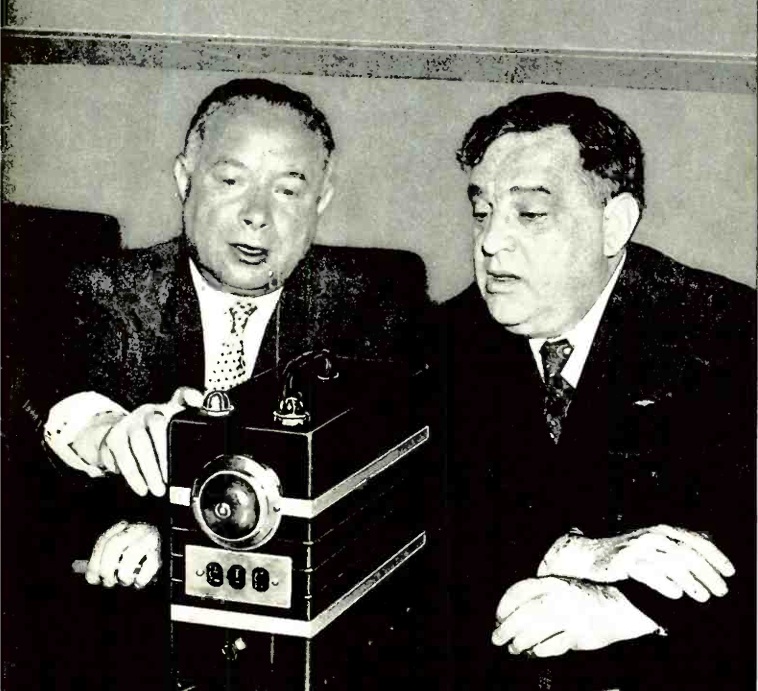 Shown here, on the cover of Radio Craft, October 1941, are RCA President David Sarnoff (left) and New York Mayor Fiorello LaGuardia (right), acting in his role as National Director of Civilian Defense. War was still two months off for America, but the nation was on a defense footing, and LaGuardia is being shown an air-raid alert which could be used with existing broadcast radios. In this test, a signal was sent out from station WJZ which would sound a bell or turn on a light on the receiver. This was accomplished by sub-audible tones (30 Hz for On, 24 Hz for Off), which would trigger the alarm.
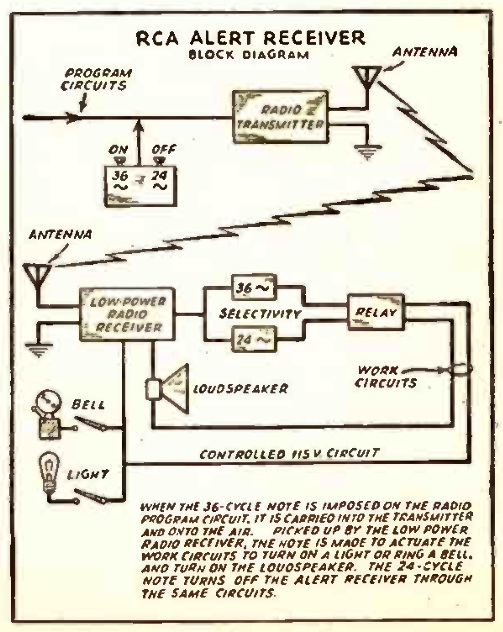 I’m not aware of this system being put into production, but the modern equivalent is the modern weather alert radio, which we have previously featured.