1922 Simplest Radio Outfit

1922DecSciInvShown here from a hundred years ago is the 7th place winner in the “Simplest Radio Outfit Contest” shown in the December 1922 issue of Science and Invention magazine.

The self-explanatory set was designed by one George Goga, who took home a $25 prize for his entry. The magazine noted that almost all of the parts, with the exception of the headphone, could be found ayt no cost in the home junk box. A pencil forms the chassis. The eraser is removed and a galena crystal inserted in its place. The coil is wound along the pencil, with about 3/16″ of the insulation cleaned off so that the slider can contact the wire.

Mr. Goga reported that he lived several miles from station KDKA, and was able to pull in concerts clearly with a 50 foot long antenna 10 feet high.


First Airplane Landing in Grand Canyon: 1922

1922DecPMIf you tried this today, the National Park Service and the FAA would probably seize your airplane and haul you off to jail. But a hundred years ago this month, the cover of the December 1922 issue of Popular Mechanics showed the first ever landing of an airplane in the Grand Canyon.

Aviator Royal D. Thomas, accompanied by photographer Anthony Ugren, successfully landed the plane at Plateau Point, despite the treacherous air currents that were known to exist there. “To the Indians who had assembled in their best paint and feathers, it must have been an awe-inspiring sight, similar to that of earlier generations of red men who saw the centaurlike cavaliers of the Spaniards and the steam train for the first time.”

The landing of the 180 horsepower plane took place on the morning of August 18. The next morning, the upward flight out of the canyon took 4-1/2 minutes, although Thomas estimated that it would have taken a minute longer if he hadn’t caught an upward air current that lifted him nearly 1500 feet.


Science Fair Ideas: Fun With a Homemade Galvanometer

1942DecPS4Eighty years ago, there was a war going on, but that didn’t stop young scientists on the home front from conducting experiments with the items available. If Junior’s science fair project is due tomorrow, he can take a cue, and whip together a great project from these ideas in the December 1942 issue of Popular Science.

Both experiments involve a galvanometer, and the magazine presupposes that young scientists know how to make one, because the instructions merely state to use “your homemade galvanometer.” But in case Junior doesn’t know, it’s easy enough. You just take a compass (a toy one from the dollar store will work just fine) and wrap a few turns of wire around it. The smallest of electric currents will cause the compass to move.  If there’s a little extra time before the science fair, we’ve previously shown how to make a deluxe galvanometer.

In the first experiment, shown above, Junior can demonstrate that water, contrary to popular opinion, is an insulator. It’s only when a little bit of salt is added to the water that it starts to conduct electricity, and the compass moves. To accentuate the effect, we recommend starting with distilled water.  And don’t worry about not being able to find the old-fashioned dry cell batteries.  These experiments will work just as well with modern alkaline D cells, especially if you purchase battery holders for them.

The second experiment, shown below, shows how to make a thermocouple. Two pieces of wire–copper and iron (or steel)–are twisted together. When the twisted wires are put into a flame of a candle, the dissimilar metals produce an electric current, as shown by a movement of the compass.  And as we always remind parents about experiments involving flames, don’t forget to give Junior a box of matches!

As with many of our projects, Junior is almost guaranteed to take home the blue ribbon, and the teacher won’t have a clue that the project was put off until the last minute.

1942DecPS3


Some links on this site are affiliate links, meaning this site earns a small commission if you make a purchase after using the link.

1937 Disco Ball

1937DecPSWhat we know as the “disco ball” has a long heritage, as shown by this depiction 85 years ago in the December 1937 issue of Popular Science. The magazine featured a number of ideas on what to do with a broken mirror, and assured readers that it needn’t signify seven years of bad luck.

1937DecPS2The magazine noted that one use was to provide spectacular color effects for parties and dances. This was done by focusing colored spotlights on a mirror-covered globe. This was made by cementing small squares of mirror on a large ball or toy globe. This was attached to a spindle which could be spun by hand or with a small geared-down motor.

According to Wikipedia, what is now known as the disco ball dates back to 1917.

If you have a piece of mirror left over after making your disco ball, you can mystify your friends with the magic trick shown below:

1937DecPS3


1942 Miniature 2 Tube AC-DC Receiver

1942DecPS1Eighty years ago this month, the December 1942 issue of Popular Science showed how to put together this two-tube AC-DC set. The miniature set used two midget tubes, types 9001 and 9002. The 9002 pentode served as a sensitive detector, and the 9001 triode was used as a rectifier.

The filaments were wired in series, and since they required a 600 ohm dropping resistor, not one but two “curtain burner” cords were used, wired in series.

With a short antenna lying along the floor, the set could pull in local stations with good selectivity. Out in the country with a 75 foot antenna, it boasted a range of 600 miles.

1942DecPS2


Tube Aging, 1947

1947DecRadioNewsThese workers at Hytron‘s plant in Newburyport, Mass., are aging tubes to ensure long life. An incandescent lamp is wired in series with each tube element to limit current. This process of seasoning and degasifying the tubes ensures more uniform tubes.

The photo appeared on the cover of Radio News, December 1947.


Electronics Numbers Quiz

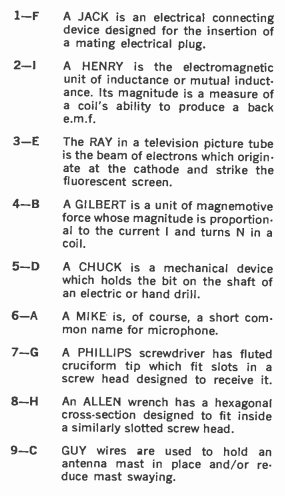
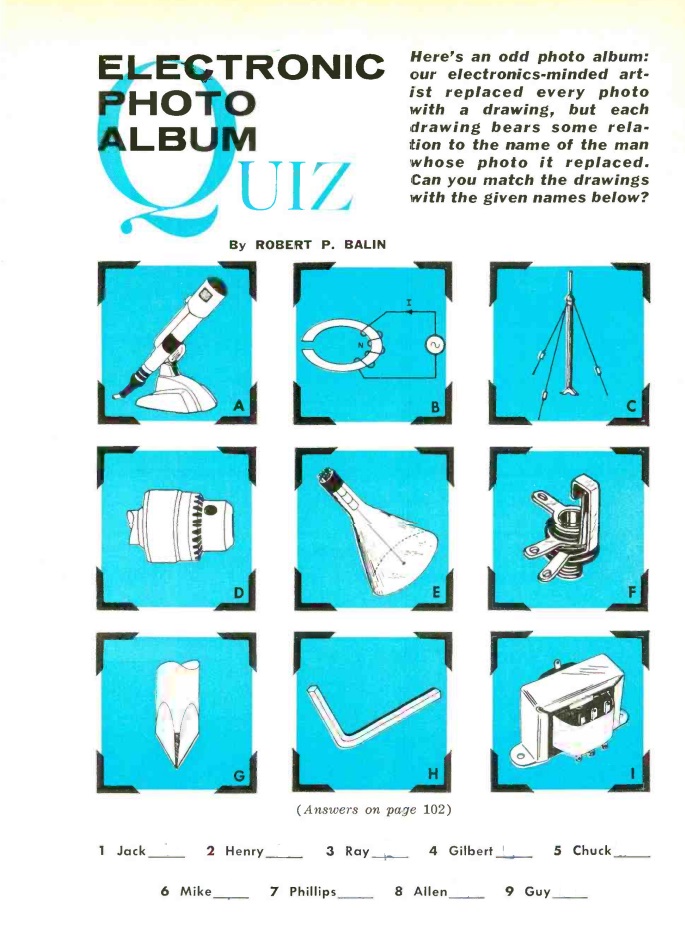
1962DecPEquizToday’s quiz comes from the December 1962 issue of Popular Electronics. You have to match up the number associated with each diagram.  Answers will appear here tomorrow.


1942 Expedient Chassis

1942DecPracWirThe December 1942 issue of the British Practical Wireless carries this self-explanatory hint sent in to the magazine by one J.M. Firth of Beckenham. He noted that there was a great shortage of aluminum and sheet iron for making chasses for radios. Quite possibly to Mrs. Firth’s chagrin, he found a suitable replacement in the kitchen in the form of a tinplate baking tin. He noted that the pan would take solder easily.


1947 Five-Tube Radio Kit

Screenshot 2022-11-18 12.51.08 PMThere’s a reason why this young woman seems particularly cheerful about pulling in a station on her broadcast radio. It’s because she put the radio together herself from a kit.

The kit is described in the December 1947 issue of Popular Mechanics, and from the description, it sounds like an “All American Five” of the type manufactured by the millions. Curiously, though, the magazine doesn’t mention the source.  If any of our readers can identify the brand of this kid, please let us know.