Acting Bears Come to Indy, 1864.

ActingBears

150 years ago today, Hoosiers were undoubtedly excited by the soon to arrive circus. But this wasn’t just any circus. The acting bears depicted here (realistically, no doubt) were but one of the many attractions to be featured at what was billed as “positively the largest exhibition of the amusement world,” The Monster Equescurriculum! It was going to be an immense and unparalleled combination, heralded here in the September 19, 1864, edition of the Indianapolis Daily State Sentinel.

The bears shown here were “Old Grizzly Adams’ Troupe of Acting Bears, from California.”  Adams himself, it would appear, wasn’t traveling with the bears, since he died in 1860 from a succession of injuries caused by the bears (and in one case, a monkey).  The bear depicted on the California state flag is apparently one of Adams’ bears.  It is not known whether that bear was one of the bears to visit Indiana, although the bear wearing a top hat bears a strong resemblance to the one on the flag.

But according to the announcement, since the combination of acts is such as had never before been attempted by private enterprise, it gave notice that the management will be “pardoned for directing attention to the fact that this magnificent phalanx of exhibitions not only combines and infinitely greater degree of novelty, variety and effect within itself than can be found in any other place of amusement in the world, but also a nearer approach to perfection in every detail.” It also notes that the performance entailed such an enormous expenditure of money that only the most liberal patronage could render it remunerative.

Admission for one of the four performances was fifty cents, 25 cents for children under 12.


1939 British Gasproofed Room

Life18Sep39

Seventy-five years ago today, September 18, 1939, Life Magazine carried this illustration from the British Home Office showing a basement room equipped and gasproofed. The caption notes that if the occupants remain quiet, there will be enough oxygen in the sealed room to accommodate five persons for twelve hours.

Presumably, the gramophone is to keep you entertained between bulletins from the wireless.


Allied Radio Newspaper Ad, 1964

AlliedAd17Sept1964

We didn’t have an Allied Radio store in my neighborhood, but they were still big in 1964, as evidenced by this full-page newspaper ad fifty years ago today, in the Milwaukee Journal, September 17, 1964.

Having good stereo gear was a rather expensive proposition. A turntable, amplifier, and speakers would set you back $129. A set including an AM-FM stereo receiver was $199. A twelve-inch black and white TV was $99.

A 3-1/4″ reel-to-reel tape recorder was available for only $9.99 (limit one to a customer). For the serious audiophile, a stereo tape deck was $169. Transistor radios started for $4.44. The nine-volt batteries for that radio were six for 99 cents, and flashlight batteries were nine cents each, but both limit 6 per customer.

While those prices appear modest, 1964 was the last year that that money was made out of real silver. By comparison, other ads in the same issue show that you could buy a case of beer for $1.79. At the Walgreen’s lunch counter, you could get a turkey dinner for 65 cents. Tires for your car started at $5.99. And at the supermarket, chuck roast was 45 cents a pound, carrots and bananas were a dime a pound, and five pounds of flour was 42 cents.

One would think that very few products made by Gonset showed up in normal commercial newspaper advertising, but this is a case where one did.  The ad shows the Gonset G-15 CB transceiver, normally $199.95, on sale for $99.  The 10-tube radio had four crystal-controlled channels, and its receiver tuned all 23 channels.  It operated on either 120 volts AC, or 6 or 12 volts DC with its built-in vibrator power supply.


OneTubeRadio.com To Visit Moon


The location of our latest expansion. (NASA photo.)

The location of our latest expansion. (NASA photo.)

OneTubeRadio.com will soon have a lunar presence. On October 23, the 14 kilogram 4M-LXS spacecraft will be launched from China. The spacecraft was developed by LUXspace in Luxembourg and has now been transported to the Xichang Satellite Launch Center.   About eight days after launch, it will pass within between 7440 and 14,480 miles of the moon, depending on the final orbital injection vector. At this point, the craft will be approximately 248,000 miles from Earth.

One of the partners in the mission is the International Amateur Radio Union, and the spacecraft will be transmitting digital data throughout its mission, including during its lunar orbit phase. The transmissions will take place on 145.990 MHz using JT65B mode. The transmitter power will be 1.5 watts to a quarter-wave monopole antenna. Transmissions will begin about 77 minutes after launch. When the spacecraft is in the vicinity of the moon, the signal-to-noise ratio will be comparable to that of Earth-Moon-Earth communications (EME) signals routinely copied by hams, and thousands of amateurs equipped for EME should be able to decode the digital signals.

LUXspace made available a limited number of slots for 13-character messages to be sent from the moon. And one of those messages will be the URL for our parent website: w0is.com.  On that page, we have a direct link to OneTubeRadio.com.  (The direct URL for this site would have exceeded the 13-character limit.)

Only a limited number of messages can be sent, but there might still be available slots. You can upload your message at the 4M-LXS website. To steer your antenna to receive the signal, azimuth and elevaton tracking data for throughout the mission is also available.

More information is also available at the ARRL website.


Operation Washtub: Stay-Behind Agents After Soviet Invasion of Alaska

1954 letter seeking background on Valdez, Alaska, amateur radio operator.

1954 letter seeking background on Valdez, Alaska, amateur radio operator.

A recent batch of documents obtained under the Freedom of Information Act by
GovernmentAttic.org paints a fascinating picture of U.S. Government plans to deal with the possibility of a Soviet invasion of Alaska in the 1950’s. The 701 pages of formerly secret documents are available at this link.

The program, code named Operation Washtub, was put into place, and agents were trained as detailed in many of the documents. The plan was to have in place “stay-behind” agents who would be recruited and trained in peacetime and paid a stipend of $3000 per year to remain on standby. At such time as Alaska fell to Soviet invaders, they would provide intelligence, engage in covert activities, and aid downed U.S. airmen.

Rather extensive equipment was assigned to the agents, including a “Gibson-Girl” type radio transmitter-receiver.

Interestingly, one potential agent was an Amateur Radio operator. It appears that the author was referring to a particular individual, although there doesn’t seem to be any indication that this particular individual was ever recruited. But he does seem like a quintisential resident of the last frontier:

An example of a typical person to be one of the principals is a professional photographer in Anchorage; he has only one arm and it is felt that he would not benefit the enemy in any labor battalion; he is an amateur radio operator; he is a professional photographer; he is licensed as a hunting or fishing guide, and well versed in the art of survival; he is a pilot of a small aircraft; he is reasonably intelligent, particularly crafty, and possessed of sufficient physical courage as is indicated by his offer to guide a party which was to have hunted Kodiak bear armed only with bow and arrow. If such an individual were chosen it is believed that he would be eminently satisfactory as a principal.

A one-armed ham is one thing, but this one was apparently proficient with archery!

At least one ham was, however, recruited. The last page of the 701 pages of FOIA documents are the request for a background check of the manager of a Valdez hotel. His name is redacted in the document (probably because he was born after about 1914 and might be a living person), but the document does alert the FBI that this person is a Ham radio operator.

Surely there weren’t very many one-armed Anchorage photographers who were also hams and archers. And surely there weren’t very many hotel managers in Valdez who were hams. It would be interesting to follow up on these gentlemen and learn more about their role in the Cold War. If you have any information as to their identities, I’d appreciate hearing from you.

References:


Childproofing the Home: 1944

1944childproof

Assuming he survived childhood, the young daredevil shown here has been drawing Social Security for about six years now. He is shown attempting to poke his fingers into the outlet in the September 1944 issue of Popular Mechanics.  The accompanying article explains how to make the dummy plug shown in the inset.

Just in case mom and dad didn’t figure it out, the article points out that to use the outlet normally, “the dummy plug can be removed and a plug with wires inserted in its place.”


Completion of the Transcontinental Telephone, 1914

TranscontinentalTelephoneA hundred years ago, it became possible for the first time to make a telephone call from coast to coast. The September 1914 issue of Popular Mechanics reports that the line from Denver to San Francisco had been completed on June 17, 1914. On that date, crews working westward from Salt Lake City and eastward from San Francisco met at the Nevada-Utah state line. The lines were spliced together at a pole erected on the state line and “the last splice was accompanied by a ceremony much like that of driving the last spike on a transcontinental railway.”

Read More at Amazon


Civil Defense Postattack Broadcast Planning: 1963

1962XtalSets

“Perfectly adequate” civil defense receivers for those close to transmitters. 1962 Radio Shack Catalog.

In an earlier post, we looked at how the Defense Civil Preparedness Agency had been planning for emergency broadcast antennas in 1973. The agency and its predecessors had long recognized the need for dissemination of information by radio, and had commissioned a number of studies on the subject. One which took a comprehensive look at the subject was conducted by Technical Operations Incorporated of Burlington Massachusetts. The study culminated in a report issued on 7 January 1963, entitled “The Civil Defense Role of Radio Broadcasting in the Postattack Period.”

The report began by identifying three distinct phases of the postattack period. The first was the Buttoned-Up Period, during which time the population would be confined to shelter because of high radiation levels or because further attack was anticipated. This would be followed by the Emergence Period when some outside exposure would be possible. At such time as a full workday was possible outside of the shelter, the Recovery Period would begin and recovery would be the focus of the public’s activities. Each of these time periods had distinct requirements with respect to broadcasting, and the report then moved on to discuss the numerous broadcast needs.

The first broadcast information discussed related to fallout, which would need to be broadcast frequently during the Buttoned-Up Period to facilitate planning by shelterees. In addition to general forecasts, these would include warnings of local hot spots, instructions on methods of decontamination and identification of safe foods, and information on the length of time over which shelter supplies would need to be rationed.

Broadcasts would also need to convey a large amount of information as to how the public could access emergency services, and would also serve a role in alerting those furnishing those services. Locations of food and water supplies could be broadcast, along with admonitions to avoid hoarding of those limited supplies. Locations of emergency hospitals and medical supplies could be broadcast, along with pleas for blood donors and volunteers to staff the hospitals. Information as to sources of fuel and power could be broadcast. And if the electrical mains were operative, the instructions might include rationing instructions. If fires were burning out of control, the broadcasts might include calls for volunteers to assist in their control, as well as warnings of fires close to particular shelters.

Much educational programming would be necessary. In addition to broadcasts of food decontamination methods, emergency first aid instructions would need to be broadcast during the Buttoned-Up Period, since no outside medical aid would be available at that time. Since some shelters might be stocked with radiological instruments with no trained personnel, this training could be broadcast as well, along with training on sanitation, shelter management, rationing of supplies, and even disposal of the dead.

During the Recovery Period, a very high civil defense priority would be re-establishment of public transportation. Once again, broadcasting would play an important role, since it could be used to call drivers back to work, as well as to announce schedules.

Even apart from this vital information, radio would be important to the public morale. The report stressed the importance of morale-boosting messages from the President, as well as by state and local leaders. Similarly, to stop the spread of rumors and boost morale, it was deemed important to broadcast news of the attack and counterattack. This would also prepare the people for the conditions they would face upon emergence, and also instill a feeling in the people that this was not a personal disaster, but that the whole population of the nation was included. The report noted that good news is always best, but that even bad news is superior to no news at all, since it helps define the environment and diminish uncertainty. The report noted that any unaffected regions of the country should be kept up to date, in order to properly tailor relief and rescue operations.

Broadcasts should frequently give the time and date, since in such emergencies, people frequently lose track. In addition, program schedules should be announced, in order to facilitate conservation of scarce batteries.

Broadcasting could also play a role to re-establish normal commerce during the Recovery Period. Even during the Buttoned-Up Period, the report recommends that people be informed as to the rules and regulations over such things as “whether the needy will be allowed to take what they require without being charged with illegal looting.”

Radio would also play a role in the care of displaced persons, since stations could broadcast information to reunite families who were separated at the time of the attack. These broadcasts would include locations of camps, shelters, and displaced person centers. In addition, during the nighttime hours, lists of people safe in various shelters could be broadcast for the benefit of their families in other areas.

Evacuation instructions and warnings of another attack would obviously have a high priority for broadcast.

The report notes that broadcast stations would undoubtedly be used to call civil defense personnel and members of the National Guard to duty and provide some instructions. Broadcast stations could even be used to relay civil defense messages from one area to another. The nighttime hours, in particular, might be put to use relaying such official messages, and civil defense officials in other areas could be assigned to monitor broadcasts from neighboring areas.

Finally, the report recommends that some entertainment should be furnished, particularly during the time in which people are in shelters. It notes that “music properly chosen many substantially aid morale in the rebuilding phase.” The report warned, however, that people with battery-operated radios should be advised to conserve batteries by listening to only a minimum amount of non-essential programming.

The overall contents of the broadcast day of a typical local station are shown in this chart:

CDbroadcastday

After identifying all of these needs, the report goes on to a discussion of how these needs can be satisfied. While some other options (such as public address systems) are briefly discussed, the only reasonable method of addressing these needs was with standard AM broadcasts. Virtually all American households had a radio receiver, and a large number had a battery-operated set. The report even notes that “for the really economy-minded, there are crystal sets selling for as little as $1.49,” which would be suitable for receiving local stations with no batteries, but with adequate antenna and ground. The footnote for this assertion is to the Radio Shack catalog, and the price obviously refers to the “Rocket Radio” shown at the top in the illustration at the top of this post.

The report did address many of the practical issues confronting broadcasting in the post-attack environment. Presumably, most information would originate at the civil defense Emergency Operations Center (EOC), and links would be necessary to studios or, preferrably, direct to the transmitter site. Since telephone lines would be vulnerable, mobile broadcast units would be advisable, although the report toyed with the idea of installing AM transmitters directly at the EOC, or the use of mobile or even airborne transmitters. Protection of station staff and equipment was addressed in this and other studies.

The report lamented the fact that the radio industry, even though some personnel served on relevant civil defense committees, largely lacked civil defense plans. For example, even radio station switchboards were poorly suited for civil defense needs. As addressed in my earlier post, vulnerability of transmitter towers to blast damage was a very big issue, as was fallout sheltering for station staff.

Station power was discussed, although the report noted that some stations already had emergency generator capability.

At the time of this report, public shelters were not stockpiled with radio receivers, and the report noted that this oversight should be rectified. This, of course, was never done, apparently the planners going along with the reasoning, “surely some people will bring radios to the shelter.”


More Dancing on the Beach to Radio, 1922

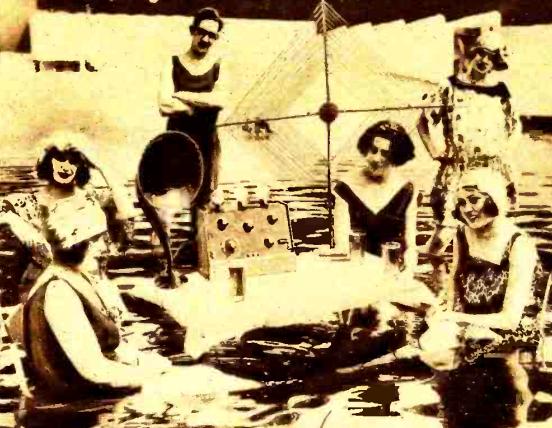
Dancing on the beach to the beat of a radio receiver was a popular pastime in the 1920’s, as evidenced by yet another photo of another young woman doing exactly that. And we see that the fad has spread to the Pacific coast, where Miss Pauline Chambers of Ocean Park, California, was captured in the act by this 1922 press service photo.