March 8, 1965: Vietnam War and Civil Rights

MilwJournal030865

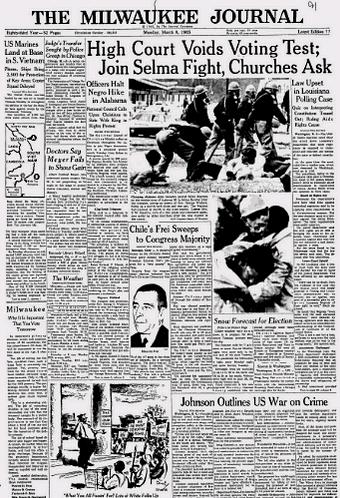
Fifty years ago today, it was anything but a slow news day, as shown by the front page of the Milwaukee Journal, March 8, 1965.

In the left column, almost lost in the clutter, is an article with the headline, “US Marines Land at Base in S. Vietnam,” which reported that 3500 U.S. Marines from the Third Marine Division at Okinawa had landed at Da Nang, or were in the process of arriving. This marked a major escalation in U.S. involvement in the war. In 1964, there were about 16,500 American servicemen in Vietnam. The March 2 attack on the U.S. Marine barracks at Pleiku marked the initiation of a three year bombing campaign, and a rapid escalation of U.S. forces on the ground. These 3500 Marines arrived on March 8, marking the beginning of the ground war. At the time, U.S. public opinion overwhelmingly supported their deployment. By the end of 1965, there were 200,000 U.S. servicemen in Vietnam.
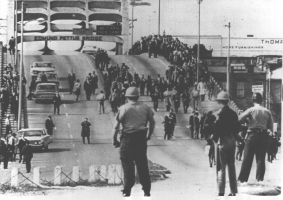
"Bloody Sunday" in Selma, AL, March 7, 1965. Wikipedia photo.

“Bloody Sunday” in Selma, AL, March 7, 1965. Wikipedia photo.

But the escalation of the war was dwarfed by other news. The photo shows not fighting in Vietnam, but on the streets of Selma, Alabama. According to the caption of the UPI photo, it shows “charging Alabama state troopers passing fallen Negroes on the median strip after the troopers, acting on orders of Gov. George Wallace, broke up a march with clubs and tear gas. The Negroes had planned to march to the state capitol.” The article notes that the march consisted of “600 praying Negroes” and had been “broken up by Alabama state troopers and deputies who used clubs, whips, ropes and tear gas. Sixty-seven Negroes were injured.” An FBI agent filming the troopers was also injured after being attacked by a group of white civilians.

The paper reported that the National Council of Churches had called upon Christians throughout the nation to join the demonstrators in another march scheduled for the following day. Catholic authorities were conferring on a plea from Rev. Martin Luther King and promised a statement as well. Rabbi Richard G. Hirsch of the Union of American Hebrew Congregations also announced that he planned to attend the march.

A number of race-related decisions from the U.S. Supreme Court were announced in the paper. The banner headline went to announcing the decision in Louisiana v. United States, 380 U.S. 145 (1965). Louisiana had vested in its election registrars virtually unbridled discretion in administering an “interpretation test” to prospective voters. Under the state law, in order to register, a voter was required to read, “be able to understand” and “give a reasonable interpretation” of any section of the state of federal constitution. According to the Court, there was ample evidence that the provision was used as a ruse to deprive otherwise eligible African-American voters of the right to vote. The court noted that “colored people, even some with the most advanced education and scholarship, were declared by voting registrars with less education to have an unsatisfactory understanding of the Constitution of Louisiana or of the United States. This is not a test but a trap, sufficient to stop even the most brilliant man on his way to the voting booth.”

The Supreme Court unanimously affirmed the district court’s striking down of this provision.

The front page also contained an editorial stressing the importance of voting in a school board primary to be held the following day. To drive home the importance, the front page cartoon shows a stereotypical southern politician addressing a group of African-Americans protesting for voting rights. He’s telling them: “What you all fussin’ for? Lots of white folks up north don’t think voting’s important.” And he was probably right. The paper notes that only 11% of registered voters bothered going to the polls in the 1963 primary.

Finally, the paper reported that President Johnson had asked congress for help in the “War on Crime.” He asked for a ban on mail-order firearms, tighter control over drugs, and for provisions to “strengthen safety in the streets” with “development and testing of experimental methods of crime control.”
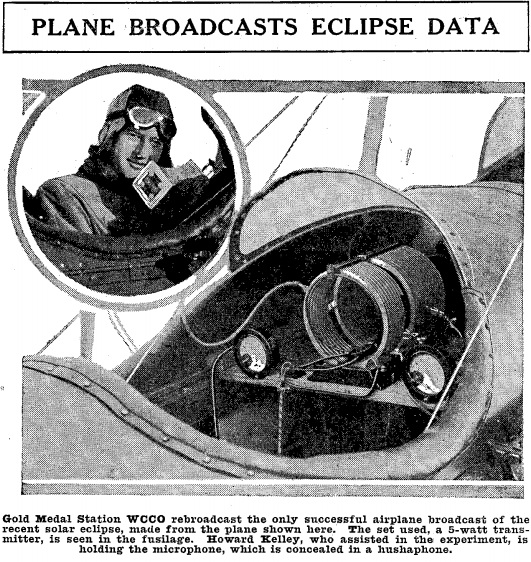
WCCO and the Solar Eclipse of 1925

WCCOElcipse

Ninety years ago today, the March 7, 1925, issue of Radio Digest carried this photo of an airplane used by WCCO radio in Minneapolis to carry “the only successful airplane broadcast of the recent solar eclipse.”

The plane was equipped with the 5-watt transmitter shown here.

The eclipse, which took place on January 24, 1925, had been visible in Northern Minnesota, and then moved over the Northeastern United States and then the North Atlantic. Its shadow had passed over Manhattan, where the path of totality was above 96th Street. Those below 96th street experience only a partial eclipse.

The film below shows film of the eclipse as seen from a Navy dirigible.

https://www.youtube.com/watch?v=l7XPjfCaltw

As I reported in an earlier post, the station had recently adopted the WCCO call sign, having previously been known as WLAG.  Another photo of the event can be found in WCCO’s 40th Anniversary album.


Another SOS by Flashlight, 1915

1915WirelessAgeSOS

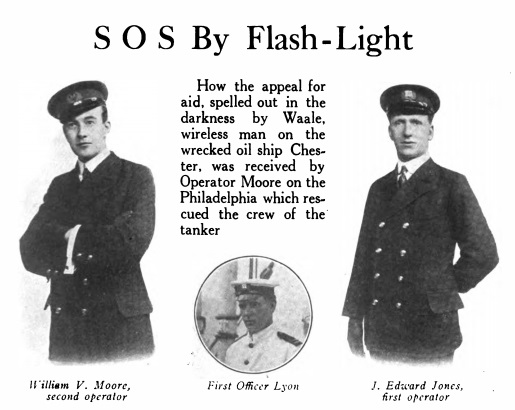
The March 1915 issue of The Wireless Age carries the tale of the steamship Chester, a tanker owned by the American Petroleum Company. She had left New York on January 23 en route to Rotterdam with a cargo of oil. She ran into rough weather a few days out and suffered a tank bulkhead burst, but there was no immediate peril.

But on the afternoon of February 2, a giant wave swept over the vessel. The hatches were demolished and oil was pouring from the tanks. The engines were flooded and stopped; most of the contents of the deck, including the lifeboats were swept away; and the ship was listing so badly that the rails were in the water.

The ship was not equipped with wireless, but the second officer, Jacobus W. Waale, held a cargo grade wireless certificate and was familiar with Morse. With the one remaining signalling lamp and a flashlight, he began to signal SOS over the dark waves. All that night, no ship spotted the signal. The next day, signal flags were hoisted, also to no avail. When darkness once again fell, Waale once again resumed signalling with the lights.

Crew of the Chester aboard the Philadelphia after rescue.

Crew of the Chester aboard the Philadelphia after rescue.

Fortunately, the steamer Philadelphia was making its way from Liverpool to New York. Normally, she would have been on a more southerly route, but had moved closer to the Chester’s position in an effort to avoid storms. A tiny spark of the Chester’s light was spotted from the deck of the Philadelphia, and the officers finally realized that a ship was trying to signal them. One of the officers had some knowledge of Morse Code and made out that it was an SOS. The captain instructed the wireless operator J. Edward Jones to establish contact with the signalling ship. This, of course, was in vain, since the Chester was not equipped with wireless. The ship’s second wireless operator, William V. Moore, was summoned to the deck to make contact with the signal light.

He flashed the message, “what is the matter?” It took almost thirty minutes to receive the reply, “we are a wreck.” The Philadelphia inquired as to whether the distressed ship had any boats, to which it received a negative reply. When asked “do you want to be taken off,” the Chester replied “yes.” The rescue was not easy, but it was facilitated by the use of the lights.

The Chester, as seen from the Philadelphia after the rescue.

The Chester, as seen from the Philadelphia after the rescue.

Interestingly, this incident came just a few months after another notable incident involving a flashlight used to send SOS from the Hanalei recounted in an earlier post.


1957 CONELRAD The Easy Way

1957ConelradStarting in 1957, U.S. Amateur Radio operators were required to participate in CONELRAD. (If you’re unfamiliar with CONELRAD, I explain it in other posts, including this one.) Under the regulations that took effect that year, hams were required to monitor an AM broadcast station whenever transmitting. If that station went off the air, the ham was required to check to see if the absence from the air was due to a CONELRAD alert. If so, he was required to leave the air.

The regulations could be satisfied by keeping an AM radio on low volume in the background, but the preferred method was to have an automated alarm that would sound if an AM station left the air. One popular receiver for that purpose was the Heathkit CA-1 CONELRAD alarm, which was an external monitor that would be hooked to a receiver. Other dedicated receivers wwere available, such as the Kaar Engineering Conalert II, although a unit such as that would be out of the price range of most hams, and probably used mostly by broadcast stations.

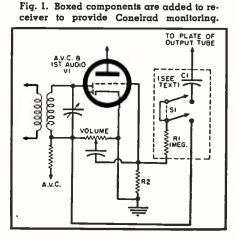
The April, 1957, issue of Radio News carries an article entitled “Conelrad the Easy Way,” with a simple method of converting a five-tube broadcast receiver into a CONELRAD monitor. As shown in the schematic above, it required only three parts, and allowed the radio to be used for normal listening. The additions to the circuit are the three parts inside the dotted lines.

This circuit ties in to the AVC voltage of the first audio amplifier. As long as there is an AVC voltage present, the added resistor biases the first tube to silence the radio. But if the AVC voltage disappears (because there is no signal present), then the output of the final audio amplifier gets fed back to the first audio amplifier, causing the two stages to break into oscillation to emit a loud squeal.

It’s a pretty ingenious and easy modification, and the author reports that many hams were using it and that he thought “it is the answer to the Conelrad needs of most hams.” He even notes that the circuit “is so simple that many broadcast listeners may want to install it on their receivers, just in case.”

The author, by the way, is John T. Frye, W9EGV. If that name rings a bell, it is because Frye was a prolific writer in many electronics and radio magazines. He was most famous as the author of the “Carl and Jerry” stories that appeared in Popular Electronics from 1954-1964.
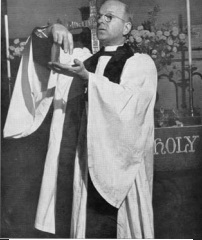


Rev. J. Stanley Light, Eagle Scout, 1915

One hundred years ago this month, Boys Life magazine, March 1915, reported that scout J. Stanley Light of Boston had completed the rank of Eagle Scout. This was regarded as a remarkable achievement, since Scout Light had been deaf from a very young age. Despite his disability, he did well in school, and in 1911 became a member of Troop 1, Boston. After earning the rank of First Class, he transferred to Troop 36, which was closer to his home. He was elected patrol leader and became an Eagle Scout on January 19, 1915, having earned the following merit badges: Chemistry, Civics, Personal Health, Public Health, Swimming, Forestry, Camping, Cooking, Pathfinding, Pioneering, Athletics, Handicraft, Business, Firemanship, Scholarship, Astronomy, Craftsmanship, First Aid, Art, Electricity, Masonry, and Life Saving.

Rev. J. Stanley Light, 1963. Photo, New England Homes for the Deaf

Rev. J. Stanley Light, 1963. Photo, New England Homes for the Deaf

Boys’ Life reported that Mr. Light was then attending Galludet College in Washington.  He went on to become ordained in the Episcopal church.  In 1963, he was the founding pastor of St. Andrews Mission for the Deaf, Brookline, Mass., which later became St. Andrews Episcopal Church of the Deaf. Sadly, he died two days after the dedication of the new mission.


More Radio on the Beach, 1924

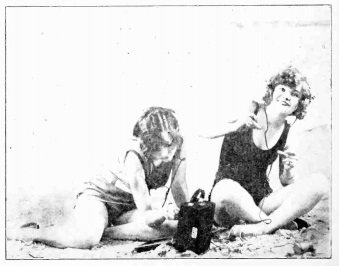
1924RadioJournalHere, in the June-July 1924 issue of Radio Journal is another radio whose owners decided to take it to the beach. The radio is a Kodel portable, the beach is Far Rockaway, Queens, New York, and the owners are Lois Wilde and Stella Wooten of the Ziegfeld Follies.  Miss Wilde went on to become leading lady in a number of 1930’s Westerns, before being injured in an automobile accident in 1938.


Integrated Circuits Fifty Years Ago

EI1965IC

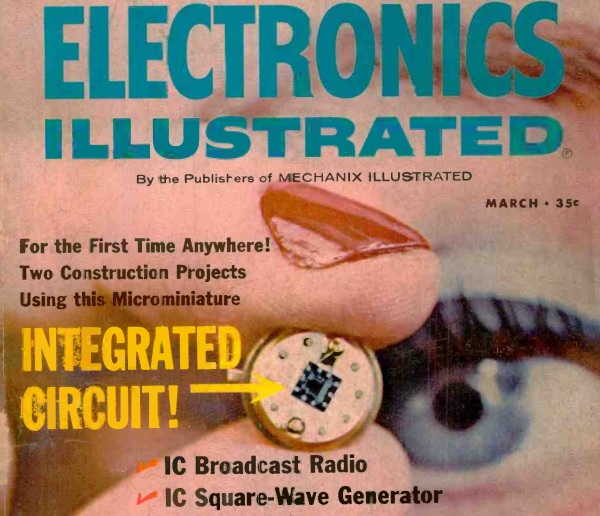
Fifty years ago this month, the cover of the March 1965 issue of Electronics Illustrated showed this integrated circuit, the Motorola MC556G. The case of this IC measured 5/16 inch in diameter, and the chip itself measured about 1/10 inch square. It contained six transistors and eight resistors. The accompanying article noted that it was now on the market at a price that hobbyists could afford to use for experimental projects,  $3.35.

To put the new device in perspective, the article compared it to the still ubiquitous 5-tube radio, which consisted of about six basic circuits using about 20-30 components. The article noted that the day would soon arrive when one or two IC’s would constitute a “complete radio that is equivalent in performance to that five-tube AC/DC job.”  That prediction came true only seven years later, in 1972 with the ZN414 AM radio IC from GEC-Plessey. The modern functional equivalent of that IC is the MK484/TA7642 am-Radio IC, which is a complete radio in a chip, requiring as its only external components a battery, coil, tuning capacitor, and earphone.
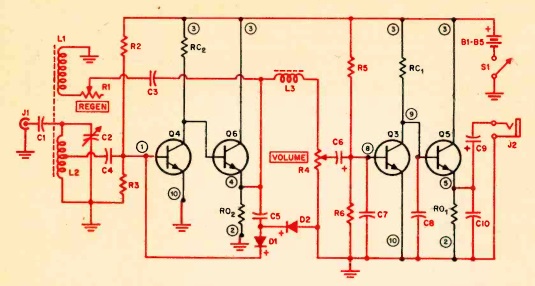
While the eight transistors in a 1/10 inch package was revolutionary at the time, transistors in current IC’s are in the range of tens of nanometers in size, allowing several billion transistors per chip. But building something with an IC was revolutionary fifty years ago, and Electronics Illustrated featured two projects making use of the MC356G. The first was a square-wave signal generator, and the second was the AM radio shown below. In this diagram, the portion shown in black is internal to the IC, and the components shown in red are external. As you can see, the circuit makes use of four of the chip’s eight transistors, and four of its resistors.

1965ICradioschematic

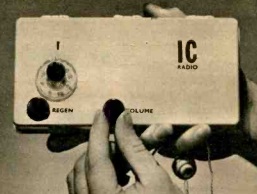
The IC was designed for use as a logic gate, but transistors are transistors, and they could be used for their amplification function. For the radio in particular, getting the circuit to work took several experimental designs, but the author finally “hit upon one that has a decent amount of sensitivity, selectivity, and audio output.” The author noted that most of the headaches in designing the radio were caused by the close proximity of the components on the chip. Having only 1/10 of an inch to work1965ICradio with presented leakage paths between the circuits that would be out of the ordinary for a radio designer.  The finished project is shown here.

In the design, two of the transistors are used as RF amplifiers, with the signal being fed back through a regeneration control. The second of those transistors also amplifies the audio, and there are two more audio amplifier stages. The actual detector consists of two external diodes.

Click Here For Today’s Ripley’s Believe It Or Not Cartoon


Minnesota Wireless Association in 1915

MNWirelessAssn1915

MplsCityHall

Minneapolis City Hall 2012 cropped” by Jason Riedy from East Point, GA, USA. Licensed under CC BY 2.0 via Wikimedia Commons.

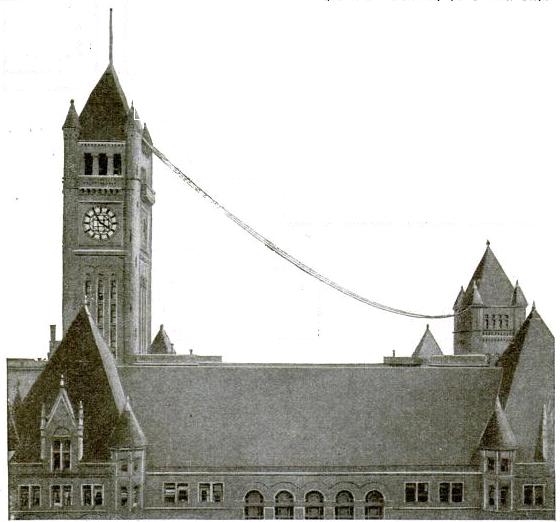
The Minnesota Wireless Association (MWA), according to its QRZ.com listing, has been in existence since 1914, and that fact is borne out by the photograph above, which appeared a hundred years ago, in the March 1915 issue of Popular Mechanics.  The article describes the station installed in the Minneapolis City Hall, a structure which is still in existence and easily recognizable, as seen in the modern photo here.

The magazine reported that the station had just been installed by the Minnesota Wireless Association, and was “probably the largest private wireless station” at the time. It noted that the instruments in the station were “arranged with particular reference to experimental work, which will include tests and comparisons of new apparatus, studies of stray electrical disturbances, and the development of new apparatus.” The antenna consisted of eleven wires between the two towers, 400 feet above ground at the clock tower.

The article reported a receiving range of 4000 miles and a “sending range limited only by the power used.” The station had a license to operate on any wavelength and with any power, but the article noted that “every precaution will be taken not to interfere with other stations.” The station apparently used only radiotelegraph at the time, but the article noted that a wireless telephone set was under construction.

According to a 1914 Wireless Age account, the station’s best DX was Colon, Panama, as member Claud Sweeny had copied that signal.  The club also reported that the station had excellent reception of time signals, presumably from NAA in Arlington, Virginia, and it was likely that those signals would be utilized for controlling the city clock, “thus giving Minneapolis the first radio municipal time.”

The MWA currently holds the call sign W0AA, although I’m not sure when they received this call.  According to the Club’s QRZ.com listing, they’ve held it since 1967, in memory of one of its members, Art Andersen, who had held the call prior to his death.  However, W0AA is shown in the 1952 call book as belonging to the club, with Andersen listed as the trustee.  The 1938 call book shows W9AA as belonging to a ham in Chicago, so it appears that the club got the ‘AA call sometime between 1938 and 1952.

According to the September 1914 issue of Wireless Age, the station bore the call sign 9ZE.  That call is listed in the 1914 call book as being held by Philip E. Edelman, who is identified in the Wireless Age article as being the Association’s president.   The club is listed in the 1920 call book as holding the license for special land station 9ZT, with an address of 402 Courthouse Bldg.  In the 1926 call book, the licensee for that call sign is a familiar name in Amateur Radio history, D.C. Wallace, later W6AM.  A QST search for 9ZT reveals that the call was Wallace’s personal call sign until he moved to California in the 1920’s.  It’s unclear, therefore, whether MWA has continously held a license for the last hundred years.  But as the photo above proves, they have been a force in Amateur Radio for a century, as 9ZE, 9ZT, W0AA, and possibly other call signs.

Read More At Amazon

Don C. Wallace: W6AM, Amateur Radio’s Pioneer


Click Here For Today’s Ripley’s Believe It Or Not Cartoon


Morse Code Secret Message in Colombian Song

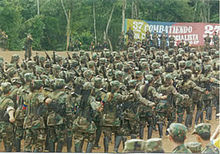
FARC Guerillas. Wikipedia photo.

FARC Guerillas. Wikipedia photo.

Morse Code was used in 2010 to get a secret message to hostages being held in the Colombian jungle by FARC guerrillas.  Some of the hostages had been held for years, and the Colombian army wanted to deliver a message that they hadn’t been forgotten, that some hostages had already been rescued, and that they were next.

Since it was known that some of the prisoners knew Morse Code, and the captors probably didn’t, the Army decided to insert a Morse message into a popular song and get it broadcast on the air.  The result was the song heard on this YouTube video, Mejores Dias (Better Days), recorded by Colombian studio musicians Natalia Gutierrez Y Angelo.

I knew there was Morse Code coming, and I heard it the first time.  If I hadn’t been expecting it, I suspect it might have taken a couple of plays for me to notice.  And once I knew it was there, it took me several times to get the entire message, since it is well hidden in the music.  But if I had a lot of time on my hands, I would eventually decode the entire message.  It’s in the chorus, starting at about 1:30, 2:30, and 3:40 in the video, following the words, “escuchas esta mensaje, hermano” (listen to this message, brother).

To make sure that the song was heard, the Colombian army arranged to have it inserted into the play lists of the government-owned stations serving the jungle areas where the hostages were being held.  The guerrillas listened to the radio, and the hostages later reported that they even liked the song.  The message was heard, as rescued hostages later reported.

The message reads:   “19 LIBERADOS. SIGUEN USTEDES. ANIMO.”  (19 PEOPLE RESCUED. YOU’RE NEXT. DON’T LOSE HOPE.)  Even if you have only a passing knowledge of Morse Code, you will hear it, and you’ll eventually be able to decode it.

More information is available at TheVerge.com, at the article linked below.

References


Heathkit GR-64, 1965

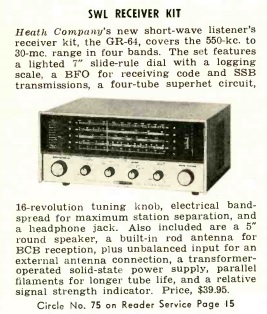
HeathGR64We recently looked at the Knight-Kit Star Roamer Receiver from 1964. It was a beginner’s general coverage receiver and was quite popular. The February 1965 issue of Popular Electronics announces another popular general coverage receiver for beginning SWL’s and hams, the Heathkit GR-64 shown here. It covered 550 kHz through 30 MHz in four bands, and made do with four tubes, a mixer-amplifier, IF amplifier, detector-audio amplifier, and audio output. The power rectifier consisted of two silicon diodes.

The kit retailed for $39.95.  The assembly manual is available for download at this link.