
Kalaupapa National Historical Park. NPS photo.
During the ARRL National Parks On The Air (NPOTA) event, Amateur Radio operators are setting up their stations in various units of the National Park Service and making contact with other Amateurs around the world. Since the beginning of the year, there have been over 3600 activations from 378 different parks, with over a quarter of a million individual contacts.
One interesting aspect of this event is learning about the different parks, some of which I did not even know existed. One of the most fascinating is Kalaupapa National Historical Park in Hawaii, located on an isolated peninsula of the island of Molokai.
The peninsula was originally the Kalaupapa Leper Settlement, created in 1866 to isolate Hawaiians suffering from Hasnen’s disease, commonly known as leprosy. From 1866 to 1969, a total of 8500 persons were relocated there for the rest of their lives. Since the 1940’s, Hansen’s disease has been curable with antibiotics, and it was also learned that the disease was not nearly as infectious as imagined. The settlement closed in 1969, but residents, many of whom were disfigured by the disease, were allowed to remain there for the rest of their lives.
For many years, the residents were cared for by Belgian missionaries from the Congregation of the Sacred Hearts of Jesus and Mary. The most well known was Father Damien, who served there from 1873 to 1889, when he himself died of leprosy. He was canonized by the Catholic Church in 2009. He was joined in 1883 by nuns including Mother Marianne Cope, who served there until her death in 1918. In 2012, she was also canonized by the Catholic Church.
When he arrived, Father Damien was instructed by his superiors not to touch his flock, and to eat only meals that he himself had prepared. Finding it impossible to minister under these conditions, he eventually ceased following these directives. After he had been there about fifteen years, he was cooking and spilled some boiling water on his foot but felt no pain. He purposely poured boiling water on his foot, but felt nothing, because he himself had leprosy.
He would normally begin worship with the words, “my fellow believers.” But that Sunday, he began “my fellow lepers.”
The historical park was established in 1980 to preserve the physical settings, which is still home to a few elderly surviving patients. The park also constitutes Kalawao County, Hawaii, the second least populous county in the United States, with a 2010 population of 90. (after Loving County, Texas, with a 2010 population of 82).
Access to the park is extremely limited, requiring an advance permit. Access by sea is prohibited. The park is serviced by Kalaupapa airport. The only land access is by a 3.5 mile mule trail connecting the penninsula to the rest of the island atop a 1600 foot cliff.
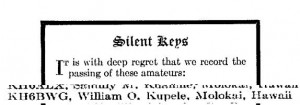
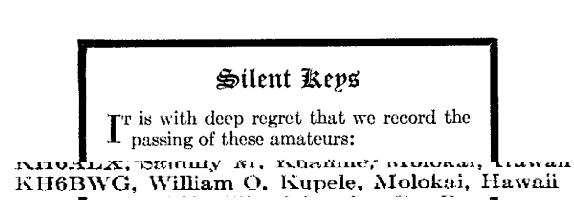
KH6BWG Silent Key notice, June 1959 QST.
The Amateur Station at the park was KH6BWG, the William O Kupele Memorial Club Station, which bears the call sign of the settlement’s last resident ham, William O Kupele, who died in 1959. Because of the park’s isolated location, Amateur Radio plays an important role in emergency communication. The main purpose of the KH6BWG team’s visit was to administer license exams to residents, and to ensure that the settlement’s station was in good operating condition. The settlement is connected to the outside world not only by HF, but also by VHF, since the team ensured that contact can be made with Hawaiian repeaters. A special concern was ensuring that the settlement’s emergency evacuation location had VHF access with the outside world. The park is in the process of formulating a management plan for preserving the site, and recognizing the communications challenges, the plan includes the use of Amateur Radio as one of the park’s vital links.
As a secondary goal of the trip, the KH6BWG group made about 2000 NPOTA contacts with other hams, including one with me.
Read More At Amazon
For Young Readers
Click Here For Today’s Ripley’s Believe It Or Not Cartoon








 Traditionally, the April issue of QST magazine carries one groundbreaking technical article. The first one I recall came out the first year I was licensed, in the April 1974 issue. This article espoused the virtues of a new form of modulation, namely,