14th Amendment 150th Anniversary

14thAmend

Today marks the sesquicentennial of the passage by Congress of the 14th Amendment to the U.S. Constitution on June 13, 1866, which was ratified on July 9, 1868.  Section 1 provides:

All persons born or naturalized in the United States, and subject to the jurisdiction thereof, are citizens of the United States and of the State wherein they reside. No State shall make or enforce any law which shall abridge the privileges or immunities of citizens of the United States; nor shall any State deprive any person of life, liberty, or property, without due process of law; nor deny to any person within its jurisdiction the equal protection of the laws.


Click Here For Today’s Ripley’s Believe It Or Not Cartoon


Nellie Melba, 1916

June121916This ad for Victrola appeared a century ago today, June 12, 1916, in the El Paso Herald.

Nellie Melba. Wikipedia image.

Nellie Melba recorded for Victor, and this ad reminds the readers that “‘Sweet as the voice of Nellie Melba’ is a musical proverb. The capture of her matchlessly pure tones in a fresh flow of beauty is an event of genuine importance to those who cherish genius.”

The particular record being advertised here was “Songs My Mother Taught Me” by Dvorak, available only on Victor Records. The twelve inch disc sold for $3. For those who did not yet own a Victrola, they could go to their nearest dealer, who would play the new Melba record or any other Victor music on machines from $10 to $400.

You can listen to the recording being advertised, which was recorded on January 12, 1916, at this video:

Click Here For Today’s Ripley’s Believe It Or Not Cartoon



1941 Phono Oscillator

1941JunePS

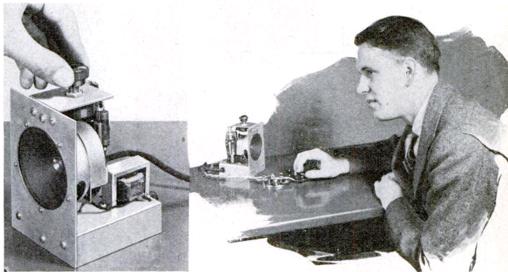
In 1941, portable radios were becoming popular, and the June issue of Popular Science noted that “this summer there will be thousands of battery-operated portable radios in use on beaches, in parks, and on picnics and excursions everywhere. They will range from the camera-style midget or “personal” radios to the “twenty-pounders,” capable bringing in Europe on the short-wave band.”

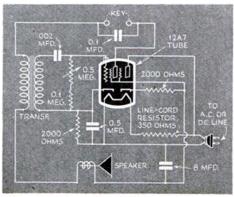
To increase the versatility of any such set, the magazine showed how to make the battery-operated wireless phonograph shown here. “Phono oscillators” as they were sometimes called were fairly popular devices. They generally used only one tube to transmit the record audio to a nearby radio receiver. This was a cost-saving measure, since almost everybody owned at least one radio, and this scheme kept the parts count down. There was no need for a speaker or audio transformer. The record player described in this article simply followed the same concept in a portable. It used a single 1A7GT tube powered by a flashlight battery for filament voltage, and a 67.5 volt B battery. The other components included a standard plug-in coil for a receiver and a small variable condenser for tuning to an empty spot on the dial.1941JunePSschematic

The phonograph motor and turntable was of the wind-up variety, which the article stated could be had secondhand for about $2.50. The entire player fir in a suitcase available for less than $1. Everything was mounted on a Masonite panel cut to fit snugly on top of the suitcase. An antenna wired of 7 feet was used, which was placed near the back of the radio. The article noted that this was legal because “the power of this transmitter is so small that it will not radiate signals beyond a few feet. It is the only type of transmitter that can be operated without a license under Federal Communications Commission regulations.”

Click Here For Today’s Ripley’s Believe It Or Not Cartoon
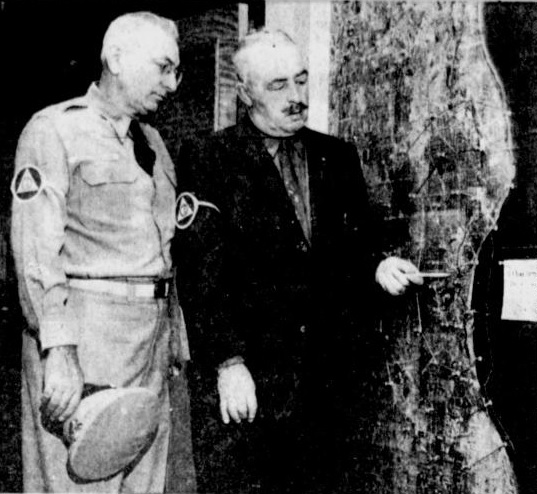


Field Day 1941

19410609MilwSentinel

Seventy-five years ago, this day’s issue of the Milwaukee Sentinel, June 9, 1941, carried this report of ARRL Field Day, which had just concluded.

The Milwaukee hams had operated for 26 hours from a location at 43rd Street and West Edgerton Avenue in Milwaukee, a site which “presented a strange mixture of homemade and expensive commercial equipment. Above the tent strewn field a 60 foot all-wave telescopic antenna reached up for messages from the sky.”

The article reported that 291 contacts were made with all nine call areas. The furthest contact was with Puerto Rico. The paper noted that this was a test of emergency communications, and demonstrated how Milwaukee would reach the outside world should catastrophe wipe out power and telephone lines.

This was to be the last pre-war Field Day, with Amateur Radio operation silenced after Pearl Harbor. In 1940, the FCC had severely restricted portable operation, restricting it to weekends, only with self-powered apparatus intended for emergency use. 48 hour advance notice was also required. At the ARRL’s request, the FCC relaxed these requirements in a March 11, 1941 order:

It Is Ordered, That during the period of the American Radio Relay League Field Day test from 4:00 P.M. E.S.T., June 7, 1941, to 6:00 P.M. E.S.T., June 8, 1941, the prohibition contained in Commission Order No. 73 shall not apply to communications transmitted by licensed portable and portable-mobile stations participating in such tests.

The announcement of this order in the May 1941 issue cautioned that the relaxation applied only to stations participating in Field Day.

Results were published in the January 1941 issue of QST, and noted that at least 2180 individuals had participated from 163 club stations and 119 non-club stations.  The Milwaukee group’s showing was overshadowed by the Tri-County Radio Association of Plainfield, NJ, W2GW/2, with 1112 contacts.  That club’s contacts were evenly split between CW and phone.  They had 163 worked on 160 meters, 447 on 80 meters, 245 on 40 meters, 32 on 10 meters, 20 on 5 meters, and 61 on 2-1/2 meters.

Like most Amateur Radio traditions, Field Day resumed after the war.  This year’s running will take place on June 25-26.  The event has continued to grow over the years.  In the 2015 running, the high scorer, Potomic Valley Radio Club and Columbia Amateur Radio Association, W3AO, logged a total of 9700 contacts from 18 transmitters.

Click Here For Today’s Ripley’s Believe It Or Not Cartoon


1926 Single Sideband

1926JuneRadioBC

Most hams think of single sideband (SSB) voice as being a relatively modern development.  It became the prominent voice mode in the 1960’s and 1970’s.  But it actually dates back much earlier than that, and was in use 90 years ago, as shown in the June 1926 issue of Radio Broadcast magazine.  The article describes the transatlantic radiotelephone circuit between New York and London, operating on 52 and 57 kHz.

Despite the low frequency, the circuit had reliability of about 95%.  The amazing reliability of this longwave circuit is explained by two factors.  First of all, brute force power was available when needed.  During the nighttime hours, much lower power could be used, but the transmitters were capable of up to 150,000 watts.  And to maximize efficiency, the circuit used single sideband.

Transmitting station at Rocky Point, Long Island.

Transmitting station at Rocky Point, Long Island.

On the American side, the transmitter was located at Rocky Point, New York, and the receiving station was at Houlton, Maine. In England, the transmitter was at Rugby, and the receiver was at Wroughton, both near London. The telephone audio was initially modulated onto a 30 kHz carrier, resulting in an AM signal on that frequency. A filter was used to remove the carrier and upper sideband, and that signal was then mixed with a carrier of 90 kHz. This resulted in two SSB signals, at approximately 120 kHz and 60 kHz, as d to suppress the 90 and 120 kHz signal, leaving only the SSB voice signal on 6well as the 90 kHz carrier. Another set of filters were use0 kHz. This signal went through as many stages of linear amplification as necessary, to produce 750, 15,000, or 150,000 watts. At the receiver, a BFO carrier was introduced, making the signal audible once again.

Receiving station at Houlton, Maine.

Receiving station at Houlton, Maine.

The article conceded that the system had not yet reached full commercial usefulness:

For ordinary messages of greeting, the apparatus of to-day is adequate, when conditions are favorable, but the commercial possibilities of transatlantic telephony will not be fully realized until the system is perfected to a degree that it can be used without flaw for business, news, and official conversations.  This requires an adequate degree of secrecy, adding still further complications.


Click Here For Today’s Ripley’s Believe It Or Not Cartoon
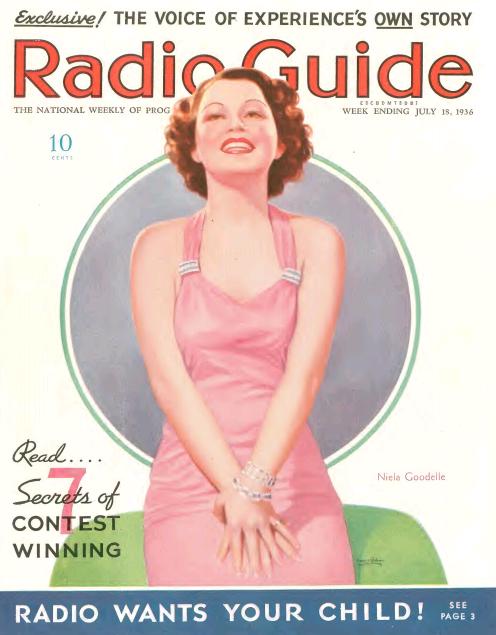


Loretta Poynton, NBC Radio, 1936

1936LorettaPoynton

Shown here on the cover of Radio Guide, June 6, 1936, is Chicago-based NBC radio actress Loretta Poynton Carroll, who performed under her maiden name. She originally planned for a career in legitimate theater, after her intense activity in school dramatics. However, because her mother was ill, she decided to look for work closer to home, and was hired by NBC. According to Radio Guide, she played the character Ruth Morrow in “Flying Time,” and the daughter in “Don Harding’s Wife.” She was later a regular on “Amos ‘N” Andy.”

She retired from Radio in the 1940’s, and died in 1992 at the age of 77 in Thiensville, Wisconsin, according to her obituary in the Chicago Tribune.

Click Here For Today’s Ripley’s Believe It Or Not Cartoon
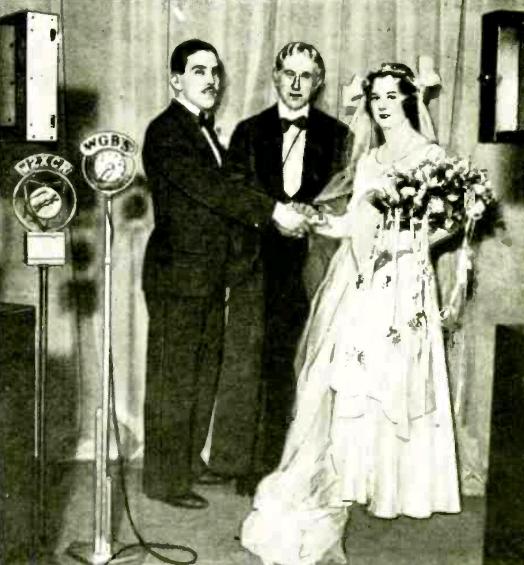


NPOTA: National Trails Day from Jay Cooke State Park, MN

TR04aJune 4, 2016 was American Hiking Society’s National Trails Day®.  Since many trails are units of the National Park Service, they are taking part in National Parks On The Air (NPOTA), an event in which amateur radio operators set up portable stations at National Park units and make contact with other amateurs at home.  The event has been very popular, and there have been hundreds of thousands of contacts made from the parks.  The North Country National Scenic Trail qualifies as a “National Park,” allowing me to operate from one of the Minnesota state parks crossed by the trail.  The North Country Trail extends from eastern New York to North Dakota.  As the trail passes through Minnesota, it becomes the Superior Hiking Trail, which runs from Jay Cooke State Park along the north shore of Lake Superior to Grand Portage.

On National Trails Day, a group of hams put together an event called  Light Up The Trail in which stations were set up at various locations in all of the states along the North Country Trail.  As I did a couple of weeks ago, I operated from Jay Cooke State Park in Minnesota, about 25 miles south of Duluth.

The weather wasn’t quite as cooperative as it had been with my previous activation, since there was a light rain when my son and I arrived at the park.  Undaunted, we moved a picnic table close to two trees what would serve as a support for a tarp.  I used my trusty golf ball retriever as a tent pole on one corner, and secured the other corner to the table itself.  A few taut line hitches had the protective shelter up in a few minutes, and I was ready to get on the air.  My original plan was to set up dipoles for 40 and 20 meters, but with the rain coming down, I decided to stick to 20 meters only, since the total antenna length was only 32 feet.  I used an inverted vee with the center supported by the golf ball retriever, and the ends tied to a tree and another picnic table.  The radio consisted of my  Yaesu FT-817, powered by a 12 volt sealed lead acid fish finder battery,

Old fort at Crown Point, New York, the eastern terminus of the North Country Trail, and my first contact. Wikipedia photo.

The activation was shorter than I had planned, but I managed 16 contacts in less than an hour of operating.  My very first contact was with N1NDN who came back to my voice CQ from the eastern end of the trail at Crown Point State Park on Lake Champlain, New York.  He had a very good signal, and didn’t seem to have any trouble copying my 5 watt signal.  I also made contacts with two other parks, W3OK at Delaware Water Gap National Recreation Area, and W5NO at Gulf Islands National Seashore.

My last contact was with AA0AW, who was operating from the North Country Trail in Duluth.  After packing up, we made a short stop at their location for an “eyeball QSO.”  A group of Duluth hams had a large multi-operator operation, and had worked about 150 contacts by the time we stopped by.

Swinging Bridge prior to 2012 flood. Wikipedia photo.

The site from which I was operating,  Jay Cooke State Park, lies next to a rapids of the St. Louis River. Because the rapids is impassible by canoe, it was the location of a portage used by both Native Americans and European fur traders, and remained in use until the 1870’s when a railroad was built in the area.   The portage was an important link between the Great Lakes and the Mississippi River.  From the portage, travelers could navigate the river to Savannah Portage, a six-mile link to the Mississippi watershed.  Jay Cooke park was formed in 1915 and remained largely undeveloped until the 1930’s when the Civilian Conservation Corps built a number of structures. I was right next to two of these. The most iconic structure in the park is the Swinging Bridge, a pedestrian bridge crossing the river. A

St. Louis River, just upstream from the park. Wikipedia photo.

rickety version was in place as early as 1924 (a picture is available at this site), until 1933 when the more substantial suspension bridge was built by the CCC.  That bridge endured until a massive flood in 2012, but the bridge has since been rebuilt to its 1930’s specifications.

River Inn Jay Cooke.JPG

River Inn Visitor Center, Jay Cooke State Park. Wikipedia photo.


My operating location was right behind the River Inn, a picnic shelter and small museum, also built by the CCC. I toyed with the idea of operating from inside the building, which had a roaring fire going in its fireplace. But unfortunately, there was no convenient way to get my antenna cable outside, so I decided to go with my expedient blue tarp.

Back of the River Inn from my operating location. The golf ball retriever is visible holding up the tarp and antenna.

Back of the River Inn from my operating location.  The golf ball retriever is visible holding up the tarp and antenna.

The 2012 flood which destroyed the bridge continues to have an impact.  Minnesota Highway 210, which serves as the access to the park (and has the distinction of being a Minnesota state highway running through a small section of Wisconsin) is still closed east of the park.  The $21.3 million reconstruction of the highway is scheduled to be completed in October 2016.

Here’s some raw video shot by my son, which will give you an idea of my operating location:


Click Here For Today’s Ripley’s Believe It Or Not Cartoon


1941 “American Ace” (Emerson Model CF-255)

June51941

Seventy-five years ago, this little radio would set you back exactly one dollar (along with an additional $29.95 purchase) at Wadlheim’s furniture store in Milwaukee. This ad appeared in the Milwaukee Journal, June 5, 1941.

It looks like a great bargain, and it probably was being sold below cost, but this radio is about as basic as they get.  While most table radios of the day were four or five tube superhets, this one was actually a two tube TRF receiver.  It would probably pull in the local stations, but even then, an external antenna would probably help it along considerably.  You can see a nice example of this patriotic little set at the Radio Attic, with more discussion at this forum.  As can be seen at those links, the white set has red and blue knobs for the full patriotic effect.

The set is identical to the Emerson model CF-255 “Emersonette” from 1939, and uses a 12B8GT serving as RF amplifier and detector, with a 32L7GT audio amplifier.  The 32L7GT also contains the rectifier.  The filament voltage is courtesy of a curtain burner line cord, in addition to another fixed resistor in series.

Click Here For Today’s Ripley’s Believe It Or Not Cartoon


1916 Boys’ Life Telegraph

1916BLtelegraph2A hundred years ago this month, the June 1916 issue of Boys’ Life showed Scouts how to make this telegraph set. The plans are pretty self-explanatory. Closing the key energizes the electromagnet and makes the sounder sound. The article notes that it works just like a regular set used by the railroad and telegraph companies. It concedes that the set “isn’t much to look at, but it is a better one than Edison made when he was a beginner.”

1916BLtelegraph1

It went on to show the hookup for two sets (simply using three wires) to communicate with a friend “across the street, down the block, or over the way.”

Collins in 1910. Wikipedia photo.

The author of the article was A. Frederick Collins, a prolific early radio author of books such as the 1915 The Book of Wireless.  He was also the principal author of the 1922 Radio Amateur’s Handbook.

The 1915 Book of Wireless, as well as his contributions to Boys’ Life, came on the heels of the low point in his life, a 1913 conviction for mail fraud, arising out of exaggerated claims over a wireless telephone stock promotion. In 1917, the year after this upbeat Boys’ Life article, his wife filed for separation, stating that he “had come back to freedom… with his disposition ruined”, “soured against the world, soured against even his benefactors, and soured against her,” and engaging in “long harangues and tirades of invectives against the world in general and the United States government in particular.”  Collins died in 1952 at the age of 82.

Click Here For Today’s Ripley’s Believe It Or Not Cartoon