Today, we interrupt our normal programming and announce our endorsement for President of the United States.
I am a lifelong Republican, and have voted for every Republican nominee since Ronald Reagan in 1980. In some cases, I cast my vote enthusiastically. In other cases, I only reluctantly voted for the nominee. But in each case, I believed that the nominee more or less reflected the principles of the party of Abraham Lincoln and Ronald Reagan. I am also a card-carrying Republican, both as a precinct officer and delegate to the Minnesota state Republican convention (although the party would certainly be within its rights to remove me for publishing this endorsement.)
For the first time in 36 years, I will be voting for someone other than a Republican for the nation’s highest office. This year, I will be voting for the Libertarian nominee, Gary Johnson. It is with a certain amount of sadness, but also with hopefulness, that I publicly endorse him.
Obviously, this amounts to a vote against Trump, and I want to explain why I am voting against him. It is not because I subscribe to the conventional wisdom and believe that Trump is Another Hitler, because I don’t think he is. I might be wrong, but it seems to me equally likely that Hillary Clinton would actually turn out to be the Another Hitler. I don’t think she is either, but it’s just about as likely.
The real reason I’m voting against Donald Trump is because he fails to embody the principles for which the Republican Party has stood for over 150 years. First and foremost, the Republican Party is the party of Liberty–and that includes both personal and civil liberties as well as economic liberty. A free people best govern themselves when personal decisions are left to the individual, with an absolute minimum of government coercion. That’s what Republicans believe, and it’s what I’ve always believed.
In the economic realm, this means that every person should be able to succeed or fail on his or her own merits. And as a conservative, I believe that the Free Market is in the least worst way of determining who should succeed and who should fail. If there’s no market for my product or service, then the public is best served if I fail and abandon that product or service in favor of another. My resources and my talents are wasted if I devote them to something the public neither wants nor needs. And the best way to deliver that message to me is to have consumers stop patronizing me.
If another casino is what we need, then the free market should bear that out for someone who wants to take the risk to open one. But the full coercive power of government shouldn’t be called upon to decide that a casino is the highest and best use for private property.
I have no doubt that Donald Trump was a successful businessman. But he did not become a success by means of the free market. For the most part, he became successful because of what are euphemistically called “public-private partnerships,” or what we used to call Mercantilism. (Or what we could call Fascism, as the word was originally defined.) He was successful because the full coercive power of the state sided with him. Perhaps another real estate developer would have been more successful, but we will never know that. The other real estate investor didn’t get the imprimatur of the regulators.
Hillary Clinton is no better. The only difference is that she sat on the other side of the table in many a “public-private partnership.” Her attitude is best exemplified in a 1993 quote in which she said, “I can’t be responsible for every undercapitalized entrepreneur in America.” This was in reference to whether health-care mandates would drive small businesses out of business. It didn’t matter to her, because she dismissed those businesses as “undercapitalized.” But they are undercapitalized only because they are not established players in a given industry. I used to believe the Democrats when they said that they cared for the little person in the fight against big business. But I started to notice that the largest established players in any given industry tend to favor greater government regulation. This is because the established players can bear the costs of overregulation, unlike their “undercapitalized” competitors and startups. It’s merely another way in which the government is able to pick winners and losers. The established competitor is favored by regulation, and innovative newcomers are locked out of the market.
There’s only one logical choice for President, and that is someone who exemplifies those principles that the Republican Party once stood for, and that choice is Gary Johnson. He’s a fiscal conservative, but more importantly, be believes in both personal liberty and economic liberty. He was a successful businessman, not because he received a favored position in a “public-private partnership,” but because he provided goods and services that the public wanted.
I don’t agree with Gary Johnson on every issue. Fortunately, however, he is not running to be the absolute dictator; he is merely running for President of the United States. He cannot act unilaterally on most issues. And critically, he seems to understand the Constitutional limitations of his office and would not act unilaterally.
I won’t catalog every issue on which I disagree, but I will mention the most troubling. Gary Johnson is apparently pro-choice. I am pro-life, and I believe that the state has a legitimate duty to protect innocent human life. To the extent that President Johnson acts in accordance with his stated principles, I will oppose him.
But I’m also aware that the President of the United States does not perform abortions, nor does he order that they be performed. He has no power to permit or outlaw abortion. Donald Trump claims to be pro-life (although he declared himself to be staunchly pro-choice in the past). But whether or not the president is pro-life has little effect on whether innocent lives will be slaughtered. The nation’s policy on abortion should be, in my opinion, properly vested in the state legislatures, who have legislated criminal codes since before the beginning of the Republic. The policy is currently vested (improperly, in my opinion), in the judiciary. But it’s not currently vested in the federal executive branch, nor should it be. So in a sense, whether or not Gary Johnson is pro-life is irrelevant. More importantly, as a proponent of limited government, Johnson himself should see it as irrelevant to his office.
Donald Trump’s sole redeeming quality is his apparent willingness to appoint conservative justices to the U.S. Supreme Court. For example, one of the names that is allegedly on his short list is that of Minnesota Supreme Court Justice David Stras. As a committed federalist, Stras, or someone like him, would be an excellent choice for the nation’s high court. Again, Trump’s pledge to nominate someone like Stras is the candidate’s sole redeeming quality.
But frankly, I don’t trust Donald Trump enough to vote for him based upon one single pledge. And given Gary Johnson’s apparent willingness to embrace the U.S. Constitution, I do trust him to appoint constitutionalist judges, even if he has not yet named names.
Roe v. Wade won’t be overruled by the executive branch, no matter how zealously pro-life the president happens to be. And it certainly won’t be overruled just because the candidate says that he’s pro-life, despite a long history of saying that he’s pro-choice. In my opinion, Roe v. Wade is a constitutional aberration that ought to be overruled. I believe that a constitutionalist judge would agree if the issue were squarely presented. And I believe that Gary Johnson is the most likely presidential candidate to appoint constitutionalist judges.
In short, Gary Johnson is not a perfect candidate. But he is the closest to a perfect candidate that I’ve seen in the past 20 years. More than any other candidate in the race, he best exemplifies the values of the Republican Party, whether or not he bears that label.
And no, I don’t believe that I am “wasting” my vote by voting for Gary Johnson. I have never voted for a candidate merely because I though he or she was going to win. In fact, as a Republican in a staunchly Democratic state, I rarely vote for the winning candidate. For example, I don’t believe that I have ever voted for a candidate for the state legislature who actually won. In every single legislative race since 1980, I have voted for the loser every single time. For 18 straight elections, I have consistently voted for the losing candidate. I’ve volunteered for losing candidates, knowing full well that they were going to lose. I’ve even served as the campaign treasurer for a losing candidate, knowing full well that she was going to lose. But I never considered my vote wasted. The purpose of the whole exercise is to determine who the majority supports. And for that process to work, the people voting for the minority candidate must see their candidate lose.
This year, it’s quite likelty that I’ll be voting for the losing candidate for President. But that’s nothing new for me. Even if I do vote for the loser, I won’t consider my vote wasted.
However, I am not convinced that Donald Trump or Hillary Clinton will be the next President. I’m not the only person who believes that there should be another choice. I’ve seen as many Gary Johnson signs as I have seen signs for Hillary Clinton or Donald Trump. I’ve seen more support for Gary Johnson on social media than I’ve seen for either of the other candidates. If all of those people vote for Gary Johnson, then he might win. It’s a self-fulfilling prophecy to vote against him merely because he will lose.
It seems unlikely that Gary Johnson will be the winner as of election night. But it seems quite plausible to me that he will carry enough states to deprive either of the other candidates a majority in the Electoral College. If that happens, then our Constitution calls for the President to be selected by the House of Representatives, voting by State. In that case, the House will be called upon to select the President from among the top three in the Electoral College. In that scenario, it seems likely that Johnson would be elected, as the only palatable compromise candidate. No Democrat is going to vote for Donald Trump, and very few Republicans are going to vote for Hillary Clinton. Johnson is probably the only candidate who can win. Or to put it another way, members of the House would be wasting their vote by casting it for either Trump or Clinton.
Currently, Gary Johnson has more endorsements by major newspapers than Donald Trump. Most recently, the Chicago Tribune endorsed Johnson. For whatever its worth, OneTubeRadio.com now joins them in endorsing Gary Johnson for President.
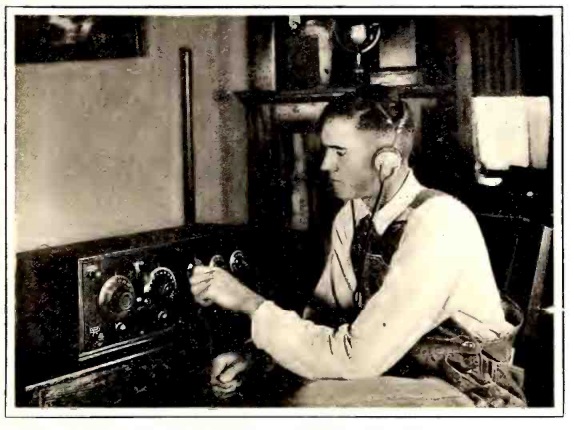
Tomorrow, we return to our normally scheduled programming, consisting of pictures of old radios.
This page was prepared and paid for by Richard P. Clem. This page is not endorsed by any candidate or candidate’s committee. Minnesota attorney Richard P. Clem is solely responsible for the content of this page.
Click Here For Today’s Ripley’s Believe It Or Not Cartoon