1937 Ohio River Flood

1937Feb13WLS

Eighty years ago this week, the United States was in the midst of one of its greatest natural disasters, the Ohio River flood of 1937.

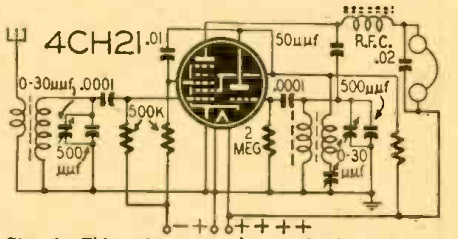
Damage was widespread, starting at Pittsburgh, which had experienced severe flooding the year before, to Cairo, Illinois. Damage was light in the Pittsburgh area, but there was extensive damage in Ohio, West Virginia, Kentucky, Indiana, and Illinois. The pictures at the top of the page are from Evansville, Indiana, and appear in the February 13, 1937, issue of Stand By, the program guide magazine of WLS Chicago, whose mobile unit is shown. The boats shown in the picture, docked at the back door of a hotel, are actually on the street, as shown by the mostly submerged street sign in the picture.

The WLS magazine reported that “radio became the principal means of communication, especially during the early days of the flood, and thousands of lives were saved because of the radio directions sent to rescue workers. Commercial, amateur and military stations all provided communication.”

Hazelton, Indiana, January 23, 1937. National Weather Service photo.

Hazelton, Indiana, January 23, 1937. National Weather Service photo.

In Evansville, the local station, WGBF, had an emergency radio set up at the relief headquarters. The station went to 24 hour service, and the programs were interrupted frequently to broadcast relief messages.

Downtown Huntington, WV, during the flood. Wikipedia photo.

The flood caused 385 deaths, with a million left homeless. Property damage reached $500 million, and relief and recovery was strained, with the disaster coming in the depth of the depression and only a few years after the Dust Bowl.  The head of the Red Cross called the disaster the greatest since the war.  For many impacted areas, it was the most severe flood yet experienced.

The water levels began to rise on January 5, and rains throughout the

Ohio basin continued.  By January 23, it was clear that the flood would be severe.  Martial law was declared in Evansville on January 23.  On today’s date, the water crested in Cincinnati at 80 feet, the highest level in the city’s history.  By the next day, 70% of Louisville was under water.  It wasn’t until February 5 when the water levels dropped below flood stage in most areas.

As might be expected, amateur radio operators played a key role in communications, and many of these stories were recorded in the April, 1937, issue of QST.  Since many of the active hams were also involved in the Army Amateur Radio Service or the Naval Reserve, Army and Navy call signs were often used in addition to amateur calls.

In an action unprecedented since the war, on January 26, the FCC entirely closed the 160 and 80 meter bands nationwide to all but those hams directly involved in flood relief. The FCC order stated:

To all amateur licensees: The Federal Communications Commission has been advised that the only contact with many flooded areas is by amateur radio, and since it is of vital importance that communications with flooded areas be handled expeditionsly, IT IS ORDERED that no transmissions except those relating to relief work or other emergencies be made within any of the authorized amateur bands below 4000 kilocycles until the Commission determines that the present emergency no longer exists.

This order was rescinded on February 5.  The FCC did allow the ARRL to select 60 “vigilantes” to monitor the bands and inform any offenders of the order.  According to QST, this order had a very positive impact in reducing interference.  160 and 80 meters were still packed with signals relaying emergency traffic, but the nets were able to work very effectively when they had the bands to themselves.

Hundreds of call signs in all of the affected states are included in the QST report, but it also acknowledges that it would be impossible to list all of the hams who participated.

The 30,000 residents of Parkersburg, West Virginia, were cut off from the outside world, and about a fourth of them were homeless. Herbert Romine, W8GDF, of nearby West Milford hurried to the town. Lacking sufficient equipment, he hurredly assembled several transmitters from the serviceman’s parts stock, and established stations on fire boats in the city. These hastily constructed transmitters consisted of type 45 tube oscillators, along with another 45 serving as modulator. QST noted that this work undoubtedly saved a number of lives.

Romine then put station WPAR in Parkersburg back on the air, having to dismantle and move it a number of times as the waters rose. Another ham, W8BRE, helped put together a 160 meter radio to link the station with the Naval Reserve station.

At Leon, WV, inactive ham Clarence Casto, W8JJA, had been off the air for three years. But with the emergency, he hastily assembled an emergency version of his station to keep the town in contact.

A few miles downstream in Point Pleasant, WV, William Stone, W8MAO, was able to use a portable 20 meter rig to notify authorities in Charleston that medical supplies were needed by air.  This station was set up in the court house on the judge’s bench.

w8yxgeneratorIn Ohio, much of the relief traffic passed through W8YX, the club station of the University of Cincinnati.  Since commercial power had become unavailable, the station operated with the generator setup shown here.  Two 15 kva alternators were run by the power takeoff of a McCormick-Deering tractor.

In Kentucky, since Frankfort was cut off and flooded, the Governor of the state relied upon an amateur for emergency communications. W9AZY, who was also affiliated with a broadcast station, was able to set up a shortwave link between the Governor and his staff and broadcast station WLAP.

w9mwcThe man identified as “one of the flood’s ham heroes” was W.O. Bryant, W9NKD. On January 22, WHAS in Louisville broadcast the information that Carrollton, KY, population 2500, had been cut off from the outside world. The broadcast included a plea for an amateur to go there with emergency equipment. Bryant answered the call and brought his equipment by boat, where he was the only source of communications for 10 days.  Another such amateur is shown to the left, W9MWC, taking emergency equipment by boat to Shawneetown, KY, in temperatures of 12 degrees and sleet.


1957 3 Transistor Portable

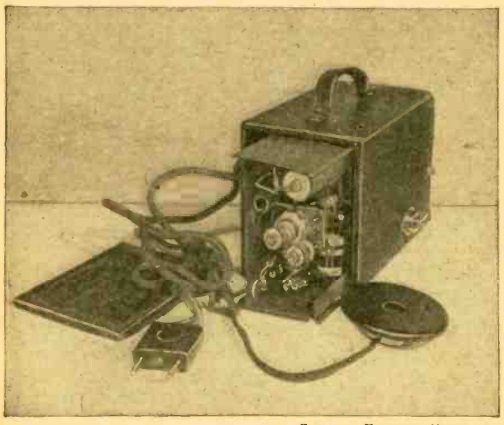
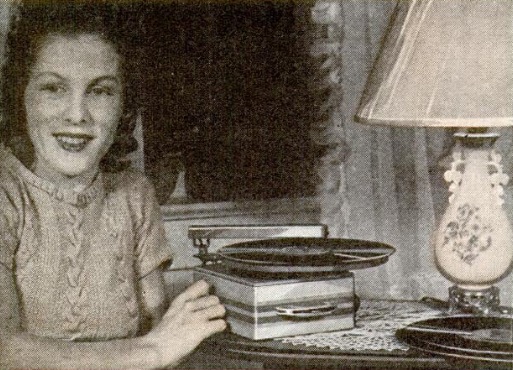
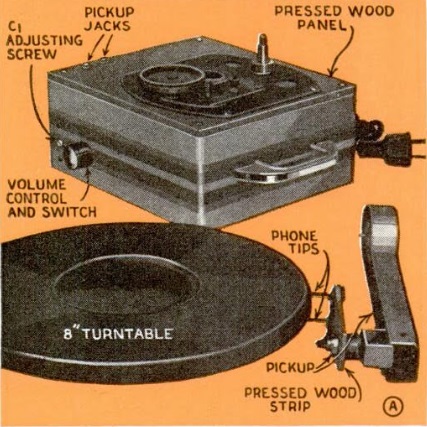
1957JanPEcoverSixty years ago this month, the January 1957 issue of Popular Electronics showed how to put together this 3 transistor superheterodyne receiver for the broadcast band. The set employed three transistors. A 2N136 served as oscillator and mixer. A 2N135 served double duty in a “reflex” arrangement as both IF amplifier and the first stage of audio amplification. Transistors were expensive, and the single transistor was capable of amplifying the 455 kHz RF and the audio simultaneously. A 2N170 served as the final AF amplifier to drive a magnetic earphone.

A signal generator was required for alignment once the simple receiver was put together. No external antenna was necessary, although a wire a few inches long would improve the sensitivity.

The set could be installed in a clear plastic case, with the inside spray painted to the desired color.

1957JanPEschematic


Pres. Trump’s Mad Scientist Uncle

John G. Trump, Wikipedia photo.

John G. Trump, Wikipedia photo.


One of our loyal readers posted a link to a conspiracy buff website pointing out a connection between President Donald Trump and, of all people, Nikola Tesla.  Since most internet mentions of Nikola Tesla turn out to be unfounded (or at least unprovable) conspiracy theories, I approached with a bit of skepticism.

I express no opinion as to the conspiracy in question (that the Trump family is involved in a long standing conspiracy to suppress certain Tesla inventions).  But I was shocked to learn that there was indeed a connection!  President Trump’s uncle, John G. Trump, was a noted professor of Electrical Engineering at MIT, and appears to have spent his career working on the same kinds of high-voltage mad scientist devices that Tesla was famous for.  At the time of Tesla’s death in 1943, the U.S. Government had to go through all of Tesla’s possessions and papers, in order to see whether there was anything worthwhile to the war effort.  Among those they called in to sift through them was none other than Professor Trump.

After his father’s death, John Trump initially went into the real estate business with his brother, Fred Trump, the father of the future president.  Fixing up old houses wasn’t to his liking, so he instead pursued a degree in electrical engineering. He he received his bachelor’s degree from the Polytechnic Institute of Brooklyn in 1929. He followed up with a master’s degree in Physics from Columbia, and in 1933 he received a Ph.D. in electrical engineering from the Massachussets Institute of Technology (MIT). He was on the MIT faculty from 1936 until his retirement in 1973.

Before the war, much of Prof. Trump’s work focused on hospital X-ray machines. Together with Robert J. Van de Graaff (of Van de Graaff generator fame), he developed one of the first million-volt X-ray generators.

As might be expected of the kind of scientist who played around with a million volts, Professor Trump made the pages of Popular Science on three occasions.

1937AprPSFor example, the April 1937 issue discusses the X-ray machine shown here.  It was designed by Prof. Trump along with Dr. Richard Dresser.  It employs a Van de Graaff generator to produce the required million volts.

And in keeping with his apparent status as a mad scientist, Prof. Trump needed a subject on which he could perform his experiments.  The lucky subject is described in the magazine’s July 1949 issue.  In the photo below, Professor Trump (left, operating the controls) is shown conducting experiments on “Mr. Cruikshank” (shown resting comfortably on the machine), a carefully constructed mannequin.

1949JulPS

Professor Trump preparing to send three million volts through Mr. Cruikshank.

Unlike human subjects, Mr. Cruikshank could have film inserted directly in his body to examine the effects of powerful X-rays. Prof. Trump had tested him with three million volts, and he was on the way to Massachussets General Hospital for comparison with the effects of a more modest 250,000 volt machine.

Finally, the magazine’s May 1947 issue mentions Prof. Trump’s work with the Van de Graaff generator as a possible method to directly and conveniently harvest nuclear energy.


References


Career Ideas for Scouts: Merchant Marine Radio Officer

1947JanBL

Seventy years ago, the January 1947 issue of Boys’ Life contained some career advice for scouts looking for excitement:

Becoming “Sparks,” a radio officer in the Merchant Marine. The article’s author was Merceant Marine radio officer Lt. Robert Aronson, who noted that as ears and mouth of the ship, the position was one of rank and responsibility.

The most important job was to maintain a constant watch on the international distress frequency, 500 kilocycles. Other duties included a daily check of the radio room batteries with a hydrometer, and checking the traffic lists of the coast stations for any incoming messages.

And, of course, the job offered plenty of opportunities for heroism. The article begins with the tale of a radio operator firing up the transmitter of the ship in distress, and within moments having every ship within 800 miles prepare to rescue. “Radio alert was maintained throughout that sector of the ocean until, two hours later, one of the freighters announced triumphantly that she had all forty-six of the crew aboard, uninjured. Once again, a capable ‘Sparks’ had blocked off a watery grave.”

The job offered a lot of spare time to read, play cards, study, or anything else. The author noted that many radiomen found the life at sea ideally suited to advancing their knowledge of radio or any other subject.

The author’s advice for scouts contemplating this career was to get their ham license, a license only “slightly lower in grade and requirements than a commercial operator.” With the amateur license, the scout could set up his own station and communicate just as though he were on a ship.

The commercial license could be acquired by enrolling in a school, but for the student who could read a textbook and absorb the instructions, he pointed out that there was no reason not to engage in self-study. The amateur license would allow the student to practice the things taught by the books, and those books were available in any public library.

The prospective operator would be eligible for a commission as an officer six months after signing on to a ship, and at that time, the government made available excellent correspondence courses.

The author noted that the commercial license was the passport to adventure, but cautioned against hastily going to sea, especially if one had a “flaring temper or if you sulk, if doing the same thing day in and day out gets you down.” For prospective radio operators who fit those descriptions, he advised that one of the many radio jobs ashore might be better suited.


ND Bond Drive, 1942

For many Americans on the home front, a major contribution to the war effort was participation in bond drives.  North Dakota was a long way from Pearl Harbor, but in 1942, these students in Epping, ND, were doing their part by performing “Remember Pearl Harbor” at a meeting of the town’s women to promote bond sales.

The song was likely the same one performed by Sammy Kaye, which was recorded just 10 days after the attack and rose to number 3 on the charts:


Answer to Yesterday’s Quiz

1956DecQuistQuizA

Yesterday, we presented the problem of how to hook up a telephone to talk across a river from Point A to Point B, without running a wire across the river.

Loyal readers knew the answer right away, because we presented a similar system for a 1940 wireless telegraph using four ground rods.  Each side of the circuit was connected to two ground rods.  The January 1957 issue of QST shows a similar arrangement for how the two Boy Scouts could hook up their field telephone:

1957JanQuistQuiz2

Each telephone is hooked up to two ground rods.  The magazine suggests separating them by 20 times the width of the river (2000 feet).  There’s still a high resistance path between the two telephones, but the leakage resistance between A and A’ and between B and B’ is even higher.  The 1940 wireless telegraph, because it used an audio amplifier, could probably get by with less separation between the ground rods on each side of the river.  But with 2000 feet separation, the scouts’ telephones should work just fine, despite not being able to run any wire across the river.


Boy Scout Field Telephone-Telegraph, 1937

1937JanBLEighty years ago this month, the January 1937 issue of Boys’ Life carried this ad for the official BSA field set, a field telephone and telegraph.  For $9.50, a scout could acquire two such units.  The possibilities for use during hiking and camping, or between two friends’ houses, seem limitless.

More details are given in an ad appearing in the February 1934 issue, which reveals that the set is manufactured by the American Electric Company, of 1033 West Van Buren Street, Chicago, “one of the world’s foremost makers of commercial telephone equipment.”  Contained in a durable khaki colored weatherproof case having a strong carrying strap, the set was ready for use at any time by simply connecting to line wires.  The set was said to have a range to be able to signal and talk clearly over a thousand feet.  The set was switched from telephone to telegraph simply by switching the key into the telegraph position.

The set was patented under US Patent 2072264, which described the set as being “inexpensively and ruggedly built to fill the need for such an assembly by Boy Scout organizations and others having need for inexpensive equipment which may be employed to establish temporary or permanent telephone-telegraph communication between two points.”

The only evidence of a surviving example I was able to find online was this eBay listing, which unfortunately contains only a photo of the unit in the closed position.

A resourceful Boy Scout owning such a telephone probably wouldn’t have had much trouble figuring out the Quist Quiz which appeared in the December 1956 issue of QST:

1956DecQuistQuiz

Two Scouts, one on each side of the river, are equipped with their official BSA field telephone-telegraph sets.  Without crossing the river or running a wire across the river, how can they hook up the phones?

Loyal readers of OneTubeRadio.com already know the answer, since we previously showed a similar system.  If you missed it, you’ll need to wait until tomorrow to see the answer.


Zimmermann Telegram, 1917

Zimmermann Telegram, as sent from Washington to Mexico City. Wikipedia image.

Today marks the 100th anniversary of the Zimmermann Telegram, which played a key role in the entry of the United States into the First World War.  The message was originally sent from Germany on January 11, and on January 19, 1917, it made the final leg of its circuitous route to Mexico City.

Interestingly, the telegram was routed through Britain, which allowed the British to intercept and decode it.  Because the Germans had no wire communications with America, President Wilson allowed them to send diplomatic cables courtesy of the American embassy in Copenhagen.  That was routed through Britain, where the British were able to intercept it.

From the German embassy in Washington, the cable was sent to Mexico City by Western Union.  The telegram instructed the German ambassador to Mexico to propose, if hostilities appeared imminent, an alliance between Germany and Mexico.


Sourcing Radio Parts in 1927

1927JanRadioNews

Radio hobbyists have long been aware that many common household objects have their highest and best use as radio components. So when this gentleman, shown on the cover of Radio News, January 1927, needed an enclosure as part of the radio he was working on, it was only natural to put the bread box to better use than it had previously seen.

Unfortunately, it appears that his wife didn’t have the same priorities, since she had to find another container for the bread.

Answer to Yesterday’s Quist Quiz

Yesterday, we offered this schematic from 1957, and asked for the effective resistance between points A and B:

1957JanQuistQuiz

The answer is 1 ohm.  If you look closely at the diagram, despite the confusing layout, the three resistors are in parallel.  Point A is connected to the left side of two of the resistors, and Point B is connected to the right side of two resistors.  The only complicating factor is that the middle resistor is backwards:  A is connected to the right side, and B is connected to the left side.  Since the polarity doesn’t matter, it’s just three resistors in parallel.  So the equivalent resistance is 1 / ((1/3) + (1/3) + (1/3)) = 1 ohm.


Quist Quiz, Jan. 1957

This little quiz appeared in QST sixty years ago, January 1957. The answer will appear tomorrow. If you can’t wait, the answer appeared in the magazine’s February 1957 issue.

1957JanQuistQuiz