1918 Boys’ Life Looks at Wireless

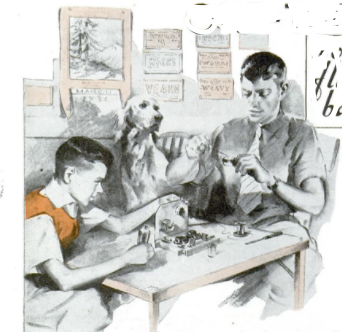
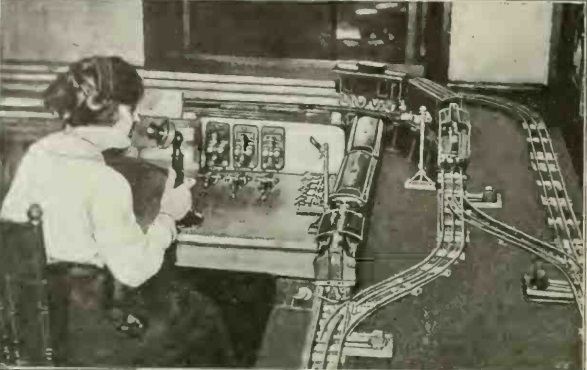
1918MarBLA hundred years ago this month, the March 1918 issue of Boys’ Life magazine included this article by F.A. Collins (probably Archie Frederick Collins) about the state of radio, especially as it related to war.  He starts by explaining that “the thing that was impossible yesterday, today is indispensable in commerce and war, wireless telegraphy.”

And he makes clear that the radio section of the Signal Corps was something especially within the grasp of scouts:

Probably no country in the world can recruit men for this exciting service in such numbers as the United States. There are already tens of thousands of boys throughout the country who have had valuable training as amateurs. It has been estimated that this army of amateurs exceeded over 100,000 boys and girls. Thousands of Boy Scouts, for example, have an excellent working knowledge of wireless and have learned to transmit at a rate of twenty words a minute or faster. The Government does not accept operators under eighteen years of age and many of these boys are practical wireless operators by the time they reach this age ready to enlist in this interesting branch of service.


1941 Lew Bonn Company Catalog

LewBonnCatalog011One of our readers recently sent us the catalog shown here. The full catalog is 168 pages, and we’ll periodically post a few pages.

The catalog is from a distributor I had never heard of, Lew Bonn Co., 1211 LaSalle Avenue, Minneapolis. It doesn’t seem to have a date, but it appears to be from early 1941. The book listing includes the “new” 1941 edition of the Radio Handbook, and it also includes the Rider Manuals up through volume 11, covering 1940-41 radios. It also notes that the 12th volume will be available soon.

The catalog also contains a full selection of amateur gear, indicating that the catalog came out before Pearl Harbor. Therefore, I conclude that the catalog dates to early 1941.

Included here are the first twelve pages of the 168 page catalog.  In the coming weeks, we’ll add more pages until it’s completely available.  You can click on any of the images below to see a larger version.

Today, we present the index (pages 1-3), some of the specials to be found in the Bargain Basement (pages 4-7), electrical appliances (pages 8-10), car radios (page 11), and power supplies and inverters (page 12).

LewBonnCatalog001

LewBonnCatalog002

LewBonnCatalog003

LewBonnCatalog004

LewBonnCatalog005

LewBonnCatalog006


LewBonnCatalog007

LewBonnCatalog008

LewBonnCatalog009

LewBonnCatalog010

LewBonnCatalog011

LewBonnCatalog012


1938 Miniature UHF Transceiver

1938MarPS1938MarPS1Eighty years ago this month, the March 1938 issue of Popular Science carried the plans for this transceiver, which it billed as the world’s smallest two-way radio. Weighing less than ten ounces, the set could be carried in a coat pocket. The set shown here was for the 3/4 meter band, but could also be built for the 1-1/2 meter band. The heart of the circuit was a 955 acorn tube.

A DPDT switch was used to switch 1938MarPS2from transmit to receive. In the transmit position, the circuit was an efficient oscillator, and in receive, a grid leak and condenser were added to the circuit to produce a sensitive receiver.

The external batteries were acually larger than the radio. Two 3-volt flashlight batteries were used for the filaments, with a 45 volt battery providing the B+.

In order to make sure the radio was operating within the amateur band, the article described a simple wave meter, consisting of a flat U-shaped loop of No. 12 wire hooked to a galvanometer. The transmitter was held close to the loop and moved along until the highest current rating was shown. The transmitter wavelength was equal to the distance along the wire to the meter.

The construction article reminded readers that an amateur license was necessary to use the transmitter. But for those considering trying for the license in the near future, the construction of the set would teach many of the radio fundamentals that would be on the test.

The circuit here is similar to this WERS transceiver shown here previously. In case you’re wondering, the 955 tubes do seem to be readily available on eBay.

1938MarPSSchematic


1943 Dymaxion Map

1943Mar1Life

Fuller and the Dymaxion map.

Fuller and the Dymaxion map.

Seventy-five years ago today, the pages of Life Magazine, March 1, 1943, included a craft project, in the form of a Dymaxion map of the world. A flat map of the round earth is always distorted, in either scale, direction, or shape. For example, the familiar Mercator projection accurately shows direction, but scale is greatly distorted close to the poles, which explains why Greenland looks much larger than it really is.

The Dymaxion map, designed by R. Buckmisnter Fuller, seeks to compromise to make all of these distortions as minimal as possible. It is a cube with the corners cut off, and is formed from six squares and eight triangles.  The transformation from a round globe to a flat map is shown in the animation at right.

The magazine contained all of these sections, some of which are shown above, with instructions for pasting them to cardboard and assembling them. When assembled, they could be laid out flat in various configurations, or put together completely as a squared-off globe.  For those wishing to duplicate the 1943 globe, it would be an easy process to print the pages on cardstock and assemble them following the directions.  (You can download the magazine at  this link,)

An interesting science fair project could be made comparing a globe, a Mercator projection, and the Dymaxion projection.


1933 One-Tube Shortwave Portable

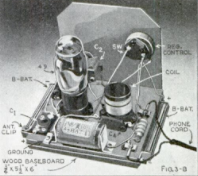
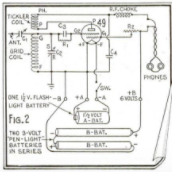
1933SWcraft3

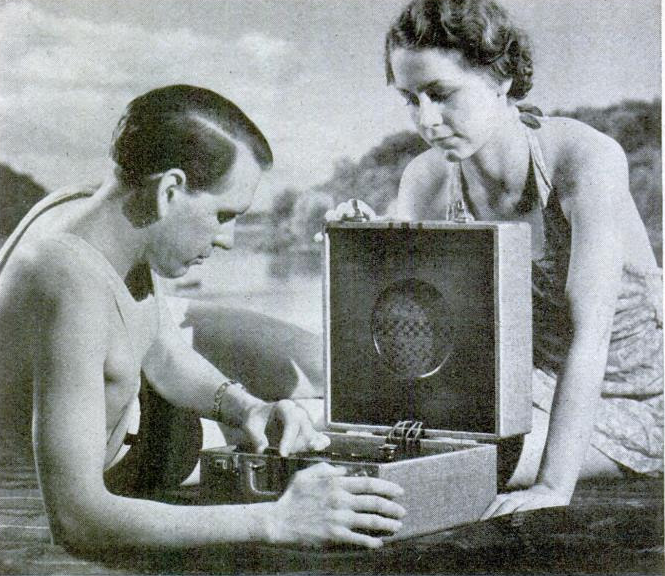
This one-tube shortwave portable was featured 85 years ago this month in  the February 1933 issue of Short Wave Craft.

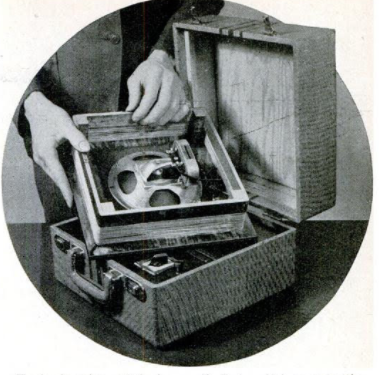
The set was awarded honorable mention in a contest sponsored by the magazine, and had been designed for a trip by the author to northern Michigan, where neither AC power nor replacement batteries would be available. Therefore, the main design consideration was low battery drain.  The set was built in the venerable cigar box, which housed all of the parts, including batteries and  antenna.

The author noted that the set could also be used as a shortwave converter with a broadcast receiver by running a wire to the phono input of the radio.  The author reported pulling in W1 and W4 stations at Detroit using only a copper screen in the lid of the radio as an antenna.

1933SWcraft4


1958 WRL Ham Shack

1958FebRadioTVNewsShown here on the cover of the February 1958 issue of Radio & TV News is Dorothy Hicks, K0BRZ, of Omaha, Nebraska, at the controls of the demonstration ham shack of World Radio Laboratories (WRL) in neighboring Council Bluffs, Iowa. The store maintained the station to showcase available products, both its own and those of other manufacturers, which were rotated through the station on a regular basis. The station was made available to hams passing through who might need to maintain a schedule, as well as to new novices.

Advertisement:


Try Audible and Get Two Free Audiobooks

Dorothy’s home station was more modest, with a Viking Ranger transmitter, National NC-300 receiver, and WRL tri-band beam. She typically did about three hours a day of ragchewing, usually on 10 and 15 meter phone.

Dorothy’s husband was Curt Hicks, K0AMM, the president of the Ak-Sar-Ben Radio Club. Their son Paul received his novice ticket at age 11, with the call KN0GZJ.

Shown at the WRL station is an Astatic D-104 microphone, Hallicrafters HT-32 transmitter, and Vibroplex bug for CW operation. The output of the HT-32 exciter fed a WRL Globe King 500 B transmitter, capable of 720 watts PEP input. Either the Hallicrafters or WRL could be used individually as transmitter.

Two receivers are shown, a Hammarlund HQ-110 and a National NC-109.


1943 Steel Penny

NNC-US-1943-1C-Lincoln Cent (wheat, zinc-coated steel).jpgToday marks the 75th anniversary of the beginning of production of the 1943 steel U.S. cent coin on February 23, 1943.

Wartime shortages of copper forced the mint to look into alternatives, and the final choice was to produce the 1943 cent with zinc-coated steel.

The coin was not a popular success.  People confused them with dimes, and the lack of zinc plating on the edges gave the coins a tendency to rust.  And becasue they were magnetic, the coins would not work in vending machines.  For 1944, the mint began using recycled shell casings with a small amount of copper, resulting in an alloy similar to that used before the war.


Life Savers Go To War

1943Feb22LifeSeventy-five years ago today, the February 22, 1943, issue of Life Magazine carried this important announcement.

The armed forces had just ordered a large shipment of Life Savers for censored, censored, and censored, meaning that the civilian supply might have been short in some areas.  It reminded customers that if they couldn’t find their favorite flavor, they should remember that some soldier, sailor, or marine was enjoying it somewhere.