October 1, 1919: Hams Back On The Air

1919NovQSTA hundred years ago today, October 1, 1919, Amateur Radio Operators were once again allowed to transmit, after being required to dismantle their stations during the war. They were allowed to begin receiving earlier in the year, but the transmitting ban was not lifted until October.

The notification came to ARRL headquarters just as the October issue of QST was going into the mail. Apparently a notice was added to the copies mailed, but that does not exist in the online QST archives. The notice above appeared in the November 1919 issue of QST.

Another article in the magazine reminded readers that prewar licenses had all expired. Amateurs who held an unexpired commercial license could operate under that authority, but all amateurs needed to get a station license.

Despite clerical staff being short, the radio inspectors were making provisions to get licenses issued as fast as possible. In fact, the inspector was able to advise the applicant that he had passed and what his call sign was going to be, and he could start operating immediately.

It was recommended that applications be made in person, but for those who couldn’t make it to the inspector’s office, there was provision for licensing by mail. In Boston, for example, the inspector required all within 40 miles to apply in person. Those more than 40 miles away from the city were allowed to apply and take the examination by mail.


1939 Three Tube Portable

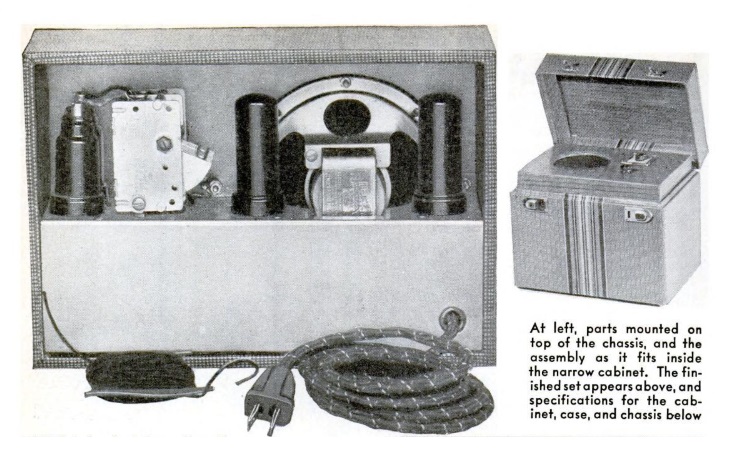
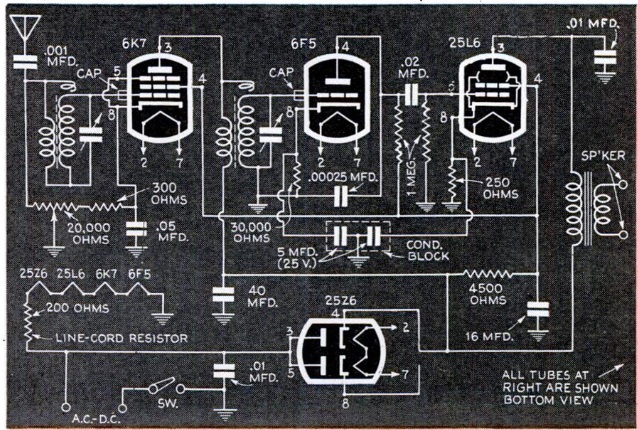
1939SepPS2This trio are pulling in stations from their campsite thanks to the three-tube portable described in the September 1939 issue of Popular Science. Just like the patio set described in the previous month’s issue, the set used three miniature tubes imported from England, although with the war just underway, it might have been hard to get more after the U.S. stocks were depleted. Apparently, the men had come to terms about taking turns with the headphones.

The author used a steel telescoping fishing rod as antenna by soldering a banana plug onto the end. The article noted that the connection could also be made by clipping a wire onto the end. In fact, if the wire were used, the set could be used in the boat, with the rod serving both to pull in stations and to pull in fish. In this case, however, an insulated handle would be needed for the fishing rod.

1939SepPSschematic


Escape of Walter Minx, 1944

1944Sep29MilJourIt’s not every day that the newspaper carries the story of an escape from prison by a criminal involved in a “blast, airplane, and submarine scheme,” but that’s what happened 75 years ago today. The September 29, 1944, issue of the Milwaukee Journal carried the story of the escape of Walter Minx from a minimum security prison in northern Wisconsin.

Minx’s crime had been elaborate, but he nearly got away with it, but for a few blunders. His plan was to extort $100,000 from the manager of the Milwaukee Sears stores. In 1940, he delivered the extortion note, but to the wrong address, as the executive had recently sold the house to a judge, who promptly reported the crime to police.

The note threatened to explode two bombs. The first, a relatively harmless one, went off as scheduled. To prevent a second blast, the executive was to pay $100,000. The money was to be dropped at a certain point in Lake Michigan.

Minx had constructed a submarine which initially tested well in the waters of Whitefish Bay, where it seemed to work well. But when he took it out into the open waters of Lake Michigan, he was unable to submerge due to the waves. Undaunted, he came up with an alternate plan involving motorcycles.

But before the money could be exchanged, the police examined the first bomb, and noticed that some of the parts appeared to come from ornamental ironwork. A Sears employee remembered that Minx had worked on a cashier’s cage at the store, and police went to his shop to investigate. There, they saw other incriminating parts, and Minx soon confessed.

Minx was released from prison in 1946, so his escape was apparently of short duration.  Minx died in Florida in 2009 at the age of 92.  You can read more at Milwaukee magazine.


Heathkit CB-1

1959Sep59PE2We’ve previously written (here and here) about the Heathkit Model CB-1 CB transceiver. Sixty years ago this month, the September 1959 issue of Popular Electronics carried a review of the kit.

The magazine described the set as handsome and lightweight and convenient for use either at home or in the car. The set had a built-in 120 volt power supply, and could be used mobile with a vibrator power supply.

The set was easy to put together, but the magazine warned not to rush and try to do it in a single evening. During that sunspot peak, the author reported that stations from several time zones were heard. When operated from the car, a station a few miles away reported a good signal with high modulation.


1944 British One Tube Regen

1944SeptPractWireless75 years ago this month, the September 1944 issue of the British publication Practical Wireless carried the plans for this very basic wartime one-tube regenerative receiver. The set employed a 1D8GT dual tube, half of which served as detector, with the other half serving as AF amp, providing about 100 mW of audio to the speaker. With a ten-foot antenna, the set would easily pull in the BBC home, European, and armed forces services.

1944SeptPractWirelessSchematic


1969 AM-FM Portables

1969SepEI3Fifty years ago this month, the September 1969 issue of Electronics Illustrated reviewed a number of pocket (for large pockets, that is) portable AM-FM receivers.

The magazine noted that many such sets were showing up as loss leaders and prices below $10, and the article asked how these cheap models compared with more expensive brand names. The surprising result was that the cheap no-name sets performed as well as the more expensive models, although the more expensive sets were, in some cases, easier to tune and looked better. But the moral of the story was that these were a class of products where shopping strictly for price was the best strategy.


Canned Bacon: 1919 and 2019

1919Sept25MilJourFullAd1919Sept25MilJourWith World War 1 soldiers on their way home or already there, the U.S. Army had some surplus commodities to get rid of a hundred years ago, and that included bacon. This ad appeared in the Milwaukee Journal a hundred years ago today, September 25, 1919, for the Boston Store in Milwaukee.

The store offered mostly dry goods, ranging from from toilet paper (6 rolls for 19 cents) up to a player piano ($395).  They also had a limited selection of food items, apparent “loss leaders” to get traffic into the store, shown at left.  And, of course, what stands out is the twelve pound can of army bacon for $3.66.  That, of course, is before a century of inflation, but a good way to put old prices in context is to remember that the money was made out of silver, so that the $3.66 really meant about 3.66 ounces of silver.  Today, that would be about $60.

That’s still a reasonable price, however.  The current WalMart price for 12 pounds of bacon is about $53.  That bacon, of course, isn’t really suitable for long-term storage, whereas the 1919 product was canned.  Interestingly enough, though, canned bacon is still readily available, and can be purchased at Amazon.  As you can see below, it’s rather expensive, especially considering that this price is for a nine ounce can:

On the other hand, for your emergency food storage needs, it might fill a niche.  According to the reviews, the product is excellent, and the 9 ounce can contains about 50 slices of bacon.  So having a can or two in the pantry might not be out of the question.

Since the modern product has 50 slices in the 9 ounce can, this means that the 12 pound can from 1919 contained several hundred slices.  So it probably was worth racing down to the store to get a couple cans.

If you’re looking for more ideas for protein for your home food storage, the most economical is probably dry beans or perhaps peanut butter.  If you crave real meat, one of the cheapest is probably tuna.  Other good options are potted meat, canned chicken, or, of course, the venerable Spam.  But if you want to get a can or two of canned bacon, I can’t blame you.

For more information about emergency food storage, see my food storage page.


Thomas Cook Undercover Mail of WWII

UndercoverLetter

The bankruptcy of Thomas Cook & Son Ltd. reminds us of one of their ventures during World War II. During the war, postal service between warring nations was suspended, but the British government was willing to allow families to remain in touch with relatives in Germany or occupied countries. Therefore, they allowed Thomas Cook to provide an “undercover mail” service via neutral Lisbon.

Writers in Britain would write their letter and place it in an unsealed envelope addressed to the eventual recipient. The letter would instruct the recipient to reply to the sender’s full name, care of Post Office Box 506, Lisbon, Portugal.

This envelope was placed in an outer envelope along with a money order for 2 shillings, along with a note of the sender’s full name and address. This was all sent to Thos. Cook & Son Ltd., Berkley Street, Piccadilly, London.

Letters were subject to censorship, and subject to numerous rules. They were to be clearly written without erasures, and could not exceed two sides of a normal sheet of notepaper. The sender’s address was not to be used in the letter or envelope and were to refer only to matters of personal interest. There was to be no reference to any town (other than Lisbon), village, locality, ship, or journey. There was to be mo mention of the fact that the writer was not in Portugal.

Box 506 was the most famous of these addresses, although there were others at various times during the war. Prior to the U.S. entry into the war, undercover addresses in New York were used by Canadians and aliens stuck in Canada to correspond with Germany and occupied countries.

References:


Homemade Battery Clamp Removal Tool

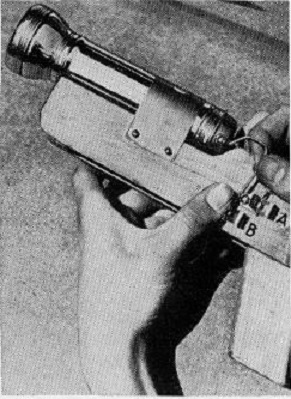
1939SepPS3
For removing stubborn battery clamps, you can buy a tool such as the one shown at left, conveniently available on Amazon. Or, you can just make your own from this self-explanatory hint shown above in Popular Science 80 years ago this month, September 1939.


An Old Soviet Tube

1929RadioL

I’m not sure what this old tube is doing, but it appears on the cover of the September 1929 issue of the Soviet publication Радиолюбитель (Radio Amateur). One would think that the word written on the ground would add some context.  But according to Google translate, “скатертъюборога” means “tablecloth,” so that doesn’t seem to help.

Since I can’t think of any other reason why atheist Soviets would be showing Christian crosses, I assume that these are grave markers.  Modern Soviet tubes have replaced the old models, and this old tube is visiting his fallen comrades at the cemetery.  Perhaps he plans to have a picnic on the tablecloth.