Category Archives: World War 2

World War 2 Short Wave Listening

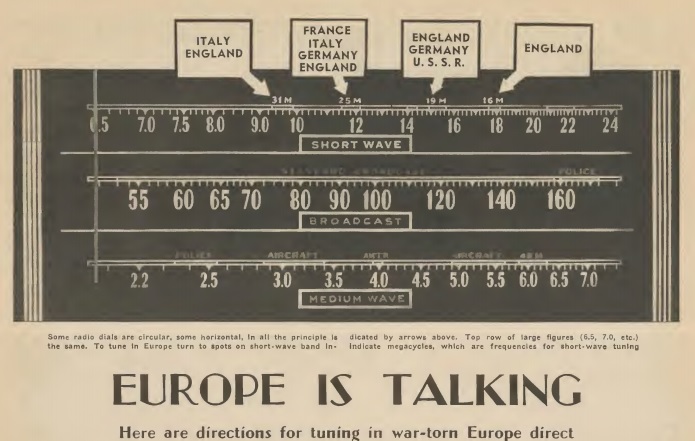
1939SWDial

Seventy-five years ago, Europe was once again at war, but America was for the time being neutral. But the shortwave bands were alive with the sounds of war, and Radio Guide, the predecessor to TV Guide magazine, was covering shortwave radio. The issue of the week ending October 6, 1939, gave some pointers for tuning in, as well as reviews of what could be heard from the European capitals. One article notes that “many listeners have given up tuning short waves in disgust after one or two feeble attempts, mainly because they did not know exactly where and when to tune for foreign programs intended for their consumption.” The article assures that by following the given instructions carefully, many stations could be heard.

Another article reviews the programs, and notes that the BBC attempted to appeal directly to the German people, and continued in its musical program to include German composers. It notes that French broadcasts were typically quite terse.

And as for the Germans, the article notes that while the output is typically crude, “the German stations have come up with the up-to-now cleversest device of combining propaganda with entertainment.” The station would play German waltzes and “only after the listener has settled down to a stretch of pure entertainment that the announcer quietly intersperses” propaganda.

For more information on the shortwave bands during the War, please visit my earlier post.


We Take You to London: 1939


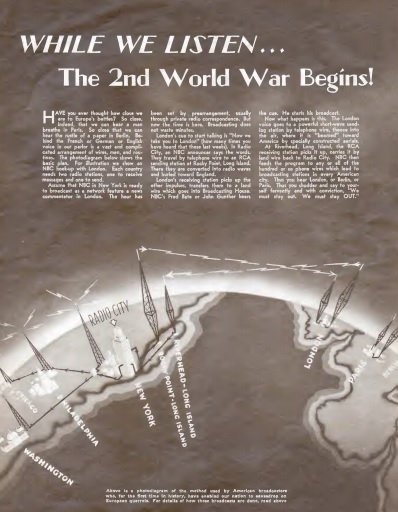
RadioGuide092939Seventy-five years ago, American radio listeners were frequently hearing the phrases, “we take you to London,” “we take you to Paris,” and “we take you to Berlin,” as Americans learned how close they were to Europe’s troubles. As this item from Radio Guide for the week ending September 29, 1939, points out, we were close enough to hear a man breathe in Paris or the rustle of a paper in Berlin.

The diagram shows the example of how NBC would connect to its correspondents in London, Fred Bate or John Gunther. From NBC’s New York studios, the cue would go via telephone to the RCA short wave transmitter at Rocky Point, Long Island. The signal would be picked up by an English receiving station and sent by telephone to Broadcasting House in London. The English broadcast would go by telephone to the English short wave transmitter and picked up by the RCA receiving station at Riverhead, Long Island. From there, the signal would go back to NBC’s Radio City studios for retransmission to the network.

The process concludes when the American listener picks up the broadcase and says to himself “fervently and with conviction,” and alas, in vain, “We must stay out. We must stay OUT.”


1939 British Gasproofed Room

Life18Sep39

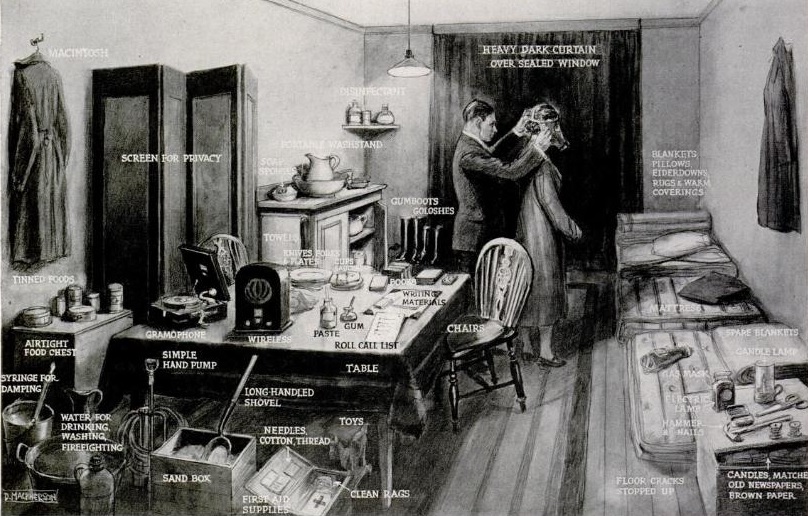
Seventy-five years ago today, September 18, 1939, Life Magazine carried this illustration from the British Home Office showing a basement room equipped and gasproofed. The caption notes that if the occupants remain quiet, there will be enough oxygen in the sealed room to accommodate five persons for twelve hours.

Presumably, the gramophone is to keep you entertained between bulletins from the wireless.


1934 Scout’s One Tube Radio

1934SeptRadioNews

Shown here in the September 1934 issue of Radio News is Scout Robert Crockett of Troop 3 of the BSA Siwanoy Council, Pelham, New York. He is shown operating the receiver that he designed and built, based upon a design in an earlier issue of the magazine. His circuit uses a single type 30 tube and a handful of other components, all of which can be obtained fairly easily today. For ideas on sourcing the components, you can visit my page describing another 1930’s era receiver or my crystal set parts page.  Full construction details are included in the 1934 article.

The author of the article was Robert’s “Scout Radio Examiner,” which presumably means Radio Merit Badge Counselor. According to this 1935 newspaper, Robert did go on to complete the Radio Merit Badge.  The magazine article concludes by pointing out that as his daily Good Turn, the Scout would be glad to help anyone building the set with their problems, and that such letters can be sent in care of the magazine. The article notes that he had logged over 300 shortwave stations with the set.

According to the National Eagle Scout Association database, Mr. Crockett became an Eagle Scout on February 24, 1937. And according to this newspaper and this one, he was serving in the military in 1943 and 1944. According to his sister’s 1943 obituary, his service was as an Ensign in the U.S. Naval Reserve.


The Cost of Leaving: Nazis, $60. USA, $2350.

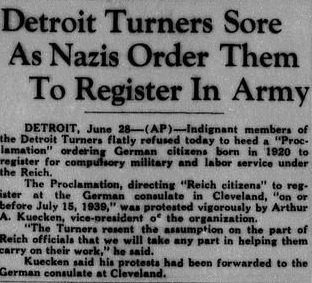
According to the Milwaukee Journal, June 29, 1939, all 19-year-old “Reich citizens” living in the United States were ordered to register at the German consulate to register for compulsory military and labor service under the Reich. According to the report, no such orders had yet been received by Germans in Milwaukee, but those in Detroit had been directed to report to the German consulate in Cleveland. According to the proclamation setting forth the order, those failing to do so would be subject to a fine of 150 reichsmarks (about $60) or with arrest.

Seventy-five years later, the U.S. Government announced that the fee for renouncing U.S. citizenship had gone up to $2350, in addition to the steep “exit tax” which applies in many cases.

References:

Forbes, U.S. Hikes Fee to Renounce Citizenship by 422%


WW2 Begins, 1 Sept. 1939

1Sept39HeadlineSeventy-five years ago today, Hitler invades Poland, annexes Danzig, and the Second World War has begun.  The headline here is from the Milwaukee Sentinel of that day.

Exactly a quarter century earlier, the papers were reporting the greatest battle the earth had ever seen, as three million men fought for Paris.


English Children Preparing for Evacuation, 1939

Evac75 years ago, war was once again only days away. This wire service photo appeared in a number of U.S. and Canadian papers in the last days before the start of World War 2. Hitler was making demands for Danzig, and the world knew that war was near.

In this photo, shown here in the 31 August 1939 issue of the Vancouver Sun, English school children are practicing evacuation. Under the plans already in place, the children were to gather at their schools, where they would be escorted to the train stations by their teachers. Other papers should similar pictures of the children of Paris preparing to flee the capital.

Read More at Amazon


Soviet-German Non-Aggression Pact, 1939

Seventy-five years ago today, only a quarter century after the start of the First World War, the Second was falling into place. Today, August 22, 1939, the papers were reporting the non-aggression pact between between Nazi Germany and the Soviet Union, that German guns were moving toward the Polish border, and that the Nazis considered the “dispute over Danzig as won.”


Another Great War Looms

Milwaukee Journal Headline, 20 Aug 1939:  "Is This the Week?"  All Europe Wonders

In 1919, Woodrow Wilson stated, “I can predict with absolute certainty that within another generation there will be another world war if the nations of the world do not concert the method by which to prevent it.”  


It turned out to be less than a generation.  On this day a hundred years ago, the First World War was well under way.

And only 25 years later, 75 years ago today, this headline, from the Milwaukee Journal of August 20, 1939, shows that Wilson’s prophecy was about to come true.  It turned out that this wasn’t the week.  It would be eleven more days until Germany invaded Poland, marking the start of the Second World War.

The Shortwave Broadcast Bands During WW2

AdmiralConsole

I’ve always been curious about what the short wave bands sounded like in the United States during World War II. Short wave was available on many, but by no means all, pre-war consumer radios. The radio shown here, Admiral model 71-M6 covers the standard broadcast band, has a phonograph, and also covers the 31 meter shortwave band, which it calls the “European” band. The ad is from the February, 1941, issue of Radio Today.

I own an Admiral console very similar in appearance to this one, but mine is a bit more upscale. Mine also includes the 25 meter band and has push button tuning for the standard broadcast band. (Most of the buttons on mine are labeled with Chicago stations, so it must have originated in the Chicago area.)  I forget the exact tube count of mine, but I believe it’s more than six. It has push-pull audio, meaning that it has two tubes in the final audio stage. Mine also has an RF preamplifier stage, which this one is probably lacking.

But the styling of mine is so close to the one shown here that it’s very likely that mine also predates the war, and the sounds of wartime shortwave broadcasts probably came out of its old speaker. Its actually a very good receiver on both the AM and shortwave bands. And since it’s set up for only the two shortwave broadcast bands, it’s quite easy to tune to a particular frequency, a feature lacking in most commercial shortwave receivers.

The ability to make sound recordings was virtually unknown in consumer equipment, so the chance of finding a recording of someone’s SWL’ing from that era is very unlikely. But the site americanradiohistory.com has a treasure trove of old radio publications, and I found one that sheds some light on what the casual listener with a radio such as my Admiral would have been able to hear. The predecessor of TV Guide magazine was  Radio Guide, and during the war years, it seems to have gone by the name Movie-Radio Guide. It did include a couple of pages of short wave listings in each issue, and provides a good look at short wave during the war years. The issue for December 20-26, 1941 appears to have been mostly ready for press prior to Pearl Harbor, but it does include a notice: “War conditions permitting, complete information as to how wartime conditions will affect your radio listening will be revealed by Curtis Mitchell, U.S. Army” in the next issue.

That issue, dated December 27, 1941, announces that the Guide will have “new, enlarged short-wave information and program section” where “short-wave dialers will find a large, carefully compiled list of the world’s short-wave stations, carrying war news in English.”

The promised listing of war news shows the scheduled times and of English-language war news broadcasts:

WarNews122741

Berlin, Rome, and Tokyo are all represented on the list.  Later issues also show a listing for the Vichy, France, station.  These stations also have programs listed in the accompanying program schedule. For example, the “Lord Haw Haw” show is shown as being broadcast at 5:30 PM U.S. Pacific Time on Saturday from DXZ (9.57 MC) and DXJ (7.24 MC) and Y (the Paris station on 9.52 MC). At 6:30 PM, Berlin carried “Greetings from British prisoners in Germany to their families in the U.S. and Canada.” The text refers to this program as a “sadistic touch.”

Most usefully, this magazine also has what appears to be a rather comprehensive list of “Transmissions Beamed on North America”. The December 27 issue covers from 17.87 MC (GSV, London) down to 5.95 MC (XGDY, Chungking).  One article notes that Radio Saigon, while Axis controlled, signed off with the Marseilles.

The January 3, 1942, issue discusses the possibility of blackouts of U.S. standard broadcast stations during air raids. It also reminds listeners that the Post Office Department suspended mail service to Germany, Italy, and other lands under their control, and that listeners shouldn’t “waste postage on reports to Axis stations.” It also notes that “with most of the interference now absent [presumably since amateurs sharing the 40 meter ham band were now silent], reception ranging from fair to excellent is being afforded by the stations broadcasting on [the 41 meter] band. DXJ (7.24), Berlin, for example, is being heard daily from 4:50 p.m. to 1:00 a.m. EST with louder signals than any of the seven other Berlin outlets for the North American service.”

This issue also presents the beginning of a list, in serial form, of all short-wave stations by frequency. This issue caries listings for the 19 meter band (15 MC). The issues for January 10, 1942 and January 17, 1942 list all of the stations transmitting on the 25 meter band (11 MC). The January 24 and January 31, 1942 issues contain the listings for the 31 meter band (9 MC). The listings for the 41 meter band (7 MC) are in the February 7, 1942, issue.

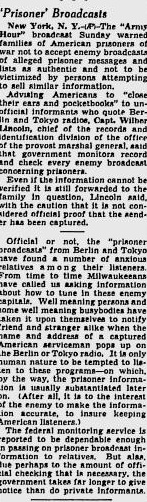
This issue also reports that Tokyo is now carrying messages from American prisoners of war, and notes that these messages are probably recorded under duress. The 49-meter band (6 MC) and a few stations below are covered in the February 14, February 21, and February 28 issues.

The February 28 issue also notes that Berlin has revamped its English service, to consist of a news broadcast followed by “a fifteen-minute talk or commentary in English by one of Goebbels’ gabblers.” This issue also notes that Moscow has expanded its shortwave service, and that “reports from all parts of the country indicate that these new transmissions are being received with very good signal strength.” These programs apparently originated from Moscow studios, but were put on the air from a transmitter at Komsomolsk, Amur.

In addition to these comprehensive listings, the magazine also contained in each issue a list of “important stations” shown here, this one from the February 28, 1942, issue:

ImportantStations022842

In short, if there was any doubt, it appears that the shortwave bands were lively during the war, and that American listeners with a shortwave receiver had many opportunities to hear first hand the propaganda being broadcast by the axis powers.