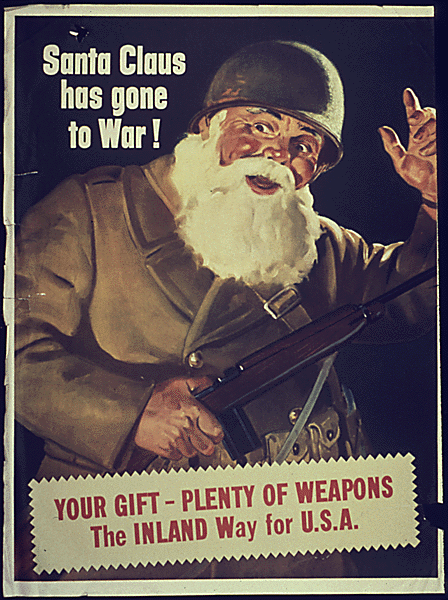
Perhaps the picture is a little bit on the politically incorrect side. But this 1942 poster from the War Production Board leaves little doubt as to which side St. Nick was on.

Perhaps the picture is a little bit on the politically incorrect side. But this 1942 poster from the War Production Board leaves little doubt as to which side St. Nick was on.
 Seventy years ago, Life Magazine, December 11, 1944, featured the life of teen-age girls, and noted that all six million of them “live in a world all their own–a lovely, gay, enthusiastic, funny and blissful society almost untouched by the war.” Music stores bulged with girls listening to the singers and bandleaders they have made famous, and “half a dozen radio programs are aimed at homes where a daughter will cut off her father’s news to follow the fictional adventures of a contemporary.”
 Shown here and above is Miss Pat Woodruff, a high school student from Webster Groves, Missouri, a suburb of St. Louis. She’s wearing her “after-school costume of blue jeans and a checked shirt,” undoubtedly getting ready to tune in one of those programs on the console radio in the parlor. She quickly gets to work tackling her homework, but with the radio playing full blast.
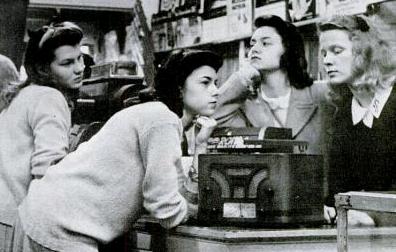 When the girls featured in the story were not listening to the radio or talking endlessly on the telephone, the phonograph occupied them. Here, a group of girls spends 2-1/2 hours listening to two dozen records at a record store, buying only one or two. Here, a group is completely engrossed listening to Dick Haymes‘ Together.
Dates were usually double, the article noted. Teen-age girls were primarily interested in themselves, with high-school boys running a poor second. Servicemen stationed near town rated last. An old high-school boy home on leave in uniform, however, was in a class by himself and rated tops.
Click Here For Today’s Ripley’s Believe It Or Not Cartoon

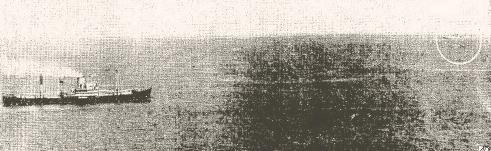
The Arauca (left). The Orion is barely visible, circled, at the right side of the photo. Big Spring (Texas) Daily Herald, December 21, 1939.
The first shot of World War Two to be fired in the United States was 75 years ago today, on December 19, 1939. On that day, the merchant ship Arauca sailed into Port Everglades, Florida, flying the Nazi flag. Just off the Hillsboro Lighthouse, the British cruiser HMS Orion was pursuing the Auraca and signaled for the Arauca to proceed into international waters. Not surprisingly, the Arauca’s captain did not heed the message. The British ship then fired a shot across her bow from not more than 12 miles away from the U.S. coast. This was a violation of U.S. neutrality, but there’s no record of any protest having been filed. The captain of the Arauca sailed the ship into the U.S. port. The Orion remained in the area for a few days, but when it disappeared, the Auraca‘s crew was seen painting the ship grey, preparing to make a run for it in the next fog.
But the Auraca never left port under its own steam. What the Royal Navy attempted to do was instead accomplished by American lawyers.
The Auraca had been sailing from Veracruz to New Orleans. She was on her maiden voyage, having sailed to Havana prior to the outbreak of hostilities. After the war started, despite the captain’s request to return to Germany, she was sent to Veracruz.
The Auraca was carrying a cargo of sugar, and about a dozen German passengers returning to Germany from Mexico. She was also carrying fuel that was thought to be in excess of her own needs, leading to speculation that she was an auxiliary military vessel tasked with refueling German warships. This was a critical distinction, because if she were deemed to be an auxiliary, she would be allowed in port for only 24 hours. It turned out, however, that this determination was never made, because the U.S. civil courts saw to it that the vessel would never again see service to Germany.
The ship’s presence in Ft. Lauderdale was quite a tourist attraction. In addition to those along the Florida coast who witnessed the shot across the bow, thousands flocked to Ft. Lauderdale to see the Nazi ship sitting at the dock.
The morning after the Auraca‘s arrival, a libel action was brought in the U.S. District Court in Florida. The Imperial Sugar Company of Galveston, Texas, filed the suit against the ship’s owner, the Hamburg-American Line, for damages for breach of contract for an earlier transaction predating the war. Other claimants followed suit, and eventually claims of over $138,000 had been filed, in addition to the Port’s claim for docking fees. To release the ship, the owners would have to post bond of more than $277,000, which never happened. The ship became a permanent fixture in Ft. Lauderdale.
Most of the passengers and crew were forced to remain aboard the ship. The captain and officers were initially allowed into the town of Ft. Lauderdale, and the captain was quite willing to give interviews to the many U.S. reporters who pursued him.
The ship and crew, basically imprisoned aboard the ship, remained until March 20, 1941, when President Roosevelt arrived at Port Everglades for a fishing trip. From aboard his presidential yacht, anchored just yards from the German ship, he was upset when he “caught sight of a Nazi flag fluttering over American soil.” Before the end of the month, 60 ship seizures, including the Arauca, took place under the Espionage Act, on the grounds that the vessels posed a threat to American harbors.
The Justice Department then obtained arrest warrants against the entire crew on the grounds that the crewmen, imprisoned in the ship, had actually overstayed their visas. The Coast Guard arrested the crew and replaced the Swastika with Old Glory. The crew was later transported to the Broward County Jail, then to the Dade County Jail, and finally to Ellis Island. They were still at Ellis Island when the U.S. joined the war, and the men were interned at the Fort Lincoln Internment Camp in North Dakota.
The litigation surrounding the ship dragged on until well after the war was over. The ship was eventually sold, and the proceeds held in trust for the various claimants. A 1949 decision, Suns Insurance Office v. Arauca Fund, 84 F. Supp. 516 (D.C. Fla. 1949), involved the computation of damages for contracts payable in reichsmarks. Since the reichsmarks were “worthless in terms of dollars” at the time of the deicision, that claimant got nothing. The attorneys didn’t fare much better, in what appears to be the final reported decision of the case, United States v. Knauth, 183 F.2d 874 (C.A. 5 1950). In that decision, the Fifth Circuit held that the prevailing attorneys did not have a lien against the vessel, since their cause of action actually arose out of a claim involving a different vessel.
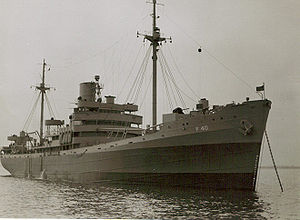
The ship in 1943, now the USS Saturn. Wikipedia photo.
The ship itself was purchased in 1941 from the U.S. Maritime Commission by the South Atlantic Steamship Company of Savannah, Georgia, which towed the ship to Mobile and renamed her the Sting. After such a long period of disuse, the ship was in need of extensive repairs and was eventually handed back to the U.S. Government. In April 1942 the ship, now named the USS Saturn, was in the hands of the U.S. Navy. She suffered numerous mechanical problems, but operated along the East Coast and to Carribean bases such as Trinidad and Guantanamo. She made one transatlantic crossing to England in 1943, and trips later in the war to the Mediterranean, Iceland, and the Carribean. She was decommissioned in 1946, but held in reserve until 1972 when she was sold to a Spanish firm for scrap.
References
 )
)
Note: In many sources, the name of the ship is incorrectly reported as the Aranca. This appears to have originated in typographical errors in many newspaper accounts in 1939. The ship was intended for trade with South America, and was given the name of the Arauca River of Colombia and Venezuela.
Click Here For Today’s Ripley’s Believe It Or Not Cartoon
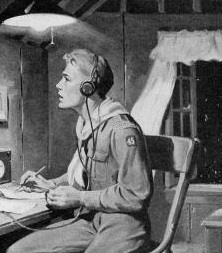
The December 1939 issue of Boys’ Life magazine carries an interesting short story, “Merry Christmas Hans” by Philip Lightfoot Scruggs
The hero of the story is Dave Smith, W2KSM. (It looks like the call was really in use, as shown by what looks like a Sweepstakes entry in this 1938 QST. And it was held in 1954 by one Howard M. Ames Jr.)
Young W2KSM, a 17-year-old Eagle Scout, decided to get on the air on Christmas Eve to wish a Merry Christmas to his DX friends in France, England, Belgium, or Holland. Much to his surprise, he heard the voice of Hans Schuler in Germany, where Amateur Radio was not allowed. (Amateur Radio actually did exist in Germany, and even continued somewhat during the war. Germany was one of the few belligerent countries where there were still a few hams on the air, even during the war. For more information, see my earlier post.) The story contains an editor’s note pointing out that the story was written before war was declared. Dave asked Hans what would happen if he was caught, and Hans replied, “the concentration camp at least.”
Still, the two continue their conversation, as Dave tells of freedom, and Hans tells of the repression in Germany, and even explains how he can quickly dismantle the station and antenna if the Gestapo got too close. Another Scout in New York City just happens to be listening to the contact, and alerts his father, a network executive, who spontaneously decides to broadcast the contact nationwide where millions, including Dave’s parents, listen to the boys talk.
Dave tells about Boy Scouts, and Hans tells of his experience preparing for war in the Hitler Youth. Dave concludes the contact by reciting the Scout Oath and Law, “that is our Scout Oath and Law, Hans–what we try to live by,” as Hans prepares to hastily disassemble his clandestine set.
Dave walks downstairs wondering whether his family will believe it, only to hear the end of the broadcast in which he and Hans had a starring role.
Click Here For Today’s Ripley’s Believe It Or Not Cartoon
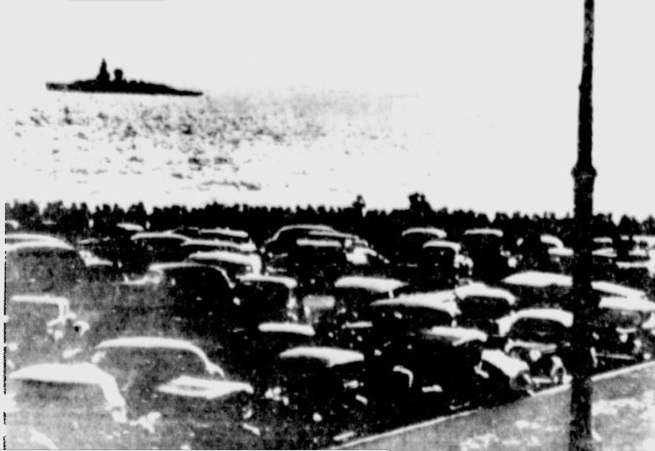
75 years ago today, December 17, 1939,thousands of curious residents of Montevideo, Uruguay, gathered at the docks overlooking the estuary of the Rio de la Plata. They can be seen in this wire service photo which appeared in the Milwaukee Journal the next day.
The ship visible three miles from shore is the German warship the Admiral Graf Spree. Two years earlier, the ship had participated in the Coronation Review for King George VI. In 1939, Germany was at war with Britain, and in the first months of the war, it had sunk nine British ships in the South Atlantic. It was confronted by British ships on December 13 and suffered considerable damage. It sailed into neutral port in Uruguay to effect repairs. Uruguay, however, allowed it only 72 hours in port, an insufficient amount of time.
The British began transmitting on frequencies known to be monitored by the Germans, and gave the immpression that a much larger force was en route to Uruguay than was truly the case. The Germans believed the misinformation, leading the Graf Spree’s captain to believe that a return to Germany would be impossible. He sailed the vessel into the Rio de la Plata, and 20,000 gathered on the docks to witness what they believed would be a battle between the German ship and British vessels. Instead, the Graf Spree prepared to scuttle the ship. At 8:55 PM, after an Argentine tug evacuated the crew, the charges were detonated, treating the spectators on shore to an explosion visible for miles.
While much of the ship was salvaged, parts are still visible in the Rio de la Plata. The ship’s captain committed suicide in his Argentine hotel room three days later.
Click Here For Today’s Ripley’s Believe It Or Not Cartoon
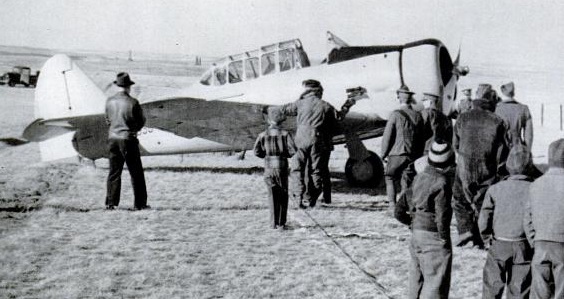 Life Magazine 75 years ago, December 11, 1939, shows this photo of an aircraft being exported from the United States en route to its new owner, the British Royal Air Force. American neutrality prevented either American or Canadian pilots from flying military aircraft across the border. To remedy this difficulty, the planes were flown from the factory in California to Sweetgrass, Montana. From the airstrip near the border, the planes were towed by automobile over the border. The line running up the picture is the international boundary. The plane’s nose is in Canada, and its tail is in the United States.
The airport in question is truly an international airport. Coutts/Ross Sweetgrass International Airport‘s current runway, 07-26, is a 2900 foot grass strip that runs East-West along the international border. It can currently be used to clear customs entering either the United States or Canada.
Click Here For Today’s Ripley’s Believe It Or Not Cartoon
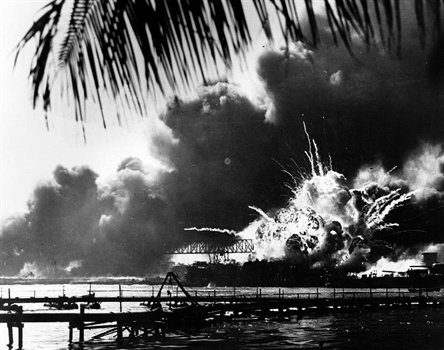
USS Shaw at Pearl Harbor. Defense Department Photo.
Contrary to popular belief, the networks never broke into live programming to announcing the attack on Pearl Harbor on December 7, 1941. The first broadcast announcement came at about 2:30 Eastern Time on CBS, during a scheduled newscast.
But you tell me that you’ve heard an announcement breaking into a symphony mid-note, with the words: “We interrupt this program to bring you a special news bulletin. The Japanese have attacked Pearl Harbor, Hawaii by air.” This was actually from a record produced by CBS in 1948. The second sentence came from an actual broadcast later in the day. You can hear the original at this link.
There was apparently no recording made of the first announcement, and there was apparently no interruption of regular programming.
A recording from Minneapolis CBS station WCCO is available at RadioTapes.com. While there’s no time stated on the WCCO recording, this was apparently recording during the break in the New York Philharmonic concert, which started at 3:00 Eastern Time. Therefore, the WCCO recording probably starts at about 3:30 Eastern Time.
References
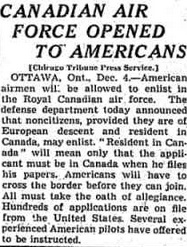
Seventy-five years ago today, December 4, 1939, the Canadian Government announced that U.S. Citizens would be permitted to enlist in the Royal Canadian Air Force. Recruits were required to be of “European descent and resident in Canada.” However, the Canadian government, eager to recruit American aviators, was quite lax on the “residency” requirement. Residency meant only that the applicant must be in Canada at the time he filed his papers.
This, of course, would have been a violation of American law and American neutrality. But even though 9000 Americans eventually enlisted, I’m not aware of a single case of an American being prosecuted for service with the Allies.
The Canadians had even been quietly recruiting in the United States, even though this was clearly a violation of U.S. law. Americans were initially required to pledge his allegiance to the British monarch, which could potentially lead to loss of U.S. citizenship. At some point, however, this was relaxed, and American recruits were required to merely obey RCAF rules and discipline for the duration of the war.
Some Americans had already enlisted. For example, De Peyster Brown, an American pilot who served in the Battle of Britain, had enlisted in the RCAF on September 9, by claiming to be Canadian.
References

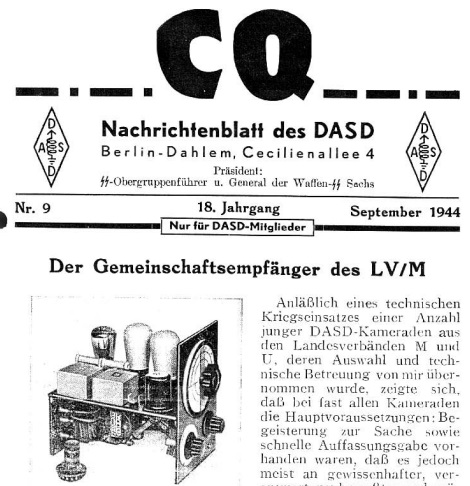
Chart showing German amateur frequency bands, 1944. DASD-CQ, September 1944.
It’s widely believed that amateur radio went off the air for the duration of World War II. That was certainly the case in the United States and Canada, as well as most of the warring countries. Some neutral countries remained on the air. For example, Portuguese hams remained on the air, and much of South America was still engaging in amateur radio as usual.
But strangely enough, the major exception was Nazi Germany. German stations were ordered off the air after commencement of hostilities in September 1939. But soon thereafter, many stations were granted a special wartime license, known as Kriegsfunkgenehmigung. QST for April 1940 carried the following announcement sent from Chris Schmelzer, D4BIU:
There seems to be a widespread misunderstanding concerning the activities of German amateur stations to-day. According to a statement made by our government, all sport activities, etc., will be continued during the war to as large an extent as possible. Due to this, amateur stations D4ACF, D4ADF, D4BIU, D4BUF, D4RGF, D4TRV, D4WYF, D4HCF and D4DKN have been relicensed recently. More licenses will follow shortly. The stations are supposed to carry on strictly in the usual manner.
The website of the Foundation for German communication and related technologies contains copies of many wartime issues of DASD-CQ, the journal of the German national amateur radio society, Deutschen Amateur-Sende-und Empfangs-Dienstes, which continued publication throughout the war. From recording calls contained in that journal, the author of the web page counts at least 86 active call signs through 1944. And DC5WW has provided a list (the source of which is not clear) of all licensed stations as of August 1944. These include a number of stations licensed only for 10 meters. And a collection of 1943 German QSL cards can be found at the website of Radioclub Braunschweig. In addition to the hams with transmitting licenses, a larger number of receiving licenses were issued to DASD members. It appears that the DASD was tasked with approving licenses at this time. A 1944 letter from DASD president Ernst Sachs to Heinrich Himmler explaining the importance of amateur radio is available online.
So it is clear that there were a significant number of hams on the air from Germany throughout the war. Many of them, it seems, were using a receiver very similar to the National HRO. In fact, the tuning condensers were manufactured by National and imported through Portugal. When the German military believed that they were not up to military specifications, they were given to the DASD for distribution to hams for use in receivers using German tubes.
As shown on the chart above, amateurs were allowed to operate on 20 channels between 3500 and 3600 kHz, as well as 7000-7200, 14000-14400, and 28000-30000 kHz. (Not surprisingly, the Germans called them kiloHertz rather than kilocycles at the time.)
One can only speculate as to why Nazi Germany allowed its hams to remain on the air when the free world was silent. The author of this page offers two reasons, both of which seem plausible. The first was to show the world a sense of normalcy. Apparently, the idea was for those in the rest of the world to have the impression that life was going on normally. Or, as the QST article above put it, “all sport activities, etc., will be continued during the war to as large an extent as possible.”
The other reason was more practical. It was believed that hams and SWL’s could provide valuable propagation information. Indeed, one source noted that both hams and SWL’s were required to keep duplicate logs and send one copy to the authorities for analysis.
According to that same author, there was apparently no political test for licensees. There was no special requirement of adherence to Nazi ideology (at least, no more so than required of the general population). While the original plan to issue licenses was apparently approved by the SS, the actual administration of the program was under the control of the Wehrmacht, whose concerns were presumably more practical than ideological.
Even more surprising is that there were a handful of QSO’s, during the war, between these German stations and British stations! In 1944, the British government allowed a small number of hand-selected prominent hams back on the air. Under this program, called “Plan Flypaper” the call signs G7FA through G7FJ were assigned and allowed to operate with 50 watts on 80, 40, 20, and 10 meters. Among these hams was Louis Varney, G5RV, who became G7FJ. The full details of this program, including the operating rules, can be found at the Southgate ARC website.
The participants in this program made numerous contacts with neutral countries, and a handful of contacts with German stations. They were forbidden from calling German stations, but they were instructed to make the contact if a German station called them. The purpose of this program was apparently two-fold. First of all, the idea was to simply make themselves available in case any interesting information was received. They had instructions, if an enemy station wished to send a message, to relay it to headquarters, and to inform the other station to contact them again the next day for any response.
The other idea was that if any Allied prisoners of war gained access to a transmitter, they would be able to make contact with one of these British stations. Apparently, neither of these goals was realized.
Here’s another interesting article about amateur radio in Nazi Germany, by Prof. Bruce Campbell KG4CUL: https://theconversation.com/nazis-pressed-ham-radio-hobbyists-to-serve-the-third-reich-but-surviving-came-at-a-price-90510
Click Here For Today’s Ripley’s Believe It Or Not Cartoon
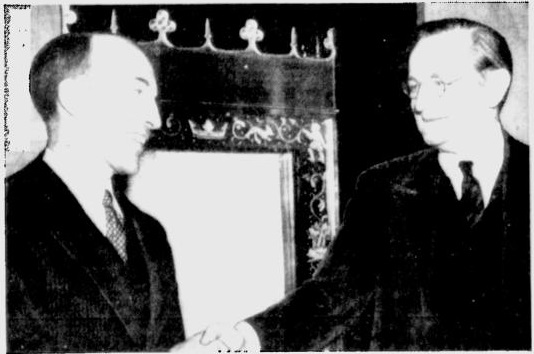
Seventy five years ago, one of the four copies of the Magna Charta was moved to America for safekeeping. Here, the Milwaukee Journal for November 29, 1939, shows the British Ambassador entrusting the document to the Librarian of Congress.
Click Here For Today’s Ripley’s Believe It Or Not Cartoon
_before_refitting_to_become_AF49_at_Norfolk,_VA.JPG)