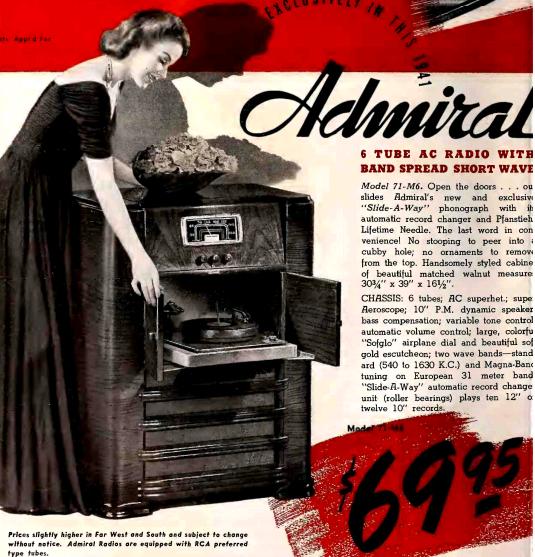
I’ve always been curious about what the short wave bands sounded like in the United States during World War II. Short wave was available on many, but by no means all, pre-war consumer radios. The radio shown here, Admiral model 71-M6 covers the standard broadcast band, has a phonograph, and also covers the 31 meter shortwave band, which it calls the “European” band. The ad is from the February, 1941, issue of Radio Today.
I own an Admiral console very similar in appearance to this one, but mine is a bit more upscale. Mine also includes the 25 meter band and has push button tuning for the standard broadcast band. (Most of the buttons on mine are labeled with Chicago stations, so it must have originated in the Chicago area.) I forget the exact tube count of mine, but I believe it’s more than six. It has push-pull audio, meaning that it has two tubes in the final audio stage. Mine also has an RF preamplifier stage, which this one is probably lacking.
But the styling of mine is so close to the one shown here that it’s very likely that mine also predates the war, and the sounds of wartime shortwave broadcasts probably came out of its old speaker. Its actually a very good receiver on both the AM and shortwave bands. And since it’s set up for only the two shortwave broadcast bands, it’s quite easy to tune to a particular frequency, a feature lacking in most commercial shortwave receivers.
The ability to make sound recordings was virtually unknown in consumer equipment, so the chance of finding a recording of someone’s SWL’ing from that era is very unlikely. But the site americanradiohistory.com has a treasure trove of old radio publications, and I found one that sheds some light on what the casual listener with a radio such as my Admiral would have been able to hear. The predecessor of TV Guide magazine was Radio Guide, and during the war years, it seems to have gone by the name Movie-Radio Guide. It did include a couple of pages of short wave listings in each issue, and provides a good look at short wave during the war years. The issue for December 20-26, 1941 appears to have been mostly ready for press prior to Pearl Harbor, but it does include a notice: “War conditions permitting, complete information as to how wartime conditions will affect your radio listening will be revealed by Curtis Mitchell, U.S. Army” in the next issue.
That issue, dated December 27, 1941, announces that the Guide will have “new, enlarged short-wave information and program section” where “short-wave dialers will find a large, carefully compiled list of the world’s short-wave stations, carrying war news in English.”
The promised listing of war news shows the scheduled times and of English-language war news broadcasts:
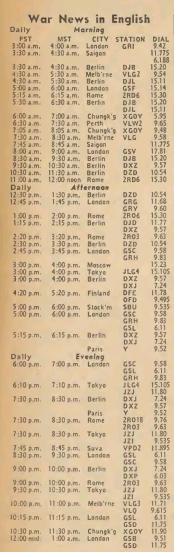
Berlin, Rome, and Tokyo are all represented on the list. Later issues also show a listing for the Vichy, France, station. These stations also have programs listed in the accompanying program schedule. For example, the “Lord Haw Haw” show is shown as being broadcast at 5:30 PM U.S. Pacific Time on Saturday from DXZ (9.57 MC) and DXJ (7.24 MC) and Y (the Paris station on 9.52 MC). At 6:30 PM, Berlin carried “Greetings from British prisoners in Germany to their families in the U.S. and Canada.” The text refers to this program as a “sadistic touch.”
Most usefully, this magazine also has what appears to be a rather comprehensive list of “Transmissions Beamed on North America”. The December 27 issue covers from 17.87 MC (GSV, London) down to 5.95 MC (XGDY, Chungking). One article notes that Radio Saigon, while Axis controlled, signed off with the Marseilles.
The January 3, 1942, issue discusses the possibility of blackouts of U.S. standard broadcast stations during air raids. It also reminds listeners that the Post Office Department suspended mail service to Germany, Italy, and other lands under their control, and that listeners shouldn’t “waste postage on reports to Axis stations.” It also notes that “with most of the interference now absent [presumably since amateurs sharing the 40 meter ham band were now silent], reception ranging from fair to excellent is being afforded by the stations broadcasting on [the 41 meter] band. DXJ (7.24), Berlin, for example, is being heard daily from 4:50 p.m. to 1:00 a.m. EST with louder signals than any of the seven other Berlin outlets for the North American service.”
This issue also presents the beginning of a list, in serial form, of all short-wave stations by frequency. This issue caries listings for the 19 meter band (15 MC). The issues for January 10, 1942 and January 17, 1942 list all of the stations transmitting on the 25 meter band (11 MC). The January 24 and January 31, 1942 issues contain the listings for the 31 meter band (9 MC). The listings for the 41 meter band (7 MC) are in the February 7, 1942, issue.
This issue also reports that Tokyo is now carrying messages from American prisoners of war, and notes that these messages are probably recorded under duress. The 49-meter band (6 MC) and a few stations below are covered in the February 14, February 21, and February 28 issues.
The February 28 issue also notes that Berlin has revamped its English service, to consist of a news broadcast followed by “a fifteen-minute talk or commentary in English by one of Goebbels’ gabblers.” This issue also notes that Moscow has expanded its shortwave service, and that “reports from all parts of the country indicate that these new transmissions are being received with very good signal strength.” These programs apparently originated from Moscow studios, but were put on the air from a transmitter at Komsomolsk, Amur.
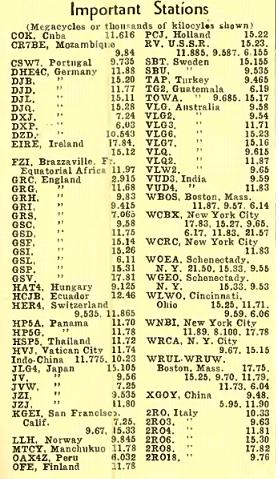
In addition to these comprehensive listings, the magazine also contained in each issue a list of “important stations” shown here, this one from the February 28, 1942, issue:
In short, if there was any doubt, it appears that the shortwave bands were lively during the war, and that American listeners with a shortwave receiver had many opportunities to hear first hand the propaganda being broadcast by the axis powers.




 , described its programming as “cover, cover, dirt, cover, dirt.” Most of its programming mimicked the official German stations. But when needed, disinformation could be inserted. The Germans eventually figured out what was going on, and they preceded official instructions with the following announcement: