Category Archives: World War 2

1942: Last of the Prewar Radios

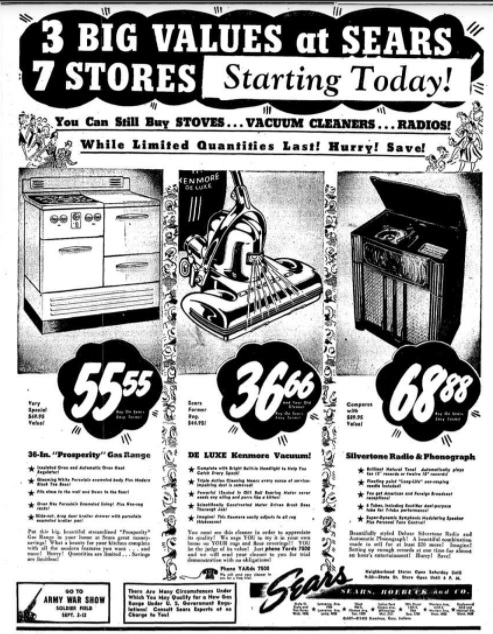
1942Aug27ChiTrib75 years ago, many consumer products, such as radios, stoves, and vacuum cleaners were no longer rolling off the assembly lines now devoted to war production. Civilian radio production, for example, ended on April 22, 1942.  But these items remained available, as retailers sold the last of the remaining stock.

This ad appeared in the August 27, 1942 issue of the Chicago Tribune and shows some of the last prewar versions of these items.

The model number of the Silvertone radio-phono is not shown, but according to the ad, the set was an $89.95 value selling for only $68.88.  It featured an automatic record changer which could accommodate up to ten 12″ records or twelve 10″ records.  The six-tube radio tuned both standard broadcast and shortwave.


1942 Mallory Wood Condensers

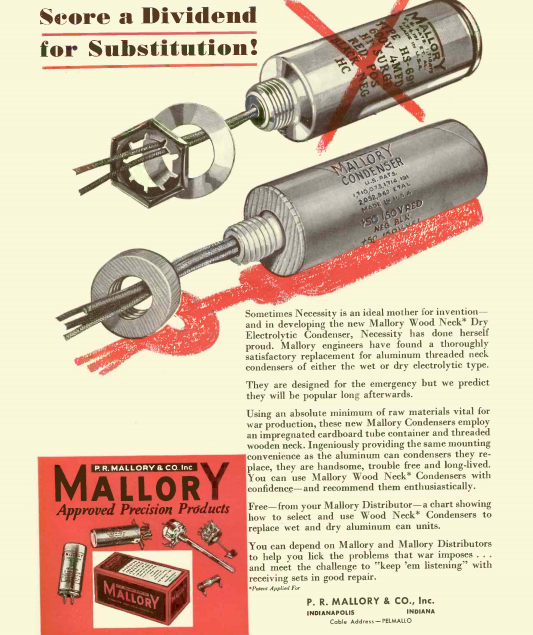
1942AugServiceWith wartime material shortages, replacement radio parts were hard to come by. And even when parts were available, the manufacturers had to adapt to wartime conditions.
This is illustrated by this ad from the August 1942 issue of Service magazine, showing the Mallory “Wood Neck” condenser (what we would call a capacitor these days).  Instead of an aluminum case and base, the capacitor had an impregnated paper case and a threaded wooden base.  The ad noted that “they are designed for the emergency but we predict they will be popular long afterwards.”


Think It Over, 1942

BC072742

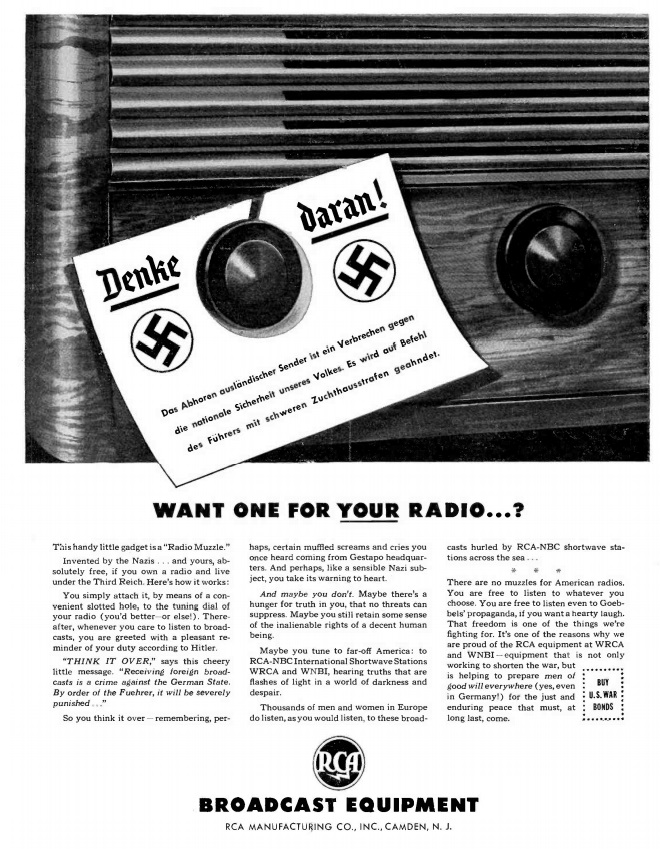
This RCA ad, which appeared 75 years ago in the July 27, 1942, issue of Broadcasting, shows the warning label affixed to radios in Nazi Germany.  It contains this warning:

Think it over. Receiving foreign broadcasts is a crime against the German State. By order of the Fuehrer, it will be severely punished.”

The ad goes goes on to say that most will think it over. And perhaps, like a sensible Nazi subject, the radio’s owner will take the warning to heart.

And maybe you don’t. Maybe there’s a hunger for truth in you, that no threats can suppress. Maybe you still retain some sense of the inalienable rights of a decent human being.

Maybe you tune in far-off America: to RCA-NBC International Shortwave Stations WRCA and WNBI, hearing truths that are flashes of light in a world of darkness and despair.


Archie Banks, 9AGD, Radio Amateur & Beekeeper

1917 Archie Banks 9AGD

A hundred years ago, American amateur radio operators were off the air for the duration of the war. All stations, both receiving and transmitting, had to be dismantled, and antennas lowered to the ground. But the July 1917 issue of Electrical Experimenter detailed the activities of 24 year old Archie Banks of rural Delmar, Iowa. Banks lived on a farm about a mile out of town, and when he was sixteen, he developed an interest in electricity. He had the house wired with electric lights powered by batteries, and within two years, he was dabbling in wireless. He reported that his first set didn’t work well, and he could only communicate the one mile to Delmar.

But his second station was considerably more successful. He was licensed as 9AGD, and among other things was able to reliably copy the twice daily news and weather reports sent by the stations at the Illinois State Agricultural College in Springfield, and the Iowa State Agricultural College at Ames.

Rather than keep these important bulletins to himself, Banks took it upon himself to share the information with neighbors. Initially, he shared the information with anyone who desired to phone him, and the service was popular. Area farmers had access to immediate weather reports, rather than having to wait for the daily nespaper to be delivered by the R.F.D. carrier.

But Banks decided to carry it a step further, as shown by the sign here. In addition to his labor on the family farm, Banks had a side business consisting of about a hundred hives which he used to raise honey. The honey was advertised by a roadside sign. He added this sign, encouraging passers by to stop and read the news and weather reports. Initially, the sign was placed as a public service. But Banks soon noticed that those stopping to read the weather would be in a good position to buy some honey.

Banks had his beekeeping-wireless enterprise in operation as early as 1913. In that year, he had a paper read at the state bee convention, published in the Report of the State Bee Inspector, an essay entitled, “The Art of Selling Honey From a Producer’s and Retailer’s Point of View.” This paper reveals that the wireless was but one advertising mechanism he employed. He recommended advertising which included a few recipes. “This will make the housewife anxious to try them out just the same as one is to try a new car.” He recommended giving out samples, since they “create an appetite for more and the neighbor or friend will probably purchase a case or more the next time he sees you.”

His main sign (not shown in the Electrical Experimenter article” was eight feet by two feet and “hung across the road,” which was a main highway. It read, in large red letters, “Eat Honey,” with the phrase “for sale here by the section or wagon load” in large black letters. He states that he also had “a large signboard on which is printed the weather report which I receive daily by wireless. Passerby stopping to read this report get a view of the honey sign also–thus killing two birds with one stone.”

Banks is also described in an article in this 1917 issue of The Country Gentleman.

According to this link, Banks was born in 1892, the son of B.D. Banks and Hannah E. Banks. According to this 2016 obituary of his son Harlan Banks, he later married Edna Bowman and had multiple children. At some point, he moved to California, since the son’s obituary shows him graduating from high school in Santa Barbara.

Archie Banks Santa BarbaraAccording to this site, in 1925, Banks was one of five hams in Santa Barbara when an earthquake struck the town on June 29, 1925. The city was completely cut off from the outside world, prompting the hams to patch together a CW station to send out an SOS. Help was summoned when an operator aboard a Standard Oil Tanker heard the SoS and summoned help. This photo, appearing in a Russian language book, shows Banks operating from Santa Barbara after the earthquake.

According to the Social Security Death Index, Banks died in October 1984 in Santa Barbara. According to his gravestone, he served in the U.S. Navy both World War I and World War II.

Banks is listed as 9AGD in the 1916 callbook with an address of R.F.D. 2, Delmar, Iowa. He doesn’t appear to have a listing, either in California or Iowa, in the 1922 call book.

DelmarIowaStreetViewInterestingly, I think I found the location of Banks’ 1917 honey sign, which would be this Google street view.  According to the Electrical Experimenter article, Banks’ station was about one mile from Delmar and eight miles from Maquoketa.  This farm house is about that distance from the two towns, and seems to match the house shown in the article, assuming the magazine photo below was taken from the rear of the house.  The location is on Iowa Highway 136, just west of US Highway 61.

1917JulyElectExp


1942 One Tube “Beginner’s Special” Receiver

1942JulyPMSeventy-five years ago this month, the July 1942 issue of Popular Mechanics carried the plans for this simple one-tube regenerative receiver. The set was designed with wartime parts shortages in mind, and most parts were non-critical, and could be found in most junk boxes.

Future issues of the magazine would carry improvements, and most parts would be reused. In addition, the suggested breadboard layout was such that there would be room for more advanced designs to be built on the same board.

The set used a single 1Q5GT tube. It used one flashlight battery to run the filament, with four in series to provide the 6 volts B+. A battery eliminator was promised for the next issue.

Coils were wound on the cardboard tubes salvaged from D cell flashlight batteries. The article called for an external antenna and ground. Tuning was accomplished by setting regeneration to maximum, and then tuning until a squeal was heard. At that point, you would turn down the regeneration control just enough to listen to the station.

1942JulyPMschematic


Electrocuting the Enemy: 1917

1917JuneElecExp

A hundred years ago this month, the cover of the June 1917 issue of Electrical Experimenter shows Hugo Gernsback‘s idea for “shooting with electricity.” In response to the German flamethrower (flammen werfer, or “liquid water”), Gernsback proposed a system inspired by a hapless firefighter who sprayed water on the third rail of an electric train. That fireman was knocked out, but not injured fatally, by the resulting shock, but Gernsback suggested that the same thing could be done in reverse. And if a more conductive fluid were used, then the results would be more lethal.

Gernsback proposed a solution of diluted sufluric acid (or chlorid of zinc or even ordinary salt water) in a tank on a soldier’s back. Another chemical is added to increase the pressure, resulting in enough pressure for a stream to reach the enemy line. The system is completed with a 10 HP gas engine driving an AC generator, whose voltage is stepped up to 10,000-15,000 volts. One side is hooked to the stream of liquid, and the other to ground (apparently through spikes on the soldier’s boots). The stream is directed at the enemy soldier. Assuming he is in contact with ground, “the enemy will almost certainly be rendered unconscious.”

As to the friendly soldier, Gernsback points out that “it is self-evident that his equipment must be such that he himself will not be electrocuted.” He suggests that this problem is easily solved by the simple expedient of his wearing a “special ‘high-tension’ rubber shoe, capable of withstanding 20,000 volts,” along with rubber gloves.


Bombardment of Fort Stevens, 1942

Shell crater resulting form Japanese shelling on Fort Stevens. - NARA - 299678.jpg

Servicemen examining a shell crater after the attack. Wikipedia image.

Today marks the 75th anniversary of the Bombardment of Fort Stevens,
the only instance during the war of a U.S. military installation within the continental United States being attacked.

The fort, which dated to the Civil War, was on the Oregon side of the mouth of the Columbia River. On June 21, 1942, the Japanese submarine I-25, which had been assigned to attack enemy shipping, entered U.S. coastal waters and followed fishing boats to avoid mines.

Late that night, Commander Tagami Meiji ordered the crew to surface at the mouth of the Columbia. The sub then fired a total of seventeen 5.5 inch explosive shells.

Upon the first sign of the attack, the fort’s commander had ordered an immediate blackout. Furthermore, he ordered his men not to return fire, since doing so would reveal the base’s location.

The strategy proved effective, and the only real damage done was the severing of some telephone cables. Most of the shells landed in a nearby baseball field or a swamp.

The sub was spotted by Army Air Corps planes on a training mission, and they called in the sub’s location for a bomber to attack. The bomber spotted the sub, but the sub was able to dodge the bombs and submerge undamaged.

The fort remained an active military base until 1947.  It is now part of Fort Stevens State Park.


Using Your Flashlight in a Blackout, 1942

1942June15Life

75 years ago, Americans were preparing for the possibilities of blackouts in case of enemy air raid. In this day’s issue of Life magazine, June 15, 1942, Eveready carried this ad explaining the importance of keeping a flashlight, and how to use it during a blackout.

The ad first admonished that every home should have one or more flashlights, but that before buying new ones, old ones should be inspected to see if they could be repaired. In many cases, only a new bulb or lens, or a fresh set of batteries was required. The flashlight should be kept in a convenient accessible spot, and always put back.

During a blackout, it was important to never point the light toward an unshielded window, skylight, or open door. Outside, the flashlight should be shielded. This could be accomplished by covering the lens with two layers of newspaper.

If unshielded, the flashlight should be used outside only when absolutely necessary, taking care to never point it even slightly upward, and never toward reflective objects.

And, of course, the flashlight should have Eveready batteries, with an extra set of spares.


Cooking With Sugar Rationing

1942JuneRadioMirror

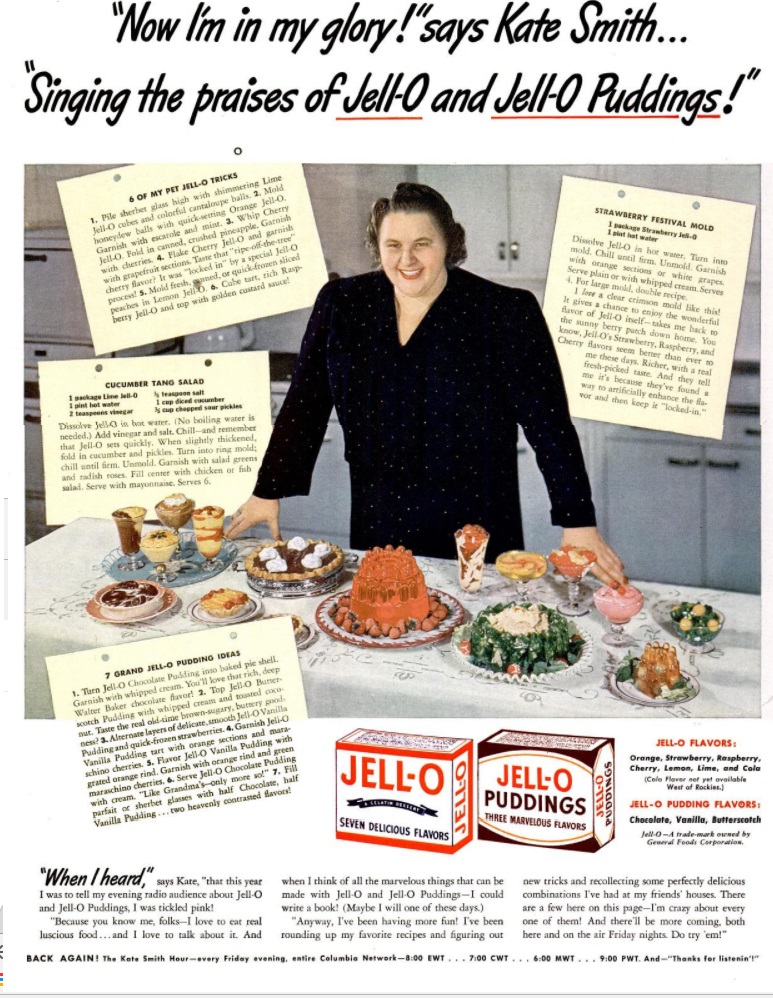
Sugar rationing took effect in the United States in May 1942, and the next month, CBS radio personality Kate Smith stepped up to the plate in the June issue of Radio Mirror with recipes with which the housewife could conserve the commodity, but still prepare deserts.

Smith knew that her readers would accept rationing for what it was–“an emergency method of making quite sure that everyone gets all the sugar he needs and that no one gets more than he really needs.” She also knew that her readers wanted to make sure that they didn’t use their portion wastefully.

Therefore, she presented these recipes showing how delicious deserts could be prepared with other sweetening agents such as corn syrup, prepared pudding mixtures (which used dextrose), molasses, and honey.

Her sugarless layer cake used corn syrup, and the molasses cake used molasses along with a bit of brown sugar. She suggested that an easy and delicious filling for either cake could be made with a package of chocolate pudding mix and milk, following the package directions, but with a bit less milk. Instead of frosting, the cake could be covered with nut meats, currants, or raisins, or a light dusting of confectioner’s sugar could be used.

She also included a chocolate souffle recipe using a packaged pudding mix, and baked stuffed oranges using corn syrup or honey.

For glazing a ham, she included a recipe with a corn syrup glaze.


Mirrorphone, 1942

1942JuneNationalRadioNews

Shown here on the cover of National Radio News, June-July 1942, is the Mirrorphone from Western Electric. The magazine noted that the magnetic tape recording device was being used by radio announcers, actors, and in speech classes as an aid to speech improvement.

It recorded the subject’s voice onto a steel tape, which was presumably in n endless loop. A switch provided for immediate playback, allowing the speaker to detect and correct errors of pronunciation, emphasis, or tone.

The recorder automatically erased previous recordings.

The magazine noted that the device was in use by a number of radio stations, dramatic groups, and speech classes to train thousands of new telephone operators and secretaries in government agencies and war industries.

More information about the Mirrorphone, along with photos, can be found at this link.