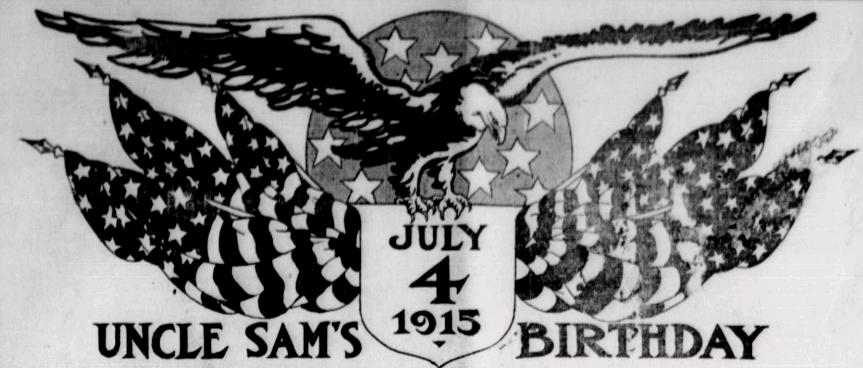
The illustration shown here appeared in the Columbus Commercial a hundred years ago today.
Click Here For Today’s Ripley’s Believe It Or Not Cartoon 

The illustration shown here appeared in the Columbus Commercial a hundred years ago today.
Click Here For Today’s Ripley’s Believe It Or Not Cartoon
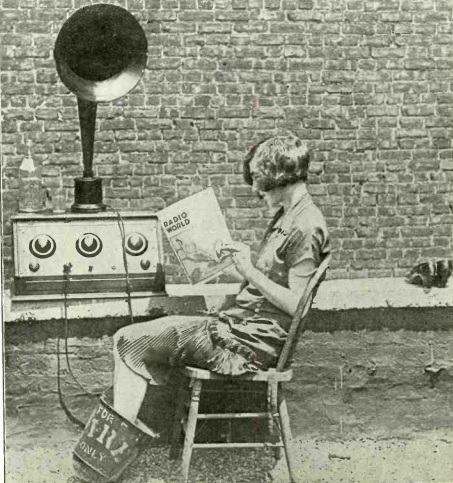
Ninety years ago, Hortense Unger took the radio up to the roof to escape the heat. She’s shown here consulting the latest issue of Radio World for the most refreshing program. This picture appeared in that magazine’s June 27, 1925 issue.
Click Here For Today’s Ripley’s Believe It Or Not Cartoon
 For those of you who have been clamoring for official OneTubeRadio.com merchandise, it’s now available! Follow this link to order your coffee mugs, T-shirts, and more!
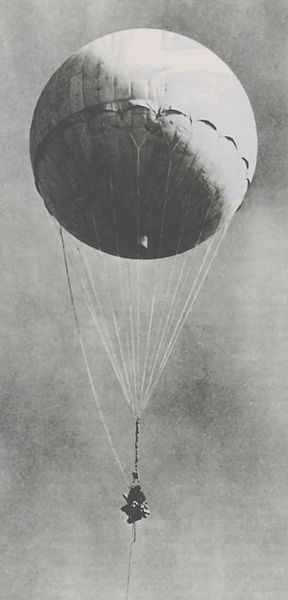
US Army photo, via Wikipedia.
In part 1 of this series, we looked at the ingenious technical details of the Japanese Fu-Go fire balloons of the Second World War. Part 2 remembered the only victims of these attacks, a pastor’s wife and five children who were killed in Oregon in 1945. While most of the balloons that made it to North America made it to the Western U.S., some of them made it far inland, although no damage appears to have been caused by the balloons making it further east. Today, we look at some of those remarkable distance flights.
For example, two of the balloons appear to have made it as far as Nebraska.
The night of April 18, 1945, there was an explosion in the sky over 50th and Underwood, in the Dundee neighborhood of Omaha. It flared brightly, but caused no damage. The spot is commemorated by a plaque inscribed “Dundee Bombed in World War II.”
The other “attack” on Nebraska involved a single piece of paper from one of the balloons that was located near Schuyler, Nebraska, on February 2, 1945. After the news embargo was lifted, the Colfax County Press reported this incident on May 27:
For some time Japan has been sending out balloons with high explosives over the western part of the United States, but all publicity was held down by the government and the FBI. These balloons drifted as far as Nebraska. They are about 32 feet in diameter and usually carry incendiary bombs or even gas bombs. One of these balloons landed on the Ludwig Vrba farm 9 miles southwest of Clarkson. The discovery of the balloon was kept secret while several FBI investigators were here and no publicity could be given at that time. Now the curtains of secrecy on these balloons was raised. The Press had known about the landing of the Jap balloon on the Vrba farm but said nothing about it, while we had been working on the case with the federal war authorities. Remnants of the balloon landed on the Vrba farm yard near the buildings but caused no damage as the greater portion of it as well as the mechanism carrying the high explosives had been destroyed before it had a chance to land. Report of any similar occurrences in this community will be greatly appreciated by us.
The piece of balloon found in Schuyler was very likely part of a balloon which made it as far as Iowa. According to a Navy report, the fragment found in Schuyler was a charred triangular piece of paper measuring about two yards by one yard. On the same day, more wreckage was found in Laurens, Iowa. No damage was reported, however, in the Hawkeye state.
None of the balloons made it to Minnesota, but according to the Navy report, five balloons made it to the neighboring Canadian province of Manitoba.
The furthest traveled of the balloons could very well have traveled over Minnesota on its way to Michigan, where two were confirmed to have landed. One started a small fire in Farmington Hills in March 1945, but witnesses did not associate the fire with one of the balloons until the press embargo was lifted in May. Upon reading of the balloons in the newspaper, one of the witnesses investigated and found the remnants of one the balloon that had started the fire.
The other confirmed Michigan balloon was found on February 23, 1945, near Grand Rapids. Three young boys. Larry Bailey, and Ken and Robert Fein, were playing on a farm field when they saw something strange floating in the sky. They started dragging the trophy home after it landed when a neighbor drove by with a truck and offered to help them haul it home. They were planning what to do with the treasure trove when, unfortunately for the boys, the sheriff was called, and the balloon was confiscated by the FBI and ultimately taken by the Navy.
The Grand Rapids balloon was to make one more flight after the war was over, and we’ll learn about it in part 4 of this series. Click here to go to part 4.
References
Read More at Amazon
We will be at the Arrowhead Amateur Radio Club Hamfest in Superior, Wisconsin, this Saturday, May 2. If you’re in the area, stop by and say hello! I’ll have copies of my books available: My study guides for the Technician and General class amateur licenses, the MROP

Interestingly, the Hamfest is located less than a mile from the transmitter site of W9XJL, Duluth-Superior’s 1930’s shortwave broadcast station.
Today is the 70th anniversary of Elbe Day, April 25, 1945. On that day, U.S. Army Lt. Albert Kotzebue and three other men in his reconnaissance platoon crossed the Riber Elbe. There, they met forward elements of the Red Army under the command of Lt. Col. Alexander Gardiev. The arranged photo shown above was taken shortly thereafter, and shows Lt. William Robertson of the U.S. Army and Lt. Alexander Silvashko of the Red Army.
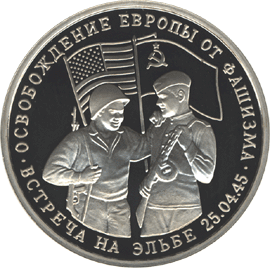
Russian commemorative coin, 1995. Wikipedia, Photo by Банк России. Original uploader was Permjak at ru.wikipedia.
Click Here For Today’s Ripley’s Believe It Or Not Cartoon
OneTubeRadio.com is running its first ever contest. The winner will receive a copy of the book U-Boats Against Canada: German Submarines in Canadian Waters

During World War II, German subs operated in Canadian waters, as far up the St. Lawrence River as 172 miles from Quebec City. They sank ships, laid mines, and even set up a secret weather station in Labrador. My earlier post about that weather station was based largely upon this book. The book is very well written. It reads like a novel, but is extremely well researched with extensive footnotes.
The book is out of print, but you will receive a used copy (a former library book from Wheaton, Illinois) in excellent condition. To enter, simply follow these two steps:
The contest ends at 11:59 PM Central Time on April 25, 2015.
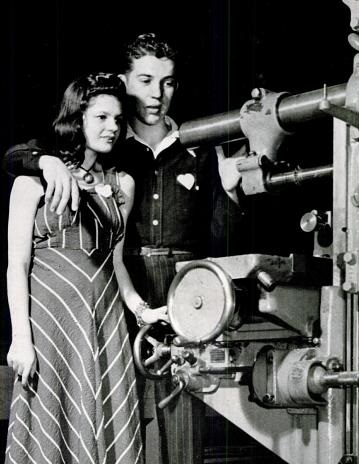 Seventy-five years ago today, Life Magazine, April 15, 1940, shows this young man and woman admiring this electric lathe at a National Youth Administration machine shop. Between 1930 and 1940, the number of American youth increased from 22,000,000 to 25,000,000. The NYA was a New Deal program designed to help find a place for those extra three million kids, sparing them of the demoralizing prospect of being out of school and out of work.
The young Romeo here is showing off the machine shop to his awestruck date during an NYA party.
Click Here For Today’s Ripley’s Believe It Or NotCartoon
Was it a morning like this?
On this Good Friday, we present Via Dolorosa:


