Category Archives: Uncategorized

1915 Toy Electric Range


1915ToyRange

Kenner came out with the Easy-Bake Oven in 1963, and millions have been sold over the years.  Even if it was powered by a humble light bulb (not included), it was capable of baking (and, of course, melting crayons).  And I think most boys would agree with me that of all the girl toys produced, it was probably the most interesting.

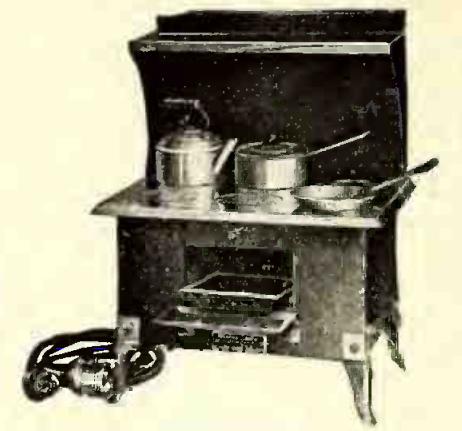
But it wasn’t a new idea, as shown by this toy electric range from a hundred years ago, as shown in the November 1915 issue of Electrical Experimenter.  As with many things, it looks like the original was even better than the watered-down later version.  This one doesn’t appear to have used a light bulb.  Instead, it appears to contain an honest-to-goodness heating element, probably capable of inflicting actual burns.

This toy range, measuring 15 inches in height, contains not only an oven (at 4-1/2 by 5 inches, slightly larger than the Easy-Bake), but also a stove top.

“On top of the range a kettle can be placed, or food can be cooked in tiny utensils that come with the range.” The range included a long cord that could go into any handy socket, and the cord even contained a switch for regulating the amount of heat.

“Little girls fortunate enough to get a toy electric range for Christmas will find ‘playing house’ a more fascinating pastime than they have ever before enjoyed.” And as with the Easy-Bake half a century later, I bet their brothers were jealous.

Click Here For Today’s Ripley’s Believe It Or Not Cartoon


Tacoma Narrows Bridge, 1940

For four months in 1940, the Tacoma Narrows Bridge was the third longest suspension bridge in the world. That distinction came to an end 75 years ago today, November 7, 1940, when the bridge, between Tacoma and the Kitsap Peninsula, Washington, came spectacularly crashing down into Puget Sound. As soon as the deck had been built in 1938, construction workers dubbed the bridge “Galloping Gertie,” due to its propensity to move vertically during windy conditions.

On the morning of November 7, the 40 MPH winds proved too much for the structure. No human life was lost in the collapse of the bridge. The last person to drive on the bridge was Leonard Coatsworth, who was forced to flee the bridge on foot. Unfortunately, his terrified cocker spaniel, was afraid to leave the vehicle, and was left behind. An engineering professor and news photographer attempted to rescue the dog during a lull, but the dog refused to leave the vehicle and bit one of the rescuers. When the bridge finally collapsed at 11:00 AM, Tubby disappeared into Puget Sound, and his body has never been recovered.

Since the bridge took some time to collapse, there was plenty of time for newsreel photographers to arrive on the scene to document the disaster.  The film is often shown to engineering students.

I first saw this film when my seventh grade drafting teacher showed it in class, apparently in an attempt to impress upon us that if you build something, you ought to build it right.  Of course, the main thing we wondered is why the guy was walking on the bridge.  Of course, he was returning from his vain attempt to rescue Tubby.

Click Here For Today’s Ripley’s Believe It Or Not Cartoon



1955 8-Transistor Portable from Popular Science

1955PSportable

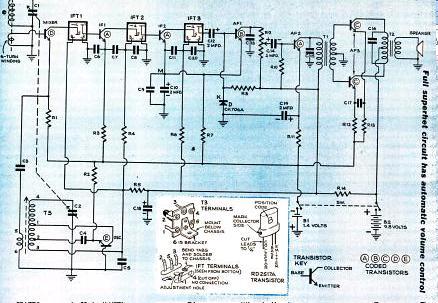
Sixty years ago, a transistor portable radio was still a rather expensive luxury.  The first such set to be marketed, the Regency TR-1 had a retail price of $49.95.  (Remember that this was when the money was still made out of silver, so it would roughly translate to the value of fifty silver dollars today).

For the hobbyist wanting to try his own hand, it was probably possible to save some money, but it was an ambitious project.  The plans for the set shown above appeared in Popular Science in September, 1955.  The article described the construction of an 8-transistor superhet using eight RD 2517A NPN transistors.  It recommends the use of a matched set, which was available for $20.

To put the circuit in terms that the readers would understand, the author noted that it was essentially the same as a receiver employing eight triode tubes, but with vastly reduced power needs. The power was supplied by a 21-volt alkaline battery consisting of 15 cells. The set actually required two batteries of 9.8 and 1.4 volts. The author described how to do surgery on the battery to get the two values. An alternative was to use AA penlite cells, with a slightly larger case.

In addition to the electronic assembly, the set required a fair amount of metal work. The article shows how to cut and bend the chassis, and describes how to make the cutouts for the IF transformers. The cabinet was made of cigar box wood.

1955PSportableschematic

The schematic reveals a circuit as good as the Regency or similar high-end transistor portable, and I have no doubt that it was a good performer. The author reports that the set performed well in the lower level of Grand Central Station, and as his train passed through the suburbs, reception was still good even 25 miles from the transmitters, and even on lower powered stations.

Click Here For Today’s Ripley’s Believe It Or Not Cartoon



1915 CO2 Scrubber Technology

1915RebreatherTest

A hundred years ago this month, Popular Mechanics, September 1915,
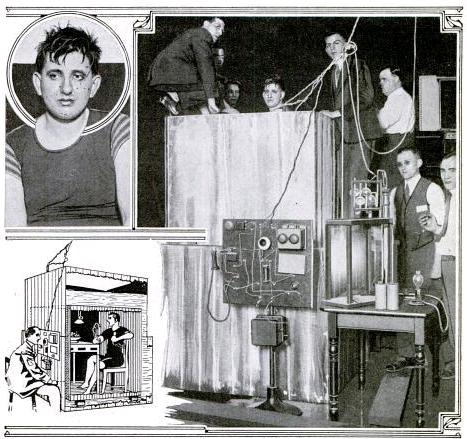
covered the experiment shown here, testing a system for purifying air aboard submarines. The inventor is shown in the upper left, but his name is not given. Under supervision of American and Russian naval experts, the inventor was sealed into a small box, which was then submerged into a larger tank. The tank reportedly contained only a 30 minute supply of air, but the test lasted seven hours, after which the tank was drained and the box opened, the inventor suffering no ill effects.

In addition to food, reading material, and a bench and table, the inventor entered the experiment with an unnamed chemical. He periodically tested the air, and if he discovered the carbon dioxide level was too high or the oxygen level too low, he released a supply of the chemical. The unnamed chemical reportedly absorbed the excess carbon dioxide instantly and released oxygen.

It’s likely that the chemical was Oxylithe, which had been invented in 1907 by Swiss Professor Georges Jaubert. Like the unnamed chemical in the Popular Mechanics experiment, Oxylithe absorbs carbon dioxide and emits oxygen. It was first used by the Royal Navy in 1909 as part of an escape apparatus, but was never used in submarines. Oxylithe was a form of sodium peroxide (Na2O2) or sodium superoxide (NaO2). Similar designs were used through World War 2 in rebreathers.

As shown in the illustrations, the chamber used in the 1915 test contained an electric light and fan, as well as a telephone for communicating. In addition, it was equipped with a glass roof through which the subject could be observed throughout the experiment.

Click Here For Today’s Ripley’s Believe It Or Not Cartoon


1915 Car Powered Ferry

1915CarFerry

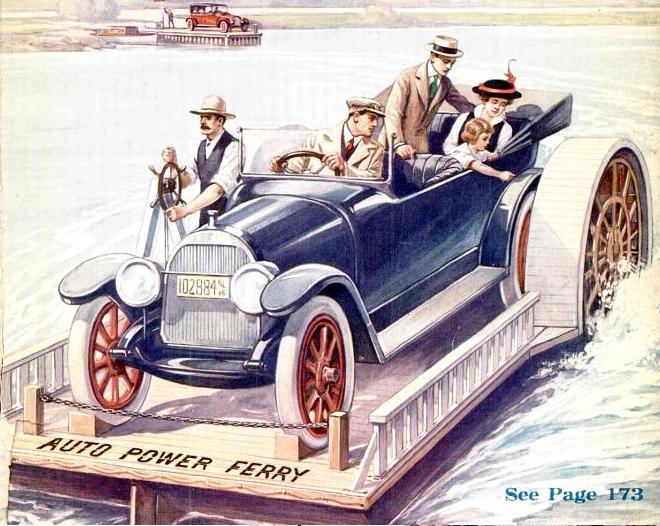
The prototype car barge shown here was reportedly built for less than $100 and in use by a motorist in Aberdeen, Washington, to cross a bay 20 miles wide. It is shown on the cover of Popular Mechanics a hundred years ago this month, August 1915.

Each paddle wheel is connected to a hardwood wheel, which is strapped with leather straps to the spokes of the car’s wheels. The rear of the car is jacked up off the floor, and the craft is ready to cross the bay. It reportedly took about eight minutes to load the car aboard and make it seaworthy.

Click Here For Today’s Ripley’s Believe It Or Not Cartoon


Fire at Barnum’s American Museum, 1865


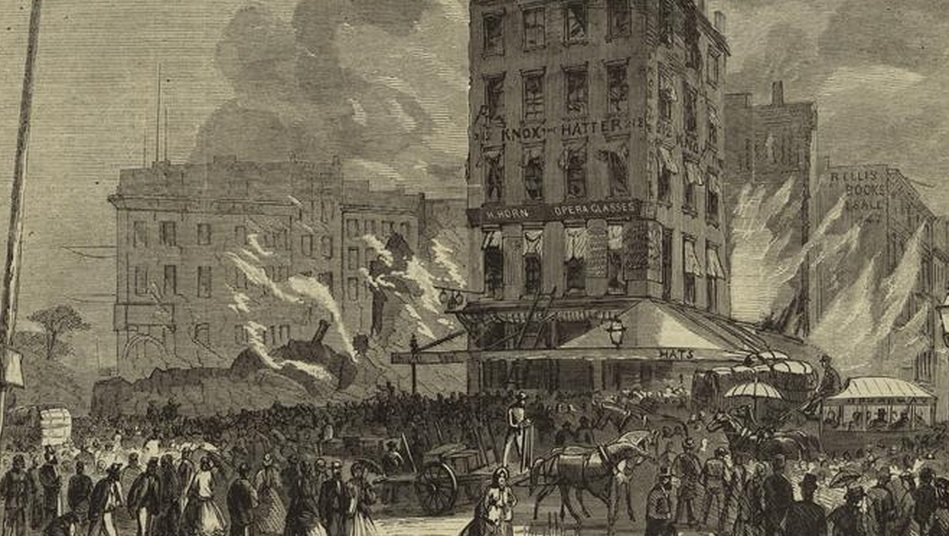
On this day 150 years ago, July 13, 1865, Barnum’s American Museum burned to the ground.  Located at Broadway and Ann Street in Lower Manhattan,

The museum had been owned by showman P.T. Barnum since 1841 and featured wholesome family entertainment, including a zoo, museum, lecture hall, theater, and freak show. Most of the animals, including the beluga whales in a second-floor tank, perished in the fire, but a few survived. The popular Ned the learned seal, was among the survivors, as was a bear that was lowered to safety by a fireman and rope.

The museum was open as much as fifteen hours a day, six days a week, and drew up to 15,000 visitors a day to pay the 25 cent admission fee.

The fire was among the most spectacular in New York history. A virtual museum supported by the National Endowment for the Humanities, recreates many of the spectacles of Barnum’s original version.

Read More at Amazon

Click Here For Today’s Ripley’s Believe It Or Not Cartoon


1925 Radio Up On the Roof

1925RadioWorld

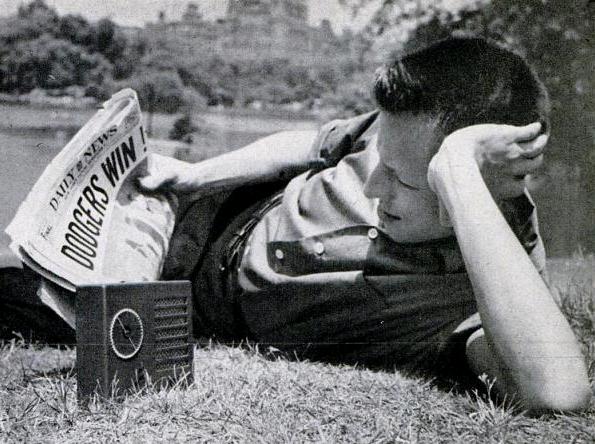
Ninety years ago, Hortense Unger took the radio up to the roof to escape the heat. She’s shown here consulting the latest issue of Radio World for the most refreshing program. This picture appeared in that magazine’s June 27, 1925 issue.

Click Here For Today’s Ripley’s Believe It Or Not Cartoon


CoffeeCupFor those of you who have been clamoring for official OneTubeRadio.com merchandise, it’s now available!  Follow this link to order your coffee mugs, T-shirts, and more!

Japanese Fu-Go Fire Balloons of WW2: Part 3

US Army photo, via Wikipedia.

US Army photo, via Wikipedia.

In part 1 of this series, we looked at the ingenious technical details of the Japanese Fu-Go fire balloons of the Second World War.  Part 2 remembered the only victims of these attacks, a pastor’s wife and five children who were killed in Oregon in 1945.    While most of the balloons that made it to North America made it to the Western U.S., some of them made it far inland, although no damage appears to have been caused by the balloons making it further east.  Today, we look at some of those remarkable distance flights.

For example, two of the balloons appear to have made it as far as Nebraska.

The night of April 18, 1945, there was an explosion in the sky over 50th and Underwood, in the Dundee neighborhood of Omaha. It flared brightly, but caused no damage. The spot is commemorated by a plaque inscribed “Dundee Bombed in World War II.”

The other “attack” on Nebraska involved a single piece of paper from one of the balloons that was located near Schuyler, Nebraska, on February 2, 1945. After the news embargo was lifted, the Colfax County Press reported this incident on May 27:

For some time Japan has been sending out balloons with high explosives over the western part of the United States, but all publicity was held down by the government and the FBI. These balloons drifted as far as Nebraska. They are about 32 feet in diameter and usually carry incendiary bombs or even gas bombs. One of these balloons landed on the Ludwig Vrba farm 9 miles southwest of Clarkson. The discovery of the balloon was kept secret while several FBI investigators were here and no publicity could be given at that time. Now the curtains of secrecy on these balloons was raised. The Press had known about the landing of the Jap balloon on the Vrba farm but said nothing about it, while we had been working on the case with the federal war authorities. Remnants of the balloon landed on the Vrba farm yard near the buildings but caused no damage as the greater portion of it as well as the mechanism carrying the high explosives had been destroyed before it had a chance to land. Report of any similar occurrences in this community will be greatly appreciated by us.

The piece of balloon found in Schuyler was very likely part of a balloon which made it as far as Iowa.  According to a Navy report, the fragment found in Schuyler was a charred triangular piece of paper measuring about two yards by one yard. On the same day, more wreckage was found in Laurens, Iowa. No damage was reported, however, in the Hawkeye state.

None of the balloons made it to Minnesota, but according to the Navy report, five balloons made it to the neighboring Canadian province of Manitoba.

The furthest traveled of the balloons could very well have traveled over Minnesota on its way to Michigan, where two were confirmed to have landed.  One started a small fire in Farmington Hills in March 1945, but witnesses did not associate the fire with one of the balloons until the press embargo was lifted in May.  Upon reading of the balloons in the newspaper, one of the witnesses investigated and found the remnants of one the balloon that had started the fire.

The other confirmed Michigan balloon was found on February 23, 1945, near Grand Rapids.  Three young boys. Larry Bailey, and Ken and Robert Fein, were playing on a farm field when they saw something strange floating in the sky.  They started dragging the trophy home after it landed when a neighbor drove by with a truck and offered to help them haul it home.  They were planning what to do with the treasure trove when, unfortunately for the boys, the sheriff was called, and the balloon was confiscated by the FBI and ultimately taken by the Navy.

The Grand Rapids balloon was to make one more flight after the war was over, and we’ll learn about it in part 4 of this series.  Click here to go to part 4.

References

Read More at Amazon