Admittedly it’s unlikely that you’ll need the information, but we occasionally provide useful advice to keep in mind in case you’re ever inadvertently subjected to time travel. If you get caught in a time warp, the experience will be much less unpleasant if you do some minimal preparation.
For example, if you get sent back to the past, your situation would be much improved if you could “invent” some modern technology. Columbus could use some better navigational tools to determine that he had not, in fact, reached India. Louis XVI would have been more likely to keep his head with a telegraph to better manage the affairs of his kingdom. Just about wherever and whenever you arrive, you’ll have similar opportunities involving people who would be willing to pay handsomely for bits of technology that you can invent.

 We’ve previously written about the importance of having a WikiReader, which holds the contents of the English Wikipedia in a handheld device. And we’ve written about how to make the most difficult component of a radio receiver, the earphone, from scratch.
We’re confident that most of our readers will do well if they’re ever whisked back into time.
How to Figure Out the Date

 In many situations, you’ll be able to determine the date easily. If you’re in an urban area in the past few centuries, you can simply peek at a newspaper. You can even ask people on the street what year it is. They might give you a funny look, but if more than one person gives you the same answer, it’s a safe bet that they’re telling the truth. If they’re not clear on the concept of the A.D. scale, then you can determine things such as the name of the king, and use your WikiReader to figure out the year.
But in some cases, this information might not be quite so convenient. Fortunately, the night sky provides a convenient clock, and with a bit of number crunching, you should be able to figure out the date.
Determining the Day of the Year

 The first step is to determine the day of the year, and this is quite easy. You simply observe the local sunrise and sunset times. The sunrise and sunset times will be the same from year to year, so you can use a reference for any year. Just note the time of sunrise and sunset, and see which day they correspond with. You’ll probably come up with two possible dates, so you might need to check again to see whether the days are getting longer or shorter. In the Northern Hemisphere, if the days are getting longer, then the date is after December 21 but before June 21. If the days are getting shorter, then it’s after June 21 but before December 21. The best source of sunrise and sunset times is probably the Old Farmer’s Almanac, although this information should be available in many places. You can probably find it somewhere on your WikiReader. Remember, the year of your source is unimportant, since the data will be about the same from year to year.
Determining the Year
Now that you know the month and day, you can move to the next step, namely, figuring out what year it is. For this, you can use the planets. The planets Mercury, Venus, Mars, Jupiter, and Saturn are all visible to the naked eye. On any given date, each one of them is supposed to be in a particular spot in the sky, in one of the twelve constellations of the zodiac. You start by finding these planets and noting what constellation they are in.
At this point, you can go to a website such as Your Sky, start punching in the various possible dates, and see which one corresponds to the observed data. When you get a match, you know the exact date, at least within a few days. For example, currently (1 August 2018), Mercury is in Cancer, Venus is halfway between Leo and Virgo, Mars is right between Capricorn and Sagittarius, Jupiter is in Libra, and Saturn is between Scorpio and Sagittarius.
So if I knew it was August 1, I would simply use that date, and repeat the process with different years until I found that the planets matched up with what I was seeing in the sky. In this case, as soon as I plugged in 2018, I would see that it matched, and know that I guessed the year correctly.
How To Do This Without the Internet

 Of course, I’m sure that by now you’ve spotted a big flaw in this strategy. If you have the internet available, then you can just ask the internet what date it is. But that website, and others like it, merely employ a relatively simple computer program. You can find all of the information you need to calculate the same positions by using a book such as Practical Astronomy With Your Calculator or Spreadsheet. It will contain all of the information you need to do the calculations, either with a calculator or computer, or if all else fails, with pencil and paper. You can buy the book now, before the time warp.
On the other hand, you’re probably thinking that the likelihood of needing such a book is quite small. If you don’t get stuck in a time warp, then it’s money wasted, and I would have a hard time arguing with you. In fact, if you get sent back along with a public library, you’ll probably be able to find a similar book there.
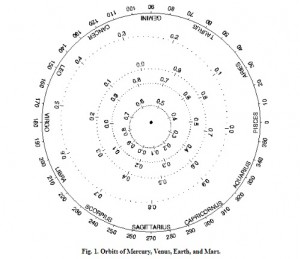
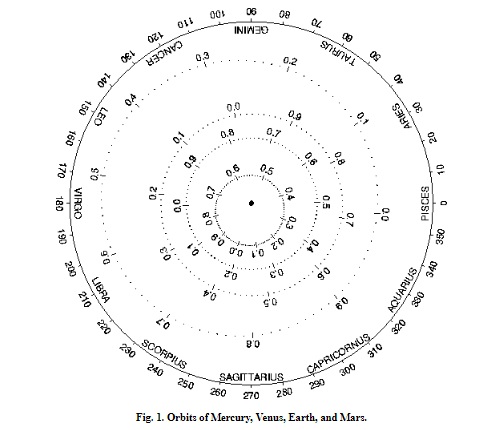
You’ll want to use the full size version of this chart, which is available, along with complete instructions, at this link.
But there’s still a minimal level of preparation with practically zero cost! I found this homework assignment from a college astronomy course. If you print this out before getting sent back in time, it actually includes all the information you will need to calculate the positions of the five visible planets! It uses a graphical method: Right there on the worksheet it gives the position of the planets as of a certain date. You simply calculate how many times each planet will need to go around to reach that date. After you do the division, the remainder is the portion of one orbit the planet is away from that spot. You plot the position of both that planet and the Earth on the provided graph, and you can then see where in the sky the planet is located on a given date.
This method is not as precise as the computer programs, but those computer programs are designed to show you exactly where to point your telescope. You don’t need that level of precision. By graphing the general location of several planets, you will be able to confirm what year it is.
You should download (or better yet, print) that worksheet now, before the time warp.
Checking Your Work
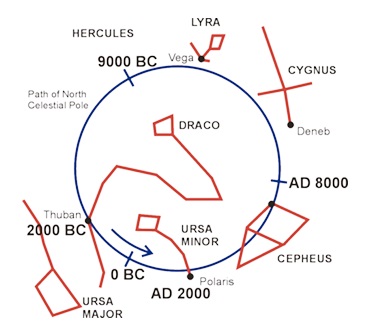 To confirm that you’ve picked the correct year, you might want to use another method. It’s possible, for example, that all of the planets were in the same position in the sky on today’s date millions of years ago. The best way to check your work is to use the precession of the equinoxes. Simply put, the star Polaris is currently located at the North Celestial Pole. In other words, all of the stars in the sky seem to revolve around this point. But the celestial pole moves over time, following a 26,000 year cycle. You’ll want to print the handy chart shown here. Match up the pole star with the chart, and you’ll know where you are in the cycle. For example, if you discover that Vega is the pole star, that means the year is approximately 11,000 BC (or maybe 12,000 AD).

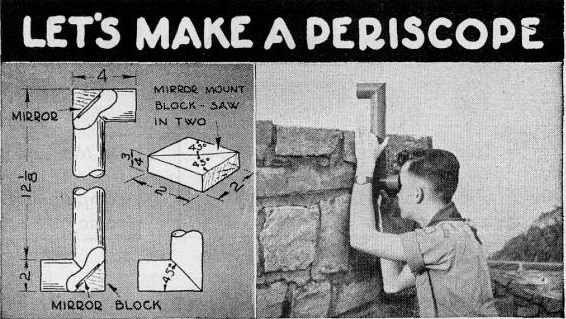 For anyone desiring to see around corners, the periscope is the ideal solution to the problem. 70 years ago this month, the October 1948 issue of Boys’ Life showed how to make this simple but effective model.


 We recently featured a 1958

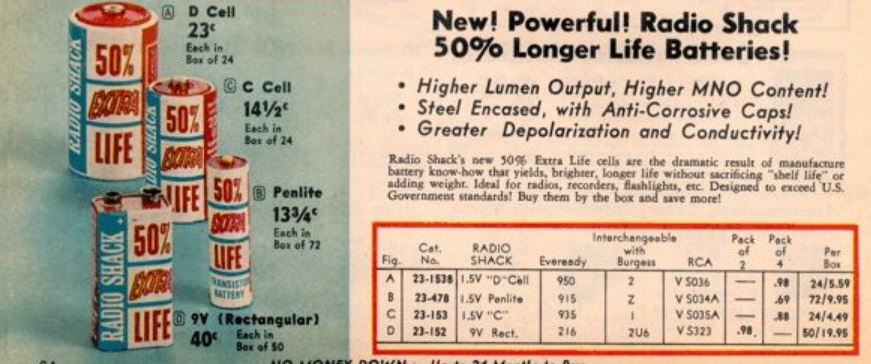
 To use your new power supply to listen to the radio, you could add the

 You’ll need a
 If you would prefer to have someone else do the construction work, the solar oven shown at left is you can find

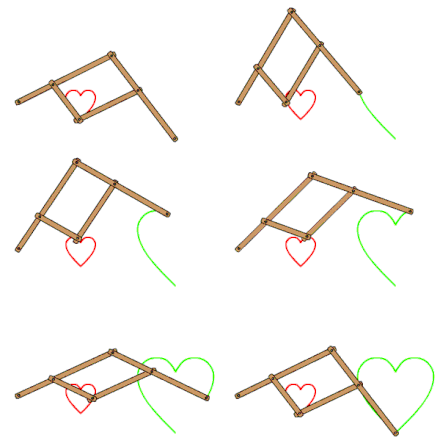

 As far as I know, the Pyro Pantagraph is no longer available, but inexpensive





 The flame can come from a variety of sources. The higher the temperature the better, but the author was able to produce sound with as little as a single candle. Various types of torches, or even a