Category Archives: Radio history

Mme. Tetrazzini Sings to the Fleet: 1920

1920Dec12NYTribShown here a hundred years ago today, in the December 12, 1920, edition of the New York Tribune, is Italian Soprano Mme. Luisa Tetrazzini.

According to the newspaper, she is warbling from her New York apartment to every battleship in New York Harbor, courtesy of the wonderfully ingenious radio telephone.

Mme. Tetrazzini died in 1940.  The dish tetrazzini  is named after her.


Transatlantic Signals Heard in 1920?

1920DecRadioNews1

Today marks the 99th anniversary of the ARRL Transatlantic Tests.  On that date, the signal from 1BCG in Greenwich, Connecticut, was heard in Androssan, Scotland, the first successful Transatlantic transmission on shortwave frequencies.

But a hundred years ago this month, the December 1920 issue of Radio News reported the Transatlantic reception of the signals of 2QR, the station of brothers Hugh and Harold H. Robinson of 13 Walnut Street, Keyport, NJ.

The signals were allegedly heard in Scotland by amateurs George Benzie and James Miller, who reported hearing voice, phonograph records, and the 2QR call sign. The letter received from Scotland is shown in the magazine. The magazine did report that “even today there is considerable doubt entertained by many leading amateurs as to whether or not it was done.” When the issue went to press, the American amateurs had written to Scotland seeking more details, such as the exact time of the transmission and the records heard.

It turns out that the signals had not been received. In January 1922, QST carried the results of an investigation carried out by a committee of the Radio Club of America, headed up by Edwin Armstrong (one of the principals of the successful 1921 test), who concluded that the signals were not heard in Scotland. Apparently, the follow up from Scotland reported reception at a time when 2QR had not been on the air.

The RCA report did conclude that the Robinsons had acted in good faith. It was silent as to whether the committee believed that Benzie and Miller had, indeed, heard something.


1940 Antenna Mast

1940DecPM2When antenna adjustments were necessary, this 1940 family was able to effect them quickly, thanks to this “well-sweep” antenna mast, constructed with 18 foot lumber. The support consisted of two 4×4’s four feet part, set in cement. The mast itself is hinged at the midpoint and counterbalanced for ease of raising and lowering.

Here, while Little Sister supervises, Junior tends to the antenna wire while Father makes the required adjustments. When he’s done, he’ll hoist it up to its 31 foot height, pin it in place, and go inside to pull in the distant stations. These plans appeared in the December 1940 issue of Popular Mechanics.


1970 One Tube VLF Receiver

1970DecSciElec2Fifty years ago this month, the December 1970 issue of Science and Electronics showed how to make this one tube VLF receiver with a tuning range of 13-28 kHz. The set used a 6U8A dual triode-pentode, with half serving as regenerative detector and the other half AF amplifier.

The tuned circuit used two fixed capacitors in parallel, with one switched in or out to adjust the tuning range. Tuning was accomplished with a variable inductor, originally intended as a TV horizontal oscillator coil.

The author reported that from his Michigan location, he had excellent reception, day and night, of NAA in Maine, NSS in Maryland, and NPG on the west coast. He reported that he copied CW signals consisting of five-letter code groups, as well as plain language press reports, all intended for nuclear subs around the world.

I don’t believe there is normally any CW on the air on these frequencies, although stations such as NAA are still there, sending FSK transmissions which could be heard, but not decoded. One signal that could be decoded, definitely in Europe, or perhaps in North America, is the annual test transmission from SAQ in Grimeton, Sweden, which sends a CW message on Alexanderson Day, each year in June or July.

The author of this project is a familiar one, Hartland Smith, W8VVD, now licensed as W8QX.  We previously highlighted his projects such as a steam powered CW transmitter, a 65 watt transmitter, and a shortwave preamplifier.  Remarkably, in 1958, he received Transatlantic TV signals with a modified U.S. television set.

1970DecSciElec3


Testing CRT: 1945

1945DecRadioNews
This employee of the National Union Tube Company of Landsdale, PA, is performing a laboratory test on a 10AP4 cathode-ray tube that had just rolled off the assembly line. She is measuring the engineering performance of the tube under actual load and operating conditions.

The picture appeared 75 years ago this month on the cover of the December 1945 issue of Radio News.


Pearl Harbor

imgHandler

USS Shaw at Pearl Harbor. Defense Department Photo.

Today marks the 79th anniversary of the Japanese attack on Pearl Harbor, December 7, 1941. Here are links to some of our earlier posts marking that event:


Selling Recorders in 1940

1940DecRadioRetailing3Shown here transporting a set are Cleveland radio dealer Louis Schwab and Rev. W.P. Schmidt of the Parma Evangelical Lutheran Church, 2625 Oak Park Ave., in suburban Cleveland. The photo is from an article in the December 1940 issue of Radio Retailing, which details Schwab’s success with selling recording phonographs. The article noted that less than 5% of the phonographs sold included recording, but with salesmanship of the type employed by Schwab, this number could be increased. The magazine noted that once the set was sold, sales of blank records were almost sure to follow. One family with musically inclined offspring bought two packages of records a week. And another customer did “recording parties,” at which he would go through at least three dozen disks.

The sale depicted in the photograph resulted from the fact that the church organist was going to have a baby. Rather than pay a substitute during her maternity leave, the church sprang for the radio-recorder shown here. The organist pre-recorded the hymns to be played during her absence, and the machine took over the musician’s duties. The set was used at other church gatherings to listen to broadcasts and recorded music.

The church shown here appears to be the predecessor of Parma Lutheran Church, which is now located about a mile away from its 1940 location.


1920 French Crystal Set

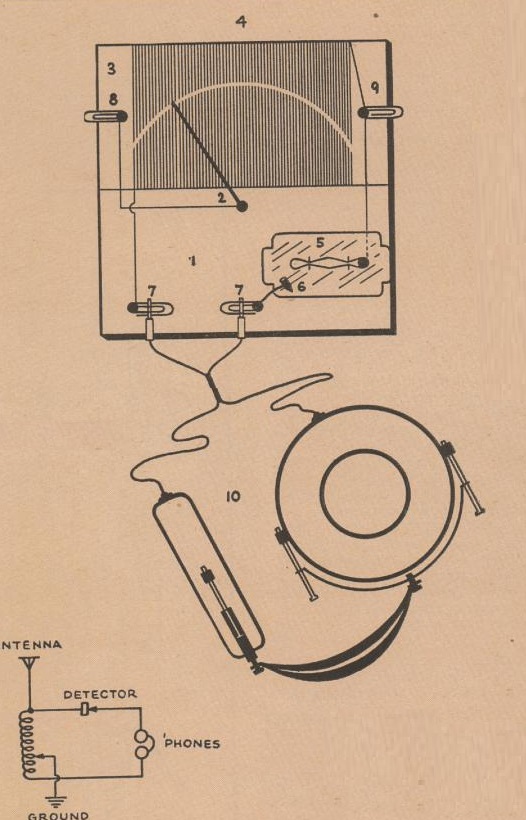
1920DecRadioNewsA hundred years ago this month, the December 1920 issue of Radio News showed this French receiver designed for receiving time signals from the Eiffel Tower. If it looks familiar, it’s because we featured it before.  The same receiver appeared in Popular Mechanics in 1914, so it had been on the market for at least six years before showing up on the cover of Radio News, which gave more details of the set and of the time signals sent from the Eiffel Tower.

In the magazine, we learn that the receiver is known as the Ondaphone, and consists of a galena detector mounted on the back of the telephone receiver. One wire is connected to a convenient ground, such as a radiator, and the other wire is connected to an antenna. In the picture here, a light fixture is used for the antenna. In a rural area, the article suggests that even an umbrella might form a suitable antenna.

Despite any inductor, the set was said to work well throughout Paris, and even in outlying areas.


Marketing Personal Portables: 1940

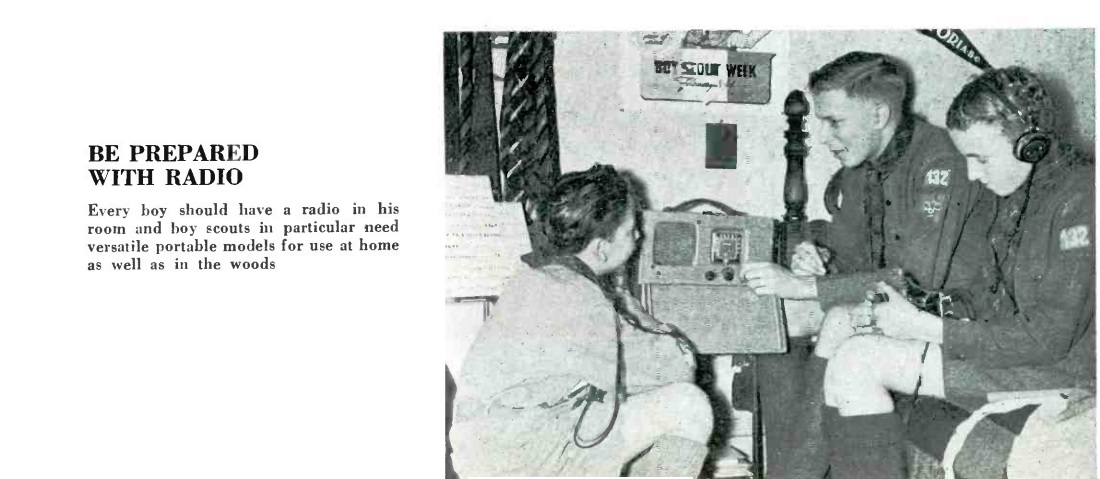
1940DecRadioRetailingEighty years ago this month, according to the December 1940 issue of Radio Retailing, everybody, including Santa Claus, stopped, looked, and listened to the new personal portables that had been hitting the market. When America entered the war, sourcing the required batteries would become an iffy proposition, but in the meantime, the sets were popular.

It’s quite possible that Santa got the idea from having lunch in downtown Denver. According to the magazine, the radio buyer of the Denver Dry Goods Company harnessed the power of “women paid to gossip” to sell the sets. You could put one on layaway for a dollar down and a dollar a week. Then, to drum up excitement, “certain shopgirls were loaned instruments, subsidized to play and talk about them during lunch in the smartest restaurants in town.”

The young women shown below are on their lunch break from their duties at the store at one of the aforementioned smart restaurants. For each sale they referred, they earned a one dollar commission.

1940DecRadioRetailing2

According to the article, twenty radios were sold the first day, and “in this case, it paid to pay women to gossip.”


1940 Two Tube Radio-Phono

1940DecPM1Eighty years ago, Junior was hard at work putting together this inexpensive two-tube receiver, while Dad unobtrusively keeps an eye on the progress. He is holding the construction article (complete with his own picture) as it appeared in the December 1940 issue of Popular Mechanics.

When complete, the set would provide about a watt of loudspeaker volume and pull in the local stations. In addition, it had a phono input for connection to a record player, which could be had for about $6. To accomplish this easily, the set was equipped with two volume controls. When you wanted to listen to records, you simply turned down the radio and turned up the control hooked to the record player.

The tube lineup was 25B8GT serving as RF amplifier and detector, with a 70L7GT as rectifier and AF output. When working as a phonograph, the detector stage of the 25B8GT was pressed into service as an audio driver. The set was said to provide volume sufficient for the average room.

1940DecPMschematic