Category Archives: Radio history

1971 Italian One Tube Reflex Radio

1971MarRadiopraticaFifty years ago, this Italian gentleman is expressing his approval at the loudspeaker volume coming from this one-tube medium wave set, described in the March 1961 issue of Radiopratica magazine.

The set used a single dual tube, an ECL86, known in America as a 6GW8. The tube was reflexed to get double duty out of the tube, allowing the use of a speaker with a relatively simple circuit. The set ran off line current, thanks to solid state rectifiers, and the detector is also a solid state diode.

1971MarRadiopratica2

1971MarRadiopratica3


1951: Building the Family Foxhole

1951MarPS1951MarPS4Seventy years ago this month, the cover of the March 1951 issue of Popular Science featured this artwork by artist Denver Gillen (who made the first drawings of Rudolph the Red Nosed Reindeer, and later, numerous covers for Outdoor Life) showing “what an A-Bomb blast may do to your home,” but with an inset of a family safely hunkered down in their family foxhole.

The cover entreats the buyer to save the issue, since it contains a special section on emergency preparedness written by Michael Amrine, formerly of the Atomic Energy Commission.

The magazine’s editors noted that much of the literature regarding civil defense was “tragic nonsense–aspirin for cancer. Even the official booklets say mainly, ‘Keep calm, keep covered, and follow directions.” But it goes on to say that official directions might not be forthcoming, since there did not exist civil defense organizations comparable with the problem. Instead, the magazine advocated “planning and plain hard work” by individual homeowners, and the magazine contained advice on how to do that. “The hard truth is that the most you can expect from civil defense will be control and rescue work after a bombing. The most effective preparation for atomic attack will be family by family, house by house.”

1951MarPS2The article first noted what not to do, and pointed out that steps such as blacking out the house, taping windows, or even buying a Geiger counter were of very minimal utility. It noted that, as in Hiroshima and Nagasaki, radiation was not going to be the big killer. Instead, it would be the familiar forces of heat and blast, and the article gave pointers on preparing a refuge room to protect against them. The author asked readers to “imagine that your house is in a cyclone or hurricane belt, and next door to a gas tank” and plan accordingly. The most important principles in planning a refuge room were making sure there were at least two exits, keeping out from under heavy furniture or appliances, and preferably being in a corner of the cellar with the least windows or exposure. The importance of using a corner is illustrated by the drawing at left.

After a spot was located, ideas such as shuttering windows and making use of a heavy table or workbench were outlined.

The article included a number of frequently asked questions, including “what should I tell the children?” The answer was simple: the truth. They should be instructed where to go in a raid and how to hit the deck. You shouldn’t scare them, but don’t make it a game, either.

1951MarPS3For homes without a basement, the author suggested placing earth or logs against an outside wall, with a sturdy table inside.

The list of recommended supplies included the usual suspects such as canned food and battery operated lights. Under the category of “valuables,” the recommendation included an extra pair of glasses and a lockbox for valuable papers. Rounding out that category was money (in small bills), on the assumption that, as in the last war, the economy would be in full operation.

The list included a wind-up clock and maps of the city and county. The battery operated radio made its usual appearance on the list. The article noted that utilities would probably be out, although some, especially the gas lines, might continue to function for a time. Since battery operated radios were still quite rare (but not unheard of) in 1951, the article noted that a car radio would also work.

The article did note that it was dealing with just the Hiroshima-style A-bomb, and not the H-bomb. It notes that the H-bomb was then still just a theoretical possibility, but that if perfected, it would wreak the same level of damage over a still larger area.

1951MarPS5


1941 “Little Giant” 5 Tube Superhet

1941MarPM1AFor many years, the March issue of Popular Mechanics featured a radio receiver dubbed the “Little Giant,” and the couples here are enjoying the last months of the prewar era by dancing to the sounds of the magazine’s 1941 rendition.

The set is a familiar “All American Five” AC-DC superheterodyne circuit, featuring a tube lineup of 12A8GT, 12K7GT, 12Q7GT, 50L6GT and 35Z4 rectifier.

The magazine noted that the set was easy to build, had unusually good tone, with full volume and distance-getting ability. The cabinet could be homemade, or purchased from a parts house.

1941MarPM1B


Using Bad Tubes as Rectifiers

1946MarPS375 years ago this month, the March 1946 issue of Popular Science showed what you could do with bad tubes. If a tube tested bad for its particular circuit, it was a shame to just throw it away, and you didn’t have to. As pointed out here, unless a tube was completely burnt out, it would probably serve just fine as a rectifier. As shown here, the plate and grids were wired together to form the anode, and the tube could continue for many years serving as a rectifier.


1946 Automatic Hot Dog Machine

1946MarRadioCraftThese gentlemen 75 years ago were purchasing their power lunch from a coin-operated vending machine capable of dispensing hot dogs, hamburgers, or grilled cheese sandwiches. The picture appeared in the March 1946 issue of Radio Craft, which points out that the machine was only slightly larger than the usual soft drink or cigarette machine, and operated from a standard 117 volt outlet.

The food was heated by radio waves, from “two specially developed high-frequency power oscillator tubes.” In other words, the machine was an early version of the microwave oven. THe engineers toiled long and hard to develop the machine. In particular, the choice of frequency was problematic. Some frequencies would heat the roll but not the frankfurter. Other frequencies would heat the frankfurter but burn the bun. Finally, however, a frequency that was just right was found, and the machine was put into production.

While we recognize this dialectric high frequency heating to be the principle employed by the modern microwave oven, the magazine cautioned that home ovens were not just right around the corner:

It should not be construed from this development that the electronic stove is just around the corner, electronic engineers hasten to explain. The canteen grill and the electronic stove present two different kinds of problems and the accomplishments in the development of the former should not be interpreted as solving the problems yet to be overcome in the field of electronic cooking.

The two in the picture are identified by the magazine as Messrs. Baker and Leverone, first names not given. They are associated with General Electric and Automatic Canteen, the companies responsible for the new machine.  Leverone is probably Nathaniel Leverone, the founder of the vending machine company.


1941 Young Soviet Radio Hobbyists

1941MarRadiofrontWhen this photo was taken for the March 1941 issue of Радиофронт magazine (Radio Front), the Molotov–Ribbentrop Pact of 1939 was still in effect, and it wasn’t until June 1941 that Hitler decided to invade the Soviet Union.

But if you look carefully at these young comrades, you can see that they know something is wrong. They handed the headphones to their most skilled operator, the young woman at the left, and she is probably pulling in a faint message indicating that the Germans are up to something. Chances are, she tried to warn Stalin, who wouldn’t listen to her. But these comrades knew that they would soon be called upon to defend Mother Russia from the invading horde.

And unfortunately, it’s unlikely that all of these young people lived to see the end of 1945.


GE Model L-678 Radio Phono: 1941

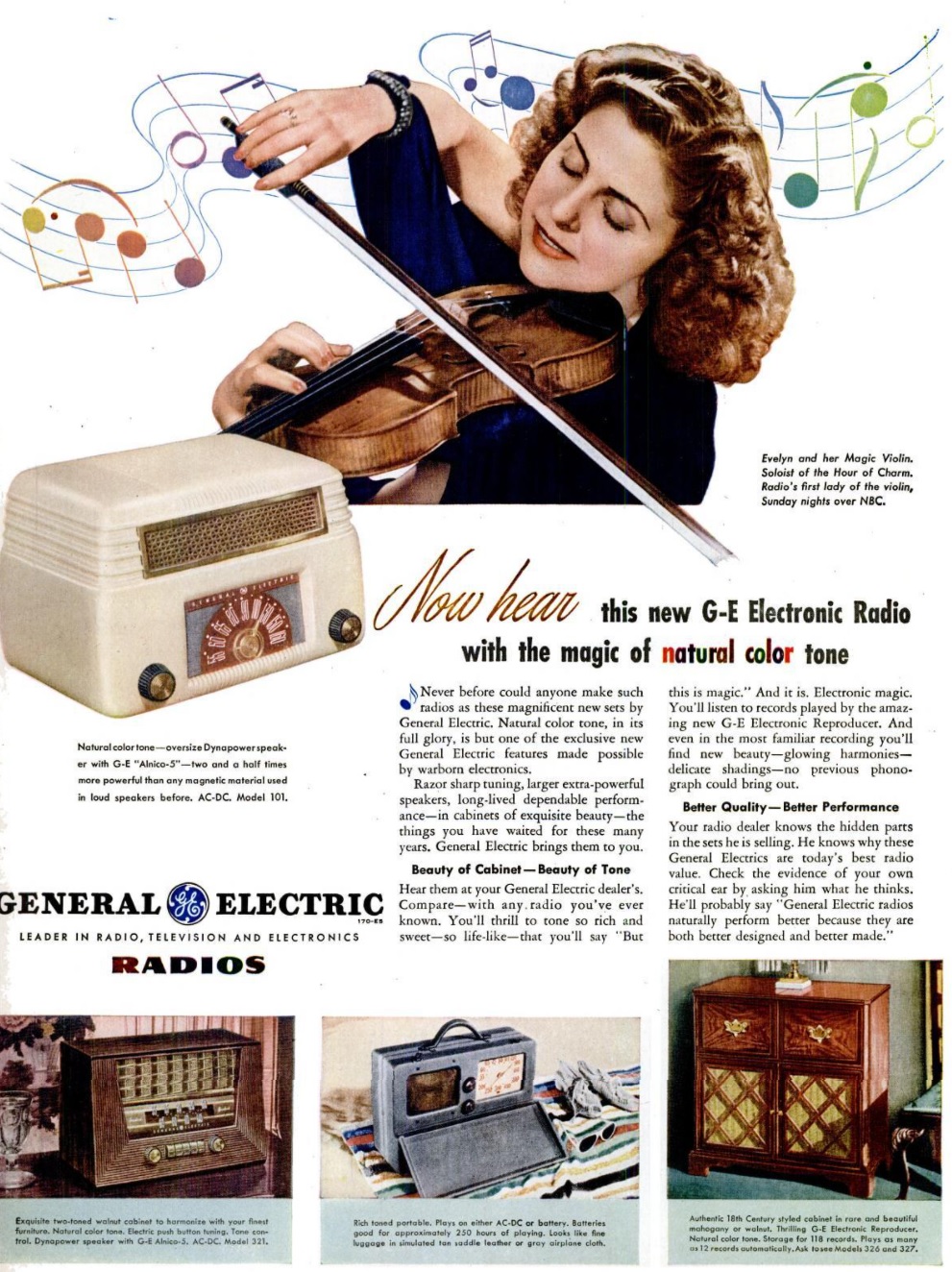
Life19410310These girls are now close to 90 years old, but they undoubtedly had an appreciation for music their entire lives, thanks to their parents’ foresight in buying this model L-678 radio-phono from General Electric. They are shown here having a concert in their very own room thanks to the instrument. They were able to operate the set themselves, and the turntable could accommodate 12 inch records, even with the lid closed.

Their parents were able to find much of the world’s finest music especially arranged for children, allowing them a wonderful opportunity to develop an appreciation for good music. This set retailed for only $39.95. The ad also featured the model L-500 radio, “encased in handsome mahogany plastic cabinet that won the top award in the nation-wide Modern Plastics contest.” Also shown is the portable model JB-410, which the police officer notices and points out that he also has a GE radio in his squad car.

The ad appeared 80 years ago today in the March 10, 1941, issue of Life magazine.


1921 Creed Automatic Radiotelegraphy System

No. 7W/3 Reperforator, manufactured by Creed and Company Limited, Croydon, London, England, 1925

Creed No. 7W/3 Reperforator (1925). Image courtesy of Science Museum Group Collection, © The Board of Trustees of the Science Museum, U.K. released under a Creative Commons Attribution-NonCommercial-ShareAlike 4.0 Licence.

No. I.T. Morse Tape Printer (1925).

No. I.T. Morse Tape Printer (1925). Image courtesy of Science Museum Group Collection, © The Board of Trustees of the Science Museum, U.K., released under a Creative Commons Attribution-NonCommercial-ShareAlike 4.0 Licence.

The two devices shown above represent a hundred year old method of automatically decoding International Morse Code. They, along with the sending device, are described in the March 1921 issue of Radio News.

1921MarRadioNews3At the sending end, the message is typed on a typewriter-like keyboard and punched onto a paper tape. An example of the tape is shown below. It’s not immediately obvious that the tape contains Morse code, but upon closer observation, it is. A “dot” is indicated by one hole directly above another hole. A “dash” is indicated by two holes that are slanted. Once you see this, the Morse code is obvious. The first word shown here is “the.” The first two holes are slanted. This is a single dash for the letter T. This is followed by four sets of holes, one directly above the other–four dots, for the letter H. Next, there is a single set of vertical holes, another dot for the letter E.

Once this tape is produced, it is sent through another machine which keys the transmitter and sends the Morse signal over the air.

At the receiving station, the two machines shown above are used to receive and print the message. The reperforator (top) connects to the receiver and produces an exact duplicate of the paper tape. Then, the paper tape is fed into the Morse Tape Printer, which prints the message on a paper tape.

The process was known as the Creed Automatic System, named after inventor Frederick G. Creed, an important figure in the development of the teleprinter. At the beginning of the 20th Century, Creed was told my none less than Lord Kelvin  that “there is no future in that idea.” Undaunted, he managed to sell twelve machines to the British post office in 1902.  The 1921 machine described for use with wireless telegraphy appears to be a variation of that device.

By the late 1920s, the company was producing teleprinter equipment using a variant of the five-bit Baudot code.  The company became part of IT&T, and Creed retired from the company in 1930. Among his later projects was the “Seadrome,” a floating airport which could be placed along international air routes. The project is described in a March 1939 article in the Glascow Herald, and was undoubtedly a casualty of both the War and increased aircraft range. The Seadrome is the subject of US Patent 2238974, applied for in February 1939 and granted in April 1941.

The images above are copyrighted and provided courtesy of the Science Museum Group, U.K., where they are on display, and released under a Creative Commons Attribution-NonCommercial-ShareAlike 4.0 Licence.

Santa Catalina Radiotelephone, 1921

1921MarRadioNews1A hundred years ago, if you were located 26 miles across the sea (40 kilometers, for those in leaky old boats) at Avalon, Santa Catalina Island, California, you could enjoy the luxury of telephone service with any telephone in the United States, thanks to the radiotelephone service operated by Pacific Telefone and Telegraph Co., as described in the March 1921 issue of Radio News.

The system consisted of stations KUVX at Avalon and KUXT at Long Beach. A complicating factor was the presence of naval station NZL, also located at Avalon. To avoid interference, the radiotelephone receiving station employed a wave trap to null out NZL’s frequency. The article gives the radiotelephone wavelength of 425 meters (706 kHz). The system was full duplex, meaning that there would be different transmitting and receiving frequencies. Since the 425 meter wavelength is discussed in conjunction with the wave trap on the receiving antenna, it appears that the Long Beach station transmitted on 425 meters, and Avalon transmitted on a different frequency.

The author described an interesting catch for an SWL as part of a test conducted by the Avalon station. He listened in on a conversation from Avalon to the mainland, which was carried by the transcontinental telephone lines to New York, where the call was carried by another radiotelephone station to a ship in the Atlantic. The author reported that the voice was a little distorted, but could be clearly heard throughout the ten minute test.

The Avalon station was powered by a motor generator, and to avoid having to restart the power, the carrier was left on 14 hours a day, with calls to and from local hotels, stores, and residents carried as needed. A licensed radio operator oversaw the transmitter, connected to an eight-wire antenna, and receiver, connected to a loop antenna. A telephone operator put through the calls, presumably with another operator at the Long Beach side of the circuit doing the same.

The system was able to transmit telegraph signals simultaneously with telephone conversations without interference. This was accomplished by “superimposing a high pitched harmonic on the carrier wave.”

A more detailed technical description of the system can be found in the December 1921 Proceedings of the IEEE.  You can also find additional references at Wikipedia, which notes that the system was replaced by a submarine cable in 1923, ending the possibility of radio listeners being able to tune in to telephone conversations.

1921MarRadioNews2


Radio Hams Practice for War: 1941

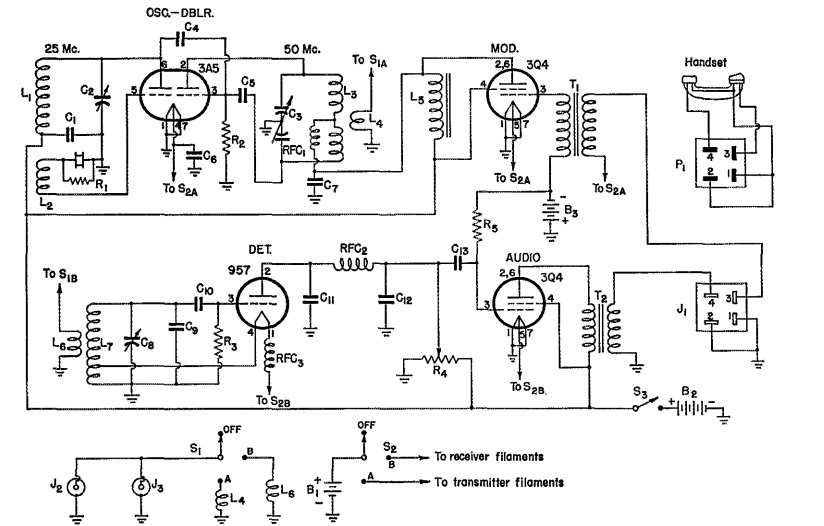
1941MarPM
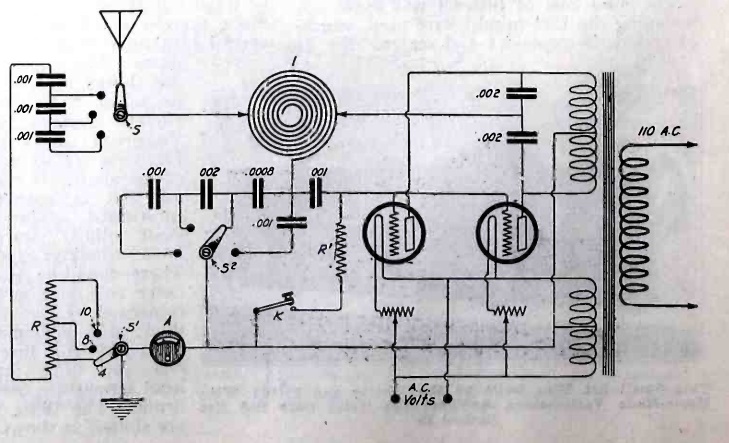
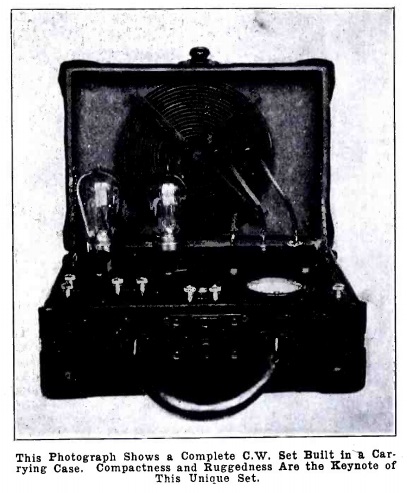
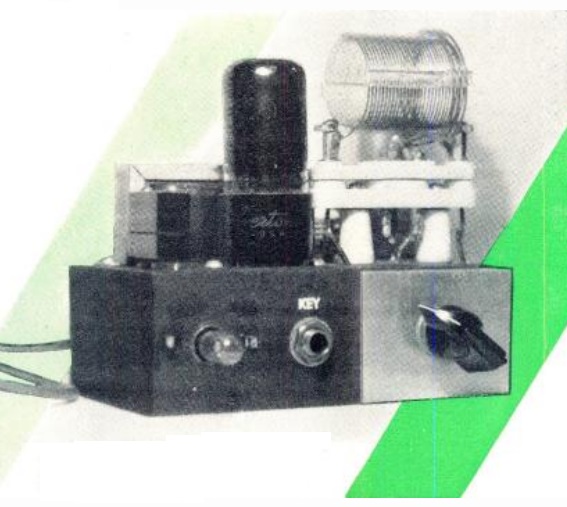
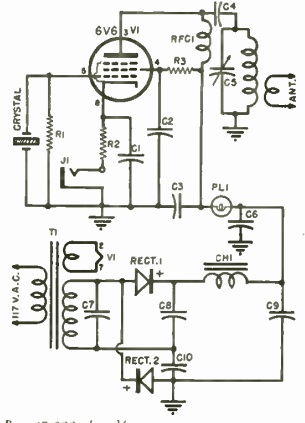
In 1941, the ham radio operator shown here was asked how long he would need to get his portable station into operation in the field. “Six minutes is the average time,” he replied. The officers asking the question were skeptical, but they watched as he opened his suitcase, hooked up a car battery, hammered in a ground stake and slung the antenna into a tree. He then tapped out a message to the control station fifteen miles away.

This was but one of the tales recounted eighty years ago this month, in the March 1941 issue of Popular Mechanics, in an article entitled “Radio Hams Practice for War.” It detailed the work of the 1800 member Army Amateur Radio System and pointed out that in time of war, thousands of trained hams would go into the military for active duty, and others would take on civilian duties such as listening for clandestine stations.

In another exercise, hams were asked, “your radio transmitter is completely smashed by a falling chimney. How long will it take to borrow an old broadcast receiver from a neighbor and build a new transmitter from its parts?” Another ham was ordered, “simulate destruction of your main transmitter. Rig up your emergency equipment and report back on the air as soon as you can.”

The article detailed a number of ways in which hams were “preparing themselves against a possible ‘M’ day.”