Category Archives: Radio history

Field Day 1946

WFD1This weekend is ARRL Field Day, an amateur radio operating event in which hams set up their stations in remote locations and attempt to make as many contacts as possible.  It’s a hotly debated question of whether it’s an emergency preparedness exercise, a contest, or just a fun weekend.  The truth is that it’s all three.

Even if all infrastructure were to be destroyed immediately, it would still be quite possible for hams to communicate worldwide using simple equipment, relying on nothing other than the laws of physics.  Short of a zombie apocalypse, the need for such ability might be rare, but it’s a point of pride with hams what they can do.

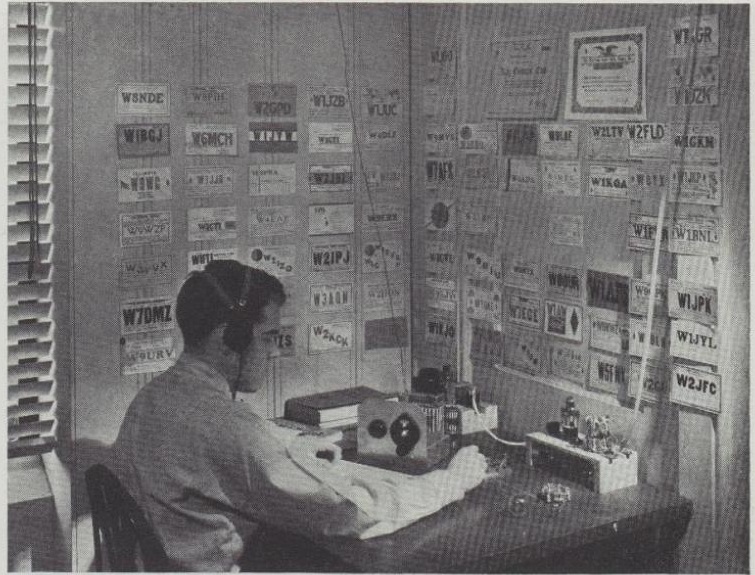
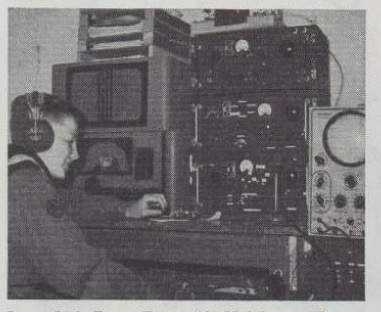
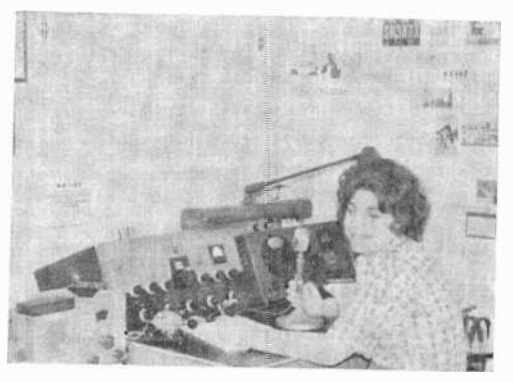
1946 Field Day. QST for Feb. 1947.

1946 Field Day. QST for Feb. 1947.

Amateur radio was off the air for the duration of World War II, so Field Day 1946, 75 years ago, was the first postwar opportunity for hams to show that they could still communicate off-grid.

When the results were published, it was pointed out that comparisons with earlier Field Days were not appropriate.  Hams had only recently come back on the air, and they were not yet allowed on all bands.  In particular, they did not yet have privileges on the 160, 40, and 20 meter bands, all workhorses of earlier Field Days.  Instead, their HF was limited to 80, 11 and 10 meters.  The top portion of the 80 meter band had just been re-opened, and here were the allocations, as shown in the June 1946 issue of QST:

1946JunQST

The top score in the 1946 event was W2FC/2, the Jersey Shore Amateur Radio Association, which netted 9621 points from a total of 809 contacts.  The 27 participants had eight transmitters on the air simultaneously.

Shown above is my most recent field operation.  It wasn’t ARRL Field Day, but instead Winter Field Day 2021.


Using Radio for a Free Vacation

1921JunRadioNewsA hundred years ago, these summer tourists were enjoying dance music at some fine hotel, thanks to the entrepreneurial spirit of a young radio enthusiast. This was but one idea shown in an article in the June, 1921, issue of Radio News.

The article started by noting that some young men might be trying to decide whether they should spend their money on a new piece of radio gear, or instead on a nice summer vacation.  The solution to the dilemma was to parlay the radio hobby into a free vacation.  Stamps were cheap, and it was simply a matter of proposing ideas to resort hotels:  In exchange for free room and board, the entrepreneur could provide useful services to the hotel.

One such idea is illustrated above.  A dance required music, and that music could come over the radio.  In addition to being a source of the dance music, the radio was still a novelty in its own right, and would have a particular allure.

Some hotels might be in remote areas, and the morning papers might not arrive until the afternoon.  A young man equipped with a radio set could get the morning headlines to guests before the papers arrived.  And the presence of the two-way set could be an important selling  feature for a hotel to offer the availability of emergency message sending.

In some cases, the young man could offer radio classes to guests.  Also, a young man with a radio set would have numerous networking opportunities.  The possibilities were endless!


1961 Dorsal Electronics Model RT-101 Two-Way Radio

1961JuneElectronicsTechnicianSixty years ago this month, the June 1961 issue of Electronics Technician magazine showed this interesting combination, a two-way radio for 27 MHz, with a built-in AM radio.

The “Walk’N Talk” model RT-101 is being advertised to radio and electronics technicians, and it might come in handy for tasks such as aiming a TV antenna. It’s probably a 100 mW unit, so no license was required. The built-in AM radio seems like a nice touch. A set of two retailed for $159.95.  According to this inflation calculator, that works out to over $1400 in 2021 dollars, so it’s apparently for the well heeled electronics technician.  I don’t know if it’s still available, but you can see a nicely preserved example at this Facebook Marketplace listing.


Selling School Sound: 1946

1946JunRadioRetailing3Seventy-five years ago this month, the June 1946 issue of Radio Retailing reminded dealers of the profits to be made selling public address systems to schools. It detailed the experience of a dealer in North Carolina. The school district had just experienced growth, and there was a need for new facilities. And in a progressive district, new buildings meant the latest in technology.

And the local radio dealer was ideally poised to serve as expert in all matters involving sound. This dealer was consulted at two school board meetings, and walked away with the contract for the installation.

“Get out your paper and pencil today and start figuring your profits for tomorrow’s PA sales to your local institutions. They’re waiting for you!”

1946JunRadioRetailing4


Terado Co. Trav-Electric Model 6-1160 Inverter, 1946

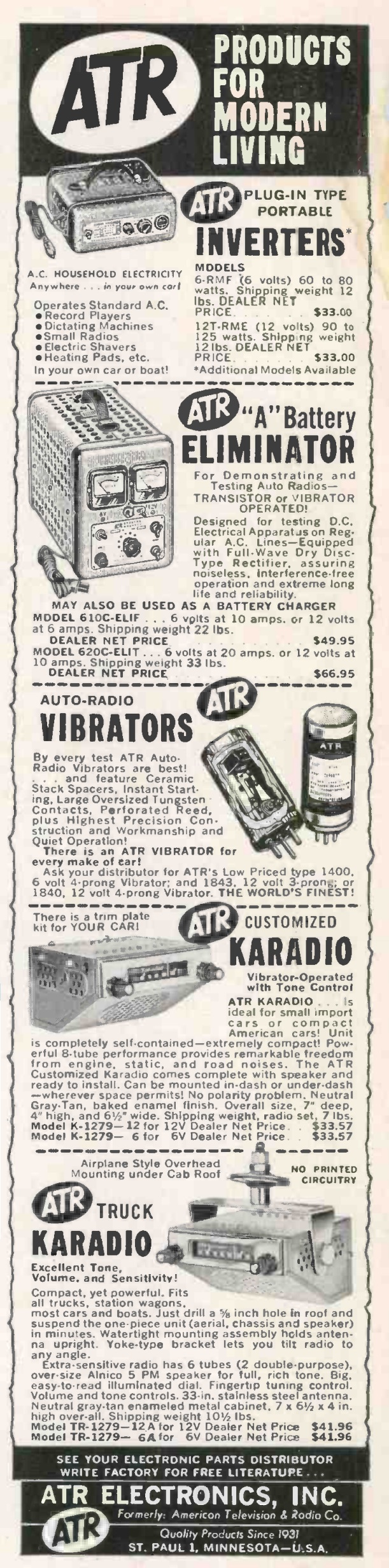
1946JunRadioRetailing2I found this ad from 75 years ago to be intriguing. It’s an inverter for running 120 volt appliances from a car’s electrical system, presumably six volts. The ad appeared in the June 1946 issue of Radio Retailing.

I haven’t found much information about this unit, model 6-1160,  But it’s almost certainly vibrator driven.  The electromechanical vibrator changes the DC to a square wave, which is stepped up by a transformer.  It’s billed as providing up to 40 watts.

It’s priced at $15.95.  According to this inflation calculator, that works out to about $330 in 2021 dollars.  By comparison, a modern one such as the one shown here outperforms it and sells for just a few dollars.

The manufacturer, the Terado Company, appears to be defunct, but their street address jumped out at me.  I drive past it, 1068 Raymond Avenue, St. Paul, MN, almost every day.  There is currently an apartment building at that address, which I believe was built in the 1980s.

Some links on this site are affiliate links, meaning this site earns a small commission if you make a purchase after clicking on the link.

1946 GE Clock Radio

1946JunRadioRetailingThe postwar era brought a new product: The clock radio. This ad, from the June 1946 issue of Radio Retailing, showed one of the earliest examples from General Electric, which appears to be a model 50, a four-tube set.

With this new innovation, customers could say goodbye to sleep-shattering alarms, but after five minutes, an alarm would sound, to keep them from cheating.  Dealers were encouraged to stock up, since it was a natural for multiple set sales.  Everyone in the family would want one, and there was a great ad campaign in progress, along with full color point of sale displays.


1961 Electronic Project Lab

1961JuneRadioElecSixty years ago this month, the June 1961 issue of Radio Electronics posed the question, “how can I prepare my child for today’s electronic world?” The answer was shown on the cover. A kit such as this would not make a child an electronic genius overnight, but it would let the parent find out of the child had an interest in and aptitude for electronics.

Shown here is the Heathkit Electronic Workshop model SK-50, and the magazine reviewed a number of similar kits. This one allowed the young radio fan to build 19 different electronic projects, simply by wiring the components together according to the instructions. The magazine article doesn’t state the price, but the kit was still in Heath’s 1966 catalog for $19.95.

I sometime hear it lamented that these kits are no longer available, but that’s not true. First of all, from the picture above, it would be possible to recreate the kit shown above simply by looking at the picture. But if you want to buy a similar set for Junior, then one of the Elenco Snap Circuit kits shown below fits the bill:


1946 Two Meter Transceiver

1946JunePMSeventy-five years ago, this ham was just getting back on the air after a wartime hiatus, thanks to a two-tube two meter transmitter described in the June 1946 issue of Popular Mechanics. The magazine noted that for the ham licensed prior to Pearl Harbor, as well as the newly licensed, the simple set would provide an efficient way of getting on the air for local contacts while the big rig was still under construction.

The set used a 6N4 to serve as oscillator, with a 7C5 modulating. On receive, the 6N4 became a superregenerative detector, with the 7C5 serving as audio amplifier. Also shown above is a 300 volt power supply, although another supply, such as a vibrator supply in a car, could be used to power the rig. The recommended antenna was a folded diple constructed of 300 ohm twin lead.

1946JunePM2


1941 RCA BP-10 Portable

Screen Shot 2021-06-03 at 12.04.10 PMEighty years ago today, the June 9, 1941, issue of Life magazine showed some of RCA’s offerings. The portable was the main feature, and was billed as the perfect Father’s Cay gift. The superhet weighed in at only 4-1/2 pounds, but was a full toned powerful set. It featured a built-in antenna in the lid, and the speaker was said to pay symphony music with amazing tone and volume. The set sold for $20, and if you acted fast, they would toss in the leather case.

The set appears to be model BP-10, a four-tube set powered by a 67.5 volt B battery and 1.5 volt filament battery.


Homemade Cardiac Monitor: 1961

1961JunePEIf Junior is looking for a spectacular science project in the field of biomedical engineering, this one is a sure winner.

Sixty years ago, the June 1961 issue of Popular Electronics showed how to construct this simple cardiac monitor. The circuit was simple, amounting to a 4 transistor audio amplifier. The diagram called for 2N279 transistors, which are apparently unobtainium today, but this substitution guide lists the 2N2431 as equivalent, and it is available at a reasonable price.

The input comes from two electrodes, one of which is placed on each arm. In this position, they will pick up the currents from the heart, which are alternating currents of up to 100 kHz. The audio portions will be audible in the headphones, and also displayed on the meter. The magazine notes that you are not hearing the actual sound of the heart, merely the amplified voltage sent to the heart muscle. Other muscles can be monitored by placing the electrodes on either side of the muscle in question.

The electrodes are simply pieces of metal placed on the body. Prior to placing them, the skin needs to be scrubbed to improve the conductivity. This is done by scrubbing with Lava soap
or Ajax cleanser. (However, since Ajax is now billed as “non-scratching”, I’m not sure it would still work.) The article notes that the device is completely safe, even for children. First of all, it runs off only three volts. And the connection to the electrodes goes through a capacitor, so even that voltage has no pathway to the body.

More advanced versions are available today, but the advanced student will almost certainly bring home the blue ribbon in the science fair by building the medical device at home.

1961JunePE2