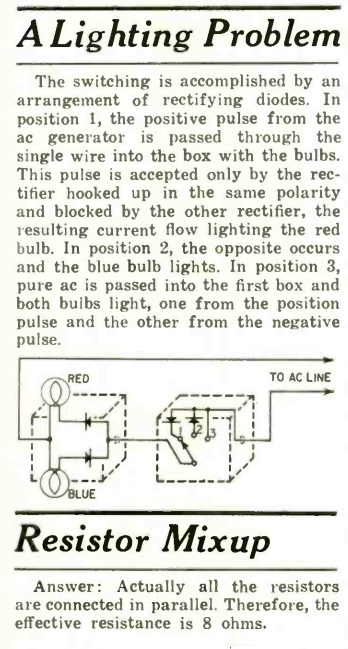
 As promised, here are the answers to yesterday’s quiz. They appeared in the September 1961 issue of Radio-Electroincs.

As promised, here are the answers to yesterday’s quiz. They appeared in the September 1961 issue of Radio-Electroincs.
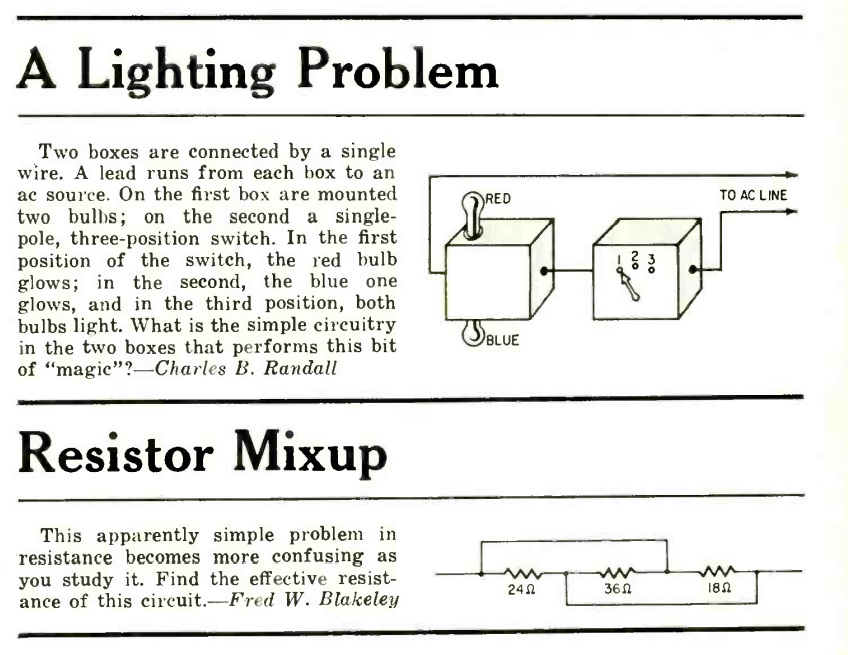 These two quizzes appeared 60 years ago in the August 1961 issue of Radio Electronics.
We’re confident that most of our readers can figure them out. If not, we’ll post the answers tomorrow. If these look vaguely familiar, it’s probably because you’ve seen them here before. The first “black box” quiz is very similar to a circuit we showed previously from October 1956 QST. And the second one with resistors is almost identical (only the values have changed) to the one we previously showed from the January 1957 issue of QST.
The 1961 answers (which are similar to the 1956-57 answers) will appear here tomorrow.
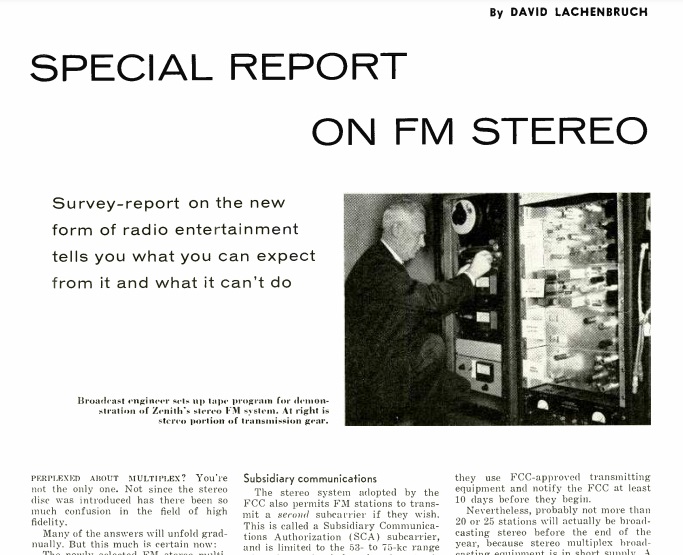 FM stereo is 60 years old this year, and 60 years ago this month, the August 1961 issue of Radio Electronics carried an update on the status of FM stereo broadcasting. The format had been approved by the FCC on April 19, 1961, and the first station to start stereophonic broadcasting was GE-owned WGFM in Schenectady, NY, followed soon by Zenith’s WEFM in Chicago.
FM stations were free to start stereo service whenever they wanted, as long as they used approved equipment and gave the FCC 10 days’ notice. But the magazine noted that due to shortages of equipment, there would only be 20-25 stations on the air before the end of the year.
The magazine was advertising a few stereo receivers, and the article noted that there were two ways to get stereo. Some receivers had been constructed with multiplex inputs, and the manufacturers were tooling up to produce adapters. However, in most cases, it would be necessary to use an adapter from the same manufacturer.
Table model receivers were also soon available. The magazine predicted that FM stereo would not mean the end of monophonic FM. In fact, the additional demand for FM stereo would probably add interest to FM in general, to the benefit of stations broadcasting in mono.
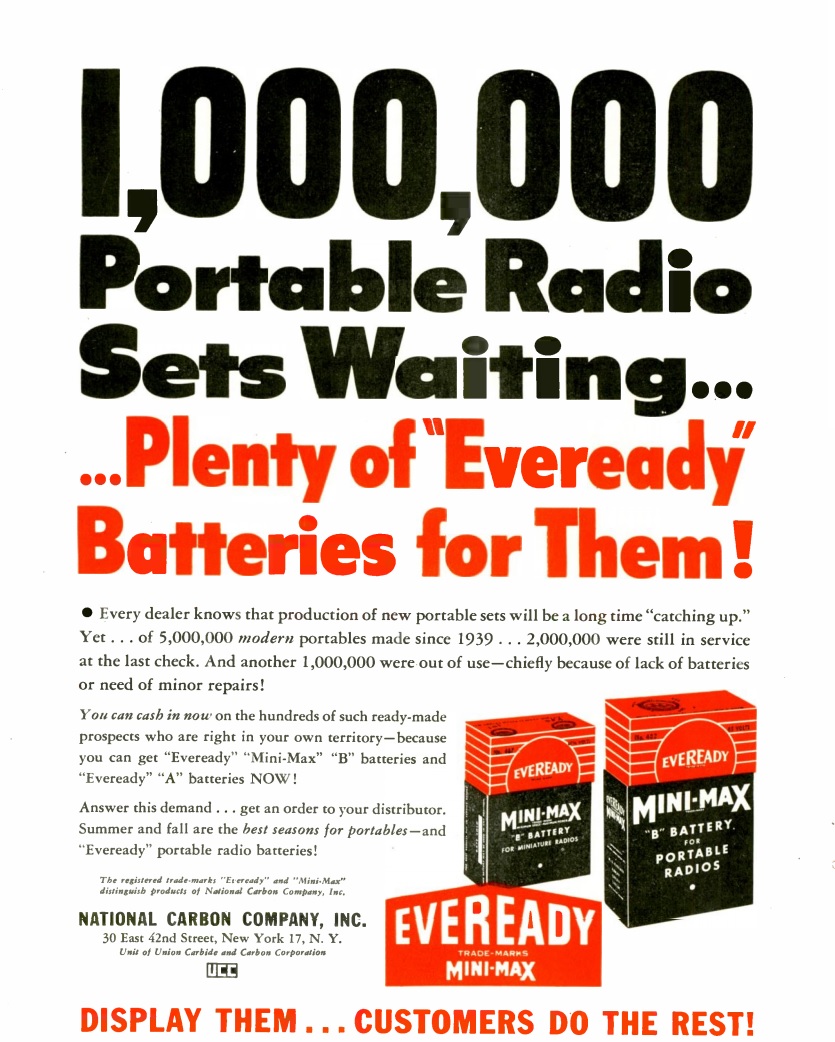 Seventy five years ago this month, the August 1946 issue of Radio Retailing carried this ad for Eveready batteries. The wartime years were ones of shortages of many consumer products, and radio batteries were difficult or impossible to find.
Millions of portable radios had been manufactured since 1939, but a million of them were out of service, mostly because no batteries were available. Summer was prime time for portables, and Eveready reminded dealers that if they put the batteries on display, they would sell themselves.
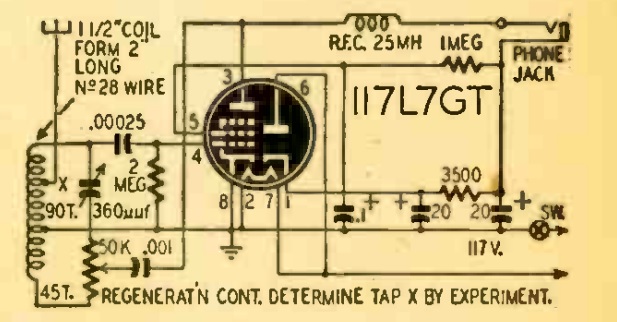 Seventy-five years ago this month, the August 1946 issue of Radio Craft carried this simple circuit for a one-tube receiver. The circuit had been sent in to the magazine by one Robert Sherrington of High Prairie, Alberta, who noted that the circuit was very selective and would pull in locals with good volume on a loudspeaker. It employed a 117L7GT, half of which served as a rectifier, with the other half serving as a regenerative detector.
The designer of the circuit was almost certainly the same Robert Sherrington, who was 16 at the time he sent the circuit into the magazine. According to his 2015 obituary, he attended the Radio College of Canada in Toronto in 1949, and then owned a radio repair shop in High Prairie. He later moved to British Columbia, where was licensed as VE7DLX.
The magazine’s editor noted that the circuit, while unusual for the time, was not new, having been used in earlier receivers, including the Reinartz.
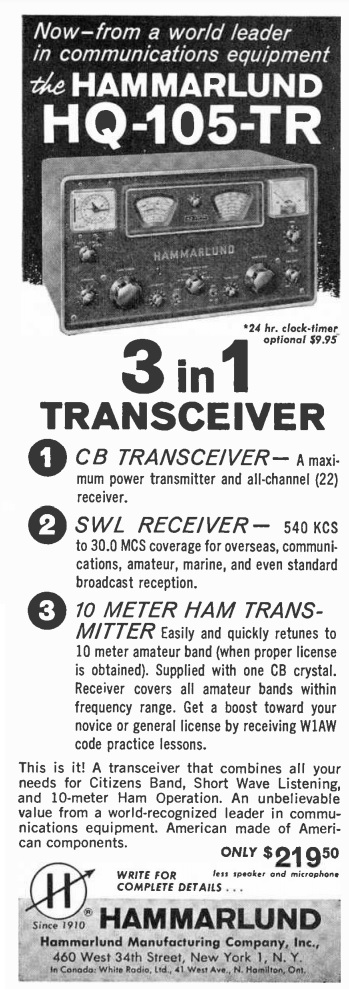 Sixty years ago this month, the August 1961 issue of Popular Electronics included this ad for an unusual combination from Hammarlund–the model HQ-105-TR.
The set was basically an HQ-100 receiver with one added feature: It included one additional tube for the CB transmitter. One CB crystal was included, and the receiver’s audio amplifier was used as the modulator.
The receiver covered the broadcast band up to 30 MHz, and had a bandspread calibrated for the ham bands. The ad noted that when the owner got the general class ham license, the transmitter could be easily retuned to the 10 meter band. In the meantime, the receiver could be used to copy W1AW code practice toward getting that license.
You can view the receiver in action in this video:
Interestingly, the mike connection is in the back, and there is no indication on the front panel that the unit also contains a transmitter.
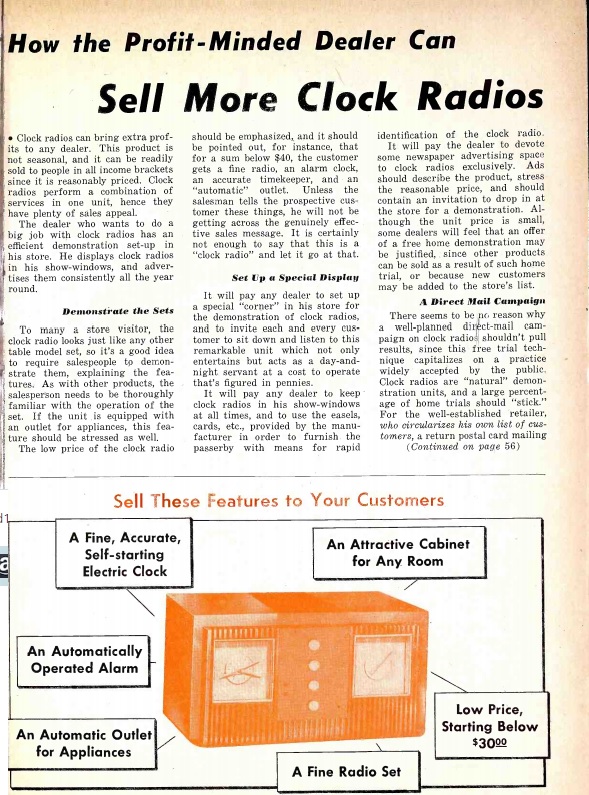 Seventy years ago this month, the August 1951 issue of Radio Television Retailing reminded dealers that there was money to be made by selling clock radios, an item that readily sold to people in all income brackets.
The clock radio “looks just like any other table model set” to the customer, so some salesmanship was required. The salesman needed to be thoroughly familiar with the product, and emphasize the low price for something that could serve as a fine radio, an alarm clock, a timekeeper, and in many cases, an automatic outlet.
The magazine suggested that direct mail might be a profitable way to sell. Select customers could be sent a mailing offering a set on approval, and once in the home, the customer was very likely to keep the set.
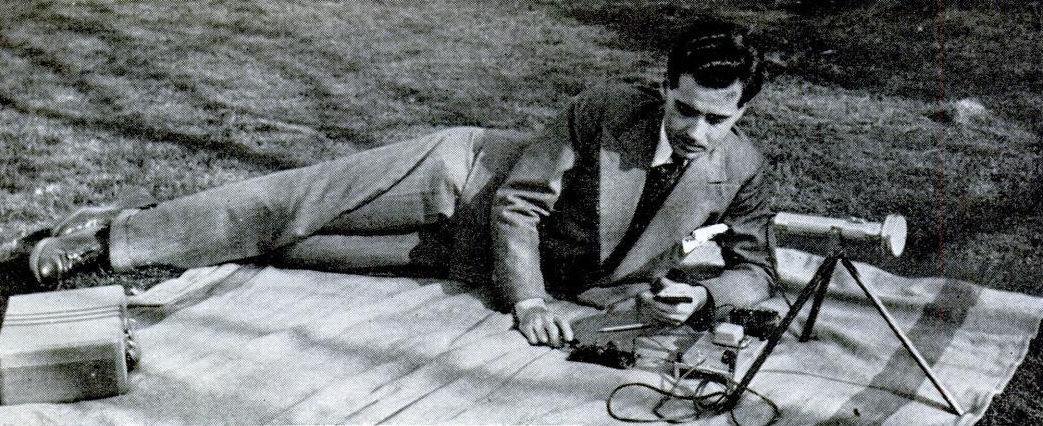 Eighty years ago, this well dressed gentleman was sending a message through this light beam transmitter, as described in the August 1941 issue of Popular Science.
The magazine was a bit prophetic, since there was more experimentation with the idea after Pearl Harbor. When hams were ordered off the air for the duration of the war, optical communications was one of the ways they continued to practice their hobby (along with carrier current communications.)
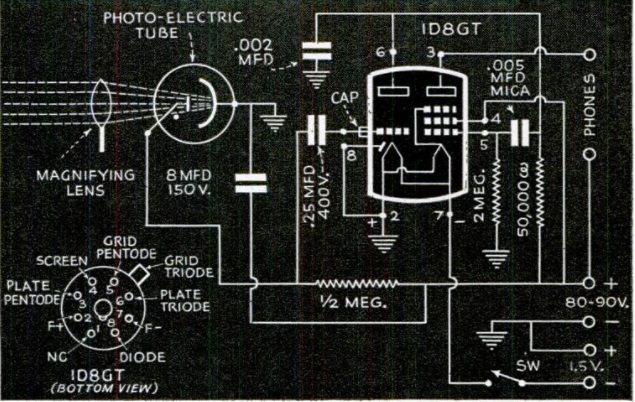
The idea is simplicity itself, and it’s an idea that I independently invented as a youngster 30 years later, and I know others did as well. The light beam of a flashlight is modulated with an audio signal by wiring the light in series with the secondary of a transformer. The primary of the transformer is wired with a buzzer and key to send Morse code. When I did the same thing, I hooked the transformer primary to the output of a transistor radio or other audio amplifier, allowing voice signals to be sent.
The receiver is an audio amplifier, with a photoelectric tube hooked to the input. In my later experiments, I used a solar cell hooked directly to the input of an amplifier, which didn’t seem to mind the small DC voltage.
The student looking for an interesting project for a science fair could easily duplicate this experiment with modern equipment, at very low cost. It’s an easy demonstration of a communications device dependent only upon light.

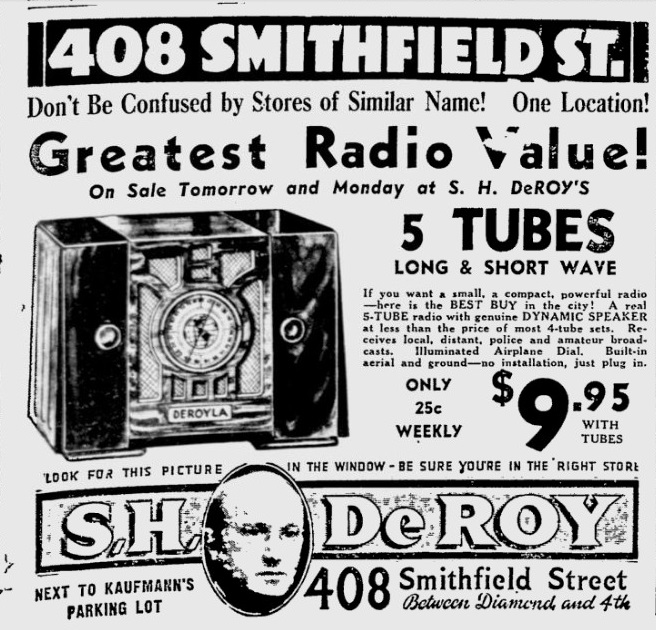 This ad appeared in the Pittsburgh Press 85 years ago today, August 7, 1936, and it raises some interesting questions. It’s for the store of one S.H. DeRoy, 408 Smithfield Street, Pittsburgh.
It implores customers not to be confused by stores of a similar name, and points out that there is but one location for the S.H. DeRoy store. There was a picture of S.H. DeRoy in the window, and you were supposed to look for that before going in.
It appears that other relatives of S.H. DeRoy might have been operating their own competing stores, hence the warnings. This case from the U.S. Tax Court reveals that S.H. had been in partnership with his brother and father running a jewelry business, but the partnership went bankrupt in 1930. Another brother acquired the assets, formed a new corporation, and attempted to continue the business. But by 1937, it too had become insolvent. While it’s hard to tell for sure, it’s likely that other family members were in competition, hence the warnings.
According to the court decision, the company was primarily in the retail jewelry business, and it appears that much of their business was frames for eyeglasses. In 1936, S.H. apparently branched out into radio, with the model shown here. The court opinion notes that the jewelry was sold on credit, and the radio was as well, since you could take it home for only 25 cents per week, or buy it for $9.95 cash.
Despite the insistence on not being misled by similar names, it’s interesting to see the brand name of the radio being sold. This set, described only as receiving both longwave and shortwave, bears the brand name of Deroyla. That makes perfect sense, since it’s being sold by DeRoy. But it’s also suspiciously similar to Detrola, which was a major brand name at the time. The only other Deroyla radio I’ve been able to find is this ebay listing, which is for a model with a similar description by somewhat different front panel layout.
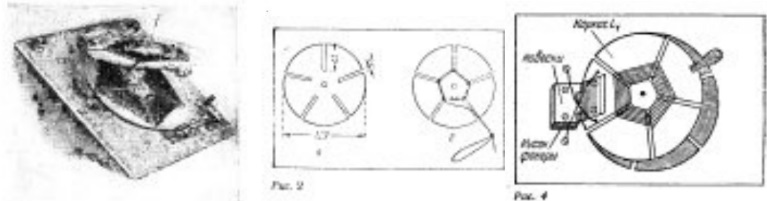
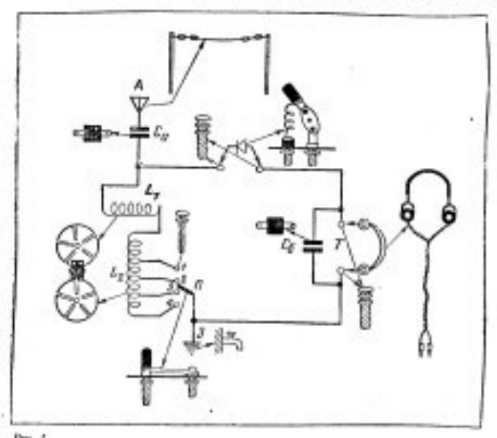 In August 1941, the Germans were busy invading the Soviet Union, but they would have realize the futility if they had known that the Soviets were quite undaunted, and were busy putting together crystal sets. As you can see from the August 1941 issue of Радиофронт (Radio Front) magazine, that is exactly what they were doing. The diagram shown above is clearly a crystal set, and most of the parts appear to be homemade. Despite what the Germans could throw at them, the Soviets were still able to pull in the stronger stations thanks to simple receivers such as this one.
As you can see from the diagrams below, the tuning was accomplished with a variometer, using two spiderweb-style coils hinged together. And as long as they could find a suitable mineral, the Soviets could easily put together the detector shown below.