Category Archives: Radio history

1952 Omaha/Council Bluffs Floods

The spring of 1952 brought record floods to Omaha, Nebraska, and Council Bluffs, Iowa. One of the critical needs was patrolling the dikes, and local hams were pressed into action for the job. For ten days and nights, volunteers manned the dikes constantly, reporting any leaks or signs of weakness back to city hall. From there, emergency crews were dispatched to shore up any weak spots.

The equipment used here consisted of Motorola Walkie-Talkies. The equipment was supplied by the Union Pacific Railroad, and operated on the railroad’s frequency of 160.29 MHz.

This report appeared in the July 1952 issue of Radio News, July 1952,


1922 Radio Listings

1922Jul4WashStarIf you were the owner of a radio a hundred years ago, here’s an idea of what you would have been able to tune in, as listed in the Washington Evening Star, July 4, 1922.

Being the Fourth of July, it’s not surprising that most of the commercial stations have listings for patriotic readings and music. Of course, unless you were close to one of the cities with a station, it might have sounded a bit cacophonous, since all commercial stations at that time were on 360 meters (833 kHz). Naval station NAA in Arlington, Virginia, would have been in the clear, with its transmissions on either 2650 or 2950 meters (113 or 102 kHz).

The commercial stations listed are WGI BostonKDKA PittsburghKYW ChicagoWJZ Newark, and WJH Washington.


1962 One-Tube VHF Receiver

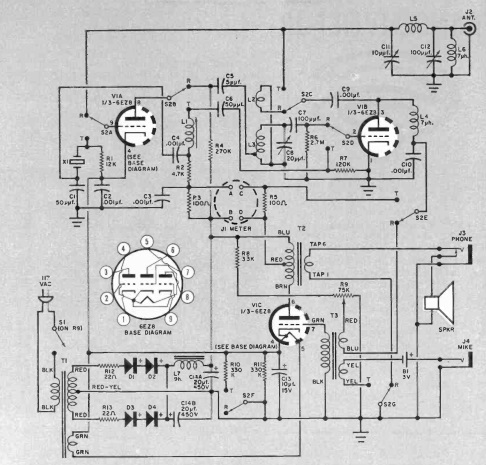
1962JulPEI’m not so sure that this little receiver is a good idea, but it is from the July 1962 issue of Popular Electronics. It’s a one-tube receiver covering 122-144 MHz, meaning that it mostly covers the air band. The problematic feature is that it’s a superregenerative receiver. And superregenerative receivers, in addition to being excellent receivers with great sensitivity, they also radiate a signal, in the form of a rushing noise, on the frequency that they are tuned to. So in addition to being able to hear airplanes in flight, the airplanes in flight might be able to hear you.

The author is aware of the problem, but asserts that “the power input to the detector is in the vicinity of 300 microwatts or less, so radiation should be of little concern.” That might be true, but I don’t think I’d want to risk it. Back in the day, I could hear my friend turning on his Heathkit Sixer a block away, since that receiver was also superregnerative. And if you used this receiver a block away from the airport, I bet you might have some splainin’ to do.

In any event, it’s a nice little receiver, which uses a 12EC8 tube. Since that tube was intended for use in car radios, it runs fine on 12 volts, and works well into the VHF range.

1962JulPE2


1942 Emergency Receiver

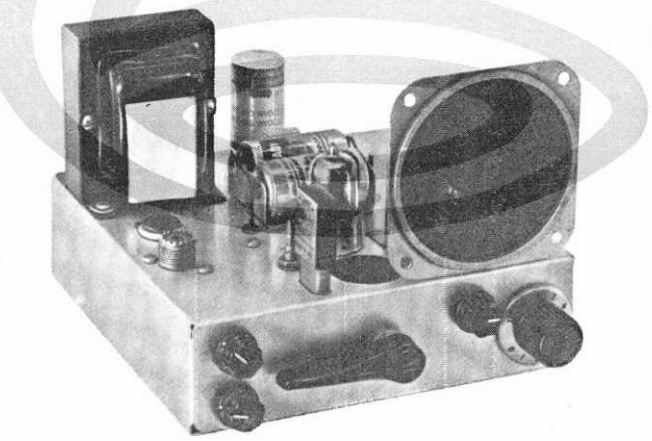
1942JulPSEighty years ago this month, the July 1942 issue of Popular Science showed how to make this compact emergency receiver, designed to meet the requirements of defense organizations. The key to the design was the elimination of bulky B batteries. Instead, the set used only about 9 volts of plate voltage, and also cut the filament voltage in half.

The circuit could be used with either metal 6SJ7 tubes or glass 1SA6GT interchangeably. The glass tubes provided better battery economy, but the metal tubes were more durable for rough service in the field. Filament votages were extremely critical. In fact, the circuit would not function at all at the tube’s normal filament voltage. A rheostat was used to get the exact voltage needed.

With suitable plug-in coils, the set could tune from 16 to 1000 meters. One tube served as detector, with the other two amplifying the audio.

1942JulPS2


Young 1922 Radio Listener

1926June26If she is still with us, the young woman wearing headphones in these photos is about 101 years old. This item appeared 100 years ago today, June 26, 1922, in the Bridgeport (CT) Times and Evening Farmer.

The young listener is the daughter of Charles C. Kolster, then the radio instructor for the First Naval District. He went on to become Supervisor of Radio for the Boston office of the Federal Radio Commission, and later Inspector in Charge of the First District of the Federal Communications Commission.

In this photo, the young Miss Kolster had the headphones placed on her head to her initial puzzlement. But this was quickly replaced by delight when she realized that she was hearing her father’s voice.


1937 Trailer Intercom

1937JuneRadioCraftI’m sure this picture would be a violation of today’s traffic safety laws. At the very least, I’m sure it would result in a ticket for not wearing a seatbelt. But 85 years ago, it was a different story, and cooking breakfast in a moving trailer wasn’t anything to worry about.

But there was a matter of telling the driver that breakfast was ready, and the intercom shown here would solve that problem. The accompanying article, from the June 1937 issue of Radio Craft points out that there were 250,000 trailers in the country, and it was an untapped market for radio sales. The trailers were practically begging to have a radio installed. It would have to be a heavy-duty unit to survive the vibrations. And equipping it with an intercom would allow the driver of the car to listen to the radio (with the radio mounted away from the ignition system and its possible interference) and also communicate back to the trailer.


Rep. George I. Clem, 1947

Seventy-five years ago today, the June 23, 1947, issue of Broadcasting magazine carried this ad from WCCO radio in Minneapolis-St. Paul. The gentleman shown speaking at the microphone is Rep. George I. Clem (no relation to the author of this website), who served one term in the Minnesota Legislature representing the 56th District, which at that time was the Pine City area, about 100 miles north of the Twin Cities.

Inexplicably, the ad copy states that Clem drove to Minneapolis to assume his duties in the Legislature, which seems unlikely, seeing that the state capital is St. Paul. But in any event, while carrying out his legislative duties by day, by night he attended WCCO’s “Radio School for Legislators,” in which station personnel taught legislators the nuts and bolts of communicating effectively by radio. The faculty included the station’s educational director E.W. Ziebarth, program director Gene Wilkey, news director Sig Mickelson, and farm services director Larry Haeg.

Rep. Clem reported that his attendance at when addressing the Pine City Commercial Club, he knew that his attendance at the school made the difference, and also made it possible for him to keep the people of his district better informed.  He served a single term in the Legislature, and died in 1988 at the age of 78.


Radio Dreams 1922

1922JuneRadioNewsA hundred years ago, this radio enthusiast lived and breathed radio. And when he slept, he dreamed of radio. Of course, he’s probably sleeping during the day so that he can stay up all night pulling in distant stations.

The illustration appeared on the cover of the June 1922 issue of Radio News.


Lane Technical High School, Chicago, 1922

1922JuneRadioAgeWe’ve previously written (here and here) about the radio department of the Lane Technical High School in Chicago, and a hundred years ago this month, the June 1922 issue of Radio Age featured the school.

Shown here are students during the school’s annual military review. Orders were sent by a sending set in the school office to these students near the field of battle. The orders were then relayed to the field officers by megaphone.


1922 Radio Scouting

1922JuneBLWe’re not told exactly what these scouts were doing, but it was obviously important. While the plane flies over, one is watching with the binoculars, and the other is listening to some important message on the radio.

The illustration, by Douglas Duer, appeared a hundred years ago this month in the June 1922 issue of Boys’ Life.

The issue contained a number of features about wireless, including one fiction story, as well as detailed instructions for constructing a crystal set. It also included this sad tale of the sinking of the SS Grøntoft.

1922JuneBL2