Category Archives: Radio history

Radio Facsimile: 1947

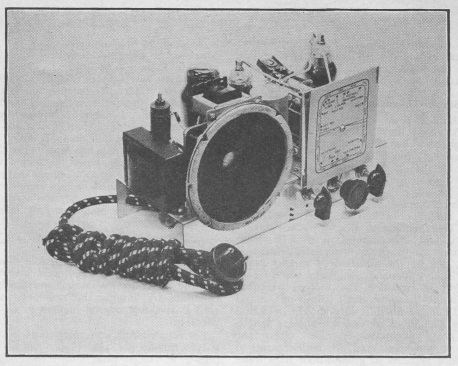
4.1" facsimile receiver for connection to FM radio

4.1″ facsimile receiver for connection to FM radio

Today, we take a look at a technology that never caught on, namely, broadcast facsimile.

Seventy years ago this month, the June 1947 issue of FM and Television carried an article optimistically entitled, “Facsimile is Ready for Home Use,” detailing both the technology and the economic aspects. At that time, a standard had not yet been adopted, and the author, the magazine’s publisher Milton Sleeper, noted that this was the first step necessary to get the technology off the ground. Home receivers were ready to hit the market for $100, but sales were unlikely unless consumers knew that the set could be used to receive future facsimile broadcasts from any FM station.

The author advocated for a standard of a 4.1 inch width, 105 lines per inch, 3.43 inches per minute. He noted that this would require a subcarrier with an audio signal ranging from about 2-5 kHz, which he pointed out would be well within the flat-response range of all FM receivers. Others were apparently pressing for an 8.2 inch width, which he noted would require greater bandwidth.

The “chicken and egg” problem, of course, was content. As he noted, newspapers weren’t particularly keen on providing content to a free competing service. Even if they could be convinced, there was little interest in starting the service before receivers were on the market. And receivers wouldn’t be on the market without content.

Few, if any, technical barriers stood in the way. Sleeper describes how he set up a demonstration at a trade show on short notice. He was given the idea the day before the show, and managed to get the equipment installed at a station that same evening. The station had an experimental license, and apparently broadcast the facsimile over its normal audio channel. The receiver could be plugged in to any FM receiver, and was also set up in short order.

Sending unit, ready to plug in to FM station's audio line and play.

Sending unit, ready to plug in to FM station’s audio line and play.


Cooking With Sugar Rationing

1942JuneRadioMirror

Sugar rationing took effect in the United States in May 1942, and the next month, CBS radio personality Kate Smith stepped up to the plate in the June issue of Radio Mirror with recipes with which the housewife could conserve the commodity, but still prepare deserts.

Smith knew that her readers would accept rationing for what it was–“an emergency method of making quite sure that everyone gets all the sugar he needs and that no one gets more than he really needs.” She also knew that her readers wanted to make sure that they didn’t use their portion wastefully.

Therefore, she presented these recipes showing how delicious deserts could be prepared with other sweetening agents such as corn syrup, prepared pudding mixtures (which used dextrose), molasses, and honey.

Her sugarless layer cake used corn syrup, and the molasses cake used molasses along with a bit of brown sugar. She suggested that an easy and delicious filling for either cake could be made with a package of chocolate pudding mix and milk, following the package directions, but with a bit less milk. Instead of frosting, the cake could be covered with nut meats, currants, or raisins, or a light dusting of confectioner’s sugar could be used.

She also included a chocolate souffle recipe using a packaged pudding mix, and baked stuffed oranges using corn syrup or honey.

For glazing a ham, she included a recipe with a corn syrup glaze.


1957 Five Transistor Loudspeaker Superhet

1957JuneRadioElec

Sixty years ago, the transistor radio was starting to become more and more a reality, as shown by this project in the June 1957 issue of Radio Electronics.  A year earlier, the magazine had carried plans for a four-transistor superheterodyne pocket receiver.  and had announced that “this is it,” in that the transistor could finally be used in a usable radio that could be built by the average hobbyist.  The project shown here was an update of that project, and featured one thing missing from the earlier set, namely a speaker.

1957JuneRadioElec2This set boasted loudspeaker volume on many local stations, with the sound audible as far as 10-15 feet away in a quiet room. For distant stations or for private listening, an earphone jack was provided.

The set featured five PNP transistors, with four 2N1112A’s as converter, first and second IF, and detector, and a 2N138 providing enough audio to drive the speaker.  The set was powered by a 4 volt battery.  A specific battery was mentioned, but the article noted that three N cells providing 4.5 volts would work well.

1957JuneRadioElecSchematic


1942 Air Raid Alarm

Screen Shot 2017-05-30 at 12.06.34 PM

The June 1942 issue of Service magazine carried this ad for an air raid alarm to be added to any radio.  It noted that the first sign of an air raid would often be local radio stations leaving the air, lest they serve as a beacon for incoming bombers.  If you were listening to the radio during the day, you would know immediately.  But at night, with the radio off, you would be caught unaware.

With this home alert, you would leave the radio on standby, and if the station you were tuned to left the air, this would be the sign of a possible air raid.  The ad noted that during air raid alarms in Los Angeles, radios equipped with this device sounded the alarm from six to ten minutes before the sirens sounded.

The unit sold for $5, and could be installed by a local service shop.


1947 Toy Telephone Crystal Set

The Twilight Zone Lili Darvas Billy Mumy 1961.jpg

Twilight Zone “Long Distance Call” 1961. Wikipedia image.

You might recall the 1961 Twilight Zone episode “Long Distance Call.”  If you don’t recall, five-year-old Billy received a toy telephone from his grandmother, who then promptly died.  After her death, Billy continued to receive “pretend” phone calls from her, in which she encouraged him to join her in the hereafter.  Finally, the father stepped in, picked up the toy phone, and told Grandma, in no uncertain terms, to knock it off.

We offer a possible explanation from just

Youngster listening to 1947 toy phone, presumably tuned to strong local station.

Youngster listening to 1947 toy phone, presumably tuned to strong local station.

fourteen years earlier, in the June 1947 issue of Popular Mechanics.  That article showed how to convert a toy telephone, which looked just like Billy’s, into a crystal set.

According to the article, Daddy really made a hit with his youngster by doing the conversion, and the youngster was, indeed, able to hear voices through the toy telephone, in the form of a pre-tuned local radio station.

The conversion entailed use of a 1N34 diode, and tuning was accomplished by a premeability-tuned coil. Dad presumably preset the tuning to the strong local station, although I suppose it’s possible that he accidentally tuned it to the hereafter. The earphone that the author was able to find was a war surplus low impedance unit, necessitating the addition of an audio output transformer.

Billy's telephone just 14 years later. Coincidence?

Billy’s telephone just 14 years later. Coincidence?

1947JunePM2


1942 Portable Aircraft Detector

1942JunePMcover

Seventy-five years ago this month, the cover of Popular Mechanics, June 1942, pictured this aircraft spotter with the latest in portable listening equipment. This plane detector featured a parabolic microphone worn as a headpiece. The spotter would listen for the low-pitched hum of an approaching aircraft, and turn his body until the sound was the loudest. He would then be facing the source and could use his binoculars to swiftly and accurately focus in on the plane.

The amplifier, featuring miniature tubes, was worn in a carrying case slung over the shoulder, which also included batteries and accessories. The magazine noted that the set could be used in places where more elaborate units were not available.

For another aircraft detector, see our earlier post.


Battle of Midway and Aleutian Islands Campaign: 1942

SBD-3 Dauntless bombers of VS-8 over the burning Japanese cruiser Mikuma on 6 June 1942.jpg

U.S. dive bombers attacking Japanese carrier. Wikipedia photo.

Today marks the 75th anniversary of two battles of World War II in the Pacific. the Battle of Midway began on June 4, 1942, and the Aleutian Islands Campaign began the day before.

At Midway, the Japanese had intended to eliminate the United States as a strategic power in the Pacific. The Japanese had made faulty assumptions of American reaction, and American cryptographers had been able to determine the date and location of the planned attack. The battle was a U.S. victory, and all four of Japan’s large aircraft carriers were sunk. Along with the Guadalcanal Campaign which began in August, the battle is considered a turning point in the war in the Pacific.

Navy radio station at Dutch Harbor, AK. Wikipedia photo.

On June 3 and 4, the Japanese attacked the SuS. airfield at Dutch Harbor, Alaska.

The attack on Dutch Harbor prompted a blackout of radio stations along the West Coast of North America. According to the June 8, 1942, issue of Broadcasting, stations along the West Coast were silenced for more than eight hours, from 9:01 PM until 5:24 AM the next morning. This was the longest radio blackout to date. Stations in British Columbia, Canada, and Baja California, Mexico, were also off the air for about the same time period.

The magazine noted that the blackout resulted in heavy loss of revenue, but the West Coast stations “cheerfully dug in for the duration.” In most cases, full staff remained on duty. Station switchboards were flooded with calls from listeners, but “operators and attendants on duty kept the public reassured.” According to the magazine, “stations up and down the entire Pacific Coast area have been highly complimented by official Washington, the Army and Navy, as well as by an appreciative public for their efficient cooperation in following through on all orders given.”


“If All The Guys In The World” 1957

1957JunePEThe June 1957 issue of Popular Electronics includes these shots from the 1956 French film Si Tous Les Gars du Monde.  The magazine gives the film’s English title as If All the Men In the World, although the correct English title of the film as released was If All the Guys in the World.

According to the magazine,  the film prominently features amateur radio in a story of twelve sailors’ lives being saved.

The crewmen of a fishing trawler two days off the coast of Norway suffer from a mysterious illness. The ship’s radio fails, but the skipper turns to his ham set and raises FD8IM in French Togoland. That ham summons a local doctor, who correctly diagnoses the crew with botulism, and informs them that they must take the anitserum within 15 hours.

The race is on, and FD8IM contacts F8YT in Paris. Much international cooperation follows until the antiserum is successfully delivered.

According to the magazine, the film was received with great acclaim in Paris, Rome, Berlin, and Oslo, and was then touring America.

The movie doesn’t appear to be available in English or French.  More information about the English version is available at IMDB.  Information on the French version is available at this site.  It appears that the movie is based on a French novel of the same title, and used copies of that book are available at amazon.fr.

The following video includes the film’s French theme song, and includes clips from the film:

https://www.youtube.com/watch?v=uX30jZbZGc0


1942 QST: Visual Signalling

1942JuneQSTSignalling

75 years ago, American amateur radio operators were off the air for the duration, but QST kept rolling off the presses, and continued to encourage hams to hone their skills for the war effort.  One skill, of course, where hams had a natural edge was their knowledge of the International Morse Code, which was widely used both in the military and by government and civilian radio stations.

In the June 1942 issue, long time QST Editor Clinton DeSoto, W1CBD, wrote this article about methods of visual signalling. He noted that many a young amateur “joined up with the Navy or the Sginal Corps secure in the belief that because he knew radio he knew all there was to know about communications.”

But DeSoto noted that knowledge of CW and radiotelephone, and even a smattering of wire telephone and telegraph, covered only a part of communications methods then in use. In many cases, radio was unavailable, such in cases where a ship had to observe radio silence, and wires were not always an option. Therefore, especially in the Navy, but also in the Army Signal Corps, a knowledge of visual signalling methods was critical.

In the article, he gives a primer on the methods then in use, and encouraged hams to learn these methods. Those methods were (1) aural; (2) blinker; (3) wigwag; (4) semaphore; and (5) the international flag code.

DeSoto noted that aural signalling would require little or no new knowledge for a ham, since copying Morse from a fog horn or siren was no more difficult than copying CW on the air.

Copying code from a light blinker required a bit of practice, since the ham had to use a different sense to transmit the signal to the brain. However, he noted that most hams could acquire a speed of 8-10 words per minute with just a few hours practice. This speed was quite useful, since 12 WPM was about the maximum ever encountered in blinker work.

The third method, wigwag, was rarely used, but since it was also based on International Morse Code, most hams would have an edge when it came to using it. In wigwag, a single signal flag or light is used. It is dipped to the left (from the viewer’s point of view) for a dot, and to the right for a dash. Between dots and dashes, the flag or light is held vertically above the head.

Wigwag is very slow and cumbersome, and had a maximum speed of a couple of words per minute. For that reason, it was rarely used except when nothing else would serve.

The much more efficient system of signalling with flags is semaphore, and DeSoto devoted much of the article to its explanation. As shown in the diagram above, semaphore uses two flags held in the positons shown above. Semaphore had been around since Napoleon’s day, and in addition to flags, shore-to-ship communication, and even inland links, of the past had used stations with tall masts and giant signalling arms.

With practice, a skilled operator could achieve speeds up to 25 words per minute, making semaphore a vitally useful skill.

The article gave the basics of the procedure used. To begin, the sender would wave the flags for the attention signal, until the receiving operator answered with the acknowledgment “C”. As the sender completed each word, he dropped his arms to the “break” signal. At that point, the receiver would acknowledge with another “C”. If no acknowledgement was received, that word would be repeated.

Some of the prosigns and abbreviations used by hams were also used in semaphore. For example, the symbol AR was commonly used to indicate the end of a message.

Finally, DeSoto spent some time discussing the international flag code, which used individual flags for each letter of the alphabet. Each flag also had an independent meaning. Therefore, if a single flag was displayed on the signal mast, it was understood that it was conveying that message.

To minimize the number of flags that had to be carried, four flags were assigned as “repeat” flags. The “First Repeat” flag would be used to indicate that the first letter of the word was being repeated. The “Second Repeat” flag would mean that the second letter of the word was being used again.

The international flags were reproduced in the article, but in black and white. DeSoto warned that it wouldn’t be a good idea to attempt to learn them from those illustrations. He recommended either coloring them on the pages of the magazine with water colors or crayons, or simply making a set of identification cards in the correct colors. He also included the source of flashcards, available for 50 cents postpaid, or the official “International Code of Signals (Vol. 1, Visual and Sound)” available from the Navy Department for $2.25. A more recent edition of that text is available at this link.

This article would be of particular interest to Boy Scouts or their counselors working on the Signs Signals and Codes merit badge.  As I discussed previously at this post and this post, that merit badge includes Morse Code, semaphore, international flag codes, in addition to other topics.  Therefore, DeSoto’s 1942 article includes much of the information necessary to earn the merit badge.

Elsewhere in the same issue of QST (page 53), ARRL Communications Manager F.E. Handy, W1BDI, suggested a use for the signal flags. With amateur radio off the air, there would be no Field Day in 1942. Handy suggested that hams could use the traditional Field Day weekend, the third weekend in June, to make an outing to their usual Field Day location to practice some of these techniques:

Working in pairs, amateurs should call out characters as they are interpreted from the flags, impressing a bystander for ‘recorder’ if necessary. With some experience you will with to try for greater DX. Then we also suggest a planned trek to the usual FD location if you can make it on that third weekend of June. This will make a good outing for those of the group that can be rounded up; it will rouse afresh the memories of the last ARRL Field Day. Don’t forget to give the signal-flag idea a Field Day workout!


1937 Trailer “Private Address” System

1937JuneRadioCraft

Eighty years ago this month, the June 1937 issue of Radio Craft offered this idea for how the radio man could make life easier for the owners of the nation’s 250,000 trailers. The issue is billed as the “private address” number, and contains a number of articles about “private address” systems, or what we would more commonly call intercoms.

In this case, the wife, unencumbered by the nuisance of seat belt laws, is busy cooking breakfast while her husband motors to their next campsite. If they need to talk, they have the convenience of a private address system, possibly including a radio.

The magazine suggests that the radio is best mounted back in the trailer, where it benefits from a greater distance from the car’s ignition system, and where it has the possibility of a larger antenna. The sound can be piped to the driver, to be interrupted only when told that it’s time to pull over for breakfast.