Category Archives: Radio history

1917 Wireless Telegraph

1917JulyElectExpWirelessTelegraph

We’ve carried plans for other wireless telegraphs and telephones that relied upon ground conductivity, and here’s another one that comes from a hundred years ago this month, in the July 1917 issue of Electrical Experimenter.

This one is a bit mysterious for a couple of reasons.   First of all, the receiver appears to contain a crystal detector wired in series. (At least I think that’s what the component to the left of the capacitor is.) Admittedly, I haven’t tried making one of these, but I can’t really see the purpose of it, since the signal transmitted through the ground is essentially an AF signal that the headphones would be able to pick up.

Second, I can’t see any real advantage in burying one of the ground electrodes so deep (10 feet). Doing so does achieve 9 feet of separation between the two grounds, and this separation is necessary. But it seems to me that this could be accomplished much more easily by placing both grounds near the surface, separated horizontally. This would avoid the necessity of having to dig a 10 foot hole, which seems like a lot of work.

Finally, I can’t think of any good reason for making one electrode copper and the other zinc.

The accompanying text doesn’t answer any of these mysteries. The diagram was submitted by a reader, one O.M. Warren of Detroit, MI, who submitted it along with the question, “would it be possible to use the following scheme to telegraph a distance of a block or two?”

The editors answered merely: “Yes. You will have no trouble in transmitting considerably more than the distance you mention.” But they don’t even hint that Mr. Warren needn’t bother digging the two ten foot holes.

The reader also asked whether a tuning coil or loose coupler should be used, but the editors did say that they should not be used, since “it is impossible to tune any distant signal with this ground telegraph system, speaking generally.”

But since radio transmission or reception were forbidden during the war, Mr. Warren would be able to communicate.  Let’s hope that nobody told him his ten foot holes were unnecessary.


Think It Over, 1942

BC072742

This RCA ad, which appeared 75 years ago in the July 27, 1942, issue of Broadcasting, shows the warning label affixed to radios in Nazi Germany.  It contains this warning:

Think it over. Receiving foreign broadcasts is a crime against the German State. By order of the Fuehrer, it will be severely punished.”

The ad goes goes on to say that most will think it over. And perhaps, like a sensible Nazi subject, the radio’s owner will take the warning to heart.

And maybe you don’t. Maybe there’s a hunger for truth in you, that no threats can suppress. Maybe you still retain some sense of the inalienable rights of a decent human being.

Maybe you tune in far-off America: to RCA-NBC International Shortwave Stations WRCA and WNBI, hearing truths that are flashes of light in a world of darkness and despair.


WJAZ and the Eclipse of 1925

WJAZ

Portable station WJAZ. Radio News, Jan. 1925.

NASA eclipse imageDuring the August 21 solar eclipse, I’ll be contributing some radio propagation data by making beacon-style transmissions on 7 MHz from the path of totality.  These will be picked up by the Reverse Beacon Network, and can be analyzed later to see how the eclipse affected radio signals traveling through the ionosphere.

Such experiments are nothing new, as shown by an article in the February 15, 1925, issue of Radio Progress.  Radio station WJAZ was one of several portable radio stations licensed in the 1920’s. The station was owned by and licensed to Zenith Corporation, and was mounted on a one-ton truck chassis. It was originally built in 1924 for testing to determine the best location in Chicago for the company to build a permanent station. It continued service to promote Zenith radios by rolling into towns to provide something for local radio buyers to listen to. The station was equipped with a battery operated 100 watt transmitter, a generator, and 53 foot telescoping antenna masts.

In anticipation of the  eclipse of January 24, 1925, the company brought the station to Escanaba, Michigan, which was on the center of the eclipse path of totality.  This eclipse was visible along a path from northern Minnesota extending to the northeastern United States and then over the North Atlantic.  WCCO in Minneapolis managed a live remote broadcast with a portable transmitter in an airplane.

After driving the 1120 kHz portable station to Escanaba, Zenith set it up at the rear of a garage building with a 100 foot antenna running almost straight up the mast. The studio was set up in the front show window. For the three nights preceeding the eclipse, the station ran a musical program from 10:00 PM to 1:00 AM and solicited reception reports. An average of 500 reports were received by telegram each night, since the station was awarding free Zenith receivers to those reporting from the greatest distance, as well as to listeners selected by drawing. The greatest distance covered during those tests was about 800 miles.

The night before the eclipse, the station was on the air from 10:00 PM until 1:30 AM. At 3:00 AM, the station was back on the air in advance of the 8:02 AM eclipse, and remained on the air until 9:00 AM.

The station reported that between 3:00 and 5:30 AM, only ordinary results were obtained, with a few telegrams coming in from Missouri, Kansas, and Nebraska. As the normal “gray line” propagation began at about 5:30 with the sun starting to rise, propagation was enhanced, and telegrams were received from as far away as Oklahoma. As the station began to go under the shadow of the moon, the station reported that the normal early morning enhancement of propagation continued, with reports being received from Nebraska, North Carolina, Ontario, Oklahoma, Kansas, and Iowa.

The article concludes that the tests “proved conclusively that the theory of ionization and absorption of radio waves due to the sun’s rays is no longer a theory only, but actually a fact.”


Making QSL’s With a Hectograph

1937JulSWTVhectographThe venerable hectograph made an appearance 80 years ago this month in the pages of the July 1937 issue of Shortwave and Television magazine. Today, it’s trivially simple to print numerous copies of a document at home with an inkjet or laser printer, or to go to the local copy store and print them there. But this hasn’t always been the case.  80 years ago, printing in quantity was more or less a secret art practiced only by professional print shops.

But there was one exception, and that exception was the hectograph, or gelatine duplicator as it’s called here.  The desired image was drawn or typewritten onto paper using special ink, that ink was transferred to gelatine, and then copies could be made onto any paper.  The hecto- prefix implies that a hundred copies could be made, although that’s more of an upper limit.  Nonetheless, for small print jobs, the hectograph provided about the only method of home printing for many years.

This was not lost on one Miss M.E. Burke, who was apparently a shortwave listener in need of an inexpensive method to produce SWL or QSL cards.  She used a gelatine duplicator, simply printed them at home, and then sent the idea to the magazine, which agreed that it was a good idea.

Back in the day, hectographs could be purchased wherever office supplies were sold.  My own entry into the world of publishing came when I got a toy hectograph for Christmas.  I soon graduated to a more professional model, on which I was able to prepare typewritten newspapers.

Since they are obsolete technology, you can’t buy a hectograph today.  But fortunately, they are so simple that you can make one at home, and I have full instructions at my website.  All of the materials you will need are readily obtainable, and you’ll be on your way to creating a vintage style QSL card or other printed item.


1957 VHF Receiver

1967JulPEIt was a simpler time sixty years ago, and this electronics hobbyist and aviation enthusiast was able to walk out onto the tarmac with her suspicious electronic device, as shown on the cover of Popular Electronics, July 1957.

She is listening to aircraft traffic with a simple VHF receiver, and the plans are shown in the magazine. The set was a crystal set using a 1N82 diode, with one CK722 transistor for audio amplification and tuned 90-145 MHz. In addition to being useful for listening to aircraft, the magazine said that it could be used to zero in with bloodhound accuracy in a hidden transmitter hunt.

In testing the set at a local airport, the tower could be heard several hundred feet away and approaching planes could also be heard.

1967JulPESchematic


Wanted by Uncle Sam: 2000 Amateur Wireless Operators

1917JulyQST2

A hundred years ago, Uncle Sam was looking for amateur wireless operators, and the ARRL was doing everything within its power to make sure the need was met. The July 1917 issue of QST came complete with the application blank necessary for young hams to sign up:

1917JulyQST

It was explained that applicants were to take the filled in enrollment form to their nearest Navy Recruiting Office. (If they didn’t know where it was, ARRL HQ could provide the address.) At the recruiting station, the officer there was to certify the applicant’s physical condition. Then, the applicant would return the form to ARRL HQ, which would send it to the proper headquarters. “They will notify you when and where to report.”

The accompanying article explained that 2000 wireless operators were needed by the Naval Reserve. “At the outset all will probably agree that this is a call of humanity and before it is over every one of us will have to play his part. To play your part and do your bit,–does not mean you must shoulder a gun. Your part if you are a radio operator is to serve in that capacity. Your duty is to enroll today. Uncle Sam must have wireless operators. You must not fail him in this hour of need.”

The article explained that enlistment was for the duration of the war, and that reservists would be able to ask for discharge during times of peace. It stressed that enlistment would give one of the finest educational courses in the country, comparable to a college education.

1917JulyQST3Two schools were in operation by the Navy. Harvard University had turned over to the Navy Pierce Hall, in which at present 150 radio electricians were being trained. A smaller school was in operation at the Brooklyn Navy Yard. And as enlisted man, the recruit would have the opportunity to enter the Naval Academy by examination. Pay ranged between $32.60 and $72.00 per month, plus uniform and subsistence.

An accompanying editorial, probably written by Hiram Percy Maxim, admonished “hurry up and enroll.” The Old Man notes that the “engineering course given is unquestionably one of the finest things offered in this country in the way of a practical training in electrical engineering.”

After mentioning the pay, the Old Man opines that “any amateur radio operator who does not take advantage of it ought to have his head examined.”

The editorial concludes by admonishing young men to think it over, “and make Mother and Father read this editorial.”


Archie Banks, 9AGD, Radio Amateur & Beekeeper

1917 Archie Banks 9AGD

A hundred years ago, American amateur radio operators were off the air for the duration of the war. All stations, both receiving and transmitting, had to be dismantled, and antennas lowered to the ground. But the July 1917 issue of Electrical Experimenter detailed the activities of 24 year old Archie Banks of rural Delmar, Iowa. Banks lived on a farm about a mile out of town, and when he was sixteen, he developed an interest in electricity. He had the house wired with electric lights powered by batteries, and within two years, he was dabbling in wireless. He reported that his first set didn’t work well, and he could only communicate the one mile to Delmar.

But his second station was considerably more successful. He was licensed as 9AGD, and among other things was able to reliably copy the twice daily news and weather reports sent by the stations at the Illinois State Agricultural College in Springfield, and the Iowa State Agricultural College at Ames.

Rather than keep these important bulletins to himself, Banks took it upon himself to share the information with neighbors. Initially, he shared the information with anyone who desired to phone him, and the service was popular. Area farmers had access to immediate weather reports, rather than having to wait for the daily nespaper to be delivered by the R.F.D. carrier.

But Banks decided to carry it a step further, as shown by the sign here. In addition to his labor on the family farm, Banks had a side business consisting of about a hundred hives which he used to raise honey. The honey was advertised by a roadside sign. He added this sign, encouraging passers by to stop and read the news and weather reports. Initially, the sign was placed as a public service. But Banks soon noticed that those stopping to read the weather would be in a good position to buy some honey.

Banks had his beekeeping-wireless enterprise in operation as early as 1913. In that year, he had a paper read at the state bee convention, published in the Report of the State Bee Inspector, an essay entitled, “The Art of Selling Honey From a Producer’s and Retailer’s Point of View.” This paper reveals that the wireless was but one advertising mechanism he employed. He recommended advertising which included a few recipes. “This will make the housewife anxious to try them out just the same as one is to try a new car.” He recommended giving out samples, since they “create an appetite for more and the neighbor or friend will probably purchase a case or more the next time he sees you.”

His main sign (not shown in the Electrical Experimenter article” was eight feet by two feet and “hung across the road,” which was a main highway. It read, in large red letters, “Eat Honey,” with the phrase “for sale here by the section or wagon load” in large black letters. He states that he also had “a large signboard on which is printed the weather report which I receive daily by wireless. Passerby stopping to read this report get a view of the honey sign also–thus killing two birds with one stone.”

Banks is also described in an article in this 1917 issue of The Country Gentleman.

According to this link, Banks was born in 1892, the son of B.D. Banks and Hannah E. Banks. According to this 2016 obituary of his son Harlan Banks, he later married Edna Bowman and had multiple children. At some point, he moved to California, since the son’s obituary shows him graduating from high school in Santa Barbara.

Archie Banks Santa BarbaraAccording to this site, in 1925, Banks was one of five hams in Santa Barbara when an earthquake struck the town on June 29, 1925. The city was completely cut off from the outside world, prompting the hams to patch together a CW station to send out an SOS. Help was summoned when an operator aboard a Standard Oil Tanker heard the SoS and summoned help. This photo, appearing in a Russian language book, shows Banks operating from Santa Barbara after the earthquake.

According to the Social Security Death Index, Banks died in October 1984 in Santa Barbara. According to his gravestone, he served in the U.S. Navy both World War I and World War II.

Banks is listed as 9AGD in the 1916 callbook with an address of R.F.D. 2, Delmar, Iowa. He doesn’t appear to have a listing, either in California or Iowa, in the 1922 call book.

DelmarIowaStreetViewInterestingly, I think I found the location of Banks’ 1917 honey sign, which would be this Google street view.  According to the Electrical Experimenter article, Banks’ station was about one mile from Delmar and eight miles from Maquoketa.  This farm house is about that distance from the two towns, and seems to match the house shown in the article, assuming the magazine photo below was taken from the rear of the house.  The location is on Iowa Highway 136, just west of US Highway 61.

1917JulyElectExp


1942 One Tube “Beginner’s Special” Receiver

1942JulyPMSeventy-five years ago this month, the July 1942 issue of Popular Mechanics carried the plans for this simple one-tube regenerative receiver. The set was designed with wartime parts shortages in mind, and most parts were non-critical, and could be found in most junk boxes.

Future issues of the magazine would carry improvements, and most parts would be reused. In addition, the suggested breadboard layout was such that there would be room for more advanced designs to be built on the same board.

The set used a single 1Q5GT tube. It used one flashlight battery to run the filament, with four in series to provide the 6 volts B+. A battery eliminator was promised for the next issue.

Coils were wound on the cardboard tubes salvaged from D cell flashlight batteries. The article called for an external antenna and ground. Tuning was accomplished by setting regeneration to maximum, and then tuning until a squeal was heard. At that point, you would turn down the regeneration control just enough to listen to the station.

1942JulyPMschematic


1937 Weather Balloon

1937JulSWTV

Shown here from 80 years ago this month is a weather balloon from the cover of the July 1937 issue of Shortwave and Television magazine.

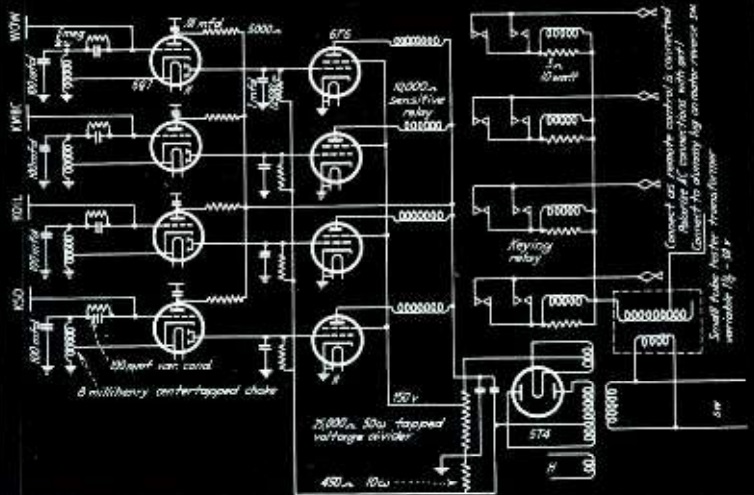
1937JulSWTVschematicThe accompanying article explains the operation. The transmitter consisted of two type 30 tubes operating push-pull, as shown in this schematic. The system was developed under the direction of National Bureau of Standards physicist Dr. L.F. Curtiss, who chose the type 30 tube due to their low cost, since there was no guarantee that the set would be recovered, and also due to their low filament drain.

The 45 volt B battery was specially designed and built by Eveready, and represented the lightest weight B battery ever built.

When the hydrogen balloon was launched, it began transmitting pressure, temperature, and humidity. Keying was done by an electric motor. While the article didn’t provide details, it appears that the length of each signal encoded the data. On the ground, a superregenerative receiver hooked to a strip recorder was used, allowing the duration of each pulse to be measured accurately. A vertical dipole was used for reception of the signals, which were on exactly 55 MHz.

Not surprisingly, the airborne signals could be received over a long distance, despite the low power. The article noted that signals had been received over a hundred miles, and from altitudes as high as 127,000 feet (24 miles). When the balloon reached maximum altitude, it burst, with the transmitter descending on a small parachute. The article noted that the parachute was mostly to prevent damage to persons or objects on the ground, recovery of the transmitter apparently being a secondary concern. Dr. Curtiss noted that it was his hope that the transmitters would soon be made so cheaply that it would no longer be worthwhile to attempt recovery.


1957 Boys’ Life Hallicrafters Ad

1957JuneBLHallicraftersAdSixty years ago this month, the June 1957 issue of Boys’ Life carried this Hallicrafters ad, highlighting the excitement available on the shortwave bands.

The comic book style ad featured a young hero with the unlikely name of Billy Hallicrafters. Billy and his friend Tim have been out boating and were securing their boat after a quick storm blew up. Billy agrees that the storm is a bad one, and invites Timmy to come tune the marine frequencies on his Hallicrafters S-85.

An amazed Tim asks whether it’s really possible to listen to the fleet talking, and Billy assures him that it is. In addition to the exciting traffic from ships, he tells Tim that he can tune in police, fire, amateurs, planes, and foreign stations.

They get to Billy’s receiver, where on an international emergency frequency they hear a desperate distress call from a ship run aground on a reef and sinking. The ship tries in vain to raise the Coast Guard, but to no avail.

Our hero Billy quickly gets on the phone to the Coast Guard and gives the ship’s position. The Coast Guard tells him that they didn’t pick up the SOS, but had a cutter and plane in the area. Twenty minutes later, the Coast Guard has rescued the ship, which included an injured man.

In the next scene, Billy and Tim are down at the dock talking to the grateful Coast Guard officer, who tells them that this proves that shortwave listening is both exciting and fun.

An ambulance is seen waiting to take the injured man to the hospital, and it turns out that Billy had taken it upon himself to have the ambulance standing by.

Tim adds that he’s going to get his own Hallicrafters shortwave set.

Billy’s S-85 is revealed to have a list price of $119.95. For the more budget conscious Scout thinking of listening for distress calls, the ad also showed the venerable S-38D with a list price of $49.95.